Recommended Free Tools
Ranked as complete generations—not by each generation’s rarest halo car—the C5 comes first for its blend of performance, usability, engineering, and racing success. The C8 is the most radical and capable modern break from Corvette tradition; the C3, despite its iconic shape and long run, ranks last here because its 15 model years encompass a wide range of performance and technology. This is an argued overall ranking, not an objective consensus: weighting styling or historical importance differently would change the order.
How this Corvette ranking works
This list compares the eight generations Chevrolet includes in its history timeline, from C1 through C8. It weighs performance and driving capability alongside styling, usability, reliability, desirability, and historical importance. Performance, design, engineering progress, and the breadth of the generation’s appeal carry the most weight. Reliability is considered cautiously: the available sources do not provide comparable reliability data by generation, so no generation is labeled the least reliable as a fact.

The ranking is generation-wide, not a contest between the best individual examples. A rare or celebrated trim can make a generation more desirable without representing the typical car. Chevrolet’s timeline establishes milestones and specifications; the placements below are editorial judgments, not Chevrolet’s ranking or a measured enthusiast consensus.
Every Corvette generation, ranked
1. C5 (1997–2004): the strongest all-round generation
The C5 earns the top spot because its redesign made a compelling balance of performance, modern engineering, and everyday usefulness. Chevrolet highlights its rear-mounted transmission, which moved weight distribution toward the rear, and the LS1 5.7-liter V8. The Z06 returned in 2001, while the C5-R racing program scored wins at Daytona, Sebring, and Le Mans, according to Chevrolet.
Do these 3 things before closing this tab:
1Clear out junk files and repair common Windows errors2Scan for outdated or missing drivers - takes under a minute3Repair Windows errors before they cause bigger problems#1 Best Overall

- Opening parts and rolling wheels
- Easy assembly, pre-painted metal body
- When finished the vehicles are fully functional
- Rolling diecast replica
- Skill level: intermediate
That combination gives the C5 more than a single headline feature: it was a major engineering reset, had a meaningful high-performance branch, and proved its credentials in competition. It does not have the C2’s visual singularity or the C8’s dramatic layout change, but as an overall generation it is the most balanced choice in this ranking.
2. C2 (1963–1967): the design and desirability benchmark
The Sting Ray generation is the most instantly collectible-looking Corvette in the list. The 1963 split-window coupe is a defining design, and Chevrolet’s timeline also marks that year as the debut of the Z06. Disc brakes and a big-block engine arrived in 1965; Chevrolet highlights the 427/435 engine for 1967.
The C2 ranks just below the C5 because its brilliance is concentrated in a short, particularly influential run and its appeal is more rooted in style and historical stature than modern usability. For a reader who values design, rarity, or classic-era significance above all else, the C2 could reasonably be number one.
Rank #2

- Brand new box.
- Real rubber tires. Has opening doors.
- Detailed interior, exterior. Made of diecast with some plastic parts.
- Dimensions approximately L-7.5, W-3.5, H-2 inches.
3. C8 (2020–2026 on Chevrolet’s history page): the boldest modern reset
The C8 changed the Corvette’s basic formula by moving to a mid-engine layout and pairing it with a dual-clutch transmission. Chevrolet’s timeline also identifies the E-Ray as an all-wheel-drive hybrid, while the page reviewed lists Stingray, Z06, and E-Ray. These are substantial changes in layout and technology, not merely a new body style.
Quick wins for a faster PC:
Repair Windows errors before they cause bigger problemsFix Now →Fix the driver behind crashes, sound loss and screen glitchesFind Drivers →It ranks third because the C8’s engineering leap is undeniable, but a generation-wide verdict must account for tradition and the full ownership proposition as well as headline performance. Its model range also continues to develop; the 2020–2026 span reflects Chevrolet’s history page reviewed on October 4, 2026, not a claim that the generation has reached a final endpoint.
4. C6 (2005–2013): serious performance across the range
Chevrolet calls the C6 the first Corvette generation to offer 400 horsepower as standard. Its Z06 used a racing-inspired aluminum chassis, and the C6.R competed successfully in GT1 and GT2. That gives the generation a strong performance identity beyond one exceptional variant.
Rank #3
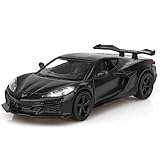
- High-Quality Materials:The Chevrolet Corvette die-cast car is made of zinc alloy,plastic parts and rubber tires,making it safe for children to play with.It features detailed interior and exterior trim, and is very sturdy.
- Function:No batteries are required, but the vehicle has a powerful pull back feature. Simply pull it back, then release your hand, and the car will go for a long distance. The doors may be opened to view the whole inside of the vehicle. So appealing to children and collectors alike.
- Size:1/36 scale vehicle model with beautiful English packaging,ideal for toddlers to play with and carry. Car collectors will appreciate the perfect small size, which allows them to collect a complete set of cars without taking up too much space.
- Grow From Play:Help children learn more about car ,expand their knowledge ,increase the hand-eye coordination and the reaction speed of the children in the play.
- Ideal Christmas Festival Gift:All of TOKAXI die-cast model cars are attractively packaged in English, making them the perfect Christmas, Birthday, Children's Day, New Year gift for kids, party favors, home decorations, or travel toys for boys and girls.gifts for boys girls.
The C6 falls behind the top three because its significance is less transformational than the C5’s layout change or the C8’s mid-engine shift, and less culturally distinctive than the C2. It remains a strong pick for buyers drawn to a traditional Corvette shape with a clear performance focus.
5. C7 (2014–2019): the high point of the front-engine era
The C7 brought back the Stingray name and closed the front-engine chapter before the C8 transition. Its range included the ZR1, whose supercharged LT5 was rated at 755 horsepower on Chevrolet’s history page. It is an appealing combination of modern capability and familiar Corvette proportions.
Free tools Windows power users keep installed
One-click scans. No signup required.
Fifth place reflects the strength of the generations around it more than a lack of achievement. The C7’s standout ZR1 is a halo car, but the ranking evaluates the whole generation rather than allowing one top trim to decide the result.
Rank #4
6. C1 (1953–1962): the origin that established the name
The C1 is historically indispensable, but its long evolution means early and late cars are very different propositions. Chevrolet reports that only 300 Corvettes were produced in the first year, all Polo White. A small-block V8 arrived in 1955, and fuel injection followed in 1957.
That progression—from a modest beginning to increasingly serious performance—makes the C1 essential to Corvette history. It sits sixth because it cannot match later generations for performance, usability, or breadth of capability, while the C2 that followed made a more lasting visual and performance statement.
7. C4 (1984–1996): a major technological reset, uneven as a whole
The C4 introduced new architecture and a stronger body structure. Tuned Port Injection arrived in 1985, the ZR-1 became a high-performance halo model, and Chevrolet records the one-millionth Corvette in 1992. The generation also included the 1996 Grand Sport, with an LT4 small-block and ZR1 chassis upgrades, limited to 1,000 cars.
The Tool Desk
Outbyte PC Repair FREEClear out junk files and repair common Windows errorsFree Scan →Outbyte Driver Updater FREEScan for outdated or missing drivers - takes under a minuteDriver Scan →Best Value

- Versatile 3-in-1 Kit: Build your 1963 Chevy Corvette Sting Ray as factory stock, a street custom, or a drag gasser with this multi-option kit.
- Enhanced Features: Includes pre-lettered drag slicks, clear red taillights, and stock & custom wheels for an authentic and detailed build.
- Multiple Engine Options: Customize your model with various engine intake options, allowing for unique and personalized creations.
- Retro Styling: Comes with a full-color, retro-styled decal sheet and vintage “Street Rods Series” packaging, perfect for nostalgic collectors.
- High-Quality Collectible: AMT's improved reissue offers superior parts and detailing, making it a must-have for model enthusiasts and collectors.
The C4’s achievements are substantial, but its broad model-year span and distance from the classic C2 and more cohesive modern generations put it near the bottom in this overall comparison. The ZR-1 and Grand Sport are important counterexamples to any suggestion that every C4 was an ordinary or unambitious car.
8. C3 (1968–1982): the iconic shape with the widest performance arc
The C3 has one of the Corvette’s most recognizable silhouettes and the longest run in this ranking. Chevrolet notes that the ZR1 package debuted in 1970, the 500,000th Corvette was built in 1977, and electronic fuel injection arrived in 1982. Its history therefore includes both high-performance ambition and later technological change.
It ranks eighth because the generation’s 15 model years cover a broad arc, and the entire run is less consistently compelling on performance and technology than the generations above it. That does not make the C3 a bad Corvette: its shape, longevity, and important variants keep it desirable, while making “worst” a relative label among generations with real strengths.
Independent reader supportYour contribution helps us test, update, and keep practical guides available for everyone.Why a generation ranking can hide the best individual Corvette
Several standout models complicate any single ordering. Chevrolet says the original 1963 C2 Grand Sport was a race car: only five were built, and it recorded notable class wins, including at the 1964 Twelve Hours of Sebring. The 1996 C4 Grand Sport was a very different car, pairing an LT4 small-block with ZR1 chassis upgrades and a 1,000-car production limit.
Grand Sport returned for C6 (2010–2013) and C7 (2017–2019), combining wide-body and chassis elements with the standard engine. Chevrolet Chief Engineer Josh Holder describes this approach as the “sweet spot” between everyday usability and track ability. The label’s changing meaning across generations is a useful reminder: a standout trim can improve a generation’s appeal without defining every car in it.
- The 1963 C2 split-window coupe and Z06 show how a single model year can establish both a design icon and a performance line.
- The 1967 C2 427/435 represents a different kind of appeal from the original C2’s styling.
- The 1996 C4 Grand Sport demonstrates that a generation near the bottom of an overall list can still contain a rare, highly distinctive model.
- Later Z06, ZR1, Grand Sport, and E-Ray versions make generation-wide judgments especially sensitive to which trim a reader has in mind.
What changed from one Corvette generation to the next?
| Generation | Model years | Distinctive milestones |
|---|---|---|
| C1 | 1953–1962 | 300 first-year cars, all Polo White, reported by Chevrolet Europe on its history page; small-block V8 in 1955; fuel injection in 1957. |
| C2 | 1963–1967 | Sting Ray; split-window coupe and Z06 debut in 1963; disc brakes and big-block in 1965; 427/435 highlighted for 1967. |
| C3 | 1968–1982 | Long-running shape; ZR1 package debuted in 1970; 500,000th Corvette built in 1977, per Chevrolet Europe; electronic fuel injection in 1982. |
| C4 | 1984–1996 | New architecture and stronger body structure; Tuned Port Injection in 1985; ZR-1 halo model; one-millionth Corvette built in 1992, per Chevrolet Europe. |
| C5 | 1997–2004 | Redesign with rear-mounted transmission and LS1 5.7-liter V8; Z06 returned in 2001; C5-R racing wins cited by Chevrolet. |
| C6 | 2005–2013 | First generation with 400 horsepower standard, according to Chevrolet; Z06 aluminum chassis; C6.R in GT1 and GT2. |
| C7 | 2014–2019 | Stingray name returned; 755-horsepower supercharged LT5 ZR1 rating on Chevrolet’s history page; final front-engine generation. |
| C8 | 2020–2026 on Chevrolet’s page reviewed October 4, 2026 | Mid-engine layout and dual-clutch transmission; E-Ray hybrid all-wheel drive; current lineup named on the page includes Stingray, Z06, and E-Ray. |
Chevrolet’s history timeline gives these generation spans. There was no retail 1983 Corvette: GM’s 1996 vehicle information kit says the next-generation car entered the market as a 1984 model. The C5’s rear-mounted transmission and C8’s mid-engine architecture are examples of why the timeline represents engineering changes as well as new styling.
Quick Recap
Which Corvette generation is best for you?
- For the strongest all-round case: C5, for its engineering reset, performance, usability, and racing record.
- For classic design and historical desirability: C2, especially if the split-window coupe is central to your idea of a Corvette.
- For a modern layout and technology break: C8, with its mid-engine design and expanding range.
- For a traditional front-engine modern Corvette: C6 or C7, depending on whether you favor the C6’s performance identity or the C7’s final-generation character.
- For heritage and an unmistakable classic silhouette: C1 or C3, while recognizing that model year and trim matter substantially within both.
Product prices and availability are accurate as of the date/time indicated and are subject to change. Any price and availability information displayed on Amazon at the time of purchase will apply.




