Short answer: A dually truck has two rear tires on each side, giving a pickup six tire positions instead of four. It is designed for heavier rear-axle loads and demanding fifth-wheel, gooseneck, camper, agricultural, and commercial work. Choose one when the loaded pin weight or cargo makes a properly configured single-rear-wheel truck marginal—not simply because a dually has the largest advertised towing number.
What is a dually truck?
A dually truck is a pickup or chassis-cab truck with dual rear wheels, usually abbreviated DRW for dual rear wheel. A conventional dually pickup has two tires on the front axle and four tires on the rear axle, for six tire positions total.
As an Amazon Associate I earn from qualifying purchases.
The extra rear tires are part of a complete manufacturer-engineered configuration. A factory DRW truck may have different rear wheels, tires, fenders, axle components, suspension, brakes, frame specifications, and certification ratings than a comparable single-rear-wheel truck. A single-rear-wheel truck does not become a properly rated dually simply because wider aftermarket wheels or wheel spacers are installed.
Do these 3 things before closing this tab:
1Clear out junk files and repair common Windows errors2Fix the driver behind crashes, sound loss and screen glitches3Repair Windows errors before they cause bigger problemsManufacturers build DRW heavy-duty pickups and commercial chassis cabs for applications that place substantial weight on the rear axle, especially large fifth-wheel and gooseneck trailers, slide-in campers, equipment, livestock, agricultural loads, and commercial bodies.
#1 Best Overall

- Over 75 Years of Play: Tonka toys are proudly passed down through generations for over 75 years. Designed to foster imaginative play, Tonka is a trusted brand that connects generations of families and creates memories that last a lifetime.
- Tonka Tough: Trust the Tonka name for high-quality toys that last. Get ready to take control of the ultimate construction machine! Constructed with steel and sturdy plastic the Tonka 4 X 4 Pickup Truck mirrors the look and feel of a real-life, powerful pickup truck. Its bold and vibrant yellow color, along with its attention to detail, will make you feel like you're in the driver's seat of a full-sized truck.
- Realistic Actions: Equipped with a real working tow winch, foldable rear gate and tough tires, the Tonka 4 X 4 Pickup Truck means business when it comes to hauling. These impressive feature allow you to hook and haul the toughest jobs, just like a real truck. Whether it's rescuing other vehicles, transporting heavy cargo, or aiding in construction projects, the Tonka 4 X 4 Pickup Truck is always up for the challenge!
- There is only 1 Tonka: Tonka inspires kids to put down their screens and get back to real play. Tonka’s sturdy trucks inspire active, open-ended playtime for kids either outdoors or in, instead of passive, stationary screen time.
- Take on Any Terrain: Get ready to conquer rough terrains and take your playtime to the next level! The yellow Tonka 4 X 4 Pickup Truck is built to handle any challenge that comes its way. With its rugged design and Tonka Tough Tires, this truck will power through dirt, gravel, and even the toughest backyard adventures.
Why do people choose a dually?
More rear-axle and payload capacity
The main reason to choose a dually is additional rear-axle load capability and payload headroom in the manufacturer’s DRW configuration. A fifth-wheel or gooseneck trailer transfers a significant portion of its loaded weight directly onto the truck’s rear axle. Four rear tires and wheels share that load instead of two.
That does not mean the extra tires permit unlimited loading. The truck remains limited by its certified GAWR, tire ratings, wheel ratings, suspension, brakes, frame, and GVWR. The door-jamb tire and loading label and the manufacturer’s specifications are more important than the number of tires.
More stability with substantial pin weight
The wider rear stance and additional tire capacity can provide more lateral support when the truck is carrying a heavy fifth-wheel or gooseneck pin load. That can make a DRW truck a better match for a large RV, horse or livestock trailer, machinery trailer, or recurring commercial load.
Free tools Windows power users keep installed
One-click scans. No signup required.
Stability is not a substitute for correct loading. A dually still needs properly inflated tires, a correctly installed and rated hitch, an appropriate trailer brake system, correct trailer loading, and a speed suitable for the road and weather.
More flexibility for demanding trailer combinations
Ford, Chevrolet, GMC, and Ram publish separate DRW towing and payload tables because the permissible weight varies considerably by configuration. Engine choice is only one factor. Cab style, bed length, two- or four-wheel drive, axle ratio, wheelbase, transmission, trim, options, and hitch type can all change the published rating.
For that reason, a truck advertised with a very high maximum trailer rating may not have that rating in the exact configuration on a dealer’s lot. The correct question is not whether a model is a dually; it is whether the specific truck can carry the actual loaded truck-and-trailer combination within every applicable rating.
Dually versus single-rear-wheel truck
| Factor | Dually advantage | Trade-off compared with SRW |
|---|---|---|
| Rear load capacity | Four rear tires and wheels provide more capacity in many comparable heavy-duty configurations. | The truck is still limited by its certified axle, tire, wheel, suspension, brake, frame, and GVWR ratings. |
| Heavy pin loads | More support and stability for substantial fifth-wheel or gooseneck loads. | Extra capacity may be unnecessary if the actual trailer leaves an SRW truck with ample verified margin. |
| Operating cost | Greater capability can avoid running a marginal truck in a demanding duty cycle. | Two additional tires increase replacement, inspection, and maintenance costs. Purchase, insurance, and fuel costs may also be higher. |
| Daily driving | A good fit when heavy towing or hauling is the truck’s primary job. | Wider rear fenders complicate garages, parking spaces, drive-through lanes, and narrow roads. An unloaded DRW may feel less nimble and can ride more firmly depending on configuration and tire pressure. |
| Tire service | Four rear tires share the load. | Inner rear tires are harder to reach and require careful pressure, tread, valve, and debris inspections. |
Who usually needs a dually?
A dually is usually justified when the truck will regularly perform one or more of these jobs:
- Tow a large fifth-wheel or gooseneck trailer whose loaded pin weight consumes most of an SRW truck’s payload or rear-axle capacity.
- Carry a slide-in camper, service body, fuel tank, tools, auxiliary equipment, or other bed-mounted cargo while towing.
- Haul dense cargo such as livestock, machinery, construction equipment, or agricultural loads where rear-axle capacity is the limiting factor.
- Operate repeatedly in a commercial or agricultural duty cycle where additional load margin and stability justify the cost and width.
- Tow near the upper end of the applicable manufacturer rating while also carrying passengers, fuel, tools, hitch hardware, and normal cargo.
An SRW truck may be the better choice for a lightly loaded travel trailer, utility trailer, or occasional recreational use when its verified payload, rear-axle, and towing ratings comfortably cover the real load. Buying a dually solely for its largest advertised trailer number can create unnecessary expense and daily inconvenience.
How to determine whether you need a dually
Use the actual loaded weights of your truck and trailer rather than the trailer’s empty weight or a model’s headline maximum. The following process works for both a dually and an SRW truck.
1. Establish the trailer’s realistic travel weight
Start with the trailer as it will be used, not its brochure dry weight. Account for water, propane, batteries, food, clothing, tools, spare parts, personal cargo, aftermarket equipment, and upgrades.
Rank #2

- SCALE DETAILS: Precisely crafted 1:46 O scale die-cast metal model of the 2019 Dodge Ram 1500 pickup truck, measuring approximately 5 inches in length
- AUTHENTIC DESIGN: Features detailed black exterior finish, realistic wheels, and accurate body styling matching the full-size 2019 Ram 1500 truck
- CONSTRUCTION: Built with durable die-cast metal construction and high-quality plastic components for long-lasting play value
- DISPLAY QUALITY: Perfect for collectors and enthusiasts, with authentic detailing including grille, headlights, and body contours
- RECOMMENDED AGE: Suitable for ages 3 years and up, makes an ideal gift for truck enthusiasts and young collectors
For a fifth-wheel or gooseneck, determine the loaded pin weight carried by the truck. For a conventional trailer, determine the actual loaded tongue weight and verify the receiver and weight-distribution requirements. A trailer’s gross vehicle weight rating is not automatically its actual travel weight, but it is an important upper limit that should not be ignored when planning.
Recommended Free Tools
2. Calculate the truck’s payload demand
Truck payload demand includes the driver, passengers, fuel where applicable, hitch or fifth-wheel hardware, bed cargo, accessories, and the trailer’s imposed pin or tongue weight. The truck’s available payload is not simply the advertised maximum for the model family.
For example, suppose a particular truck’s door label shows 4,800 pounds of available payload. An illustrative load might include 500 pounds of occupants, 250 pounds of fuel and accessories, 200 pounds of hitch equipment, and a 3,500-pound loaded pin weight. That uses 4,450 pounds, leaving only 350 pounds before considering any additional cargo. This example is not a rating for any specific truck; it demonstrates why pin weight can consume payload quickly.
Optional equipment and occupants reduce the remaining payload. A diesel engine, crew cab, four-wheel drive, large fuel tank, steps, bed cover, toolboxes, generator, and other additions all contribute to the truck’s actual weight.
3. Check GVWR and GAWR separately
GVWR is the maximum loaded weight of the truck itself. The truck’s occupants, cargo, fuel, hitch hardware, and trailer tongue or pin weight count against it.
GAWR is the manufacturer-specified capacity of an individual axle system. It is governed by the lowest applicable rating among components such as the tires, wheels, springs, or axle itself. The loaded combination must remain within the truck’s front-axle and rear-axle ratings as well as its total GVWR.
Checking only GVWR is not enough. A truck can be below its total GVWR while still exceeding its rear GAWR because a large portion of the trailer weight is concentrated behind the cab. This is one of the most important reasons to weigh a loaded combination rather than relying on a brochure calculation.
4. Check GCWR and every trailer-system rating
GCWR is the maximum allowable loaded weight of the truck and trailer together. It includes the towing vehicle, occupants, cargo, and trailer. GCWR depends on the vehicle, engine, transmission, axle ratio, options, and hitch type.
Also verify the following:
- The receiver or fifth-wheel/gooseneck hitch rating.
- The hitch ball, kingpin, safety-chain, and mounting hardware ratings where applicable.
- The trailer axle, wheel, and tire ratings.
- The trailer brake system and the truck’s brake-controller compatibility.
- The maximum conventional, fifth-wheel, or gooseneck rating for the exact truck configuration.
- Any state-specific operating, licensing, equipment, or weight requirements that apply to the combination.
Do not assume that the highest engine-specific towing number applies to every cab, bed, drivetrain, axle ratio, trim, accessory package, or hitch arrangement.
Quick wins for a faster PC:
Clear out junk files and repair common Windows errorsFree Scan →Fix the driver behind crashes, sound loss and screen glitchesFind Drivers →Repair Windows errors before they cause bigger problemsFix Now →5. Weigh the loaded combination
A certified public scale or truck scale is the most reliable way to verify front-axle, rear-axle, truck, trailer, and combined weights. Weigh the combination in the configuration used for travel, with passengers, fuel, tools, hitch equipment, and normal cargo onboard.
Rank #3

- Long-lasting Little Blue Truck Toy: Our little blue truck toy is made from high-quality alloy and polyethylene materials, reinforced metal body and rounded safe edges, making it durable for daily use for a long-lasting playtime enjoyment, designed for Kids Boys Girls
- Toy Trucks: This car toys a truck toy for kids Boys Girls, providing endless entertainment and developmental benefits. These racing cars encourage active play while keeping children entertained away from screens. As they engage in play, children can enhance their motor skills, hand-eye coordination, and imagination
- Pull Back Cars Toy: Runs without batteries and features an easy-to-use rear-wheel pull-back mechanism, making it easy to place on the ground and gently press and pull back to let it go. The toy truck is capable of sustained high-speed travel over extended distances, so you don't need to worry about running out of power,Truck Toy for Kids Boys Girls
- Kids Truck Toy: The toy truck measures 5*1.85*2 inches, enjoy solo play or interactive group fun at home, outdoors, or in the classroom; its compact size makes it easy to carry and store, ready for play anytime, promoting creativity and cognitive development in young children
- Openable Doors and Customizable Toy Trucks: Our Diecast Cars toy for kids Boys Girls, featuring a realistic design, have openable doors with authentic interior details, and can be fitted with small ornaments on the back, adding to the fun and excitement of playing with toy trucks
When planning a long trip or changing trailers, cargo, or truck accessories, a search for a truck scale near me can help locate a suitable certified scale. Confirm in advance that it can provide individual axle-group readings rather than only a single gross weight.
Compare the scale readings with the ratings on the truck’s door label, the trailer’s certification label, the hitch documentation, and the applicable manufacturer towing guide. If the rear axle or payload is marginal in real use, changing the trailer or cargo plan may be more appropriate than assuming a dually accessory will solve the problem.
6. Choose capacity with usable headroom
A truck that technically reaches a published maximum is not automatically a comfortable choice for every trip. Your real-world load should leave practical room for passengers, tools, cargo changes, weather, and loading variation. There is no universal spare-capacity number that applies to every truck or jurisdiction, but repeatedly operating at the edge of a rating leaves less flexibility and makes accurate loading more important.
The Tool Desk
Outbyte PC Repair FREEClear out junk files and repair common Windows errorsFree Scan →Outbyte Driver Updater FREEFix the driver behind crashes, sound loss and screen glitchesFind Drivers →If an SRW truck remains comfortably within its payload, front- and rear-axle, combined-weight, tire, wheel, and hitch ratings after weighing, a dually may offer little practical benefit. If the SRW truck is consistently close to or over a limiting rating, a factory DRW configuration is the more appropriate starting point.
Current 2026 dually platforms
For model year 2026, the main full-size dually pickup choices in the United States are the Ford Super Duty F-350 and F-450, Chevrolet Silverado 3500 HD, GMC Sierra 3500 HD, and Ram 3500. Their published figures are configuration-specific, and model-year charts should be checked before ordering or buying.
| Platform | What the current information shows | Important qualification |
|---|---|---|
| Ford Super Duty F-350 and F-450 DRW | Ford offers DRW pickup configurations in both lines. Its 2026 towing material lists specific DRW conventional figures as high as 48,000 pounds and fifth-wheel/gooseneck figures as high as 45,600 pounds. | Those are specific maximum-rated configurations, not universal F-350 or F-450 limits. Engine, axle ratio, cab, wheelbase, drivetrain, bed, and hitch type change the result. Ford also identifies the STX Appearance Package as available on the F-350 DRW for 2026. |
| Chevrolet Silverado 3500 HD DRW | Chevrolet offers the Silverado 3500 HD with SRW and DRW configurations. Its 2026 chart separates conventional from fifth-wheel/gooseneck ratings and lists a specified Duramax DRW fifth-wheel/gooseneck maximum of 43,500 pounds. | The applicable number depends on cab, bed, drivetrain, engine, and rear-wheel configuration; other combinations are lower. |
| GMC Sierra 3500 HD DRW | GMC offers the Sierra 3500 HD with DRW capability and positions it for demanding agricultural, professional-fleet, and heavy gooseneck applications. | GMC’s 2026 chart varies by cab, bed, drivetrain, engine, and hitch type. Use the exact table entry rather than a model-family maximum. |
| Ram 3500 DRW | Ram offers DRW configurations with gas and diesel powertrains. Its 2026 chart separates SRW and DRW and lists distinct GVWR, GCWR, payload, and trailer ratings. A specified diesel DRW configuration reaches 45,000 pounds for fifth-wheel/gooseneck towing. | The applicable rating depends on engine, axle ratio, cab, bed, drive configuration, and equipment. |
These headline figures are useful for understanding the capability range, but they are not a substitute for the towing guide, vehicle-specific door label, and scale ticket. For current-model shopping, compare 2026 dually trucks only after matching the exact cab, bed, drivetrain, engine, axle ratio, and intended hitch type. Inventory, equipment packages, and specifications can change.
Dually tires and wheels
A dually has six tire positions, but that does not mean all six tires are automatically interchangeable. Some trucks use different front and rear tire sizes or wheel fitments, and recommended cold inflation pressures can differ by axle and load condition.
What’s actually slowing this PC down?
Pick the symptom - the matching free tool is one click away.
The driver’s-door tire and loading label and the owner’s manual control. Tire load ratings on an axle must meet or exceed that axle’s GAWR. The correct replacement tire must also have the appropriate size, load range, speed rating, and dual-application suitability.
What to inspect
- Check all six tires, including both inner rear tires.
- Set cold inflation pressure according to the manufacturer’s recommendation for the load condition. Do not substitute a generic dually PSI number.
- Inspect for stones, mud, snow, or other debris trapped between paired rear tires.
- Look for mismatched tread depth, uneven wear, sidewall damage, valve-stem problems, and unusual heat.
- Confirm that paired rear tires have compatible size, inflation, and tread condition.
- Follow the truck manufacturer’s rotation instructions and the tire manufacturer’s requirements rather than applying a generic six-tire rotation pattern.
- Use the correct torque procedure for the truck’s particular wheel, stud, and lug-nut system.
Because the inner rear valves can be difficult to access, a dually truck tire pressure gauge with a suitable chuck can make routine checks easier. It is still necessary to confirm that the gauge reaches the valve and is rated for the pressure required by the specific truck. A gauge does not replace the door-label pressure specification.
Dually tire valve extensions can improve access to inner-tire valves, but they are fitment-dependent. Use only hardware compatible with the wheel and valve assembly, and make sure it is installed correctly and does not leak, rub, or interfere with the paired tire.
Rank #4
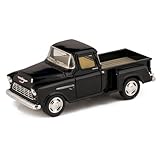
- CLASSIC DESIGN: Authentic 1:32 scale replica of the iconic 1955 Chevrolet Step Side pickup truck in vibrant paint finish with detailed exterior features
- FUNCTIONAL FEATURES: Working doors that open and close, plus pull-back action mechanism for interactive play value
- QUALITY CONSTRUCTION: Die-cast metal body construction with plastic components and rubber tires for enhanced durability and detail
- PERFECT SIZE: Compact 5-inch length makes it ideal for display or play while maintaining impressive detail and authenticity
- REALISTIC DETAILS: Features authentic styling elements including chrome-look trim, detailed grille, and period-correct wheel designs
Replacing dually tires or wheels
When replacing tires, do not treat the truck as though it has six identical tire positions. Verify the exact front and rear fitments, load ratings, dual-service designation, inflation requirements, and tread compatibility.
Before buying dually truck tires, record the size and load information from the sidewall and door label, then confirm the application with the tire manufacturer or a qualified installer. When changing wheels, verify the bolt pattern, offset, backspacing, load rating, stud or lug-nut compatibility, and inner-tire clearance. A wheel can physically bolt on and still be unsuitable for a dual-rear application.
Aftermarket fitment deserves particular caution. Some dually wheel combinations may require clearance modifications, and the correct result depends on the exact truck, wheel, tire, and fender arrangement. Never assume that a wheel advertised as fitting a single-rear-wheel truck is suitable for its DRW counterpart.
Independent reader supportYour contribution helps us test, update, and keep practical guides available for everyone.Towing equipment for a dually
The right equipment depends on the truck and trailer, but a heavy-duty towing setup commonly includes the following:
- Fifth-wheel or gooseneck hitch hardware: Match the hitch to the truck’s bed system, puck or rail arrangement, trailer coupler or pin box, mounting method, and loaded weight. Select fifth-wheel or gooseneck hitch hardware only after confirming compatibility with the exact truck and trailer.
- Trailer brake control: Use a properly integrated factory system or a heavy-duty trailer brake controller compatible with the trailer’s brakes and the truck.
- Tire-pressure monitoring: A system capable of monitoring both the truck and trailer can make it easier to detect pressure loss or abnormal temperature before a tire failure.
- Inflation equipment: Carry a quality gauge and inflation equipment rated for the truck’s required cold pressures.
- Wheel chocks: Use correctly sized heavy-duty trailer wheel chocks for the actual truck and trailer. Chocks are for securing a parked combination; they do not replace the parking brake, proper coupling, or trailer brakes.
- Spare equipment: Confirm that the spare tire and wheel are correctly rated and compatible with the truck or trailer. A spare for one axle or fitment may not be suitable for another.
- Mud flaps or rock guards: These can reduce spray and stone damage to the trailer, particularly with a wider rear axle and dual tires.
- Tow mirrors and cameras: Use mirrors and camera systems appropriate for the trailer’s width and the driver’s sight lines.
- Scale visit: Weigh the loaded combination before a long trip or after changing the trailer, cargo, or truck accessories.
None of these accessories increases the certified GVWR, GAWR, GCWR, tire rating, wheel rating, hitch rating, or trailer rating. A stronger-looking hitch, helper spring, tire, or wheel cannot legally or mechanically re-certify the entire truck for a higher load.
Crashes, No Sound, or Screen Glitches?
Random freezes, missing sound and display glitches usually trace back to one bad driver. Find and replace yours safely.Free scan · under a minutePC Slower Than It Used to Be?
A free scan shows the junk files, broken settings and background clutter dragging Windows down - then fixes them in one click.Free scan · Windows 10 & 11Common dually misconceptions
A dually can tow anything
False. A dually can have substantially higher capacity than an SRW counterpart, but the applicable limit is the lowest controlling rating in the complete truck-and-trailer system. Engine power alone does not establish a safe or permitted towing capacity.
The extra tires double the payload
False. The additional rear tires contribute to the DRW design’s capacity, but the truck remains limited by its complete certified system, including the axle, wheels, tires, suspension, brakes, frame, and GVWR.
The advertised maximum applies to my truck
Usually false. The maximum may apply only to a particular engine, axle ratio, cab, bed, drivetrain, wheelbase, trim, option set, and hitch arrangement. Read the row for the exact truck rather than the largest number in the brochure.
All six tires should be the same
Not necessarily. Front and rear fitments may differ, and paired rear tires need compatible size, inflation, and tread condition. Tire replacement and rotation should follow the truck and tire manufacturers’ instructions.
A dually is always safer
A DRW truck can provide useful stability and load capacity for an appropriate heavy-duty application, but it does not correct overloading, poor trailer balance, underinflation, inadequate brakes, incorrect hitch installation, or excessive speed. A properly matched SRW combination is preferable to an improperly loaded dually.
Best Value

- CLASSIC DESIGN: Authentic 1:32 scale replica of the iconic 1955 Chevrolet Step Side pickup truck in vibrant paint finish with detailed exterior features
- FUNCTIONAL FEATURES: Working doors that open and close, plus pull-back action mechanism for interactive play value
- QUALITY CONSTRUCTION: Die-cast metal body construction with plastic components and rubber tires for enhanced durability and detail
- PERFECT SIZE: Compact 5-inch length makes it ideal for display or play while maintaining impressive detail and authenticity
- REALISTIC DETAILS: Features authentic styling elements including chrome-look trim, detailed grille, and period-correct wheel designs
Buying checklist
Before buying a new or used dually, confirm each of the following:
- Identify the trailer’s realistic loaded weight and pin or tongue weight.
- List the people, fuel, hitch equipment, tools, accessories, and bed cargo the truck will carry.
- Read the actual vehicle’s door-jamb GVWR, front GAWR, rear GAWR, tire sizes, and cold inflation pressures.
- Match the VIN or exact configuration to the current manufacturer towing guide.
- Verify conventional and fifth-wheel/gooseneck ratings separately.
- Check GCWR, the receiver or fifth-wheel/gooseneck hitch rating, and all trailer ratings.
- Confirm that the truck fits where it will be parked and driven, including garage width, parking spaces, and narrow access roads.
- Budget for six-tire inspection and replacement, inner-tire access, wheel service, and any model-specific fitment requirements.
- Confirm that the intended hitch, brake controller, mirrors, camera system, and trailer wiring are compatible.
- Weigh the loaded combination and compare front-axle, rear-axle, truck, trailer, and combined readings with every rating.
Bottom line: is a dually worth it?
Choose a dually when the actual loaded rear-axle and payload demands of the trailer or cargo make an SRW truck marginal, or when the added stability and operating margin of a DRW platform justify its cost, width, and six-tire maintenance. Choose an SRW truck when it provides adequate verified capacity for the real load and the truck will spend most of its time as a daily driver or moderate-duty tow vehicle.
In either case, select the exact configuration from the current manufacturer towing guide, read the door-label ratings, and weigh the loaded combination. The number of tires and the biggest advertised trailer rating are only starting points; the scale readings and lowest component ratings determine whether the setup is actually suitable.
Quick wins for a faster PC:
Scan for outdated or missing drivers - takes under a minuteDriver Scan →Repair Windows errors before they cause bigger problemsFix Now →Fix the driver behind crashes, sound loss and screen glitchesFind Drivers →Frequently Asked Questions
Do I need a dually for a travel trailer?
A dually is usually worthwhile when a large fifth-wheel or gooseneck trailer, slide-in camper, bed cargo, livestock load, or commercial equipment regularly pushes an SRW truck close to its payload or rear-axle limit. It is often unnecessary for a lightly loaded travel trailer or occasional utility-trailer use when the SRW truck has verified capacity and practical headroom.
Does a dually double payload?
No. Four rear tires contribute to the DRW design’s load capacity, but the truck remains limited by its GVWR, GAWR, tires, wheels, suspension, brakes, frame, and other certified components. It is possible to exceed the rear-axle or total payload rating even with a dually.
Do all six tires on a dually have to match?
Not necessarily. Some trucks use different front and rear tire or wheel fitments. Even when the tire size is the same, paired rear tires must have compatible size, inflation, and tread condition. Follow the truck and tire manufacturers’ replacement and rotation instructions.
How do I know whether my dually is overloaded?
Use the actual loaded truck and trailer weights. Compare the truck’s door-label GVWR and front and rear GAWR with the scale readings, then check GCWR, the hitch rating, tire and wheel ratings, and the trailer’s axle, tire, and brake ratings. A model’s maximum tow number is not enough.
Is an F-450 dually better than an F-350 dually?
Not automatically. The correct F-350, F-450, Silverado 3500 HD, Sierra 3500 HD, or Ram 3500 depends on the exact cab, bed, engine, axle ratio, drivetrain, wheelbase, options, and hitch configuration. Compare the precise row in the current manufacturer towing guide and verify the truck’s door label.
The Bottom Line
Bottom line: A dually is the right tool when a recurring heavy pin load, rear-axle demand, or commercial cargo makes an SRW truck marginal. It is unnecessary for many moderate towing jobs. Verify the exact truck’s GVWR, GAWR, GCWR, tire, wheel, hitch, and trailer ratings, then confirm the loaded axle weights at a certified scale.
Quick Recap
Product prices and availability are accurate as of the date/time indicated and are subject to change. Any price and availability information displayed on Amazon at the time of purchase will apply.




