Recommended Free Tools
A driver fatigue detection system cannot read tiredness directly. Instead, it watches for signs associated with reduced alertness—such as prolonged eye closure, an unfocused gaze, head nodding, lane wandering, or increasingly erratic steering—and warns the driver before the situation becomes more dangerous.
Depending on the vehicle, the technology may use an interior camera, steering and lane data, or a combination of both. It is an assistance system, not a substitute for sleep: when the car tells you to take a break, the correct response is to stop driving.
As an Amazon Associate I earn from qualifying purchases.
What is driver fatigue detection?
Driver fatigue detection, also called driver drowsiness and attention warning (DDAW), is a safety feature that estimates whether a driver’s alertness may be declining. The system does not diagnose fatigue in the medical sense, measure how many hours you slept, or guarantee that you will stay awake.
Outdated Drivers Are Slowing You Down
One free scan finds every outdated or missing driver and matches the right update for your exact hardware.Free scan · exact hardware matchPC Slower Than It Used to Be?
A free scan shows the junk files, broken settings and background clutter dragging Windows down - then fixes them in one click.Free scan · Windows 10 & 11Fatigue can result from sleep loss, long working hours, night shifts, medication, illness, stress, or a sleep disorder. It can affect reaction time and decision-making even when a driver’s eyes appear open. That is why production systems look for patterns across a period of driving rather than treating one yawn or one steering correction as proof that the driver is falling asleep.
How anti-sleep technology works
Most systems follow the same basic sequence:
- Collect data: Sensors observe the driver, the vehicle, or both.
- Extract indicators: Software looks for eye closures, gaze changes, head movement, lane drift, steering corrections, and other signals.
- Compare the pattern with a threshold: A time window and driving baseline help separate normal behavior from a sustained decline in alertness.
- Issue a warning: The vehicle displays a message, sounds a chime, or activates a vibration. Some systems escalate the warning if the driver does not respond.
The system generally needs enough driving time and suitable conditions before it can make a useful estimate. For example, Tesla documents its drowsiness warning as activating above 65 km/h after at least 10 minutes of driving, and becoming inactive below 60 km/h. Exact thresholds vary by manufacturer and model.
Camera-based fatigue detection
Newer driver-monitoring systems use an infrared or near-infrared cabin camera mounted near the instrument panel or steering column. Infrared illumination allows the camera to work in low light, although visibility can still be affected by glare, obstruction, eyewear, and the driver’s position.
A camera-based system may assess:
- How long the eyes remain closed
- Slow or heavy eyelid movements
- Repeated yawning
- Head nodding or a dropping head position
- Whether the driver’s gaze is directed toward the road
- Whether the driver responds to earlier alerts
One commonly referenced measurement is PERCLOS: the percentage of a defined time interval during which the eyes are at least 80% closed, excluding normal rapid blinks. Longer closures and repeated microsleeps are more concerning than an ordinary blink.
Free tools Windows power users keep installed
One-click scans. No signup required.
That does not mean every vehicle uses PERCLOS in the same way, or that it is a complete fatigue measurement. A driver can be impaired without obvious eye closure, while a driver looking away briefly at a mirror may be fully alert. Production software therefore combines indicators and uses thresholds designed to reduce unnecessary warnings.
Vehicle-behavior detection
Some systems do not need to look inside the cabin. They infer a possible loss of alertness from the way the car is being driven.
Rank #2

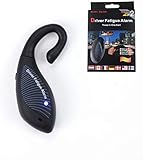
- ● Driver alarm can help accidents caused by sleep when driving.
- ● Examine whether it is in the normal :it beeps when you are leaning your for head forward and makes no sound while sitting straight , it is at normal .
- ● Put it behind ear, Alerts when the for head lower in the degrees of 15° to 20°.
- ● Especially suitable for long-distance driving or night driving.
- ● It is suitable for a wide of people, such as night shifts, door guards, guards, television stations, radio stations, night broadcasts of personnel, and security personnel.
The vehicle may monitor:
- Small steering corrections and how frequently they occur
- Increasingly irregular steering
- Lane-position variability
- Slow drift toward a lane marker
- Repeated corrections after drifting
- Changes in speed stability
Volvo’s Driver Alert Control, for example, compares lane-marker position with steering-wheel movements and can display a “Time for a break” message when driving becomes sufficiently erratic. Such systems are most useful on major roads where lane markings and driving speed are relatively consistent. They are less dependable in dense city traffic, on winding roads, or where lane markings are poor.
This approach detects a driving consequence of reduced alertness, not the driver’s physiological state. A strong crosswind, road damage, construction markings, or an evasive maneuver can look like fatigue to the software.
Why vehicles combine several signals
No single sign reliably identifies every tired driver. Eye closure can be hidden by sunglasses. Lane position can be affected by weather. A driver may keep their eyes open while still suffering from slow reactions or poor judgment.
A combined system can compare driver and vehicle data. For example, a warning becomes more plausible when the car has been traveling at highway speed for a sustained period, the driver’s eyes are closing for longer, gaze repeatedly leaves the road, and steering becomes less consistent. One glance at a mirror or one correction around a pothole should not normally be enough.
Research systems have also examined EEG, eye-movement sensors, heart-rate variability, skin conductance, respiration, and wearable devices. These may provide more direct physiological information, but they are harder to use comfortably and reliably in ordinary passenger cars. Factory-installed systems therefore usually rely on cameras and vehicle behavior.
Rank #3

- Material: Plastic; Weight: 11g/each
- Built-in high-sensitivity sensor, when you doze off, it will automatically sound an alarm as soon as you bow your head.
- Hang it on your ear while driving. It is like a doze alarm.
- Since the sound is ringing in your ear, it has little effect on others, and the sound makes a short and long alarm sound depending on the angle of your head.
- This Driving Doze Reminder suits to those who drive at night or long distances. It can provide an audible warning to remind drivers to drive safely.It is also for those who need to be vigilant while on duty, such as security guards, machine operators and who are learning or correcting sitting posture to avoid and hunchback.
What warning will the driver receive?
The first alert is usually deliberately simple: a coffee-cup symbol, “Take a break” message, chime, or warning in the instrument cluster. Depending on the model, the car may also use:
Quick wins for a faster PC:
Fix the driver behind crashes, sound loss and screen glitchesFind Drivers →Repair Windows errors before they cause bigger problemsFix Now →- Steering-wheel vibration
- Seat vibration
- A louder or repeated audible alert
- An escalating warning if the driver does not respond
Most fatigue systems warn rather than intervene. They do not wake the driver in a dependable way, take the car to a rest area, or make it safe to continue for another hour. Some advanced driver-monitoring systems associated with automated-driving functions can detect an unresponsive driver and initiate stronger safety actions, but that capability is not universal and should not be assumed from the presence of a fatigue-warning feature.
When the system may not work properly
Read the owner’s manual for the exact limitations of your vehicle. Common failure conditions include:
| Condition | Possible effect |
|---|---|
| Dirty, blocked, or damaged cabin camera | The system may not see the driver’s face or eyes clearly. |
| Sunglasses, very dark lenses, masks, or hats | Eye or facial tracking may become less accurate. Some systems continue to work with sunglasses; others may not. |
| Bright sunlight, glare, darkness, or condensation | Camera performance can deteriorate. |
| Faded, missing, or confusing lane markings | Vehicle-based lane and steering analysis may be unreliable. |
| Rain, fog, snow, construction, sharp curves, or hills | Road-facing cameras may lose usable lane information. |
| Low speed or short trips | The feature may remain inactive because it has not gathered enough data. |
| Urban congestion or frequent lane changes | Normal driving may resemble inconsistent or erratic behavior. |
False positives are possible. The car may warn an alert driver after an evasive maneuver, on a rough road, in strong crosswinds, or when the driver is checking a mirror or blind spot. False negatives are also possible: the system may fail to warn before a driver becomes unsafe, particularly when fatigue affects judgment without obvious eye closure.
Is the camera recording you?
A cabin camera can analyze the driver in real time without necessarily storing a video recording. Data handling is manufacturer-specific, so check the vehicle’s privacy settings, connected-services terms, and owner’s manual rather than assuming all camera-equipped cars work alike.
Rank #4

- BLUE-----The NOD-Stopper is a sleep warning device that you wear over your ear. The NOD-Stopper: The NOD-Stopper helps prevent automobile accidents caused by falling asleep behind the wheel. This device is lightweight, it's comfortable and you can wear it even while wearing glasses!
For example, Tesla documents a setting at Controls > Software > Data Sharing > Allow Cabin Camera Analytics. Tesla also states that its cabin camera does not identify the driver and that camera images normally remain in the vehicle unless data sharing is enabled. Other manufacturers may use different settings and policies.
In the European Union, DDAW rules require normal operation not to depend on biometric information such as facial recognition, and require unnecessary data to be avoided or deleted after processing. The regulatory requirement is performance-based and technology-neutral; it does not prescribe one camera, sensor, or algorithm.
EU requirements for fatigue warnings
For vehicles covered by the relevant EU rules, DDAW requirements applied to new vehicle types from July 6, 2022, and to all new vehicles from July 7, 2024. The detailed rules cover motor vehicles in categories M and N with a maximum design speed above 70 km/h.
The requirement is for a warning system, not for an autonomous cure for fatigue. Manufacturers must validate the system with human participants and account for real-world conditions. A vehicle can comply without using an interior camera if it can meet the required performance using driving or steering behavior.
The Tool Desk
Outbyte PC Repair FREEClear out junk files and repair common Windows errorsFree Scan →Outbyte Driver Updater FREEFix the driver behind crashes, sound loss and screen glitchesFind Drivers →What should you do when the warning appears?
- Acknowledge the warning without trying to defeat it. It is not a prompt to turn up the music or open a window.
- Reduce risk immediately. Keep both hands available, avoid unnecessary lane changes, and take the next safe exit or rest-area opportunity.
- Stop driving. Park somewhere legal and safe, away from live traffic.
- Sleep or take an appropriate rest break. Caffeine may provide temporary help for some drivers, but it does not replace sleep.
- Do not rely on the system for the next trip. If you regularly feel sleepy while driving, consider insufficient sleep, medication effects, a sleep disorder, or a schedule that needs changing.
NHTSA’s guidance is straightforward: adequate sleep is the only true protection against drowsy driving. A warning system can give you an important opportunity to stop, but it cannot restore alertness after you have become too tired to drive safely.
Best Value

- [DETECTION METHOD] Ear-worn tilt sensor detects head nodding within 15-25° range, triggering immediate alerts to prevent drowsy driving accidents. Ideal for long highway drives.
- [ALERT TYPE] Features audible alarm mode that only the wearer can hear, ensuring privacy while effectively waking you without disturbing passengers or others nearby.
- [SENSITIVITY] Responds within seconds when head tilt exceeds safe range (adjustable 15-25°), giving timely warnings before microsleep occurs during s.
- [COMFORT] Lightweight 14g plastic design with zero-wear feel, comfortably clips on ear for extended wear during night broadcasts or security guard duties.
- [POWER] Runs on long-lasting AG3 button batteries (included), providing reliable operation for medical personnel, truckers, and overnight workers.
Common claims, checked
| Claim | What is actually true |
|---|---|
| “The car knows exactly when I am tired.” | It estimates reduced alertness from indirect signals. |
| “One yawn proves the system should warn me.” | Reliable systems look for sustained patterns rather than one ambiguous event. |
| “Every anti-sleep system has a cabin camera.” | Some use steering, lane, and speed behavior instead. |
| “A warning lets me continue safely.” | The warning means you should stop and rest. |
| “Fatigue monitoring and distraction monitoring are identical.” | Drowsiness, distraction, microsleep, sleep, and unresponsiveness are different conditions. |
FAQ
Do all cars with fatigue detection use an interior camera?
No. Some systems infer drowsiness from steering corrections, lane position, speed stability, and other driving behavior. Newer systems may combine those signals with an infrared cabin camera.
Can driver fatigue detection work with sunglasses?
It depends on the vehicle. Some camera systems can continue monitoring with sunglasses, while others need clearer visibility of the eyes or face. Check the owner’s manual and keep the camera area clean.
What does a fatigue warning mean?
It means the system has detected a pattern associated with reduced alertness. It is not a medical diagnosis, but you should treat it seriously, pull over safely, and rest.
Can anti-sleep technology prevent a crash?
It may provide an early warning, but it cannot guarantee that a driver will stay awake or react in time. It is a driver aid, not a replacement for adequate sleep.
The Bottom Line
Anti-sleep technology works by estimating drowsiness from observable clues: eye closure, gaze, head movement, steering, lane position, and driving context. Camera-based systems watch the driver directly; older or simpler systems infer fatigue from vehicle behavior. Both approaches have blind spots, and neither can make an exhausted driver safe. Treat the alert as an instruction to stop, not as permission to carry on.
Quick Recap
Product prices and availability are accurate as of the date/time indicated and are subject to change. Any price and availability information displayed on Amazon at the time of purchase will apply.




