What’s actually slowing this PC down?
Pick the symptom - the matching free tool is one click away.
A well-matched supercharger can increase low-speed torque and sharpen response, but it does not automatically improve fuel economy. It takes mechanical power from the engine to compress intake air; any efficiency benefit depends on the compressor, controls, calibration and how the vehicle is driven.
How can a supercharger affect low-speed torque?
A supercharger is mechanically driven by the engine, so it can deliver pressurized intake air without waiting for exhaust energy to spin a turbocharger. If the compressor and engine calibration are designed to deliver airflow at low engine speeds, that additional air can support more torque there. The result depends on the whole setup, not simply on installing any supercharger.
As an Amazon Associate I earn from qualifying purchases.
Eaton says its TVS2 design provides more than 30% greater low-speed airflow than its earlier TVS design, enabling increased torque at low engine speed. That is an airflow comparison for those designs, not a promise of a 30% torque increase in every engine or vehicle. Eaton also describes TVS technology as providing rapid transient response and boost across the operating RPM range; actual response depends on system design. Eaton’s TVS2 announcement contrasts this with turbocharging’s reliance on exhaust energy and need for higher engine speeds to create boost.
Does a supercharger improve fuel economy?
There is no automatic mileage gain. The supercharger consumes engine power to drive its compressor, which can increase fuel use. A more efficient compressor or controls that reduce unnecessary drive losses may offset some of that demand in particular operating conditions, but the outcome must be assessed for the complete engine and vehicle.
#1 Best Overall

- VMP Gen 6 3.0L Supercharger Kit: Boost your Mustang's power
- Stage 1 Kit: Entry-level performance upgrade
- Gain Over 300 RWHP: Unleash your engine's potential
- Complete Kit: Includes all essential components
- Stock-Like Driving Experience: Enjoy enhanced power without compromises
Eaton reported a 10–16% improvement in isentropic efficiency for TVS2 versus the TVS R410 in targeted operating zones. That is a component-efficiency comparison, not a 10–16% improvement in miles per gallon. Eaton says the efficiency improvement reduces required drive power and improves fuel economy in those zones, but does not give a general real-world mileage gain for arbitrary vehicles. Eaton’s announcement is manufacturer information, so treat the result as specific to its design and stated comparison.
Fuel economy should be compared under matched conditions—ideally the same vehicle, engine, calibration, route or test cycle, and load—rather than inferred from a compressor’s efficiency figure. The available SAE record reports a design result, not a broad vehicle fuel-economy test.
Rank #2

- If you want the most advanced, most powerful, most upgradeable and highest quality system available, then here it is! Whipple Superchargers has yet again set a new precedence for bolt-on power with the all new 7.3L Supercharger system featuring the new Gen 5 3.0L Whipple twin-screw supercharger. The Whipple Supercharger system bolts to the factory engine with no cutting or grinding. The system makes an astonishing 750* tire shredding foot pounds of torque and 700* horsepower to the flywheel! Whether its a daily driver or a weekend tow rig, the Whipple Supercharger will give you the power you crave.
Why do supercharger designs behave differently?
Compressor families can target different parts of the operating range. Eaton describes its R-Series as aimed at peak engine power, while its V-Series is designed for peak efficiency at moderate pressure ratios and low speed, making it suitable for single-boosted or compound-boosted engines. Those are manufacturer-described design aims, not a guarantee that one family will be more economical in every application. Eaton’s supercharger overview describes the distinction.
Recommended Free Tools
An SAE International abstract by Michael Froehlich and Nathan Stewart of Eaton Vehicle Group reports that V-Series development targeted low-speed volumetric and isentropic efficiency and demonstrated up to 18% improvement in low-speed volumetric efficiency. This is a design comparison, not a vehicle torque or fuel-economy percentage. The record provides an abstract rather than the complete paper. SAE International’s paper record gives the abstract.
Rank #3

- [ADDS 45-55% HORSEPOWER] Complete 6-71 Roots-style supercharger kit pumps streetable, instant-throttle boost into your Small Block Chevy - case, double-pinned 3-lobe rotors, factory-timed for consistent boost.
- [FITS ALL SBC BLOCKS] Bolts to standard-deck 265/283/305/307/327/350/383/400. Carb adapter accepts dual 4-barrel square-bore ( 600-850 cfm typical). Verify rotating assembly for sustained race use.
- [COMPLETE BOLT-ON KIT] Includes supercharger, intake manifold, snout, 50T/55T Gilmer pulleys, idler with bracket, 3in belt, V-belt crank pulley, dual-carb adapter, and all gaskets. Carbs/dist/fuel sold separately.
- [BUILT TO SURVIVE BOOST] Heavy-duty front/rear bearing plates handle sustained PSI. Double-pinned rotors prevent slip under detonation. Pop-off valve relocated to rear. 12-month warranty.
- [DIAL IN YOUR BOOST] Ships with 50T/55T pulleys for popular street range. 48T, 60T, 65T sold separately to adjust overdrive for race or street. Intended for racing - verify local emissions.
What should you compare before choosing a setup?
- Low-speed torque and response: Look for a torque curve and response data at the engine speeds you actually use, not only peak horsepower.
- Compressor efficiency and drive power: Compare figures at the intended operating points. Component efficiency alone does not establish vehicle fuel economy.
- Controls and system layout: Consider the bypass, clutching, and any turbo-compounding strategy, since these can affect when the compressor imposes a load.
- Matched fuel-consumption results: Seek measurements on the same engine or vehicle under comparable conditions before and after the change.
- Fitment and compliance: Confirm the exact vehicle and engine compatibility, required calibration, installation requirements, and applicable emissions rules before buying a kit.
Eaton notes that aftermarket partners offer forced-induction solutions for cars, trucks, and SUVs, but a suitable kit cannot be identified without the vehicle, engine, region, and intended use. Eaton’s overview describes the aftermarket category; verify a specific product’s fitment and emissions status with its manufacturer and relevant local authorities.
Quick Recap
Best Value
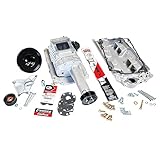
- Conventional Cylinder Head Compatibility
- Edelbrock 122 System Type
- Carbureted
- Eaton H122 Rotor Type
- 6-Rib 3. 75 in. Pulley
Rank #4

- [VEHICLE FITMENT]: Compatible with GM (Chevy) Cruze 2011-2015; Sonic 2012-2020; Trax 2013-2021; Compatible with Buick Encore 2013-2021 ---1.4L Gas VVT Turbocharged Ecotec LUV
- [REFERENCE PART NUMBER]: 781504-0001, 781504-0002, 781504-0004, 781504-0006, 781504-0007, 7815040001, 7815040002, 7815040004, 7815040006, 55565353, 55565354, 667-203, 783791-1
- [KEY FUNCTIONS]: An sealing device is installed between compressor wheel and bearing support, prevent oil from leaking into intake manifold and eventually cause engine burn oil.
- [TURBOCHARGER FEATURES] : Turbo kit is equipped with wastegate and actuator, and this compressor and turbine housing is made of high grade alloy to rapidly dissipate heat at extreme rotate speed, ultimately extending the service life of the product.
- [ABOUT WARRANTY]: 1 Year (12 Months) Unlimited-mileage Quality Guarantee.
Product prices and availability are accurate as of the date/time indicated and are subject to change. Any price and availability information displayed on Amazon at the time of purchase will apply.




