Yes—a combustion-engine car can turn some exhaust or coolant heat into electricity or mechanical work. It cannot convert all that heat into propulsion, and the equipment must work around changing temperatures, limited space, added weight, and emissions systems. The leading approaches are thermoelectric generators and Rankine-cycle systems; neither should be confused with a proven universal retrofit for ordinary cars.
Why a car has waste heat to recover
Fuel energy does not all become motion. Some leaves the engine as heat in the exhaust or coolant. The U.S. Department of Energy’s general overview says about 30% of a typical combustion engine’s chemical energy is lost as hot exhaust gases; that is an agency-wide overview figure, not a measurement for every car. DOE’s overview of energy recovery and exhaust controls also explains that heat is important to emissions equipment.

A separate DOE 2012 report estimates that, for a gasoline production passenger engine operating at full power, roughly 35–40% of fuel energy is lost in exhaust and 30–35% through engine coolant. Those estimates describe that specific operating condition; they should not be added to or substituted for the general exhaust figure as though they were universal values. DOE’s 2012 Advanced Combustion R&D progress report
How a car can recover waste heat
Thermoelectric generators: heat directly to electricity
A thermoelectric generator (TEG) places thermoelectric materials between a hot surface and a cooler one. The temperature difference produces electricity directly, without a conventional turbine. In a vehicle, that electricity could supply electrical loads and, if it offsets electricity that the alternator would otherwise make, potentially reduce the engine work spent on generation. The net benefit depends on actual output, conversion and cooling losses, added mass, and driving conditions.
Outdated Drivers Are Slowing You Down
One free scan finds every outdated or missing driver and matches the right update for your exact hardware.Free scan · exact hardware matchPC Slower Than It Used to Be?
A free scan shows the junk files, broken settings and background clutter dragging Windows down - then fixes them in one click.Free scan · Windows 10 & 11#1 Best Overall

- 12V WASTE OIL BURNER HEATER: Designed for users who need a compact heating solution for workshops, garages, sheds, farm spaces and maintenance areas. A practical waste oil burner for turning suitable used oil into usable heat.
- MULTI-FUEL OIL COMPATIBILITY: Works with waste engine oil, hydraulic oil, vegetable oil and other suitable non-volatile oils. Do not use gasoline, alcohol, highly flammable liquids or explosive fuels. Always follow normal fuel handling safety practices.
- COMPACT WORKSHOP HEATING SETUP: The 12V design makes the unit suitable for low-voltage power setups and mobile maintenance environments. Ideal for users who need a practical oil furnace for small work areas, repair shops or equipment service spaces.
- STEADY HEAT FOR USED OIL REUSE: Helps reuse suitable waste oil for heating instead of letting it sit unused. A useful choice for garages, machinery shops, farms and workshops that already generate used oil from daily maintenance work.
- INSTALLATION AND SAFETY NOTICE: Use only in properly ventilated areas and install according to local rules and safe operating practices. Keep flammable materials away from the burner and confirm fuel type, power supply and setup before use.
The National Academies describes a Ford vehicle demonstration that produced approximately 450 W at 65 mph when exhaust was near 250°C, and more than 700 W near 500°C. These are demonstration figures tied to the reported vehicle and conditions—not a prediction for another car or a typical drive. The chapter also estimates about a 2.5% potential fuel-consumption reduction at 65 mph for the 450 W example: it assumes about 15 kW of engine power, converts the electrical output to 360 W of mechanical power at 80% efficiency, and therefore represents a conditional calculation rather than a general road result. National Academies, fuel-economy technology chapter
Rankine-cycle systems: heat to an expander
A Rankine-cycle bottoming system transfers heat to a working fluid, heats or vaporizes it, and expands it through a machine to produce mechanical work. The fluid is then condensed and recirculated. A generator can convert the expander’s output into electricity; alternatively, the system can return mechanical work. Compared with a TEG, this approach requires a working-fluid circuit and additional machinery, such as a pump, expander, and condenser.
A 2016 SAE review of passenger-vehicle Rankine-cycle applications identifies potential but emphasizes two automotive constraints: limited installation space and a heat source that changes during driving. SAE’s passenger-vehicle Rankine-cycle review
Other approaches
Exhaust turbocompounding is another engineering route: it extracts work mechanically from exhaust energy. DOE’s technology discussion covers turbocompounding alongside thermoelectric and thermodynamic power cycles. These are powertrain-engineering approaches, not evidence that a generic bolt-on device is suitable for a consumer car. DOE’s 2012 report on advanced combustion research
Rank #3
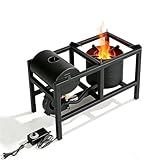
- 12V WASTE OIL BURNER HEATER: Designed for users who need a compact heating solution for workshops, garages, sheds, farm spaces and maintenance areas. A practical waste oil burner for turning suitable used oil into usable heat.
- MULTI-FUEL OIL COMPATIBILITY: Works with waste engine oil, hydraulic oil, vegetable oil and other suitable non-volatile oils. Do not use gasoline, alcohol, highly flammable liquids or explosive fuels. Always follow normal fuel handling safety practices.
- COMPACT WORKSHOP HEATING SETUP: The 12V design makes the unit suitable for low-voltage power setups and mobile maintenance environments. Ideal for users who need a practical oil furnace for small work areas, repair shops or equipment service spaces.
- STEADY HEAT FOR USED OIL REUSE: Helps reuse suitable waste oil for heating instead of letting it sit unused. A useful choice for garages, machinery shops, farms and workshops that already generate used oil from daily maintenance work.
- INSTALLATION AND SAFETY NOTICE: Use only in properly ventilated areas and install according to local rules and safe operating practices. Keep flammable materials away from the burner and confirm fuel type, power supply and setup before use.
TEG and Rankine cycle compared
| Consideration | Thermoelectric generator | Rankine-cycle system |
|---|---|---|
| How it converts heat | Temperature difference across thermoelectric materials produces electricity directly. | Heat drives a working-fluid cycle and expander to produce mechanical work; a generator can produce electricity. |
| Main integration needs | Hot-side heat transfer, a way to dissipate heat on the cold side, electrical connections, and room for the system. | Heat exchangers and working-fluid equipment, including a pump, expander, and condenser, with space for the circuit. |
| Key operating challenge | Output depends on the temperature difference and heat flow available as driving conditions change. | Performance depends on changing heat supply; packaging the additional machinery is a major constraint. |
| Evidence cited here | A Ford vehicle demonstration is reported by the National Academies; its output and potential fuel-consumption calculation are specific to the stated conditions. | A passenger-vehicle review discusses potential and integration constraints. A DOE heavy-duty diesel project listed a 5% fuel-economy improvement as an objective, not an achieved result. DOE Vehicle Technologies Office’s 2016 Affordable Rankine Cycle review |
What determines whether recovery saves fuel
Recovered watts are not the same as net fuel savings. A system must deliver useful output after conversion losses and any energy needed to run pumps, fans, or other components. Its added mass also affects vehicle energy use. For a TEG, the benefit depends in part on whether recovered electricity displaces alternator generation; for a Rankine system, it depends on useful net work after the cycle’s own demands. Both outcomes vary with engine load, exhaust temperature and flow, and the drive cycle.
DOE’s 2012 report says research had shown the potential to improve vehicle fuel economy “by as much as 10%.” That is a potential statement in a progress report, not an average result, a guarantee, or a claim that a consumer car will achieve that saving. DOE’s 2012 Advanced Combustion R&D progress report
Rank #4
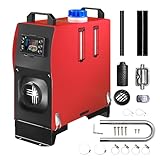
- All-In-One Heater: Our diesel heater offers efficient heating without the need for installation. Heater Power: 8 KW; Rated Voltage: 12 V. Applicable Range: 215-269ft²/20-25m². Working Temperature: -40℉-104℉. Only 10 minutes, allowing you to quickly put into a warm environment
- LCD & Remote & APP Control: Our diesel heater 12V offers LCD panel control and a dedicated remote as standard (within 32 ft/10 m). For an upgraded experience, simply download the APP to unlock smartphone remote control (within 98 ft/30 m) – warm your space anytime, anywhere!
- Extended Runtime, Exceptional Efficiency: Our 8KW diesel heater boasts a precision-engineered, low-noise fuel pump that cuts fuel costs significantly—using roughly 1 gallon per night, with consumption as efficient as 0.18-0.38 L/h. Paired with a large 5L/1.3gal fuel tank, this portable heater delivers nonstop warmth for up to 24 hours, ensuring maximum fuel efficiency and minimal energy waste
- Portable & Usable Everywhere: Our diesel air heater runs on DC 12V-24V, keeping you warm in RVs, cars, campers, trailers, and even during camping or fishing trips in winter. Stay ready when the weather shifts
- Wide Applicability: Our diesel heaters perform efficiently at altitudes below 9,843ft. Compact and easy to install, it delivers consistent warmth in high-altitude or frigid environments, keeping you comfortable wherever you are
Why exhaust heat cannot simply be extracted
Heat in the exhaust also helps emissions after-treatment work. Catalysts need heat for their reactions, and particulate filters need heat to regenerate. Removing too much thermal energy—or changing how quickly the exhaust warms—could interfere with those functions. A practical design therefore has to account for warm-up and after-treatment temperatures as well as recovered output. DOE’s overview of energy recovery and exhaust controls
The hardware also has to cope with changing exhaust conditions and the realities of a passenger car. A 2022 review of automotive thermoelectric generation identifies conversion efficiency, cost, hot-side heat transfer, cold-side heat dissipation, added weight, and connections as design challenges. 2022 review of thermoelectric generation for engine waste-heat recovery
Quick wins for a faster PC:
Fix the driver behind crashes, sound loss and screen glitchesFind Drivers →Repair Windows errors before they cause bigger problemsFix Now →Best Value

- Auto Shutoff & Leak Protection: This gasoline siphon pump is equipped with a sensor in the fill, so when the fluid reaches the spout, it automatically shuts off the pump to prevent overflowing. This feature ensures safety and convenience, especially if you get distracted during the filling process. Simply insert the fill hose, clip it to the tank, press the button, and let it fill up on its own. You can also manually shut it off if needed.
- USB & Battery Powered: Our gas pump offers two power supply options - you can power it with either 4 AA batteries (not included) or a USB Type-C. In case of emergency, it can also use 2 AA batteries to save power. This portable pump is perfect for pumping liquids such as gasoline, diesel, kerosene, light oils, and non-potable water.
- 3.2GPM Maximum Flow & 51-inch Hose: With a maximum flow of 3.2 GPM, this pump allows you to quickly transfer fluids to other containers without heavy lifting or strenuous effort. It can empty a full 5-gallon gas can within just 2 minutes! The included 51-inch hose provides ample length to reach various fuel tanks without any struggle or discomfort.
- 4 Size Adapters & Wide Pump Compatibility: We provide 4 adapters for different fuel canisters that allow you to securely attach the pump directly to the tank. This ensures a leak-free connection and prevents mishaps during transfers. The adapters come in sizes of 2 inch/2.1 inch/2.75 inch/3.75 inch - please check your cans' compatibility before purchasing.
- Easy to Use & Wide Application: Our transfer pump is suitable for cars, boats, tractors, RTVs, lawnmowers, snow blowers, generators and vehicles. It makes refueling easy and fast whether you're out on the trail, camping, or at home. No more struggling with heavy gas cans above your head or over the side of your boat.
Can you add a waste-heat system to an ordinary car?
The evidence cited here describes research, vehicle demonstrations, and engineering programs; it does not establish a suitable, validated consumer retrofit for an ordinary car. A TEG module or heat-recovery component sold on its own is not proof of vehicle compatibility, net fuel savings, or emissions compliance. Treat a retrofit claim skeptically unless it is specific to the vehicle and supported by credible performance and emissions data.
Quick Recap
Product prices and availability are accurate as of the date/time indicated and are subject to change. Any price and availability information displayed on Amazon at the time of purchase will apply.




