Crashes, No Sound, or Screen Glitches?
Random freezes, missing sound and display glitches usually trace back to one bad driver. Find and replace yours safely.Free scan · under a minutePC Slower Than It Used to Be?
A free scan shows the junk files, broken settings and background clutter dragging Windows down - then fixes them in one click.Free scan · Windows 10 & 11Many features of modern transport did not begin with one all-conquering invention. They took shape through vehicles that tested a new power source, layout, production method, or way of moving people and goods. These 15 examples show how some ideas endured, while others exposed the limits of technology before roads, railways, manufacturing, or everyday use could catch up.
How early vehicles shaped transport
“Pioneered” does not always mean “invented first.” A vehicle can matter because it demonstrated a workable design, helped establish a lasting engineering principle, or revealed what had to change before a technology could spread. The examples below are grouped by the problem they addressed: making vehicles practical, moving them with new power sources, and building the systems that let them operate.

Road vehicles and bicycles: making transport practical
1. Michaux/Lallement velocipede (1871 museum object)
The early pedal velocipede helped turn the bicycle from a machine pushed along by the rider’s feet into a human-powered vehicle driven by pedals. The Deutsches Museum describes the addition of a pedal crank to the front axle around 1863, but says it remains disputed whether Ernest Michaux or Pierre Lallement originated the idea. The object is a useful reminder that early transport advances often developed through overlapping experiments rather than a single undisputed inventor. Deutsches Museum
2. Adler “Kreuzrahmen-Rover” safety bicycle (1887)
The safety bicycle’s equal-sized wheels, rear-wheel chain drive, and lower saddle position made it easier and safer to handle than the high-wheel bicycle. The Deutsches Museum identifies the Adler as a licensed product and notes that earlier Starley & Sutton bicycles helped shape bicycle construction in the 1880s. Its lasting lesson is not a single invention, but the value of a stable, controllable layout that riders could use in ordinary life. Deutsches Museum
What’s actually slowing this PC down?
Pick the symptom - the matching free tool is one click away.
#1 Best Overall
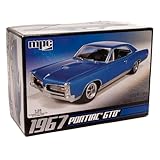
- V8 POWER: The model features a 400 cubic inch V8 engine, reflecting the muscle and power that defined the GTO's reputation.
- DETAILED SUSPENSION & EXHAUST: The kit incorporates separate rear suspension and exhaust detailing, adding to the realism of the model.
- BUCKET SEATS & CONSOLE: The model's interior features bucket seats and a floor shifter with a console, capturing the iconic look and feel of the GTO.
- OPTIONAL SUPERCHARGER: For those seeking more power, the kit offers an optional supercharger, allowing you to customize your model.
- CLEAR & COMPREHENSIVE INSTRUCTIONS: The included instructions are clear and user-friendly, making the kit accessible to modelers of different skill levels, from beginners to experienced hobbyists.
3. Benz Patent-Motorwagen (1886)
Carl Benz’s Patent-Motorwagen was a petrol-powered three-wheeler that combined a high-speed single-cylinder engine with a carburettor and some components borrowed from bicycle construction. The Deutsches Museum describes Benz’s patent as a “vehicle with gas engine operation” and calls it the first automobile with a petrol engine. That is a specific claim about a petrol-powered automobile, not a claim that the vehicle established the later standard car layout. Its commercial reception was initially modest: the museum exhibit says, “In the beginning, however, it had attracted little attention amongst contemporaries.” Deutsches Museum
4. Ford Model T (museum specimen dated 1922)
The Model T shows that transport innovation can happen on the factory floor as much as on the road. The Deutsches Museum calls it the first car manufactured on an assembly line and says assembly-line production streamlined manufacturing and lowered selling prices. The important connection is between production capacity and access: a vehicle becomes transformative not only when it works, but when it can be built in sufficient numbers and sold at a price more people can manage. Deutsches Museum
5. Büssing ZU 550 truck (1903)
The Büssing ZU 550 represents the early development of commercial road transport. The Deutsches Museum calls it the oldest surviving German-manufactured truck and describes an overhead-camshaft engine and a specially designed suspension intended to absorb forces during starting and braking. Testing and inspection of the truck informed later trucks and buses, according to the museum. It is best understood as an example of engineering work on heavier vehicles, not as proof that one truck established modern suspension design. Deutsches Museum
Rank #2

- Versatile 3-in-1 Kit: Build your 1963 Chevy Corvette Sting Ray as factory stock, a street custom, or a drag gasser with this multi-option kit.
- Enhanced Features: Includes pre-lettered drag slicks, clear red taillights, and stock & custom wheels for an authentic and detailed build.
- Multiple Engine Options: Customize your model with various engine intake options, allowing for unique and personalized creations.
- Retro Styling: Comes with a full-color, retro-styled decal sheet and vintage “Street Rods Series” packaging, perfect for nostalgic collectors.
- High-Quality Collectible: AMT's improved reissue offers superior parts and detailing, making it a must-have for model enthusiasts and collectors.
6. Auto Union Type C (1936/37)
The Auto Union Type C put its engine longitudinally ahead of the rear axle, a mid-engine arrangement the Deutsches Museum identifies as standard in racing-car construction today. The museum lists the car at 520 hp. This is a racing-car comparison, not a general description of passenger cars: its significance lies in how a competition vehicle helped establish a layout that remains common in racing. Deutsches Museum
7. Rumpler Tropfenwagen (1922)
Designed by aircraft designer Edmund Rumpler, the Tropfenwagen applied aerodynamic thinking to a road car. Its teardrop shape was intended to reduce dust and fuel consumption; the Deutsches Museum gives it a drag coefficient of 0.28 and says this was lower than many current small cars in the comparison on its page, which is not dated. Yet a clever shape could not solve every practical problem. The museum says the car’s engine, limited luggage capacity, road conditions, and consumer expectations constrained its commercial appeal. It is an important aerodynamic experiment, not a successful mass-market precursor. Deutsches Museum
8. Serpollet steam-powered car (1891)
Early road transport did not follow a straight path from steam to petrol. Léon Serpollet’s three-wheel steam car used a flash boiler, developed in 1887, that could quickly produce superheated, high-pressure steam. The Deutsches Museum notes that the design avoided storing boiler pressure, but preparation time and limited water and fuel supplies restricted its everyday range. It illustrates why an alternative power source had to work as a complete transport system—not merely produce motion. Deutsches Museum
Rank #3

- Revell Model Kit #14531, Skill Level 5, Contains 77-Parts, Recommended for ages 13 and up
- Detailed 440+6 V-8 engine, hood scoop that can be positioned open or closed
- Detailed interior with separate side panels and a front bench seat
- Molded in white and clear with chrome plated parts and black vinyl tires
- Illustrated assembly instructions. Requires paint and glue. (not included)
9. Megola Sport motorcycle (1922)
The Megola placed a five-cylinder radial engine in its front wheel, a striking arrangement that the Deutsches Museum says increased comfort and stability. It also lacked a clutch, gearbox, and starter, making it impractical for everyday road traffic. The company ceased production after four years. The Megola’s story shows the difference between technical originality and a design riders can readily operate in ordinary conditions. Deutsches Museum
Rail vehicles: propulsion depends on infrastructure
10. Puffing Billy (built 1814)
The Deutsches Museum calls Puffing Billy the first serviceable steam locomotive. It hauled coal wagons at a mine in Wylam, but its weight broke the early cast-iron rails. It was temporarily converted to four axles until stronger rails became available. That mismatch captures a recurring transport problem: a vehicle’s capabilities are limited by the infrastructure beneath or around it. A locomotive could not become more useful without track able to carry its weight. Deutsches Museum
Quick wins for a faster PC:
Fix the driver behind crashes, sound loss and screen glitchesFind Drivers →Repair Windows errors before they cause bigger problemsFix Now →11. Siemens electric locomotive (1879)
Werner Siemens’s demonstration locomotive is described by the Deutsches Museum as the world’s first electric locomotive. It used a direct-current motor and demonstrated a conductor-rail and pantograph concept for supplying power. Early battery-powered electric locomotives had limited range and performance; electric rail transport instead depended on power stations and lines. The vehicle therefore points beyond the motor itself to the supply network required to make electric operation useful. Deutsches Museum
Rank #4

- A PERENNIAL CLASSIC FOR EXPERIENCED MODELERS: AMT’s 1/25 scale 1967 Shelby GT-350 is the perfect project for muscle car builders. Add it to your collection today!
- FEATURE PACKED: The 1967 Shelby GT-350 is a historical muscle car that stands alone! Fully paintable, it features authentically detailed water-slide decals. Build it up right with a Ford 289 V8 engine and all the Shelby touches—custom rear lower pan, chrome wheels, custom taillights and front grille, bucket seats, and more. Wrapped up nicely in retro-styled packaging!
- QUICK SPECS: 1/25 Scale, 123 Parts, 7 inches long once assembled. Parts molded in white, clear and transparent red, with black vinyl tires. Some parts are chrome plated. Plastic model kit paint and cement required (Testors or Tamiya brands recommended). Paint guide included in kit. Skill Level 2. For ages 10+
- THE PERFECT PRESENT: Don't know what to get dad for his birthday? Or maybe you have an avid hobbyist or collector in your life. This model kit makes an ideal gift for any occasion!
12. 999 “Empire State Express” locomotive
The Griffin Museum of Science and Industry describes locomotive 999 as the first land vehicle to exceed 100 miles per hour. That priority claim comes from the museum’s exhibit summary; it should be read within that attribution rather than as an independently established record here. The locomotive’s place in the story is a milestone in high-speed rail, where performance depends on the train, track, and operating conditions together. Griffin Museum of Science and Industry
Independent reader supportYour contribution helps us test, update, and keep practical guides available for everyone.Aircraft and transport systems: design, commerce, and logistics
13. Wright Flyer and the Wrights’ engineering methods
The Wrights’ contribution was not only a successful airplane. The Smithsonian National Air and Space Museum says the basic elements of their airplane design have been used in successful airplanes ever since. Its account of their wind-tunnel work says the experiments generated specific data that the brothers used directly in aircraft design, describing them as pioneers of modern aeronautical engineering. The lasting influence is therefore both a set of design foundations and a disciplined method of testing before building. Smithsonian National Air and Space Museum
14. 1909 Wright Military Flyer
The Smithsonian identifies the 1909 Wright Military Flyer as the world’s first military airplane. Its significance was the demonstration that an airplane could serve a military role, extending aircraft development beyond experimentation and civilian possibilities. That is a claim about this aircraft’s military status, not a claim that it created military aviation by itself. Smithsonian National Air and Space Museum
Recommended Free Tools
Best Value
15. Ford Tri-Motor
The Ford Tri-Motor helped commercial aviation grow by carrying passengers and serving airlines. The U.S. Navy History and Heritage Command says it was used by more than 100 airlines worldwide and was important to the growth of U.S. commercial aviation. That history makes it an example of a vehicle supporting a new transport service, rather than a claim that the Tri-Motor invented passenger air travel. U.S. Navy History and Heritage Command
Why some ideas spread and others did not
These vehicles point to several conditions that separate a striking prototype from a lasting technology:
Quick Recap
- Usability: The safety bicycle’s manageable layout helped make cycling easier to control; the Megola’s missing clutch, gearbox, and starter made everyday operation difficult.
- Infrastructure: Puffing Billy needed stronger rails, while electric railways needed power stations and supply lines.
- Production and affordability: The Model T illustrates how manufacturing methods can affect the price and availability of a vehicle.
- Fit with real needs: The Tropfenwagen’s aerodynamic form could not compensate for limited luggage capacity and other obstacles to adoption.
- Systems beyond the vehicle: Commercial aircraft, trucks, and military transport depend on networks, maintenance, and logistics as much as on the machine itself. The U.S. Army Center of Military History describes military transport development in connection with airplanes, helicopters, containerized cargo, and support for an interstate road system. U.S. Army Center of Military History
Product prices and availability are accurate as of the date/time indicated and are subject to change. Any price and availability information displayed on Amazon at the time of purchase will apply.




