Big Wind was a Hungarian tracked fire-extinguishing vehicle built for a job ordinary fire engines cannot do: attack raging oil- and gas-well blowouts at close range. Its aircraft turbojets drove a high-speed mixture of exhaust and water toward the fire. That combination cooled the wellhead and disrupted the burning flow; it was a specialized well-control machine, not a general-purpose firefighting tank.
How did Big Wind put out oil-well fires?
The familiar shorthand—that jet engines simply blew out the flames—leaves out the key part: water. Big Wind’s turbojets produced a fast exhaust stream, and water was injected into it before the mixture reached the fire. The resulting gas-and-water jet combined force with cooling.
A 2016 Safety & Fire Technology article describes gas/water-jet equipment as producing an outlet mixture of about 60% water and 40% gas by total mass. It reports oxygen concentration of no more than 14% at the outlet, rising to 17–18% at 12–15 metres. These are category-level figures, not measurements specific to Big Wind. The article explains that some water vaporizes in the hot stream, while small droplets reach the combustion area and cool it.
The same technical article gives an example from a related vehicle, the AGVT-100: a flow of 60 litres per second for five minutes reduced wellhead temperature from 950°C to 100–150°C. That is an AGVT-100 example, not a recorded Big Wind result.
#1 Best Overall

- Slide molded turret and upper hull parts give an unbeatable combination of hassle-free assembly and highly realistic detail levels. Cast metal turret and welded hull surface textures are rendered accurately.
- The rear showcases sharp, detailed molding on engine grilles and exhausts, as well as the numerous accessories depicted by the kit.
- Clear parts are used to recreate light lens and cupola vision block parts, further upping the realism of this kit.
- The single-pin T66 tracks are recreated with minimum fuss and great accuracy, by the included belt-type tracks. Drive sprockets feature fine holes.
- A commander figure in realistic pose is provided for the cupola. The periscope seen on the hatch underside is depicted using separate parts.
What was Big Wind built for?
Big Wind belonged to a wider family of turbo-reactive extinguishers developed for oil- and gas-well blowouts. The approach followed earlier Soviet and Hungarian experiments, alongside other tracked and truck-mounted systems. A 2024 historical account in Műszaki Katonai Közlöny places the Hungarian unit’s Kuwait firefighting operations between 1991 and 1993.
In Kuwait, well fires followed the 1991 Gulf War. Big Wind’s purpose was to get a powerful stream close enough to a well to suppress or disrupt the fire while cooling the area. The Kuwait Oil Company’s environmental-program publication describes Hungarian teams bringing a vehicle with MiG-21 engines, first mounted on a T-34 chassis and later on a T-55. Its account is available through the company’s environmental-program page.
Rank #2
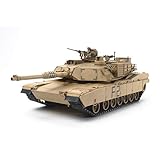
- 1/48 scale plastic model assembly kit. Length: 205mm, width: 77mm.
- Anti-slip surface details molded into the main sections of the model.
- Assembly type tracks feature straight sections for a highly realistic finish.
- Kit includes a weight for creating a heavy feel model.
- 2 marking options are included to recreate U.S. Army 3rd Armored Cavalry Regiment M1A2s from 2003 in the Iraq War.
Which tank chassis did Big Wind use?
Big Wind’s chassis history is easy to blur in photographs and retellings. Accounts describe the Kuwait-era vehicle as beginning on a T-34 base, with its superstructure later transferred to a T-55-family recovery vehicle, commonly identified as the VT-55A. A caption that names only one chassis may therefore describe one phase rather than the vehicle’s entire history.
Do not confuse Big Wind with the separate German “Hurricane” design. The 2024 Műszaki Katonai Közlöny article describes that later vehicle as using a T-55 combat-tank chassis and a Soviet R-13-300 engine. Those details belong to Hurricane, not Big Wind.
What’s actually slowing this PC down?
Pick the symptom - the matching free tool is one click away.
Rank #3

- 1/48 scale plastic model assembly kit. Length: 156mm. width: 62mm.
- Surface textures of cast turret and welded upper hull panels.
- Wide, single-pin T66 tracks are assembly type with one-piece straight sections.
- Four hull weights included give the model an authentically weighty feel.
- Comes with a commander torso figure and 2 marking options.
What did it accomplish in Kuwait?
A 2024 article in Acta Oeconomica reports that the Hungarian team extinguished nine wells in 42 days, including one in 34 seconds. Treat those numbers as that article’s historical account, not as a controlled engineering test or a typical time for putting out a well fire. Operational accounts also differ on crew size: Hackaday describes a three-person operating crew, while the Acta Oeconomica account refers to a four-person drilling-firm crew followed by a Hungarian quintet.
Independent reader supportYour contribution helps us test, update, and keep practical guides available for everyone.What were Big Wind’s limits?
A jet-powered stream was not a universal answer to an oil-well fire. The 2016 technical article says gas/water-jet vehicles have an effective range of no more than 15 metres and consume large quantities of extinguishing agent, which can be costly. Getting close enough to use the stream also makes operating distance and heat exposure central considerations.
Rank #4

- Revell Plastic Model Tank Kit #85-7853 is skill level 4 and contains 152 parts. Recommended for ages 12 and up.
- Features include: opening and closing hatches, movable turret, cannon, machine gun and tank treads
- Includes 2 crew members and six military figures
- Model scale 1:35
- Illustrated assembly instructions
The same article discusses other approaches, including continuous water delivery, powder jets, impulse systems, explosives, mechanical methods and combinations. Conventional water monitors can be unsuitable near major eruptions because of thermal radiation. Powder systems bring cost and environmental-contamination concerns; impulse powder methods can offer mobility and dispersion but have short range and health or environmental drawbacks. The best method depends on the fire, access, agent supply, personnel protection and cleanup consequences—not on a single vehicle’s spectacle.
Where can you see Big Wind?
Big Wind appears in the 1992 IMAX documentary Fires of Kuwait, which covers the broader international effort to extinguish Kuwait’s oil fires. Hackaday notes the vehicle’s appearance in the film. A DVD edition is documented, though current availability and the exact edition offered vary by marketplace.
Free tools Windows power users keep installed
One-click scans. No signup required.
Quick Recap
Product prices and availability are accurate as of the date/time indicated and are subject to change. Any price and availability information displayed on Amazon at the time of purchase will apply.




