For automotive R-134a work, choose a detector that explicitly supports R-134a and look for documented SAE J2791 compliance. CPS LDA1000H, INFICON AST200IR and Robinair 22791 are manufacturer-documented options, but the available specifications do not establish an independently tested best overall detector. Their sensitivity figures use different stated methods, so they are not a reliable head-to-head ranking.
How to choose an R-134a leak detector
Confirm refrigerant support and the standard
Check the exact model’s documentation for R-134a support. For an electronic probe-type detector used on a vehicle air-conditioning system, documented SAE J2791 compliance is a useful selection criterion. SAE International’s current catalog lists SAE J2791_202505, revised May 16, 2025. It describes testing and functional requirements intended to help detectors identify smaller refrigerant leaks in motor-vehicle air-conditioning systems. The standard does not establish suitability for every refrigerant, and SAE explicitly says it does not address safety issues concerning detector design or use. SAE International: SAE J2791_202505
Read sensitivity claims in context
A sensitivity number is meaningful only alongside its test method, operating mode and qualification. ASE’s August 2024 training material describes J2791’s three selectable detection scales as 4 g (0.15 oz.) per year, 7 g (0.25 oz.) per year and 14 g (0.5 oz.) per year. ASE also says J2791 requires manufacturers to provide a list of common underhood chemicals that may cause false triggering. Those are details reported by ASE, not a substitute for reviewing the full standard or the detector’s instructions. ASE training material on MVAC leak detection
Manufacturer figures below are not directly comparable simply because one number is smaller. For example, INFICON states sensitivity per EN 14624, while Robinair gives three selectable levels without describing that figure in the same way. CPS says its model detects leaks smaller than a stated annual rate. Compare each claim with the method and conditions the maker provides; do not treat the figures as results from one shared test.
Quick wins for a faster PC:
Scan for outdated or missing drivers - takes under a minuteDriver Scan →Clear out junk files and repair common Windows errorsFree Scan →#1 Best Overall
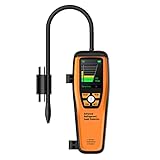
- Infrared Leak Detector: Compared with the heated diode leak detector, the infrared refrigerant leak detector has strong anti-interference ability, faster response speed, more accurate and longer service life.
- Higher Sensitivity: Adjustable sensitivity with High/Medium/Low levels and the maximum sensitivity is up to 0.14oz/yr.
- Detecting All Halogenated Gases: It can detect all kinds of halogen refrigerants including CFCs, HFCs, HCFCs, HCs, HFOs and mixed refrigerants such as R11/R22/R404a/R410a/R600a/R1234yf and Blends such as AZ-50, HP62, MP39 etc.
- 2.8' Large Screen: Do not missing any leakage. The peak display clearly indicates the orientation of the leak detection point and provides users with a quiet working environment.
- US Local Team R&D and Service: We offer 24/7 customer service and technical support.
Manufacturer-listed R-134a detector options
The specifications in this table are manufacturer-published unless the source is identified otherwise. They are a shortlist of documented options, not an independent performance ranking. Current retail prices and stock were not established.
| Model | R-134a support and standards | Sensing and sensitivity claim | Power and replaceable parts | Warranty |
|---|---|---|---|---|
| CPS LDA1000H | CPS lists R-134a and R-1234yf; SAE J2791, SAE J2913 and EN 14624. | CPS describes proprietary EMOS pulse-modulation sensing and claims detection of leaks smaller than 0.1 oz per year. | CPS states up to 500 hours of sensor life and 50 hours of battery life using three C batteries. Replacement sensor: EMOS2; filter pack: LS2XF; vapor-filter sensing tip: LS2XVF. | CPS lists a two-year warranty, excluding sensor and batteries. |
| INFICON AST200IR | INFICON lists R134a and R1234yf, along with SAE J2791, SAE J2913 and EN14624:2012. | Infrared sensor; INFICON states 1 g (0.03 oz.) per year per EN 14624. | Rechargeable lithium-ion battery, filter cartridges and a replacement sensor are listed. INFICON also lists an R134a reference leak. | Not stated on the cited INFICON product page. |
| Robinair 22791 | Robinair lists compliance with SAE J2791 for 134A and SAE J2913 for 1234yf; its listed detection coverage includes CFC, HFC, HCFC blends and HFO-1234yf. | Infrared detector; Robinair lists three sensitivity levels down to 0.15 oz./year. | Robinair lists an eight-hour lithium-ion battery and automatic recalibration in contaminated areas. | Not stated on the cited Robinair product page. |
Sources: CPS LDA1000H, INFICON AST200IR and Robinair 22791. These manufacturer specifications can change; check the exact product listing and manual before purchase.
Rank #2

- RECHARGEABLE LITHIUM BATTERY: A 2500mAh built-in lithium battery delivers up to 24 hours of continuous work on a single charge, so the detector is ready whenever a call comes in. Charges from any USB-C power source; cable included. No disposable batteries to buy or carry.
- HIGHLY SENSITIVE SENSOR: Japanese-made metal-oxide semiconductor sensor responds to the full halogenated refrigerant family, with selectable High and Low sensitivity so you can sweep an area broadly first, then switch down to close in on the exact joint.
- BEFORE YOUR FIRST JOB: Like all metal-oxide sensors, this detector reaches full sensitivity after running for several hours - leave it switched on in clean air when it is new or has been in storage. In use, switch it on in clean air away from the leak, then move the probe no faster than 1 inch (25 mm) per second, about 1/4 in from the joint, with fans and drafts off. This is what separates a found leak from a missed one.
- BROAD RANGE DETECTION: SFD200 responds to the full halogenated refrigerant family - CFCs: R11 R12 R113 R114; HCFCs: R21 R22 R31 R121 R122 R123 R124 R141b R142b R401a R402a R402b R408a R409a R509a; HFCs: R23 R32 R41 R125 R134a R143a R152a R404a R407c R410a R417a R507 R508a R508b; HFOs: R-1234yf R-1234ze R449a R452b R454a R455a R456a R457a R459a, and more - covering home and commercial air conditioning, refrigeration and automotive AC. If you also need to check natural gas, LPG or propane lines, choose the SFD201 model on this page.
- LIVE PPM READING: A large color LCD shows the actual concentration in ppm plus a bar graph, so you can watch the number climb and narrow down to the exact joint instead of guessing from faster beeping. The buzzer follows the reading as well and can be muted when you need to work quietly.
What the specifications mean in practice
- CPS LDA1000H: CPS lists a broad set of standards and both R-134a and R-1234yf support. Its runtime and sensor-life figures are “up to” claims; sensor and battery are excluded from the stated two-year warranty.
- INFICON AST200IR: Its published sensitivity is tied to EN 14624. The listed R134a reference leak is a product accessory or reference item; the manufacturer page does not establish that it is required for ordinary leak detection.
- Robinair 22791: Its infrared design and stated recalibration feature may matter when considering how the unit is intended to operate in contaminated areas. Confirm operating instructions and suitability for your service conditions.
Why SAE J2791 matters—and what it does not prove
SAE J2791 is a performance standard for electronic probe-type refrigerant leak detectors used in motor-vehicle air-conditioning service. SAE’s catalog scope says it is intended to help identify smaller leaks, including in systems with improved sealing and smaller refrigerant charges. It is not a safety certification, and the standard’s scope does not mean a detector automatically works with every refrigerant.
ASE’s August 2024 material says J2791 sets minimum performance requirements for electronic detectors used with R-134a MVAC systems. It also notes that older J1627 detectors are not as accurate or sensitive as J2791 detectors. Treat that comparison as ASE’s description, and verify the specific model’s labeling and documentation rather than assuming that a general “electronic leak detector” listing meets J2791.
Rank #3

- 1oz of leak detection dye
- Used to identify leaks in R-1234yf A/C systems
- UV dye glows when under ultra-violet light for easy identification (UV flashlight sold separately)
- Compatible with lubricants that are commonly used in cars with R-1234yf A/C systems
- Meets SAE requirements
Electronic detection versus fluorescent dye
ASE describes electronic detectors and fluorescent dye detectors as two primary approaches to locating MVAC refrigerant leaks. An electronic probe samples around likely leak points; dye inspection instead relies on compatible fluorescent dye and a suitable UV light to reveal traces at a leak location. Dye is an alternative method, not a mandatory add-on to every electronic detector. Follow the vehicle, dye and equipment manufacturers’ compatibility instructions before adding dye or using UV inspection.
CPS lists an LDA1000UV model with a clip-on UV light and separately lists replacement components compatible with the LDA1000H. That can be relevant if you are considering UV inspection equipment or maintaining a compatible CPS detector, but confirm the exact part and tool compatibility with CPS before ordering. CPS product information
Rank #4

- Works in All AC Systems – Compatible with R1234YF, R-134a, R-12, R-22, R-600a, R-290 and more – Safe for all oils (PAG, POE, Mineral).
- Instant Leak Detection – Bright UV fluorescent dye circulates with refrigerant and glows under UV light, making leaks easy to see.
- Easy Install – Just Like Adding Refrigerant – Connect to your low-side port, invert can and dispense. No special tools required.
- Choose Your Kit – Available with R134a hose, R1234YF hose, 1/4" flare hose, or #5010 top tap for gauges & custom setups.
- Save Time & Refrigerant – Pinpoint leaks, fix only what’s leaking, and stop wasting money on constant recharge cycles.
Compatibility and maintenance checks before buying
- Verify R-134a support on the exact model, not just a broad product-category description.
- Look for explicit SAE J2791 documentation if you want a detector aligned with the standard for automotive R-134a work.
- Check whether sensitivity is quoted under a named method or standard, and whether the figure depends on a setting or stationary-versus-moving operation.
- Confirm battery type or runtime, and whether the sensor, filters or cartridges are replaceable.
- Match replacement sensors, filters and reference leaks to the exact detector model. Parts are model-specific; a similar brand name is not sufficient evidence of compatibility.
- Check the current manual, warranty terms, price and availability with the manufacturer or retailer; those facts can change and are not established by the specifications cited here.
An additional model specification to interpret carefully
Johnson Controls’ PENN RLD-H10PRO page, in a catalog revised April 12, 2020, lists a heated-diode sensing element. In small-leak setting/manual mode, it states approximate sensitivity of 0.006 oz./year stationary and 0.1 oz./year moving per SAE J2791, with roughly one-second response and a two-minute warmup. Because the source is an older catalog revision, verify whether the model remains current before treating it as a buying option. The large difference between stationary and moving figures also illustrates why a sensitivity number without test conditions can mislead. Johnson Controls / PENN RLD-H10PRO specification
Can you name one best 134a leak detector?
Not from these specifications alone. CPS, INFICON and Robinair each publish support for R-134a and relevant standards, but no independent comparative test here establishes which unit finds leaks most reliably or is easiest to use. Choose by documented refrigerant support, standard compliance, the sensitivity method, serviceable parts and operating requirements—not by comparing isolated sensitivity numbers.
Crashes, No Sound, or Screen Glitches?
Random freezes, missing sound and display glitches usually trace back to one bad driver. Find and replace yours safely.Free scan · under a minutePC Slower Than It Used to Be?
A free scan shows the junk files, broken settings and background clutter dragging Windows down - then fixes them in one click.Free scan · Windows 10 & 11Quick Recap
Best Value

- AUTOMOTIVE LEAK DETECTION SOLUTIONS - The LEAKFINDER brand from TRACER PRODUCTS offers the brightest, most cost-effective, and efficient solution for finding AC and fluid-based vehicle leaks.
- PRODUCT DETAILS - Includes: Caulking gun-style dye injector assembly, BigEZ R-134a hose/coupler and purge fitting, LF1800 8 oz (237 ml) BigEZ universal multi-dose AC dye cartridge, Each cartridge services up to 64 vehicles.
- LEAK DETECTION MADE SIMPLE - Let the UV fluorescent dye circulate throughout the vehicle system. The dye escapes with the host fluid and collects at all leak sites. Use a LEAKFINDER leak detection lamp to scan and see all leaks glow brightly.
- PINPOINT MICRO LEAKS WITH HIGH ACCURACY - LEAKFINDER UV leak detection dyes find the smallest and most problematic leaks that would otherwise be impossible to detect. Quickly pinpoint hard-to-find leaks - including intermittent and multiple leaks.
- MADE IN THE USA - Proudly manufactured in the U.S.A., Tracer Products has over 65 years of experience delivering award-winning professional service and the industry’s most powerful leak detection dyes, inspection lamps, and diagnostic tools.
Product prices and availability are accurate as of the date/time indicated and are subject to change. Any price and availability information displayed on Amazon at the time of purchase will apply.




