No portable fire extinguisher should be presented as a way to put out an electric car’s high-voltage traction-battery fire. If an EV battery is burning, get out, move well away and upwind, and call emergency services. An extinguisher may have a narrow role in a small fire involving a vehicle’s low-voltage system, or as temporary protection during an occupant rescue—but it is not a reason to approach a burning EV.
Can a fire extinguisher put out an electric car battery fire?
Do not count on a consumer extinguisher to extinguish a fire involving an EV’s high-voltage lithium-ion traction battery. Battery fires can involve thermal runaway, intense heat and hazardous combustion products; they may need extended cooling and can reignite after appearing to be out. The U.S. Fire Administration (USFA) describes continuing gaps in the science informing safe and effective EV-fire response, while its lithium-ion guidance discusses cooling, monitoring and reignition risk: USFA, “Emergency Response to Electric Vehicle (EV) Incidents,” July 29, 2025; USFA, “Risks and response strategies for lithium-ion battery fires”.
A December 2022 federal EMS/NHTSA presentation says battery involvement requires large, sustained volumes of water for extinguishment and warns about delayed ignition or reignition. That is a professional response consideration, not a do-it-yourself instruction: do not try to cool, open or otherwise work on a high-voltage battery. Follow emergency-service directions and the vehicle maker’s instructions. NHTSA/FICEMS, “Li-ion Battery Fires in Electric Vehicles,” December 2022.
What can a portable extinguisher do in an EV?
Its defensible role is limited to certain small fires—not the traction battery. UK Department for Transport recovery guidance says a suitable extinguisher may be used if a fire starts in the 12/24-volt supply, and otherwise directs people to defer to the fire service. It says only specially trained fire-service personnel using self-contained breathing apparatus should tackle these fires. Federal EMS/NHTSA guidance describes an extinguisher as possible temporary protection from flames if occupants cannot be removed quickly, while rescue or a hose line is arranged. Neither scenario makes a portable extinguisher a battery-fire solution.
#1 Best Overall

- Combats Vehicle Fires: Use to fight basic fires common to your cars & trucks: flammable liquids and gases (Class B) & electrical equipment (Class C)
- All-Metal Construction: Durable valve assembly, rust, and impact-resistant handle & easy pull safety pin
- Quick and Powerful: Discharge time of 8-12 seconds, a discharge range of 6-8 feet & operating pressure of 100 PSI
- Easy-to-Read Pressure Indicator: If arrow is in the green it’s charged
- Scan QR Code: Provides quick access to online registration, warranty, and product info
These are narrow, situation-specific instructions, not a recommendation for drivers to approach a burning vehicle. If a fire is developing, prioritize escape and emergency services over retrieving or using an extinguisher. UK Department for Transport, “Recovery operators: working with electric vehicles”; NHTSA/FICEMS presentation, December 2022.
What to do if an EV catches fire
- Get people out. Leave the vehicle and move away; do not stop to collect belongings or retrieve an extinguisher.
- Move away and upwind. Keep clear of smoke and the vehicle, and follow the directions of local emergency authorities. Exact distances and procedures vary by jurisdiction.
- Call your local emergency number. Tell responders that an electric vehicle is involved and, if known, where the fire or damage is.
- Do not return to the vehicle. A battery fire can reignite, so stay away until emergency personnel say it is safe.
Singapore’s Land Transport Authority and Civil Defence Force advise the public not to fight a battery fire, to move at least 15 metres away and to call 995. That distance and number are specific to Singapore, not universal instructions. UK recovery guidance instead says to retreat to a safe place well away and upwind. Follow the applicable emergency authority where you are. Singapore LTA/SCDF, “Robust standards and public awareness key to safety,” March 9, 2026; UK Department for Transport guidance.
Rank #2

- EASY TO USE WITHOUT TRAINING:Patented handle design removes the safety pin—no twisting, no fiddling. This 2.5lb fire extinguisher is ideal for homes, allowing anyone from teens to seniors to act fast without needing instructions.
- TRUSTED ABC PROTECTION THAT WORKS:Rated for Class A, B, and C fires, this ABC fire extinguisher tackles grease, electric, and fuel fires. Proven in kitchens, cars, and offices. A fire extinguisher for home, car, or business that performs when it matters.
- READY FOR HOME GARAGE AND CAR:Install beside your stove, keep under the sink, or place it in your garage or car trunk. This home fire extinguisher fits into daily life and works as a reliable vehicle fire extinguisher or part of any fire safety kit.
- HEAVY DUTY DESIGN FOR REAL FIRES:Weighing 4.4 lb, this fire extinguisher is built with thick-wall steel and a high-performance formula for faster, stronger suppression. A dependable fire extinguisher for vehicle, car kits, garages, or high-risk zones.
- FIRE HITS FAST BE READY ALWAYS:The 2024 California wildfires and rising fire incidents remind us: fire doesn’t wait. This fire extinguisher for kitchen, hallway, or car is a backup plan for the emergencies you hope never happen—but must prepare for.
How to choose an extinguisher for a car
If you want an extinguisher for ordinary small vehicle fires or a limited low-voltage fire scenario, choose and store it for that purpose only—not as protection against a traction-battery fire. The evidence here establishes no best model, brand or comparative test. Check the specific product’s fire-class rating and agent, size and mounting method, operating instructions and range, serviceability or replacement schedule, and your vehicle maker’s guidance. Use it only when there is a small fire, a safe escape route and no need to approach an EV battery; otherwise leave and call emergency services.
In Singapore, authorities say dry powder may help with a small internal-combustion vehicle fire but is less effective against an EV battery fire. That is not a basis for describing dry powder—or an ABC extinguisher—as a reliable way to stop battery thermal runaway. Singapore LTA/SCDF, March 9, 2026.
Quick wins for a faster PC:
Clear out junk files and repair common Windows errorsFree Scan →Fix the driver behind crashes, sound loss and screen glitchesFind Drivers →Rank #3

- Simple, Fast Activation:Take control with an easy-to-use design—just press, aim, and spray. Each extinguisher Emergency Survival Kits includes two sturdy mounting brackets for quick access in kitchens, cars, and other essential spots.
- Versatile 8-in-1 Fire Protection:Effectively tackles a variety of fires: wood, cooking oils, gasoline, and lithium-ion battery fires in devices like phones and laptops. A protective barrier helps prevent reignition for added security.
- Eco-Friendly and Non-Toxic Formula:The non-toxic, water-based formula is safe for users and the environment. It leaves no residue, making cleanup fast and mess-free—perfect for homes, vehicles, or offices.
- Compact and Portable:Lightweight and easy to store, this extinguisher fits into small spaces like kitchen drawers, glove compartments, or boat lockers, ensuring you’re prepared for emergencies anytime.
- Reliable 6-Year Warranty :Enjoy peace of mind with a six-year warranty. Whether it’s support, replacement, or guidance, the customer service team is ready to assist, keeping you safe and covered.
Reduce charging-related fire risk
Prevention is more useful than expecting a portable extinguisher to solve a battery fire. For home charging, the USFA recommends using equipment certified by a nationally recognized laboratory, following the vehicle and charger manufacturers’ instructions, and using a qualified electrician for a dedicated circuit or Level II charging device when applicable. See USFA, “Electric Vehicle Fire Safety,” last reviewed April 1, 2023.
Independent reader supportYour contribution helps us test, update, and keep practical guides available for everyone.What the available fire statistics do—and don’t—show
Singapore LTA/SCDF reported that in Singapore in 2025, EVs made up about 6% of the vehicle population and accounted for about 1.8% of vehicle fires; it also reported about 7 fires per 100,000 EVs compared with about 22 per 100,000 internal-combustion vehicles. These are figures for Singapore and that year, as reported by the local authorities; they do not establish comparative fire rates for other countries or fleets. They also do not change what to do at an active fire: evacuate, move away and call emergency services. Singapore LTA/SCDF, March 9, 2026.
Quick Recap
Best Value

- Reliable Fire Protection: Stop basic home fires involving trash, wood, paper, liquids, gases, and electrical equipment
- All-Metal Construction: Made with robust materials for long-lasting durability
- Easy pull safety pin
- Compact & Lightweight: Aluminum construction and small size allow for easy storage and use
- Easy-to-Read Pressure Indicator: If arrow is in the green it’s charged
Rank #4
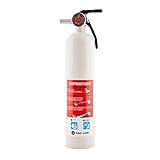
- First Alert's AUTOMAR10 Marine Fire Extinguisher is UL rated 10 B:C; It features a durable metal head and commercial grade valve and trigger
- Designed to fight flammable liquid and electrical fires; Uses sodium bicarbonate extinguishing agent
- Metal pull pin with safety seal to help prevent accidental discharge and discourage tampering
- Secure extinguisher mount, bracket and strap are included for secure placement of extinguisher
- Easy instructions with a chemical resistant & water proof label with 4 step instructions won’t deteriorate
Product prices and availability are accurate as of the date/time indicated and are subject to change. Any price and availability information displayed on Amazon at the time of purchase will apply.




