PC Slower Than It Used to Be?
A free scan shows the junk files, broken settings and background clutter dragging Windows down - then fixes them in one click.Free scan · Windows 10 & 11Crashes, No Sound, or Screen Glitches?
Random freezes, missing sound and display glitches usually trace back to one bad driver. Find and replace yours safely.Free scan · under a minuteFor most U.S. drivers, the best dash cam of 2025 is the VIOFO A229 Pro 2CH. It combines detailed 4K front video, a useful 2K rear camera, strong low-light performance, GPS, HDR, Wi-Fi, and parking modes without requiring a monthly subscription. It is not the right choice for everyone, however: the A329 is better for maximum image quality, the Nextbase iQ is better for LTE-connected alerts, and the Garmin Dash Cam Mini 3 is better if you want the smallest possible installation.
This is a U.S. market snapshot evaluated through December 31, 2025, not a claim about products released after that date. Prices are 2025 list-price or launch-price references where available, not guaranteed current sale prices. Check the exact channel configuration, bundle, memory card, hardwire kit, and subscription terms before buying.
Quick verdict: the best dash cams in 2025
| Model | Best for | Video configuration | GPS | Parking mode | Subscription | 2025 U.S. price reference | Main compromise |
|---|---|---|---|---|---|---|---|
| VIOFO A229 Pro 2CH | Most buyers | 4K front + 2K rear | Yes | Buffered, time-lapse, low-bitrate; needs suitable constant power | Not required for local recording | $359.99 RRP reference | Rear-camera wiring and hardwiring take time |
| VIOFO A329 2CH | Best image quality | 4K front up to 60 fps + 2K rear | Yes | Requires appropriate installation for engine-off recording | Not required for core local recording | $469.99 retail-price reference | Expensive, bulky, and more than many drivers need |
| Nextbase iQ 4K | Remote alerts and cloud access | 4K front + integrated infrared cabin camera | Check exact configuration | Smart Sense Parking and connected alerts | Advanced features use paid plans | $499.99–$699.99 historical range by resolution | Recurring fees and cellular dependence |
| Garmin Dash Cam Mini 3 | Smallest, least conspicuous camera | 1080p front | No | Needs an appropriate parking-power arrangement | Not required for basic local recording | At the lower end of Garmin’s $149.99–$399.99 X-series launch range | No screen, no GPS, no rear camera, and only 1080p |
| Rove R2-4K Dual | Affordable front/rear coverage | 4K front + 1080p rear | Check exact bundle | Depends on power installation and bundle | Core recording is local | Varied by package; card included in the tested configuration | Rear video and installation are less polished than premium systems |
| Thinkware U3000 | Parking surveillance | 4K front + 2K rear | Yes | Radar, buffered impact, motion, time-lapse, and energy-saving modes | Not required for core local recording | Varies by kit and retailer | Needs hardwire or OBD-II power for parking surveillance |
| Vantrue N4 Pro | Rideshare and cabin recording | 4K front + 1080p cabin + 1080p rear | Yes | Yes, with suitable power | Not required for core local recording | Approximately $349.99–$399.99 depending on variant | Three cameras mean more wiring, storage, and privacy concerns |
| 70mai 4K Omni | Rotating, unusual 360-degree coverage | 4K rotating front camera; rear-camera bundles available | Yes | Requires constant power | Check optional connected services | Varies by bundle | A rotating lens does not record every direction simultaneously |
Price warning: retailer discounts can make a premium camera look like a budget model for a short time. Compare list price with the complete ownership cost: memory card, polarizer, hardwire or OBD-II cable, professional installation, optional battery, and any cellular subscription.
| # | Preview | Product | Price | |
|---|---|---|---|---|
| 1 |
|
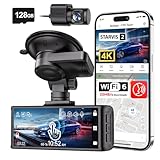
REDTIGER 4K STARVIS 2 Dashcam Front Rear, 5GHz WiFi 20MB/s, Free 128GB Card | $139.99 | Buy on Amazon |
Best dash cam for most people: VIOFO A229 Pro 2CH
The VIOFO A229 Pro 2CH is the most defensible all-around recommendation for a typical driver who wants dependable accident evidence without paying for cloud service. Its front camera records 4K at 30 frames per second and its rear camera records 2K at 30 fps. The front uses Sony’s STARVIS 2 IMX678 sensor, while the rear uses the STARVIS 2 IMX675. The lenses cover 140 degrees in front and 160 degrees behind, and both channels have HDR.
That combination matters more than the 4K label alone. The A229 Pro gives you a detailed forward view for road signs, vehicles, and incident context, while the rear camera can document a rear-end collision, tailgating, or a hit-and-run from behind. Independent testing from TechRadar found it dependable and easy to use, with strong daytime and nighttime footage. VIOFO also summarizes Wirecutter’s selection after research into more than 400 models and hands-on testing of 61, although that testing claim is presented through VIOFO’s page rather than a direct Wirecutter page.
#1 Best Overall
- [4K+1080P Dual Recording] REDTIGER F7N TOUCH captures your drive journey in stunning 4K UHD resolution with STARVIS 2 sensor 170° wide-angle view for the front dash cam and 1080P FHD resolution 140° wide-angle for the rear car camera. Equipped with WDR and HDR technology, the enhanced super night vision ensures better visibility even in low-light situations, providing you with reliable recordings day and night.
- [Voice Control & Touch Screen] F7NTOUCH dashcam features voice commands, allowing for hands-free control of your 4K car camera, which enhances safety by minimizing distractions. The dual camera dash cam also has smart touchscreen that can lock emergency video, turn on wifi, and capture scenery with one click. Redtiger also retains the buttons, multiple control methods are integrated.
- [Built-in GPS & 5.8GHz WiFi] Both Android and IOS users can connect to dashcam WiFi via the REDTIGER Cam app. Although the dash cam is installed wired, you can enjoy wireless control on your smartphone, faster 20MB/s download speed and share your driving experiences in real-time with friends and insurance companies. Car recorder built-in GPS provides traceable location, speed, and accurate route in the recordings.
- [Loop Recording & G-Sensor] REDTIGER F7N TOUCH dual channel dash cam automatically overwrites the oldest footage when the memory is full, ensuring endless recording with the included 128GB card. With a built-in G-sensor that detects sudden movements or impacts, it automatically locks and protects the associated footage when an event is detected on the road, ensuring it won't be overwritten during loop recording.
- [24-hour Parking Monitoring*] REDTIGER Car dashboard camera offers G-Sensor Parking Mode that automatically record when it detects any collisions or sudden motion while vehicles is parked. Time Lapse Parking Mode provides continuous surveillance by offering a condensed overview of any events that may occur during parking periods. *Please note that the parking monitoring function requires a separate hardwire kit.
Why the A229 Pro wins
- 4K front and 2K rear recording are a sensible balance of detail, storage use, and price.
- STARVIS 2 sensors, HDR, and good low-light processing are more useful than resolution by itself.
- GPS can record location and speed information, subject to local settings and evidentiary considerations.
- It supports 2.4GHz and 5GHz Wi-Fi, voice control, event detection, buffered parking mode, time-lapse, and low-bitrate parking recording.
- Core recording is local, so there is no required monthly cloud subscription.
The main drawback is installation. The rear camera cable must be routed through the vehicle, and genuine engine-off parking surveillance requires a hardwire kit, OBD-II power cable, or an appropriate external battery. A switched 12-volt outlet normally turns off when the ignition is off, so merely plugging in the A229 Pro does not create all-night protection.
The A229 Pro is sold in front-only, front/rear, and front/rear/cabin versions. Always write the channel count into your shopping list: A229 Pro 2CH means front and rear, while the A229 Pro 3CH adds an interior camera. They are not interchangeable packages.
Who should skip it?
Choose the A329 instead if you routinely drive at highway speeds and want 4K/60 video, faster transfers, and external SSD support. Choose the Garmin Mini 3 if a rear camera, GPS, and a screen are less important than a nearly invisible camera. Choose the Nextbase iQ if remote alerts and Live View matter more than avoiding subscriptions.
Quick wins for a faster PC:
Clear out junk files and repair common Windows errorsFree Scan →Fix the driver behind crashes, sound loss and screen glitchesFind Drivers →Best premium image quality: VIOFO A329 2CH
The VIOFO A329 2CH is the upgrade for buyers who want the most capable local-storage system in this group and are willing to pay for diminishing returns. It records 4K front video at up to 60 fps and 2K rear video. The higher frame rate can make fast-moving details appear smoother and gives you more frames to work with, although it also increases storage requirements and does not guarantee that a distant license plate will be readable.
The A329 adds Wi-Fi 6, 2.4GHz/5GHz compatibility, Bluetooth, GPS, HDMI video output, and support for an external SSD of up to 4TB in addition to a microSD card of up to 512GB, according to VIOFO and independent testing. A Digital Camera World review praised its 4K/60 footage, 2K rear camera, polarizing filter, and SSD support. TechRadar’s 2025 buying guide treated it as its closest thing to a complete all-rounder.
The 2025 recommendation is the original A329, not the later A329S. Do not silently substitute the newer model when comparing this dated guide.
The 2CH A329 had a 2025 retail-price reference of $469.99. The difference from the A229 Pro is most noticeable if you crop footage, transfer large files often, drive at night or on high-speed roads, or want external storage. A commuter who mainly needs a clear record of a nearby collision may not notice enough improvement to justify the added price, larger body, and more involved wiring.
Best smart and connected dash cam: Nextbase iQ 4K
The Nextbase iQ 4K is the right choice when a dash cam needs to behave more like a connected security camera than a conventional recorder. It offers LTE connectivity, app access, Live View, cloud storage, parking alerts, Witness Mode, voice control, and an integrated infrared cabin camera. The iQ family also has 1K/1080p and 2K/1440p versions; this recommendation specifically refers to the 4K front-camera model.
Its advantage is remote awareness. A conventional microSD camera can preserve footage after you return to the car, but the iQ is designed to send alerts and provide connected access while you are away. That is useful for a parked vehicle in a driveway or public lot, especially if an impact or suspicious activity occurs and the camera has time and cellular coverage to communicate.
The subscription changes the math
Nextbase’s U.S. subscription page lists a free Solo tier, a Protect tier at $9.99 per month, and Protect Plus at $19.99 per month. Paid tiers unlock features such as Live View, Smart Sense Parking, Witness Mode, cloud storage, and emergency-related functions. Plan names, features, prices, and availability can change, so check the current subscription page before publication or purchase.
At those listed rates, three years of Protect costs $359.64; Protect Plus costs $719.64. Using Nextbase’s historical U.S. price range of $499.99–$699.99 for the iQ family, the camera-plus-plan total before installation is approximately:
- Protect: $859.63–$1,059.63 over three years.
- Protect Plus: $1,219.63–$1,419.63 over three years.
These are arithmetic illustrations, not a current quote or a guarantee that every plan feature remains unchanged. Cellular coverage, account status, upload time, service outages, and plan limits can all affect connected protection. Cloud access also does not eliminate the need to preserve the original local file.
If you only want collision footage on a microSD card, an A229 Pro, A329, Garmin Mini 3, or Vantrue N4 Pro will usually be a simpler ownership proposition. The iQ earns its premium through remote access and alerts, not necessarily through the best raw video value.
Best discreet budget camera: Garmin Dash Cam Mini 3
The Garmin Dash Cam Mini 3 is for drivers who want a tiny, unobtrusive front camera and can accept basic 1080p video. It has a 140-degree field of view, a built-in polarizer, no display, and no built-in GPS. Video is managed through the Garmin Drive app, and a microSD card is required but not included.
Its landscape-oriented body is compact enough to sit behind the rear-view mirror with minimal visual distraction. That makes it easier to live with than a large-screen camera, but the trade-off is significant: 1080p provides less useful distant-detail latitude than a good 2K or 4K camera. The Mini 3 is an uncomplicated evidence recorder, not the choice for maximum license-plate detail, rear coverage, or speed/location overlays.
Garmin’s X-series launch announcement placed the Mini 3 at the low end of a $149.99–$399.99 U.S. range. Treat that as a launch-price reference rather than a current guaranteed price. Parking protection still requires an appropriate constant-power arrangement; the camera does not watch a parked car all night simply because parking-related functions exist in the app.
The Mini 3 is also not a compelling upgrade for every Mini 2 owner. Its new landscape orientation and built-in polarizer are useful, but they do not transform its 1080p capability into a high-detail 4K system.
Best value front-and-rear system: Rove R2-4K Dual
The Rove R2-4K Dual is the value pick for buyers who want two viewpoints without paying premium-system prices. It pairs a 4K front camera with a 1080p rear camera and includes a memory card in the tested configuration. The package offers broad coverage and a relatively accessible entry price.
TechGearLab selected the R2-4K Dual as its best dash cam for most people after buying and testing eight models over more than 200 miles in September 2025. That result supports its value case, but the rear camera remains a clear step down from the A229 Pro’s 2K rear channel. The review also found installation less polished than with premium systems.
What’s actually slowing this PC down?
Pick the symptom - the matching free tool is one click away.
Do not confuse the R2-4K Dual with the newer R2-4K Dual Pro. They are different products. The Pro review and product listings should not be used to quietly substitute specifications or pricing for the model tested by TechGearLab.
Because the supplied 2025 evidence does not establish one stable U.S. list price for the exact R2-4K Dual bundle, compare the precise package rather than a retailer headline. Confirm whether the card, rear cable, GPS function, and parking-power accessory are included.
Best for parked-car surveillance: Thinkware U3000
The Thinkware U3000 is the strongest choice here for an owner whose priority is what happens while the car is parked. It combines a 4K front camera, a 2K rear camera, Sony STARVIS 2 hardware, built-in radar, and several parking-surveillance modes. The front camera can record 4K at 30 fps or 2K at 60 fps and has a 152-degree diagonal viewing angle.
Its parking options include radar-assisted detection, motion detection, impact detection, time-lapse, and energy-saving modes. Radar can help detect nearby movement before an impact, but it is not the same thing as recording every direction continuously or guaranteeing that every event is captured.
Free tools Windows power users keep installed
One-click scans. No signup required.
The installation requirement is critical: Thinkware says Parking Surveillance requires a hardwiring cable or OBD-II power cable. A normal switched 12-volt outlet will generally lose power when the engine is shut off. The hardwire installation should include low-voltage cutoff protection, and drivers of hybrids, vehicles with sensitive battery-management systems, or cars with unusual fuse layouts may want professional installation.
Thinkware lists 64GB, 128GB, and 256GB microSD options. Its published operating range is 14°F to 140°F, with a storage range of -4°F to 158°F. Those are manufacturer specifications, not a promise that a camera will be immune to heat damage in every windshield installation. There is no single stable 2025 price in the supplied evidence because U3000 packages vary, so compare the complete camera, rear-camera, power-cable, and installation bundle.
Best for rideshare, delivery, or cabin recording: Vantrue N4 Pro
The Vantrue N4 Pro records three views: 4K front, 1080p cabin, and 1080p rear at 30 fps in the standard configuration. It adds 5GHz Wi-Fi, GPS, voice control, super night vision, parking mode, and advertised microSD support up to 1TB. That makes it a practical fit for Uber, Lyft, taxi, delivery, and other work where a passenger dispute or cabin event matters as much as a road collision.
The cost is complexity. Three channels produce more files, consume more storage, require more cable routing, and create a larger installation footprint. A high-capacity card may also cost more, and the exact supported capacity should be confirmed against the current firmware and manual rather than assumed from a retailer listing.
Recommended Free Tools
Vantrue listings have shown prices from approximately $349.99 to $399.99 depending on the page, bundle, and variant. Check whether you are buying an N4 Pro, N4 ProS, or a front/rear/cabin package. The product names and included cameras are not interchangeable.
The VIOFO A229 Pro 3CH is another option if you want front, rear, and cabin views with the A229 family’s local-storage approach. Choose the exact three-channel version; the 2CH A229 Pro does not include the interior camera.
Best unusual 360-degree coverage concept: 70mai 4K Omni
The 70mai 4K Omni takes a different approach to parked-car coverage. Its motorized camera rotates to look around the vehicle, and rear-camera bundles are available. It supports GPS, microSD cards up to 512GB according to 70mai’s specifications, app access, and parking mode when supplied with constant power.
This can be attractive when the concern is an incident alongside or around the parked vehicle rather than only an event directly ahead. But rotating coverage is not simultaneous multi-camera coverage. While the lens is pointed in one direction, another direction is not being recorded by that lens. A conventional dual- or three-channel camera keeps its channels pointed at their assigned views.
Do these 3 things before closing this tab:
1Fix the driver behind crashes, sound loss and screen glitches2Repair Windows errors before they cause bigger problems3Scan for outdated or missing drivers - takes under a minuteThe hardwire or constant-power accessory is therefore essential for its parking use. The 70mai 4K Omni is an interesting design for buyers who understand that trade-off, not an automatic replacement for a front/rear system.
Notable Garmin alternative: Dash Cam X310
The Garmin Dash Cam X310 is worth considering if you want Garmin’s app ecosystem, a built-in screen, and 4K video in a compact conventional camera. It has a 2.41-inch color TFT touchscreen, a 140-degree diagonal field of view, GPS and Galileo, voice control, HDR, incident detection, and synchronization of up to four compatible Garmin cameras.
It requires a microSD card, supports up to 512GB, and Garmin does not include the card. Garmin lists up to 20 minutes of battery life, but that is not a substitute for a parking-power installation. Live View and Parking Guard may depend on Garmin Vault and the appropriate connected setup. Its U.S. launch MSRP was $399.99, making it more expensive than the discreet Mini 3 and a less obvious value than the dual-camera VIOFO models.
How to choose a dash cam
4K is useful, but resolution is not the whole picture
4K gives you more pixels for cropping and can help with distant detail, highway driving, and larger fields of view. It does not guarantee readable plates. Exposure, sensor size, HDR, lens quality, bitrate, shutter speed, motion blur, glare control, compression, dirty glass, and the angle of the plate can matter more in a real incident.
A practical hierarchy is:
- 1080p: acceptable for basic front recording and compact cameras, but weakest for distant details.
- 2K or 1440p: a sensible minimum for a serious front camera.
- 4K: worthwhile when you frequently drive on highways or want maximum cropping flexibility.
- 4K/60: useful for smoother motion and fast-moving detail, but it costs more and fills storage faster.
Consumer Reports’ 2025 guidance treats 2K or 4K as the practical baseline in its tested group. TechRadar’s buying guidance correctly warns that resolution alone does not determine plate readability. Look at independent day and night sample footage when available rather than inferring performance from a box label.
Front-only, front-and-rear, or three-channel?
A front-only camera is cheaper, easier to install, and sufficient for many commuters. It can still document the road, traffic signal, lane position, and impact ahead. A rear camera adds evidence for rear-end crashes, tailgating, and hit-and-runs, but it cannot replace a correctly mounted front camera.
Rear installation can be the hardest part. Sedans, hatchbacks, SUVs, convertibles, and vehicles with tinted or opening rear glass may require different cable lengths and mounting approaches. Expect the rear cable to be the most time-consuming part of a dual-camera installation.
Three-channel systems are justified for rideshare, taxi, delivery, passenger disputes, or drivers who specifically need cabin footage. For private commuting, the extra wiring, storage use, files, and privacy implications often outweigh the benefit.
The Tool Desk
Outbyte PC Repair FREERepair Windows errors before they cause bigger problemsFix Now →Outbyte Driver Updater FREEFix the driver behind crashes, sound loss and screen glitchesFind Drivers →Understand what parking mode actually does
Parking mode is not one standardized feature:
- Impact detection records when the G-sensor detects a jolt.
- Buffered impact detection preserves footage from before and after the impact.
- Motion detection starts recording when movement is detected.
- Time-lapse records continuously at reduced frame rates.
- Low-bitrate recording records continuously in smaller files.
- Radar-assisted detection uses radar to detect nearby movement before an impact.
- Cloud or LTE alerts can send notifications or clips remotely if the camera has coverage, power, an active account, and the required plan.
Most conventional cameras shut off when a switched 12-volt outlet loses ignition power. Engine-off recording usually requires a hardwire kit, OBD-II cable, or external battery. Use a kit with low-voltage cutoff protection to reduce the risk of draining the vehicle battery. Even then, a camera cannot promise unlimited overnight recording: battery condition, driving frequency, temperature, cutoff setting, recording mode, and vehicle electronics all matter.
Local microSD storage versus LTE and cloud
Local storage is usually cheaper and more private. It has no recurring fee and lets you retrieve the original file directly from the card. LTE and cloud access are valuable when you want a remote Live View, theft alert, automatic off-car backup, or notification while away from the vehicle.
The trade-off is account and network dependence. Weak cellular coverage, an expired plan, server problems, an account error, or insufficient upload time can prevent a cloud clip from appearing. Keep the original local file even when a cloud copy exists.
Memory cards are consumables
Dash cams continuously overwrite their cards, so use a high-endurance microSD card from a verified compatible family rather than an ordinary card intended for occasional phone or still-camera use. Format the card in the camera before recording. Garmin recommends a high-quality Class 10 or faster card, notes that continuous overwriting causes wear, and advises formatting at least every six months. Its compatibility guidance lists high-endurance families from ADATA, Samsung, SanDisk, and Transcend.
Recommended Free Tools
Capacity is not automatically better. The camera firmware must support the size and filesystem. A verified high-endurance 128GB or 256GB card is preferable to an unsuitable 1TB card. The A329 supports up to 512GB microSD plus an external SSD up to 4TB; the Thinkware U3000 lists 64GB, 128GB, and 256GB options; the Garmin X310 supports up to 512GB; and Vantrue advertises up to 1TB for the N4 Pro. Confirm current compatibility before purchase.
Heat, cold, and power design
A camera mounted behind a windshield can become substantially hotter than the outside air. Supercapacitor-equipped cameras are generally preferable for high-temperature vehicle use because they do not rely on a conventional lithium-ion battery for shutdown. Do not interpret that preference as a claim that any model is heatproof.
Use the manufacturer’s operating range as a specification, not a guarantee against problems caused by windshield placement, direct sun, a blocked vent, or an unsuitable power supply. Parking mode also puts a long-duration load on the vehicle. A low-voltage cutoff can help, but it cannot compensate for a weak battery, infrequent driving, or incorrect wiring.
GPS, HDR, STARVIS 2, and polarizers
GPS can attach speed and location data to footage, which may help establish context, but it does not automatically make a recording admissible or accurate in every dispute. HDR can help manage bright headlights and dark surroundings, but implementation varies. Sony STARVIS 2 sensors are a useful hardware feature, not a guarantee of perfect night footage.
A CPL or polarizing filter can reduce windshield reflections and dashboard glare. It also reduces some incoming light and must be rotated correctly. Clean glass, proper mounting, and good exposure processing remain essential. Garmin’s X-series and Mini 3 include polarizer-related features, while the A329 and some A229 bundles offer polarizing filters.
Independent reader supportYour contribution helps us test, update, and keep practical guides available for everyone.Total ownership cost: what to budget beyond the camera
The camera price is only the beginning. A realistic comparison includes the card, power solution, installation, and service fees.
| Ownership item | What to expect | Why it matters |
|---|---|---|
| High-endurance microSD card | Buy a verified, high-endurance card; some cameras include one and some do not | Continuous overwriting wears cards and a failing card can silently lose incidents |
| CPL filter | Included, bundled, or optional depending on model | Can reduce glare but is not essential for every vehicle |
| Hardwire kit or OBD-II cable | Required for most true engine-off parking modes | Provides constant power and should include low-voltage cutoff protection |
| Professional installation | Optional for front-only; more valuable for rear cameras, parking mode, or complex fuse layouts | Airbag-safe routing and correct power connections matter more than saving a small installation fee |
| External battery | Optional alternative to drawing from the vehicle battery | Useful for long parking periods, but adds cost, space, and another component to maintain |
| LTE/cloud plan | Primarily relevant to Nextbase iQ | Can exceed the camera’s purchase price over several years |
For planning purposes, a typical dual-camera owner should compare the camera price plus a card, power accessory, and either DIY time or professional labor. The A229 Pro’s $359.99 reference price becomes a different purchase when a card, hardwire kit, and rear-camera installation are added. The same is true of the A329’s $469.99 reference price. The Garmin Mini 3 can be inexpensive to own because it is front-only and compact, but it still needs a card and a separate parking-power solution if parked surveillance is important.
The iQ is the clearest example of recurring cost. At the listed subscription prices, three years adds $359.64 for Protect or $719.64 for Protect Plus before installation. A local-storage camera may cost more upfront yet be cheaper over three to five years.
What’s actually slowing this PC down?
Pick the symptom - the matching free tool is one click away.
Installation checklist
- Confirm the exact package. Check whether it is front-only, front/rear, or front/rear/cabin, and whether the card, polarizer, GPS mount, rear cable, and hardwire kit are included.
- Install a high-endurance microSD card. Format it in the camera before recording.
- Bench-test everything first. Confirm each camera records, the date and time are correct, GPS locks, the app connects, and the rear image is oriented correctly.
- Mount near the rear-view mirror where lawful and safe. Keep the lens in the windshield-wiper-cleared area and outside the driver’s sightline.
- Route cables away from airbags. Do not run cables across curtain-airbag deployment paths or where they interfere with mirrors, sensors, or controls.
- Use the 12-volt outlet for initial testing. This confirms operation before you hide cables or commit to hardwiring.
- Use a manufacturer-approved power solution for parking mode. Verify constant power, ignition-switched power, ground, and low-voltage cutoff operation.
- Update firmware before final testing. Use the manufacturer’s current support page because firmware menus and versions change.
- Test in daylight and at night. Check plates, tunnel exposure changes, headlight glare, rear-camera visibility, and recording after a bump.
- Export a test clip. Confirm that a file opens on a computer or phone outside the camera’s app.
- Recheck after the first week. Inspect for corrupted clips, verify parking mode activates, and make sure cables and mounts remain secure.
Garmin Dash Cam Mini 3 formatting procedure
For the Mini 3, Garmin’s manual describes this in-camera procedure:
- Connect the camera to power.
- Insert the microSD card.
- Hold the designated audio/record control for approximately eight seconds.
- The status LED turns green while formatting.
- When formatting is complete, the LED turns red and recording begins.
Formatting deletes all videos and data on the card. Follow the current Garmin Mini 3 manual if the control or LED behavior changes.
What to do after a crash
- Stop recording or lock the event only when it is safe; do not operate the camera while driving.
- Use the camera’s lock button or voice command to protect the clip if available.
- Copy the original file from the microSD card to two separate locations.
- Preserve the original filename and metadata.
- Make a working copy for sharing and leave the original unedited.
- Record the date, time, location, vehicle position, and relevant file names.
- Keep the card untouched if the footage may become evidence.
- Blur faces, license plates, addresses, and private audio before posting publicly.
Do not assume a dash-cam file or GPS data is automatically admissible in court. Admissibility and evidentiary weight depend on jurisdiction, authenticity, chain of custody, relevance, and the facts surrounding the incident.
Legal and privacy warnings for U.S. drivers
Video recording on a public road is generally a different legal question from recording private conversations inside a vehicle. Windshield-mounting rules and audio-consent laws vary by state. Check the law where the vehicle is operated rather than relying on a nationwide conclusion.
Outdated Drivers Are Slowing You Down
One free scan finds every outdated or missing driver and matches the right update for your exact hardware.Free scan · exact hardware matchWindows Errors? Fix Them Before They Spread
Repair common Windows errors and clear accumulated junk for a smoother, more stable PC - no reinstall needed.Free scan · no reinstall- Mount behind the mirror or on the dashboard where lawful, without obstructing visibility.
- Cabin cameras require extra care, particularly when passengers are being recorded.
- Audio recording can require consent from all parties in some jurisdictions. Thinkware specifically warns about this issue in North America.
- Disable cabin audio when uncertain and disclose recording to passengers when appropriate.
- Do not assume a dash cam guarantees an insurance discount. Consumer Reports says footage may help document a claim, but a discount depends on the insurer and jurisdiction.
- Do not publish unblurred passenger footage, faces, plates, addresses, or private conversations casually.
Use the Digital Media Law Project state recording guide as a starting point, then verify the current law or obtain local legal advice. Thinkware’s audio-recording guidance also explains why disabling audio may be prudent.
Which dash cam should you buy?
- Want the safest default? Buy the VIOFO A229 Pro 2CH.
- Want the best image and storage flexibility? Buy the VIOFO A329 2CH.
- Want remote alerts, Live View, and cloud access? Buy the Nextbase iQ 4K, but price the subscription over several years.
- Want the smallest and least conspicuous camera? Buy the Garmin Dash Cam Mini 3.
- Want affordable front/rear coverage? Consider the Rove R2-4K Dual, checking the exact bundle.
- Want the strongest parking-surveillance design? Choose the Thinkware U3000 and budget for proper constant-power installation.
- Need cabin recording? Choose the Vantrue N4 Pro or the VIOFO A229 Pro 3CH, after checking audio-consent requirements.
- Want a rotating 360-degree concept? Consider the 70mai 4K Omni, understanding that its motorized lens does not capture every direction simultaneously.
The best purchase is not the camera with the largest resolution number. It is the model whose coverage, power installation, storage, privacy settings, and long-term cost match the way you actually drive.
Frequently Asked Questions
Do I need to hardwire my dash cam?
Not for basic ignition-on recording. A switched 12-volt outlet is usually enough for a front camera while driving. You generally need a hardwire kit, OBD-II cable, or external battery for engine-off parking mode. Use a power solution with low-voltage cutoff protection.
Is 4K dash-cam video always better than 2K?
No. 4K offers more pixels for cropping, but exposure, HDR, sensor quality, bitrate, glare, motion blur, and nighttime processing can matter more. A well-exposed 2K recording may be more useful than poorly processed 4K footage.
The Tool Desk
Outbyte Driver Updater FREEScan for outdated or missing drivers - takes under a minuteDriver Scan →Outbyte PC Repair FREERepair Windows errors before they cause bigger problemsFix Now →Do dash cams lower insurance premiums?
Do not assume so. A recording may help document a claim, but any discount depends on the insurer and state. Ask your insurer directly rather than buying a camera based on a promised discount.
What memory card should I buy?
Use a verified high-endurance microSD card compatible with the camera. Format it in the camera before use, and replace it when the manufacturer or the camera indicates degradation. Garmin recommends formatting at least every six months for its cameras.
Can I legally record passengers with a cabin camera?
That depends on state law, particularly for audio. Some jurisdictions require consent from all parties. Check the law where you operate, disclose recording when appropriate, and disable cabin audio when uncertain.
The Bottom Line
For most drivers, buy the VIOFO A229 Pro 2CH and budget for a high-endurance card plus proper power installation if you need parking protection. Spend more on the VIOFO A329 for 4K/60 and SSD storage, choose the Nextbase iQ for connected alerts, or move to the Thinkware U3000 for parking surveillance. Whatever you buy, verify the exact bundle, format and maintain the card, route wiring safely, test day and night footage, and preserve original files after an incident.
Quick Recap
Product prices and availability are accurate as of the date/time indicated and are subject to change. Any price and availability information displayed on Amazon at the time of purchase will apply.