Crashes, No Sound, or Screen Glitches?
Random freezes, missing sound and display glitches usually trace back to one bad driver. Find and replace yours safely.Free scan · under a minuteWindows Errors? Fix Them Before They Spread
Repair common Windows errors and clear accumulated junk for a smoother, more stable PC - no reinstall needed.Free scan · no reinstallBattery swapping can reduce an EV’s energy stop to minutes, but it solves range concerns only for drivers whose vehicle is compatible with a station on their route. It is most relevant where a swap network is established and dependable; it is not a universal alternative to charging.
How does EV battery swapping work?
Instead of waiting for a vehicle’s installed battery to charge, a compatible vehicle enters a dedicated station where equipment removes the depleted pack and installs a charged one. The operator manages the exchanged batteries, including charging and inspection. This requires a vehicle designed to work with that station’s battery, mechanical fittings, communications and software—not merely a removable battery or a standard charging port.




Because the station must hold charged packs and specialized equipment, swapping shifts some of the energy-stop logistics from the driver to the network operator. The driver’s benefit depends on the station having a compatible charged battery available when they arrive.
How fast is a battery swap compared with charging?
NIO reported that its automated Power Swap Stations could exchange a battery in under five minutes in 2022. NIO’s 2023 description of Power Swap Station 4.0 gives a 144-second swap and says that is 22% faster than its previous generation. These are manufacturer-reported operating times, not independent tests; they describe the swap operation, not necessarily a driver’s total time at a station.
#1 Best Overall
| Option or example | Reported time or value | What the figure establishes |
|---|---|---|
| NIO automated swap stations | Under five minutes, as reported by NIO in 2022 | Company-reported swap time; not an independent comparison with charging. |
| NIO Power Swap Station 4.0 | 144 seconds, as reported by NIO in 2023; 22% faster than the previous generation | Company-reported operating time and improvement; not a measure of total stop time. |
| Plug-in charging | Not stated in the cited NIO timing reports | Charging time varies by vehicle, charger and conditions; the cited figures do not establish a like-for-like comparison. |
A minutes-scale exchange can be attractive on a trip when the alternative is a longer charging stop. But the relevant comparison for a particular driver is the whole stop and route: station access, any queue, pack availability and the vehicle’s charging options all matter. The supplied timing figures do not establish that swapping is faster for every trip or vehicle.
Does swapping improve reliability or battery health?
NIO’s 2024 Form 20-F says automatic battery and electric-system assessments are performed during each swap. Its 2022 ESG report says a health check is conducted after every swap. Those checks give the operator a repeatable inspection point and may allow an abnormal pack to be removed from circulation.
That is a process control, not proof that a swap network has fewer failures than plug-in charging. The cited sources do not establish a comparative field failure rate. Drivers should also distinguish battery inspection from availability: a station still needs a suitable charged pack and functioning equipment when a vehicle arrives.
Which vehicles and networks support battery swapping?
Swapping is an ecosystem feature, not a standard capability shared by all EVs. The Associated Press reported in 2024 that most EVs worldwide do not currently allow battery swapping and that a vehicle must be equipped for the relevant station. Compatibility can involve pack dimensions and mounting, as well as communications and software between vehicle and station.
What’s actually slowing this PC down?
Pick the symptom - the matching free tool is one click away.
NIO: a scaled passenger-car example
NIO is the clearest scaled passenger-car example in the cited material. Its 2024 Form 20-F reports 3,054 Power Swap Stations globally and more than 61 million cumulative swaps, both as of December 31, 2024. Those company-reported figures demonstrate substantial use of NIO’s own network, not access for EVs generally.
Aulton: support across multiple vehicle companies
The International Energy Agency reported in 2023 that Aulton stations supported 30 vehicle models from 16 vehicle companies. This shows that multi-brand support is possible when manufacturers and station operators coordinate, but it does not make every model compatible with every swapping network.
Rank #3
CATL: an announced expansion plan
In December 2024, CATL announced a plan for 1,000 swap stations in China and a long-term target of 10,000 stations with partners, according to the Associated Press. These were announced targets, not evidence that those stations had already been built or were available to drivers.
Where is swapping available, and can it address range anxiety?
Network coverage is local and route-specific. The International Energy Agency reported more than 1,300 NIO battery-swapping stations in China in 2022. NIO’s later company-reported global count covers a different date and geography. Neither figure tells a driver whether a compatible station is conveniently located along a particular route today.
Do these 3 things before closing this tab:
1Repair Windows errors before they cause bigger problems2Scan for outdated or missing drivers - takes under a minute3Clear out junk files and repair common Windows errorsSwapping can reduce time spent waiting for energy when compatible stations are sufficiently close together and have charged inventory. It cannot eliminate route planning: a long gap between stations, a queue, unavailable packs or a vehicle mismatch can make the network unusable for that journey. Before relying on swapping for regular travel, check the operator’s current station map, supported vehicle list and availability in the relevant geography.
Rank #4
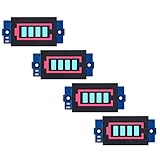
- The 2S battery capacity indicator module can be used to display lithium battery, lead acid battery, and Ni-MH battery.
- Clear and bright display, outline red, display block Blue. The different electricity quantity will illuminate corresponding blocks electricity quantity.
- How to use it: Connect the positive and negative terminals of the display board to the positive and negative terminals of the battery under test. The digital tube displays the real-time battery power.Note : after connecting a few series of lithium batteries in series, it is necessary to connect t-i-n to the corresponding pads.For example if a 2S battery is measured (two 3.7V lithium batteries are connected in series), a short circuit on the pad corresponding to S2 of the board is required.
- Widely applications: Can be widely applied to portable mobile equipment, electro mobile, balance car, cleaning machine, measuring equipment etc. battery capacity indicator.
- Note: The electricity quantity parameter is a reference value, there will be about 2% error range; This model is not waterproof, the electronic components should be used in a dry environment; The number of corresponding battery strings and use them within the corresponding voltage range. Do not exceed a voltage of 4.3*N at most.(for example, if the t-i-n on the pad of S3 is selected, the maximum voltage detected by the module should not exceed 4.3*3=12.9 V).
What standards govern swap stations?
China’s GB/T 29772-2024, issued by the State Administration for Market Regulation in 2024, covers station composition and classification; siting and layout; swap equipment; battery storage and charging; electrical protection and earthing; monitoring and data exchange; fire protection and thermal-runaway requirements; ventilation; personnel and vehicle protection; markings; and operating documentation.
A standard can improve consistency and safety practices within its scope, but it does not by itself make vehicles and stations interoperable. Broader compatibility still depends on adoption by manufacturers and operators, including across markets outside China.
Independent reader supportYour contribution helps us test, update, and keep practical guides available for everyone.What are the costs and trade-offs?
Swapping may shorten the energy stop, but it requires infrastructure beyond an ordinary charger. Operators must fund automated equipment, maintenance, safety systems and a supply of spare batteries that can be charged while other packs are in use. That duplicate inventory and station investment create an economic challenge, particularly where utilization or compatible-vehicle numbers are low.
Recommended Free Tools
The International Energy Agency notes that truck swap stations require more space and specialized equipment. For passenger cars and commercial fleets alike, the practical value therefore depends on the match between routes, station density, vehicle compatibility and network economics—not just the speed of the exchange.
There is also a history of adoption risk: the Associated Press notes that Better Place, an earlier battery-swapping venture, shut down. Its closure is a reminder that a technically quick exchange does not guarantee a sustainable network. CATL chairman and CEO Robin Zeng told the Associated Press in 2024, “By 2030, battery swapping, home charging, and public charging stations will share the market.” That is an industry forecast, not a guarantee of future coverage or adoption.
Quick Recap
How should a driver or fleet assess a swap network?
- Check route coverage. Confirm that stations are available on the routes you actually drive, including likely alternatives if a station is busy or unavailable.
- Confirm exact compatibility. Verify that the vehicle and battery are supported by the specific operator and stations you intend to use; do not infer compatibility from brand alone.
- Compare the complete stop. Consider station access, queues and pack availability alongside the reported swap operation time and the charging choices for the vehicle.
- Review battery and payment terms. Check who owns the battery, whether it is included or separately subscribed, and what happens to the battery arrangement if you sell or change vehicles. Terms vary, and no universal arrangement is established by the cited sources.
- Assess continuity and resale risk. Consider whether the network’s geographic reach and interoperability plans suit the vehicle’s expected service life, and whether relying on one operator could limit future options.
Product prices and availability are accurate as of the date/time indicated and are subject to change. Any price and availability information displayed on Amazon at the time of purchase will apply.