The Tool Desk
Outbyte Driver Updater FREEScan for outdated or missing drivers - takes under a minuteDriver Scan →Outbyte PC Repair FREERepair Windows errors before they cause bigger problemsFix Now →For software-defined vehicles, the key SoC decision is not simply which chip is fastest. Automakers and Tier-1 suppliers must decide which vehicle workloads to consolidate, how to isolate safety-critical functions from other software, and whether the silicon and its software ecosystem can scale across vehicle programs.
Renesas described a shift from distributed electronic control units toward centralized compute in a November 2024 architecture article. Announcements from Renesas, Qualcomm and Bosch, and NXP show different approaches to that shift—but they do not establish that one design fits every vehicle or that every announced platform is in production.
What changes when vehicle compute moves onto fewer SoCs?
In a distributed architecture, many electronic control units (ECUs) handle separate vehicle functions. A centralized or cross-domain design brings selected workloads together on more powerful computers, potentially combining advanced driver-assistance systems (ADAS), infotainment, and gateway functions. Renesas’ November 13, 2024 architecture article describes this as a shift toward centralized compute and domain integration.
Consolidation can give vehicle teams a common compute foundation and a chance to reuse software and tools across programs. It also concentrates more functions—and their integration demands—on fewer platforms. The design question is therefore which domains should share a computer and which should remain separate, not simply how many ECUs can be removed.
Recommended Free Tools
#1 Best Overall

- 32 Boards In Five Sizes: Choose 4 × 6 cm, 3 × 7 cm, 5 × 7 cm, 2 × 8 cm or 7 × 9 cm boards for compact circuits, controller interfaces, classroom soldering exercises and larger point-to-point builds
- Double-Sided FR4 For Soldered Prototypes: Approximately 1.6 mm FR4 provides a rigid base for permanent electronics builds, while pre-tinned plated-through holes provide solderable connections accessible from both sides
- Standard 2.54 mm Grid Fits Common Through-Hole Parts: Lay out resistors, LEDs, DIP sockets, pin headers, terminal blocks, sensors and jumper wires on a 0.1 in pitch, then create each required connection with soldered leads, bridges or insulated wire
- From Breadboard Test To Permanent Build: Transfer a proven circuit into a compact soldered assembly for sensor nodes, controllers, alarms and STEM demonstrations; corner mounting holes help secure finished boards in enclosures or on panels
- Set Expectations Before Soldering: These are isolated-pad perfboards with no breadboard-style buses or stripboard traces, and the kit does not include components, wire, solder or tools; plan the layout and check continuity before applying power
One chip does not mean one undifferentiated workload
ADAS and digital-cockpit software have different performance, reliability, and timing needs. If both run on one SoC, the platform must provide a way to keep them from interfering with each other while still enabling the vehicle to coordinate their operation. A shared chip may host distinct operating systems and software environments; it does not require the software to become one application.
Centralization shifts the integration work
Combining domains changes the engineering boundary. Teams must account for hardware capacity, operating systems, middleware, virtualization, safety analysis, cybersecurity, and validation as parts of a complete system. A vendor-provided platform can supply reusable foundations, but the OEM and its Tier-1 still need to integrate and validate the chosen configuration for the vehicle.
Can cockpit and ADAS run on the same SoC?
Yes, this is a demonstrated and marketed design approach, provided the chip and platform can support the workloads and the required isolation. Qualcomm and Bosch announced a central vehicle computer based on Snapdragon Ride Flex on January 9, 2024. Qualcomm said it could run infotainment and ADAS on one SoC; Bosch described separated domains interacting within the same central computer.
Rank #2

- Powerful Processor: Equipped with ESP32-S3R8 Xtensa 32-bit LX7 dual-core processor, up to 240MHz main frequency. Supports 2.4GHz Wi-Fi (802.11 b/g/n) and Bluetooth 5 (LE), with onboard antenna. Built-in 512KB of SRAM and 384KB ROM, with onboard 8MB PSRAM and an external 16MB Flash memory.
- Driver and Touch LCD: Onboard 1.83inch IPS Capacitive Touch Display, 240 × 284 resolution, 65K color. Built-in ST7789P display driver and CST816D capacitive touch chip, using SPI and I2C communication respectively, effectively saving the IO resources. Adopts Type-C port to improve user convenience and device compatibility.
- Supports Offline Speech recognition and AI Speech Interaction: Allows access to online large model platforms such as ChatGPT, DeepSeek, Doubao, etc. Onboard ES8311 audio codec chip and ES7210 echo cancellation circuit to meet daily audio application scenarios.
- Multifunctional Sensor: Onboard QMI8658 6-axis IMU (3-axis accelerometer and 3-axis gyroscope) for detecting motion gestures, counting steps, etc; PCF85063 RTC chip connected to the battry via the AXP2101 for uninterrupted power supply; Onboard PWR and BOOT programmable buttons for easy custom function development.
- Rich Peripheral Interface: Reserved 1 × I2C, 1 × UART and 1 × USB pads for external device connection and debugging, enabling flexible peripheral configuration. Onboard TF card slot for extended storage and fast data transfer, suitable for applications such as data recording and media playback, simplifying circuit design.
In an October 22, 2024 release for its Elite platforms, Qualcomm said automakers could combine digital-cockpit and automated-driving functions on one SoC. The release described a Type-1 safety hypervisor that lets multiple guest operating systems run concurrently and independently, with freedom from interference between workloads.
What isolation does—and does not—settle
A hypervisor is a mechanism for separating software environments on shared hardware. Its presence is relevant to mixed-criticality design, but it does not by itself establish that a particular vehicle configuration satisfies every functional-safety or cybersecurity requirement. Those depend on the complete implementation, its evidence and validation, and the vehicle program’s requirements.
When reviewing a shared-compute proposal, ask which functions are isolated, how their interaction is controlled, what safety evidence applies to the specific configuration, and what remains for the OEM or Tier-1 to integrate and validate. “Runs on one SoC” describes workload consolidation; it is not, on its own, a complete safety case.
Rank #3
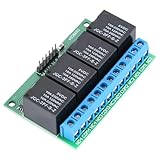
- Low Pulse Trigger Design: Effortless control with momentary low pulse signals for reliable switching without continuous power consumption
- Bistable Self Locking Function: Maintains relay state after each trigger cycle eliminating the need for constant signal input for energy efficient run
- 4 Channel Configuration: Independent control of multiple circuits with 5V DC operating voltage suitable for various industrial applications
- High Load Capacity: Supports up to 10A load current at 250V AC or 30V DC for robust performance in demanding environments
- Complete Module Package: Includes clearly labeled trigger ports and relay interfaces for straightforward installation and immediate use, ideal for automotive electronics, motor, LED, smart home, emergency lighting, MCU development board, etc
How should OEMs and Tier-1s compare SoC designs?
Compare the intended vehicle architecture and the full platform, not just a processor’s headline capability. The relevant questions are whether the design fits the target workloads, can be reused across vehicle classes, and comes with enough software and integration support for the program.
| Decision area | Questions for the vehicle program |
|---|---|
| Workload consolidation | Which domains—ADAS, cockpit, gateway, body, or zonal control—are intended to share the computer? Which should remain separate? |
| Safety and isolation | What hardware and virtualization mechanisms separate mixed-criticality workloads? What freedom-from-interference evidence and safety work apply to the exact configuration? |
| Compute efficiency | Does the available AI and general-purpose compute meet the target use case within the vehicle’s power and thermal limits? Compare performance per watt under relevant conditions, not in isolation. |
| Memory and I/O | Can the platform support the required data movement, peripherals, and workload mix? Confirm capacity and interfaces against the actual system design. |
| Scalability | Can the architecture span the program’s intended vehicle tiers or generations without forcing incompatible software branches? |
| Software portability | Which applications, middleware, tools, and virtual models can actually be reused across chips and vehicle programs, and what needs adaptation? |
| Integration burden | Which hardware bring-up, middleware integration, safety-case work, and validation are provided or supported by the platform—and which remain with the OEM or Tier-1? |
| Upgrade path | Can the design accommodate successor silicon, custom accelerators, multi-die expansion, or software updates over the vehicle lifecycle? Establish what is supported rather than assuming it. |
The official announcements cited here do not provide comparable AI-throughput, performance-per-watt, memory-capacity, or vehicle-volume figures for these options. Those values should be obtained and assessed for the specific product, configuration, and vehicle requirements rather than inferred from platform positioning.
What do the current platform examples show?
These announcements illustrate different parts of the SDV compute problem. They are not all like-for-like products: Renesas and Qualcomm describe SoC directions, while NXP presents CoreRide as a broader development and integration platform.
Rank #4

- Package Includes: The product contains 5 different sizes of circuit boards, 10Pcs 2x8 cm, 10Pcs 3x7 cm, 5Pcs 4x6 cm, 5Pcs 5x7 cm, 2Pcs 7x9cm, 32Pcs in total, it is the standard tenth-inch (0.1") spacing
- Easy to Use: 4 mounting holes at the corners of the PCB boards are convenient for installing them together
- Compact Packing: Space-saving bag packaging, take little footprint
- High Quality: Our PCB board made of durable glass fiber FR-4 material with 1.6 mm thickness
- Wide Applications: Suitable for analog circuits and discrete circuits, DIY electronics projects and various DIP type components
| Platform or example | What the cited material establishes | What is not established there |
|---|---|---|
| Renesas R-Car Gen 5 and R-Car X5H | Renesas’ November 11, 2024 launch release describes X5H as a 3-nm automotive SoC for ADAS, IVI, and gateway workloads. It presents an Arm-based architecture intended to support centralized ECUs and software and tool reuse. A November 13 architecture article discusses Gen 5 scalability and UCIe die-to-die interconnects for multi-die designs and custom accelerators. | Specific AI throughput, power figures, vehicle volumes, and production timing are not stated in the cited Renesas material. |
| Qualcomm Snapdragon Ride Flex with Bosch | The January 9, 2024 Qualcomm-Bosch announcement describes a central vehicle computer able to run infotainment and ADAS functions on one SoC, with the domains separated but interacting. | Specific performance, power, production timing, and vehicle volumes are not stated in the cited announcement. |
| Qualcomm Snapdragon Cockpit Elite and Ride Elite | Qualcomm’s October 22, 2024 release describes combining digital-cockpit and automated-driving functions on one SoC and identifies a Type-1 safety hypervisor for concurrent, independent guest operating systems. The release names collaborations with Li Auto and Mercedes-Benz AG. | Specific vehicle timing, volumes, performance figures, and the details of each named collaboration are not stated in the cited release. |
| NXP S32 CoreRide | NXP describes CoreRide as a platform for virtual modeling, testing, optimization, and integration of SDV architectures. Its March 28, 2024 release emphasizes helping automakers and Tier-1 suppliers focus more on application software and new business models. | CoreRide is presented as a platform, not as a directly comparable single SoC. The cited material does not state comparable AI throughput, power figures, or vehicle volumes. |
Renesas: a scalable, multi-domain SoC direction
Renesas positions R-Car Gen 5 as a family for ADAS, in-vehicle infotainment (IVI), gateway, and fusion systems. Its discussion of UCIe die-to-die interconnects points to a multi-die approach that could support custom accelerators. The X5H announcement gives the direction a specific multi-domain example: a 3-nm automotive SoC integrating ADAS, IVI, and gateway workloads. These are vendor descriptions of architecture and intended use, not proof of adoption across vehicle lines.
Qualcomm and Bosch: a central-computer demonstration
The Ride Flex announcement offers a concrete example of cockpit and ADAS functions sharing one central computer while remaining separate domains. Qualcomm’s later Elite-platform announcement adds a Type-1 hypervisor to its description of concurrent guest operating systems. Together, the releases illustrate why isolation and software architecture belong in the SoC decision alongside compute capability.
NXP: the platform around the chip
NXP’s S32 CoreRide framing addresses the work of bringing hardware and software together, consolidating legacy ECUs, and scaling architecture from lower- to higher-end vehicle classes. Its virtual modeling and testing emphasis highlights another comparison point: development tools and integration support can matter as much as the silicon when teams need to evaluate designs and coordinate across organizations.
Do these 3 things before closing this tab:
1Repair Windows errors before they cause bigger problems2Fix the driver behind crashes, sound loss and screen glitches3Clear out junk files and repair common Windows errorsBest Value

- ESP32-S3 4.3″ LCD Development Board,Integrates RGB Interface LCD
- IPS Display Panel,Excellent Display Performance, 160°Viewing Angle
- Supports Multiple Peripherals,Supports The Expansion Of Multiple Peripherals Via Sensor, CAN, RS485, And I2C Interfaces
- A microcontroller development board with 2.4GHz WiFi and BLE 5 support,
- Equipped with Xtensa 32-bit LX7 dual-core processor, up to 240MHz main frequency.
Why the software ecosystem matters as much as the chip
Automotive compute vendors increasingly position a complete foundation around their silicon: virtualization, operating-system support, middleware, reference software, virtual platforms, and development tools. That ecosystem can reduce duplicated engineering and make it easier to move applications across a family of designs—but portability is a capability to verify, not an automatic result of choosing one vendor.
For each proposed reuse path, establish which software layers are shared, which interfaces are stable, what must be adapted for different silicon or vehicle tiers, and how the software is maintained over the program lifecycle. Virtual models can help teams test and optimize an architecture before hardware is available, as NXP describes for CoreRide, but modeling does not remove the need to validate the final hardware and vehicle integration.
Where should the OEM’s and Tier-1’s design boundary sit?
The strategic split is moving upward from individual ECU implementation toward reusable compute foundations. Platform vendors supply more of the underlying silicon and enabling software; automakers and Tier-1s can concentrate more effort on vehicle behavior, application software, integration, and differentiation. NXP’s March 2024 CoreRide release explicitly frames its platform as a way for those teams to focus more on application software and new business models.
That division is not a handoff of responsibility for the finished vehicle. OEMs and Tier-1s still have to decide how domains are allocated, how systems interact, what safety and cybersecurity evidence is needed, and how the chosen platform fits the vehicle’s lifecycle. The right SoC design is the one whose compute, isolation, software reuse, and integration model match those program-specific obligations.
Quick wins for a faster PC:
Clear out junk files and repair common Windows errorsFree Scan →Scan for outdated or missing drivers - takes under a minuteDriver Scan →What announcements do—and do not—tell buyers
Company releases and demonstrations establish what a vendor or partner says a platform can do and which collaborations have been announced. They do not, by themselves, establish production timing, vehicle volume, commercial availability in every geography, or the status of safety certification for a specific vehicle implementation. Check those points against the current product and program details before treating an announced capability as a production commitment.
Quick Recap
Product prices and availability are accurate as of the date/time indicated and are subject to change. Any price and availability information displayed on Amazon at the time of purchase will apply.




