Quick wins for a faster PC:
Fix the driver behind crashes, sound loss and screen glitchesFind Drivers →Repair Windows errors before they cause bigger problemsFix Now →Autonomous cars can use microphones and audio analytics to detect and locate sounds such as emergency sirens, bicycle bells, horns and nearby voices. The system turns sound into detections or other metadata for the vehicle’s sensor-fusion and planning systems. It adds evidence cameras, lidar and radar may not have—particularly when an object is occluded or a sound arrives before the source is visible—but it is a complementary channel, not a replacement for those sensors.
How does audio analytics work in an autonomous car?
Audio analytics is a perception pipeline, not simply a microphone that “listens” for a siren. Exterior microphones capture sound; signal-processing and machine-learning components analyze it; and the system passes classified events, estimated directions or other features to the vehicle’s broader perception and decision systems.
- Capture: Weather-resistant microphones, sometimes arranged as an array, record exterior sound. Multi-channel acquisition can preserve the timing and level differences between microphones.
- Process: Signal processing can filter or spatially separate sound. Beamforming and direction-of-arrival estimation help infer where a sound is coming from.
- Recognize: Acoustic-event models classify sounds such as sirens, bells, horns, voices, propulsion noise or road noise.
- Report and fuse: The system provides detections or features to the vehicle’s fusion system, which can assess them alongside camera, lidar, radar, localization and vehicle-state information.
Inference may run at the vehicle’s edge to limit latency and the need to transmit continuous audio. How a particular vehicle handles audio, and which outputs its perception stack accepts, depend on its design.
ISO 23150-15:2026 specifies microphone-specific logical interfaces at feature, advanced-detection and detection levels for road vehicles with automated-driving functions. It is a standardization milestone for connecting microphone sensors or clusters with a data-fusion unit; it does not, by itself, establish that a vehicle has a particular detection capability or performance level.
#1 Best Overall

- Genuine Honda part that fits your specific vehicle
- Microphone
- Part Number: 39180-T2A-A21ZB
- Manufactured to meet specifications for fit, form, and function
What can a car learn from sound that other sensors may not?
Sound can carry information from beyond a camera’s line of sight and may announce a developing event before the source becomes visible. An approaching emergency siren is a clear example: acoustic detection could give the vehicle an earlier cue to investigate and incorporate into planning. Microphone arrays can also estimate a likely direction, helping the rest of the perception stack focus on that area.
| Perception channel | What it contributes | Important limitation |
|---|---|---|
| Audio | Sound events, such as sirens, bells and voices; possible direction or location estimates; cues from partly occluded traffic. | Wind, vehicle noise, weather, reverberation and overlapping sounds can mask or distort events. |
| Camera | Visual evidence about objects and the scene when they are in view. | A sound source may be audible before it is visible or while it is occluded. |
| Lidar and radar | Ranging evidence that complements visual and acoustic perception. | They do not provide the same acoustic event information as microphones. |
The channels are strongest when treated as complementary evidence. An audio detection should not be assumed to prove that a siren-bearing vehicle is present: the system needs to weigh the cue against other sensors and the circumstances of the scene.
Which driving tasks can benefit from acoustic perception?
Emergency-vehicle detection
Models can classify and localize police, ambulance or fire-truck sirens. A detection can alert the vehicle’s decision system and inform planning. The useful output is more than “siren heard”: direction and confidence matter when deciding whether the sound belongs to a nearby vehicle and how it relates to the road scene.
Rank #2
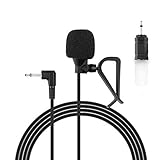
- Aftermarket microphone with 3.5mm female to 2.5mm male adapter
- Universal Car Radio Microphone 3.5mm / 2.5mm Compatible with Pioneer Kenwood Boss Corehan Power Acoustik JVC Sony Jensen Alpine Stereo receiver with Apple CarPlay and Android Auto Vehicle Head Unit Enabled Audio GPS navigation DVD
- Mono omnidirectional condensor car microphone with fast and accurate data transmission- High sensitivity, low impedance, anti-noise and anti jamming
- Enable hands-free calling under kinds of driving occasions with purity sound
- 9.84 feet / 3 meters length cable - Long distance transmission
Awareness of vulnerable road users and low-speed scenes
Bicycle bells, horns, voices and children playing can add context near crossings, in quiet-traffic areas or where a person is partially hidden. Sound can prompt closer attention, but it does not reliably identify a person’s exact position or intent on its own.
Traffic-scene understanding
Propulsion noise, active vehicle alert systems, emergency sirens and road noise can contribute clues about surrounding traffic. KU Leuven describes work on localizing and tracking vehicles while accounting for ego-noise—the sound made by the vehicle carrying the microphones—and Doppler effects, which change a sound’s observed frequency as its source and listener move.
Vehicle health and road-condition monitoring
Acoustic analysis can also be applied to the car itself. Fraunhofer describes potential uses including detecting a nail in a tire, inferring road conditions from wheel-arch sound, and identifying uneven engine operation or worn brakes early. These are vehicle-monitoring applications, distinct from detecting external traffic for automated driving.
Rank #3

- Package: 1pcs Sipeed 6+1 Mic Array
- Microphone: 6+1 MSM261S4030HO form
- Lighting: 12 LEDs are cascaded through dual signal lines
- Interface: 10P FPC and 2*5P 2.54mm terminal
- Supply voltage: 5V@ 800mA
Occupant and voice functions
Exterior microphones may also support voice interaction with a vehicle; cabin microphones can be used for occupant monitoring or driver-attention functions. These related applications use audio, but they are not the same as exterior acoustic scene perception. Their placement, purpose and privacy considerations differ.
How strong is the evidence for siren detection?
A 2021 study in IEEE Sensors Journal reported several results from particular models and test conditions:
Windows Errors? Fix Them Before They Spread
Repair common Windows errors and clear accumulated junk for a smoother, more stable PC - no reinstall needed.Free scan · no reinstallCrashes, No Sound, or Screen Glitches?
Random freezes, missing sound and display glitches usually trace back to one bad driver. Find and replace yours safely.Free scan · under a minute- A YOLO emergency-vehicle detector in an audio-vision study reported 95.5% mean average precision.
- WaveResNet, used for audio-based siren and traffic-noise classification, reported accuracy above 98% under the study’s conditions.
- The study’s prototype audio-vision emergency-vehicle detection system reported a 1.54% misdetection rate.
These are study-specific results, not fleet-wide statistics or production guarantees. They should not be compared as though they measured the same task: mean average precision, classification accuracy and misdetection rate are different metrics. Performance on other roads, in other climates, with different microphone layouts or siren designs is not established by those figures.
Rank #4

- Adopted premium electret condenser cartridge and low impedance design, this car microphone features high sound pickup sensitivity and accurate human voice capture. Built-in advanced noise reduction structure effectively filters wind noise, tire noise, traffic noise and electromagnetic interference during driving. With stable and lossless signal transmission, it delivers crystal-clear and smooth voice quality without stuttering even in complex driving scenarios such as high-speed driving, rainy days and noisy urban roads.
- Featured with a standard 3.5mm universal interface, this external car mic boasts ultra-wide compatibility. It perfectly matches mainstream brand car stereos, GPS navigation devices, DVD audio hosts and central control integrated units. It is an ideal replacement accessory for most aftermarket car audio systems, compatible with most vehicle models with no device adaptation threshold.
- Equipped with dual installation accessories including dash mount and sun visor clip, the microphone supports multi-angle fixed installation, allowing you to freely choose the installation position according to the car interior space and usage habits with neat wiring. The 2m extended and thickened cable is long enough to easily cover the distance from the car host to the driver's seat. It is suitable for sedans, SUVs, MPVs and various vehicle models with easy installation and no damage to the car interior aesthetics.
- No complicated wiring, drivers or debugging required for use, which is friendly for zero-based operation. Just plug the microphone into the dedicated MIC port on the back of the car host (not the front AUX port), and it can be automatically identified and used immediately. It supports hands-free calling and voice navigation, effectively avoiding dangerous hand-held phone operations while driving, freeing your hands, allowing you to focus on driving and greatly improving travel safety and convenience.
- Adopting mono omnidirectional sound pickup technology, it realizes 360° no-dead-angle voice capture, which can clearly collect voices from any angle of the driver's seat with a wider pickup range. It supports multiple functions such as car hands-free calling, navigation voice wake-up and car DVD voice input. Made of high-quality wear-resistant ABS material with reinforced anti-break cables, the microphone can withstand extreme car interior temperatures from -10℃ to 60℃. It features anti-aging, wear-resistant and durable performance, not easy to be damaged after long-term use.
What makes dependable acoustic perception difficult?
The vehicle’s own sound is a central challenge. Tire and engine noise, wind and other ego-noise can mask an external event. Rain and other environmental conditions can affect the recording; buildings and other surroundings can create reverberation; motion can shift frequencies through Doppler effects; and several overlapping sounds can confuse classification. Siren designs also vary, so a model that recognizes examples in one test setting may not generalize to all vehicles and regions.
False positives matter as well as missed detections. A sound classifier may confuse traffic noise with a siren or mistake one event for another. Direction estimates can be uncertain in noisy or reverberant environments. For those reasons, acoustic detections need to be validated and interpreted alongside the vehicle’s other sensors rather than treated as conclusive instructions.
What would a production-oriented system need?
A complete design involves more than choosing a microphone or classifier. Relevant engineering and validation questions include:
Best Value

- Vehicle Specific
- Manufacturer Warranty
- Hyundai Quality Assured
- OEM, Not After Market
- Vehicle Specific
- Microphones and placement: How many microphones are used, where are they mounted, and how are they protected against weather and contamination?
- Acquisition and localization: Are channels synchronized, and how accurately can the system estimate direction of arrival?
- Detection performance: What detection range and latency are achieved, and how robust are results to ego-noise, Doppler effects and reverberation?
- Compute and interfaces: Can edge inference meet timing needs, and can its detections or features be integrated with the vehicle’s fusion system?
- Validation: Has the system been assessed across climates, road conditions, microphone configurations and siren types?
- Privacy and lifecycle: How is recorded audio handled, and what maintenance or replacement needs arise over the vehicle’s life?
These are comparison criteria, not established specifications for every vehicle. A reported classifier score alone cannot answer them.
Is acoustic sensing ready for autonomous cars?
It is an active engineering area, but the available evidence does not establish universal production deployment. Fraunhofer’s “Hearing Car” work demonstrates the concept of using exterior microphones and AI-supported event recognition to complement camera, lidar and radar. Fraunhofer and CARIAD have reported road testing in Sweden, including ice and snow, and said they are testing microphone hardware and algorithms to prepare acoustic sensing for series production. That indicates industrial development and testing, not that the capability is already standard across production autonomous cars.
The clearest case for the technology is an additional, potentially early cue—especially an emergency siren or a sound from an occluded area. Whether that cue improves a specific vehicle’s decisions depends on its microphones, algorithms, fusion design and validation in the conditions where it will operate.
Quick Recap
Product prices and availability are accurate as of the date/time indicated and are subject to change. Any price and availability information displayed on Amazon at the time of purchase will apply.
Recommended Free Tools




