Recommended Free Tools
Boston Dynamics’ production Atlas humanoid robot is moving toward Hyundai manufacturing in a staged program—not an immediate rollout of autonomous vehicle assembly. Hyundai plans to train and validate Atlas at its Robotics Metaplant Application Center in 2026, begin material-sequencing work at its Georgia metaplant in 2028, and explore more complex assembly from 2030.
Atlas is headed for Hyundai production—but not as a fully autonomous vehicle assembler yet
Boston Dynamics’ production Atlas humanoid robot is moving from public demonstrations toward staged industrial deployment within Hyundai Motor Group. The first planned factory work is material sequencing—organizing and presenting parts in the right order—not complete vehicle assembly.
Hyundai’s announced schedule calls for Atlas robots to be trained and validated at the Robotics Metaplant Application Center (RMAC) in 2026, begin sequencing tasks at Hyundai Motor Group Metaplant America (HMGMA) in Georgia in 2028, and take on more complex operations such as assembly from 2030. Those are future plans, not evidence that Atlas is already operating autonomously throughout Hyundai’s factories.
Where Atlas will be used first
The first specifically identified production site is Hyundai Motor Group Metaplant America in Georgia. Hyundai plans to use the RMAC as a training and validation environment before transferring Atlas to the manufacturing plant.
Free tools Windows power users keep installed
One-click scans. No signup required.
#1 Best Overall

- 【Humanoid Robot with ESP32】 Powered by ESP32 and 17 intelligent servos, Tonybot smart humanoid robot delivers smooth, dynamic performance. Use the app to easily control it for walking, dancing, kicking, and more. Tonybot can stand up automatically, which is great for playing football and performing gymnastics.
- 【Multimodal Large AI Models】Powered by an AI model module that combines language, voice, and vision models, Tonybot Ultimate Kit unlocks advanced embodied AI functions such as natural conversation and scene understanding. (Ultimate Kit Only)
- 【AI Vision & Voice Interaction】Equipped with an ESP32-S3 vision module and voice interaction module, Tonybot AI robot enables offline face recognition, target tracking, visual line following, voice control, and more. Customize commands and train it to be your AI assistant.
- 【Expandable AI Development with Sensors】 Tonybot robot kit comes with an ultrasonic sensor, IMU sensor, buzzer, and supports modules like dot matrix display, fan, temp/humidity sensors, and WiFi for endless AI-driven development.
- 【3 Programming Options & Comprehensive Tutorials】Tonybot smart AI robot supports Arduino, Python, and Scratch programming, with open-source low-level code and step-by-step tutorials covering everything from beginner learning to advanced humanoid robot development.
| Stage | Planned activity | What it means |
|---|---|---|
| 2026 | Training and validation at the RMAC | Atlas is expected to be prepared for industrial workflows in a dedicated robotics application center. |
| 2028 | Material sequencing at HMGMA | The initial factory role is expected to involve organizing and presenting parts for downstream manufacturing. |
| 2029 | Humanoid-robot rollout expected at Kia’s Georgia plant | Yonhap reported this as a planned follow-on deployment, although Hyundai has not published a complete plant-by-plant schedule. |
| 2030 onward | More complex operations, including assembly | Assembly is a later target, rather than the first task Atlas is scheduled to perform. |
The distinction between sequencing and assembly matters. A robot that brings parts to a workstation or places them in the correct order is performing an important manufacturing task, but it is not the same as independently assembling an entire vehicle. Hyundai has not announced that Atlas will replace workers across its plants or that it will autonomously build complete cars beginning in 2028.
What Atlas is designed to do
Boston Dynamics unveiled the production version of Atlas at CES in Las Vegas on January 5, 2026. The company describes the fully electric humanoid as an enterprise robot for industrial work such as material handling and order fulfillment. Hyundai lists material sequencing, assembly, and machine tending among its intended applications.
Hyundai’s published specifications include:
- 56 degrees of freedom, allowing movement across many joints and axes;
- Human-scale hands with tactile sensing; and
- A humanoid form intended to work in spaces designed around human workers.
The human-like shape is central to Hyundai’s industrial strategy. Automotive factories already contain pathways, fixtures, tools, storage areas, and workstations designed for people. A humanoid robot could potentially use some of that infrastructure without requiring every station to be rebuilt around a specialized machine.
That does not mean a humanoid is automatically the best choice for every task. Fixed industrial robots can be faster, more predictable, and easier to optimize for highly repetitive operations. Hyundai’s case for Atlas is strongest where work is physically demanding, repetitive but variable, or difficult to automate with a machine dedicated to one narrowly defined motion.
Windows Errors? Fix Them Before They Spread
Repair common Windows errors and clear accumulated junk for a smoother, more stable PC - no reinstall needed.Free scan · no reinstallOutdated Drivers Are Slowing You Down
One free scan finds every outdated or missing driver and matches the right update for your exact hardware.Free scan · exact hardware matchWhat “material sequencing” means on a vehicle line
Material sequencing is the planned first production use for Atlas at HMGMA. In practical terms, the robot would help organize parts and deliver or present them in the order required by a manufacturing process.
Automotive plants handle large numbers of components, variants, and timing constraints. A sequencing task can involve identifying the required part, picking it up, moving it through the facility, and placing it where an operator or another machine needs it. The work may be less visually dramatic than vehicle assembly, but reliable material flow is essential to keeping a production line moving.
Atlas is also intended for machine tending. That can include loading or unloading parts from equipment and transferring workpieces between manufacturing steps. Hyundai identifies assembly as another target, but the announced schedule places more complex assembly work in the later phase beginning in 2030.
Rank #2

- Arduino Programming, Open Source: miniArm is built on the Atmega328 platform and is compatible with Arduino programming. The programs for miniArm are open-source, and learning tutorials and secondary development examples are available, making it easier for you to develop your robotic hand.
- High-Performance Hardware, Support Sensor Expansion: miniArm is equipped with a 6-channel knob controller, Bluetooth module, high-precision digital servos, and other high-performance hardware. Moreover, it provides multiple expansion ports for sensor integration, including ESP32 Cam, accelerometer, touch sensor, glowy ultrasonic sensor, etc., empowering users to engage in secondary development for sonic ranging and pose control capabilities.
- Versatile Control Options: miniArm supports app control, and users can utilize knob potentiometers for real-time knob control and offline action editing.
- Spark Your Creativity with miniArm: Expand the capabilities of miniArm with various sensors and unlock endless possibilities for your project.
- Starter Kit NO Glowing ultrasonic sensor, Touch sensor, Acceleration sensor, ESP32Cam Module.
Capabilities claimed by Boston Dynamics
Boston Dynamics says Atlas is designed to learn a broad range of industrial tasks, adapt to changing environments, lift heavy loads, and work with minimal supervision. The company also says the robot can autonomously navigate to a charging station, replace its own battery, and resume work.
Quick wins for a faster PC:
Clear out junk files and repair common Windows errorsFree Scan →Fix the driver behind crashes, sound loss and screen glitchesFind Drivers →Repair Windows errors before they cause bigger problemsFix Now →These are manufacturer-described capabilities. They should not be confused with independently measured production results. The available announcements do not establish Atlas’s sustained factory uptime, repeatable cycle times, lifting performance across Hyundai workflows, maintenance intervals, or total cost per completed task.
The CES demonstration was not a factory trial
Atlas’s CES appearance showed the robot performing movement and manipulation behaviors, but a public demonstration is not the same as a validated production deployment. The Associated Press reported that an engineer remotely piloted Atlas during the demonstration. Boston Dynamics has said the robot is intended to operate autonomously in real-world use.
That distinction gives readers a useful way to evaluate claims about Atlas:
| Evidence level | What is supported | What is not established |
|---|---|---|
| Demonstrated | Atlas has been publicly shown performing movement and manipulation behaviors. | That the same behaviors can run continuously, safely, and autonomously on a production line. |
| Designed or intended | Material handling, sequencing, assembly, machine tending, and order fulfillment are identified applications. | That Atlas is already superior to conventional automation for those jobs. |
| Scheduled or planned | RMAC preparation in 2026, HMGMA sequencing from 2028, and more complex assembly from 2030. | That these milestones have already been completed or will necessarily occur on schedule. |
Hyundai’s proposed scale is much larger than a single pilot
Hyundai Motor Group has described an ambition to deploy more than 25,000 Atlas robots across Hyundai Motor and Kia manufacturing facilities. Yonhap also reported a target for annual Atlas production capacity of 30,000 units by 2028.
What’s actually slowing this PC down?
Pick the symptom - the matching free tool is one click away.
Those figures describe announced ambitions and manufacturing targets. They do not mean that Hyundai has already deployed 25,000 robots, nor that Boston Dynamics is currently producing 30,000 Atlas units each year. The difference is especially important because the first identified factory operation is not scheduled until 2028.
If achieved, the proposed scale would make Hyundai more than a customer of humanoid robots. It would make the group a major test environment, manufacturing partner, and potential source of production data for the technology. But the program’s significance will ultimately depend on measurable results: safe operation, useful uptime, manageable maintenance, acceptable costs, and consistent performance across changing vehicle programs.
Rank #3
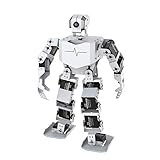
- Al-Driven & Raspberry Pi Powered. TonyPi is a high-performance AI vision robot designed for AI education applications. It is powered by the Raspberry Pi 5, integrated with an OpenCV image processing library and robotic inverse kinematics algorithms. Offering open-source access, TonyPi provides a flexible development environment that supports advanced AI robotics development.
- AI Large Model ChatGPT Integration for Enhanced User-Machine Interaction. TonyPi incorporates a multimodal model, with ChatGPT at the core of its interaction system. With AI vision and voice integration, TonyPi excels in perception, reasoning, and action, enabling advanced embodied AI applications and delivering a seamless, intuitive human-machine interaction experience!
- AI Voice Command & Recognition. Equipped with Large Language Models, TonyPi accurately understands voice commands, analyzes visual scenes in its field of view, and carries out appropriate actions—enabling smooth and responsive voice interaction.
- AI Vision Recognition and Tracking. TonyPi's 2DOF head is fitted with an HD camera that provides a wide field of view. It supports a range of AI vision capabilities, including color recognition, target tracking, ball kicking, line following, and MediaPipe-based motion control for interactive AI applications.
- Comprehensive Learning Resources. TonyPi offers abundant educational content, including resources on robotic motion control, OpenCV, deep learning, MediaPipe, AI large models, voice interaction, and sensor applications. We provide extensive learning materials and tutorials to guide you from foundational concepts to advanced practices, helping you develop your AI humanoid robot.
Hyundai Mobis is part of the supply-chain strategy
Hyundai’s plan also includes vertical integration through Hyundai Mobis. Boston Dynamics announced that Hyundai Mobis will supply Atlas actuators and collaborate on actuator production and a reliable component supply chain.
Actuators are effectively the robot’s joint-and-muscle system: they generate the movement required at its arms, legs, torso, and other mechanical joints. A dependable actuator supply could matter to the program’s ability to scale, maintain robots, and control component availability.
However, the announcement does not provide independent evidence of Atlas’s final unit price, operating economics, actuator reliability, or maintenance cost. Component involvement is strategically important, but it is not proof that the robots will be cheaper than conventional automation.
Why Hyundai is a significant test case
Hyundai is an unusually relevant environment for testing a general-purpose humanoid. Its factories combine structured processes with human-scale workspaces, frequent material movement, specialized tools, and multiple vehicle configurations.
Hyundai has linked the Atlas program with manufacturing data, the RMAC, and its Software-Defined Factory strategy. The intended model is not simply to place a robot beside a worker and hope it learns. It involves training the robot for particular tasks, validating those tasks in a controlled setting, and then expanding its responsibilities as the system proves reliable.
The strategy also tests a broader claim about humanoids: that one adaptable machine might handle several jobs in an existing facility, rather than requiring a new dedicated automation system for every variation. Whether that flexibility offsets the complexity and expense of a humanoid platform remains an open engineering and business question.
Do these 3 things before closing this tab:
1Fix the driver behind crashes, sound loss and screen glitches2Clear out junk files and repair common Windows errors3Scan for outdated or missing drivers - takes under a minuteWhat remains unknown
The current announcements do not answer several questions that will determine whether Atlas becomes a practical manufacturing tool:
Rank #4

- Al-Driven & Raspberry Pi Powered. TonyPi is a high-performance AI vision robot designed for AI education applications. It is powered by the Raspberry Pi 5, integrated with an OpenCV image processing library and robotic inverse kinematics algorithms. Offering open-source access, TonyPi provides a flexible development environment that supports advanced AI robotics development.
- AI Large Model ChatGPT Integration for Enhanced Human-Machine Interaction. TonyPi incorporates a multimodal model, with ChatGPT at the core of its interaction system. With AI vision and voice integration, TonyPi excels in perception, reasoning, and action, enabling advanced embodied AI applications and delivering a seamless, intuitive human-machine interaction experience!
- AI Voice Command & Recognition. Equipped with ChatGPT, TonyPi accurately understands voice commands, analyzes visual scenes in its field of view, and carries out appropriate actions—enabling smooth and responsive voice interaction.
- AI Vision Recognition and Tracking. TonyPi's 2DOF head is fitted with an HD camera that provides a wide field of view. It supports a range of AI vision capabilities, including color recognition, target tracking, ball kicking, line following, and MediaPipe-based motion control for interactive AI applications.
- High-Voltage Intelligent Bus Servos. Equipped with 16 high-voltage intelligent bus servos, TonyPi offers rapid response times and stable output, enabling precise multi-joint coordination and complex motion control. This ensures accurate humanoid postures and interactive movements to meet various demands.
- What will an Atlas unit cost to purchase or operate?
- How many hours can it work between charging, battery replacement, and scheduled maintenance?
- What production-line cycle times and uptime can it sustain?
- How will Hyundai certify it for each planned task and work area?
- What safeguards will protect workers around a large, mobile robot handling heavy parts?
- How much human supervision will be needed when parts, fixtures, lighting, or line conditions change?
- Will Atlas perform better economically than fixed robots, autonomous mobile robots, conveyors, or human workers for a given job?
- How many plants will participate, and will the 25,000-robot deployment target be reached?
Until Hyundai or Boston Dynamics publishes production data, claims about factory-wide autonomy, worker replacement, or commercial-scale success go beyond the evidence currently available.
What the Hyundai-Atlas announcement really means
Atlas represents a serious industrial-robotics commercialization effort, not merely a flashy humanoid demonstration. Hyundai has identified a real deployment path: train and validate the robot at the RMAC, start with sequencing at HMGMA in Georgia, and expand toward more complex manufacturing work later.
The important milestone is therefore not that Atlas can walk, lift, or manipulate an object on a stage. It is whether the robot can perform a defined automotive task repeatedly, safely, economically, and with little intervention over a real production schedule. Hyundai’s 2028 and 2030 targets will provide a much stronger test of humanoid robotics than a CES demonstration can.
Frequently Asked Questions
Are Atlas robots already autonomously assembling Hyundai vehicles?
No. Hyundai’s announced plan begins with training and validation at the Robotics Metaplant Application Center in 2026, followed by material sequencing at Hyundai Motor Group Metaplant America in Georgia from 2028. More complex assembly is planned from 2030.
What will Atlas robots do in Hyundai factories?
Material sequencing is the planned first use at HMGMA. It involves organizing or presenting parts in the correct order for downstream manufacturing. Hyundai also identifies material handling, machine tending, and assembly as intended applications, with assembly described as a later phase.
Can consumers buy an Atlas robot?
No consumer purchase option for the industrial Atlas robot was identified. Boston Dynamics does have Atlas-related merchandise, but that is apparel and fan merchandise rather than the production robot.
How many Atlas robots does Hyundai plan to use?
Hyundai Motor Group has announced an ambition to deploy more than 25,000 Atlas robots and reported a target for annual Atlas production capacity of 30,000 units by 2028. These are targets, not completed deployments or independently verified production results.
The Bottom Line
Bottom line: Hyundai plans to introduce Boston Dynamics’ Atlas humanoid robots into its manufacturing ecosystem in stages: training at the RMAC in 2026, material sequencing at HMGMA in Georgia from 2028, and more complex assembly work from 2030. The program is substantial, but its cost, uptime, safety, and autonomous production performance remain unproven.
Quick Recap
Product prices and availability are accurate as of the date/time indicated and are subject to change. Any price and availability information displayed on Amazon at the time of purchase will apply.




