Do these 3 things before closing this tab:
1Clear out junk files and repair common Windows errors2Fix the driver behind crashes, sound loss and screen glitches3Repair Windows errors before they cause bigger problemsThe Excalibur Phaeton paired prewar European-inspired styling with contemporary American engineering, creating a Milwaukee-built luxury car that was dramatic to look at and more practical to service than an authentic prewar classic. It was not a kit car or a Mercedes-Benz replica: it was an original, factory-produced American automobile, often described as a “contemporary classic.” Within Excalibur’s lineup, the four-seat Phaeton became the dominant model, with its production peak in the Series III years.
What Was the Excalibur Phaeton?
Designed by industrial designer Brooks Stevens, the Excalibur drew heavily on the appearance of the 1928 Mercedes-Benz SSK, including its upright grille, separate fenders, long hood, and exposed exhaust treatment. But the Phaeton was not an authentic Mercedes, a licensed copy, or simply a body placed on a customer’s donor car. Excalibur built complete cars, combining distinctive fiberglass bodywork with modern American mechanical components.
The four-seat Phaeton joined the range in 1966 alongside the sportier roadster. Its rear seats and touring-oriented format helped it appeal to buyers who wanted the Excalibur’s theatrical style with more everyday usefulness. Historical accounts identify the Phaeton as the company’s dominant body style.
Brooks Stevens, Studebaker, and the Excalibur’s Origins
In 1963, Studebaker asked Stevens to prepare special cars for motor-show display. The Excalibur concept used a Studebaker Lark convertible chassis and a lightweight body that evoked the Mercedes-Benz SSK. Its prototype used Studebaker power, but the company’s declining position and the end of its V8 availability led to a switch to Chevrolet Corvette-derived engines for production cars.
#1 Best Overall

- Vehicle Fitment: Brhaspatip 1 Automatic Transmission Manual Shaft Seal for Excalibur Phaeton 1970 1971 1986 1987 1988 1989 5.7L V8, for Hummer H3T 2009 2010 5.3L V8
- Package Included: 1 Automatic Transmission Manual Shaft Seal
- Supporting Vehicle Condition: Designed to support original vehicle performance, helping reduce operational noise or excess vibration. By maintaining system effectiveness, it contributes to smoother daily driving experience.
- Precise Fit, Easy Installation: Designed to original specifications for direct fitment with your vehicle's existing structure. The straightforward installation process accommodates both DIY users and professional service needs.
- Notice&Service: Ensure your exact vehicle is covered by referring to the compatibility list on the listing page for detailed submodel information.
SS Automobiles was established in 1964 and reorganized as Excalibur Automobile Corporation in 1966. The company built its cars in Milwaukee. A 1966 Society of Automotive Engineers paper discussed the engineering challenges of producing a low-volume “contemporary classic,” supporting the distinction between Excalibur and a home-built kit-car operation.
How the Excalibur Phaeton Evolved
Excalibur changed its chassis, components, and equipment over time. The broad pattern was a move from early Studebaker-derived hardware toward more purpose-developed frames and Chevrolet components, while the styling retained its prewar-inspired character.
| Series | Period | Key points |
|---|---|---|
| Series I | 1965–1969 | Early cars used Studebaker Lark-derived chassis; Chevrolet 327-cubic-inch V8s replaced the unavailable Studebaker engine supply. The Phaeton and roadster followed the first step-over design. |
| Series II | Beginning in 1970 | Introduced a purpose-developed ladder frame, Corvette suspension and four-wheel disc-brake components, and Chevrolet V8 power. Sales were initially uneven. |
| Series III | 1975–1979 | Revised chassis and body details responded to changing safety and homologation requirements. The Chevrolet 454-cubic-inch V8 became closely associated with the series, with emissions equipment affecting advertised output. |
| Series IV | Beginning in 1980 | A major redesign brought larger bumpers, a divided windshield, more enclosed bodywork, and a Chevrolet small-block V8. The range increasingly emphasized luxury and comfort. |
Descriptions of engine output and equipment should be tied to a particular year and configuration: specifications changed across series, and not every Phaeton had the same engine, chassis, or components.
Rank #2
- Vehicle Fitment: Brhaspatip 1 Automatic Transmission Manual Shaft Seal for Excalibur Phaeton 1965 4.7L V8, for Fiat 124 1973 1.4L l4
- Package Included: 1 Automatic Transmission Manual Shaft Seal
- Supporting Vehicle Condition: Designed to support original vehicle performance, helping reduce operational noise or excess vibration. By maintaining system effectiveness, it contributes to smoother daily driving experience.
- Precise Fit, Easy Installation: Designed to original specifications for direct fitment with your vehicle's existing structure. The straightforward installation process accommodates both DIY users and professional service needs.
- Notice&Service: Ensure your exact vehicle is covered by referring to the compatibility list on the listing page for detailed submodel information.
Why the Phaeton Became Excalibur’s Best-Known Model
The Phaeton’s appeal rested on a useful contrast: its appearance recalled a European sporting car from another era, while its American powertrain and supplier components made it a new car rather than a fragile antique. The four-seat layout also gave it a touring role that the two-seat roadster did not offer in the same way.
Quick wins for a faster PC:
Clear out junk files and repair common Windows errorsFree Scan →Scan for outdated or missing drivers - takes under a minuteDriver Scan →That did not make every component easy to replace. Many mechanical items came from major suppliers, but Excalibur-specific body panels, brightwork, trim, and interior fittings can be harder to source. Parts catalogs and general aftermarket listings are useful starting points, not guarantees of fit. Buyers and owners should confirm compatibility by series, model year, and component.
Series III: The Production High Point
Series III was the Phaeton’s commercial high point. One commonly reproduced production table records 82 Phaetons in 1975, 173 in 1976, 222 in 1977, 248 in 1978, and 340 in 1979, for a reported series total of 1,065. Other published sources give a different Series III total, so those figures should be treated as source-dependent rather than definitive factory records. The consistent finding is that Series III was the peak period and the Phaeton made up most of the series’ production.
Rank #3
- Vehicle Fitment: Brhaspatip 1 Automatic Transmission Manual Shaft Seal for Checker Taxicab 1969 5.3L V8, for Excalibur Phaeton 1982 1983 1984 1985 1986 1987 1988 1989 5.0L V8
- Package Included: 1 Automatic Transmission Manual Shaft Seal
- Supporting Vehicle Condition: Designed to support original vehicle performance, helping reduce operational noise or excess vibration. By maintaining system effectiveness, it contributes to smoother daily driving experience.
- Precise Fit, Easy Installation: Designed to original specifications for direct fitment with your vehicle's existing structure. The straightforward installation process accommodates both DIY users and professional service needs.
- Notice&Service: Ensure your exact vehicle is covered by referring to the compatibility list on the listing page for detailed submodel information.
| Model year | Reported Series III Phaetons |
|---|---|
| 1975 | 82 |
| 1976 | 173 |
| 1977 | 222 |
| 1978 | 248 |
| 1979 | 340 |
Specialist histories also report annual company production rising to 237 cars in 1977, 263 in 1978, and 367 in 1979. Those figures help explain why the Phaeton’s Series III run is central to its reputation, though company-wide totals and model-specific totals should not be conflated.
How Many Excaliburs Were Built?
Published estimates for total Excalibur production differ. Accounts cite figures such as 3,268, more than 3,400, and more than 3,500 cars, sometimes including cars produced under later ownership. The available figures establish a low-thousands production scale, but they do not support presenting one exact total as an undisputed factory count.
Outdated Drivers Are Slowing You Down
One free scan finds every outdated or missing driver and matches the right update for your exact hardware.Free scan · exact hardware matchPC Slower Than It Used to Be?
A free scan shows the junk files, broken settings and background clutter dragging Windows down - then fixes them in one click.Free scan · Windows 10 & 11“America’s most successful replica car” is a familiar shorthand, but it needs context. If “replica” means a modern car inspired by an earlier classic, the description fits the Phaeton’s styling. If it means a kit or dimensionally faithful copy, it does not. Excalibur was a factory-built American luxury car, and the Phaeton was the most successful model within that company’s range.
Rank #4

- High Grade Material: This scraper features a tungsten carbide blade, offering high strength that resists damage and deformation during scraping operations on hard metal surfaces, ensuring long-term stable performance. Additionally, it boasts excellent wear resistance and corrosion resistance, remaining good performance under various conditions to maintain consistent functionality over extended use.
- Vast Compatibility: The product includes two blade sizes (1-1/4 inch and 5/8 inch). The 1-1/4-inch wide blade effectively removes large, flat residues, while the 5/8-inch narrow blade reaches deep into narrow slots and corner areas. This scraper tool set is effective on hard metal surfaces like steel and alloys, providing versatile support for automotive repair tasks.
- Smooth Installation: This scraper offers user-friendly operation. First, select the scraper with the appropriate blade width. Next, choose the most suitable blade surfaces from the four available. Use this face to remove residual gasket material. After cleaning, extend the blade's lifespan by grinding it. The entire process is straightforward and intuitive, enabling users to quickly master the tool and efficiently complete tasks like residue removal in automotive repairs.
- Practical Features: This scraper rapidly removes residual glue, oil, and metal residues from cylinder head gaskets during automotive maintenance, establishing a solid foundation for subsequent repair steps. Its high-strength blade resists curling during operation, maintaining consistent scraping performance to ensure work efficiency. Besides, its specially designed blade angle prevents damage to the workpiece substrate, enhancing equipment maintenance safety.
- Ergonomic Grip: The handle of this scraper features an ergonomic design that conforms to the hand's contours for a natural, comfortable grip during operation. Even during prolonged scraping tasks, the hand maintains superior comfort, delivering a comfortable holding experience for extended automotive repair scraping work.
Preserving and Owning a Phaeton
Excalibur ownership combines relatively familiar American-car mechanicals with parts and documentation needs specific to the marque. Specialist sources continue to offer some custom or modified parts, owner manuals, parts books, wiring diagrams, and technical advice. General parts catalogs can help identify possible service items, but fitment should be verified rather than assumed.
The Antique Automobile Club of America recognized Excalibur as a factory-built antique automobile in 2007. That recognition reflects the distinction between a manufactured Excalibur and a home-built kit, while the car’s continued preservation still depends on finding marque-specific parts and records.
Independent reader supportYour contribution helps us test, update, and keep practical guides available for everyone.FAQ
Was the Excalibur Phaeton a kit car?
No. Excalibur was a factory-built, low-volume automobile manufacturer. The Phaeton used a distinctive fiberglass body and American mechanical components, but it was sold as a complete car, not as a kit for owners to assemble.
Free tools Windows power users keep installed
One-click scans. No signup required.
Best Value
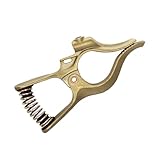
- Practical Function: This T-shaped welding grounding clamp has a 300A high-current capacity, meeting the high-power demands of automotive welding and circuit testing. During welding, the current remains stable and uninterrupted, ensuring welding quality. The duckbill design and powerful spring ensure a secure grip that does not easily come loose. Even during vehicle body vibrations or mobile operations in automotive repairs, it maintains stable grounding.
- High Quality Material: Our T-type welding grounding clamp is made of high-quality brass. Brass has excellent electrical conductivity. In automotive electrical applications, the superior conductivity of brass ensures stable current transmission and prevents poor contact. Additionally, the stability of brass ensures the product maintains performance over extended periods.
- Wide Application: This T-shaped welding grounding clamp has an overall length of approximately 6.97 inch. The width of the duckbill-shaped front ends is 0.57 inch and 0.45 inch, respectively. The width of the central circular opening is approximately 1.71 inch, while the width of the lower connection point is approximately 0.58 inch and the thickness is approximately 0.47 inch. The height of the spring section at the rear is approximately 2.91 inch.
- Easy Installation: First, ensure the vehicle is turned off. Locate the battery terminals or the area to be welded/inspected. Then open the duckbill clamp and securely grip the metal grounding point. Use the strong spring to firmly clamp it in place, ensuring good contact. Then connect the welding machine, inspection equipment, or other corresponding interfaces to begin operations. Even novice automotive enthusiasts can quickly master it, improving work efficiency.
- Complete Package: This product includes 1pc T-shaped welding grounding clamp. This T-shaped welding grounding clamp is compact and elegant, easy to store and carry, allowing for quick access in automotive repair scenarios, significantly enhancing operational flexibility, freeing you from the constraints of bulky tools, and enabling efficient completion of vehicle grounding-related tasks.
Was the Excalibur an official Mercedes-Benz replica?
No. Its design drew heavily on the 1928 Mercedes-Benz SSK, but the Excalibur was an original American car, not a Mercedes-Benz product or an officially licensed copy.
Why was the Phaeton more successful than the roadster?
The four-seat Phaeton kept the Excalibur’s dramatic styling while offering rear seating and a more usable touring format. Historical accounts identify it as the dominant body style, especially during the Series III production peak.
How many Excaliburs were made?
Published estimates vary, including figures of 3,268, more than 3,400, and more than 3,500. The sources support describing total production as a few thousand cars, but not treating one exact figure as definitive.
Are Excalibur parts easy to find?
Some mechanical components are based on widely used supplier parts, but body panels, trim, brightwork, and other Excalibur-specific items can be harder to source. Check fitment by series, model year, and component rather than assuming a general catalog listing will fit.
The Tool Desk
Outbyte Driver Updater FREEFix the driver behind crashes, sound loss and screen glitchesFind Drivers →Outbyte PC Repair FREERepair Windows errors before they cause bigger problemsFix Now →Quick Recap
Product prices and availability are accurate as of the date/time indicated and are subject to change. Any price and availability information displayed on Amazon at the time of purchase will apply.




