A “gangster car” is a cultural label, not a formal vehicle category. The most defensible example is the 1932 Ford V-8, strongly associated with Clyde Barrow through archival evidence. Capone’s Cadillacs, Bonnie and Clyde’s bullet-riddled automobile, and large 1930s Chryslers add important context—but the history is strongest when documented ownership, uncertain provenance, and movie mythology are kept separate.
A “gangster car” is not a formal automotive category. It is a cultural label for cars associated with organized crime, Prohibition-era mobility, fugitives, and the later visual language of gangster films. The most defensible centerpiece is the 1932 Ford V-8, which is strongly associated with Clyde Barrow through archival photographs and a famous—but disputed—letter. Capone-associated Cadillacs, the bullet-riddled Bonnie and Clyde car, and large 1930s Chryslers complete the picture, but each belongs to a different level of historical evidence.
That distinction matters. Some gangster-car stories are documented by photographs or collection records. Others depend on uncertain ownership histories. Still others come mainly from movies, where a dark sedan, a chase, and a cloud of dust became shorthand for criminal power and escape.
What made a car useful to gangsters?
As private-car ownership and road travel expanded in the early twentieth century, automobiles changed both legitimate travel and criminal mobility. The National Park Service’s public-history material describes how quickly private vehicles became part of ordinary American life. That normalization gave criminals an important advantage: an automobile could move people and cargo across long distances without attracting the attention that a specialized or obviously unusual vehicle might draw.
The Tool Desk
Outbyte PC Repair FREERepair Windows errors before they cause bigger problemsFix Now →Outbyte Driver Updater FREEScan for outdated or missing drivers - takes under a minuteDriver Scan →#1 Best Overall

- Gangbusters 1932 Chrysler Imperial 1/25 Scale Plastic Model Kit
- Highly detailed plastic assembly kit molded in black with clear parts
- Vintage tires with whitewall inserts
- Many additional gangster accessory parts
Four qualities were especially valuable:
- Mobility: A car connected cities, small towns, rural roads, safe houses, and border areas more quickly than earlier forms of transport.
- Concealment: A closed body and an ordinary appearance could help a vehicle blend into everyday traffic.
- Capacity: Large sedans offered room for passengers, luggage, equipment, or illicit cargo.
- Mechanical capability: Engine power and reliability could matter during a pursuit, although exact claims about speed or acceleration require period-specific evidence.
These characteristics explain why cars became important tools and symbols. They do not prove that organized-crime groups operated standardized fleets or that one make was universally preferred.
The 1932 Ford V-8: the archetypal getaway car
If one automobile deserves to be called the archetypal gangster car, it is the 1932 Ford V-8. Ford introduced its V-8 to the mass market that year, making substantial engine power available in a comparatively accessible automobile rather than reserving it for an expensive luxury model. The Henry Ford describes the engine as compact and powerful for its time and emphasizes that ordinary buyers could purchase a Ford equipped with it.
The car’s criminal reputation is closely tied to Clyde Barrow. The Henry Ford holds a photograph captioned “Clyde Barrow with 1932 Ford V-8, circa 1933.” That image provides direct archival evidence for Barrow’s association with the model. It is much stronger evidence than the generic movie image of an unidentified black sedan.
The same collection discusses a letter sent to Ford in April 1934 and attributed to Barrow. The letter praises Ford V-8 getaway cars, helping explain why the model became embedded in the outlaw-car legend. However, handwriting analysts have questioned the letter’s authenticity. It should therefore be described as a famous and influential piece of evidence—not as unquestionable proof that Barrow wrote it.
Recommended Free Tools
The appeal of the 1932 Ford V-8 is easy to understand without inventing unsupported performance figures. It combined modern V-8 technology with mass-market availability, a useful blend for people who needed a car that was capable without being a rare curiosity. Its reputation grew from the overlap of a real historical association, the public fascination with Barrow, and decades of retelling.
Rank #2
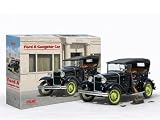
- Accurate instructions come with the parts for assembly, making it a fun and easy model kit to build. The package includes self-printed decals to make the plastic model built from the kit even more realistic.
- Safety & quality. Our model kits are made from quality plastic – the best light material. Plastic models kits are easy to design, store, and transport.
- The model kit provides a perfect way to spend time together. Enjoy quality family time together! It’s a fun & informative hobby for the whole family.
- This ICM plastic model kit is an exclusive collectible that is part of a wide assortment from ICM, providing collectors with an enticing opportunity to own a coveted piece from their favorite series.
- Please note that the glue and paint needed to accurately finish the miniature plastic model, as shown in the assembly manual, are not included in the box.
Readers who want a hands-on historical collectible can look for a 1932 Ford V-8 model car kit. A representative 1/32-scale AMT/Scale Stars 1932 Ford V-8 Coupe kit has been listed by a current retailer, with paint and cement sold separately. Treat any kit as a historically related model, not as a replica of Clyde Barrow’s exact car, unless a listing provides evidence for that specific provenance. Brand, scale, availability, and retailer status should be checked before purchase.
Capone’s Cadillac and the armored-car image
Cadillac represents a different side of gangster-car history: wealth, status, protection, and public display. The Library of Congress catalogs a photograph titled “Custom made Cadillac owned by Al Capone.” That catalog record provides a direct archival basis for including a custom Cadillac in a guide to gangster cars.
There is also a more elaborate Cadillac story. A Library of Congress article discusses a heavily armored 1928 Cadillac Town Sedan that was later used by Franklin D. Roosevelt after Pearl Harbor. The car has often been said to have once belonged to Capone, but the Library of Congress account attributes that specific provenance to Andrew Tully’s 1958 book rather than presenting a primary ownership document.
Free tools Windows power users keep installed
One-click scans. No signup required.
The careful conclusion is this: Capone is documented in connection with a custom Cadillac, while the claim that Roosevelt’s armored Cadillac previously belonged to Capone remains a reported provenance story rather than a fully established fact in the sources reviewed.
The broader armored-car image is historically plausible. Wealthy criminals had reasons to value reinforced or heavily built automobiles, and period cars could be modified. But individual ownership histories need to be checked one car at a time. A dramatic story repeated in books, museum captions, or popular articles does not automatically become documented fact.
Bonnie and Clyde’s bullet-riddled car
The automobile in which Bonnie Parker and Clyde Barrow were killed on May 23, 1934, is significant for a reason very different from the Ford V-8. The Library of Congress catalogs a photograph made on May 24, 1934, showing the bullet-riddled vehicle after the ambush by Texas Rangers.
Rank #3
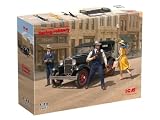
- SCALE & THEME: 1:24 scale model kit depicting a daring robbery scene with Model A vehicle and gangster figures.
- DETAILED FIGURES: Includes highly detailed gangster figures to bring the thrilling robbery scene to life.
- MODEL A VEHICLE: Features a classic Model A car replica, capturing the iconic style of the era in precise detail.
- COLLECTOR'S ITEM: A must-have for scale model enthusiasts and fans of vintage crime and gangster themes.
- ASSEMBLY REQUIRED: Kit requires assembly, offering an engaging building experience for hobbyists of all skill levels.
This was not necessarily a technically special or desirable model. Its importance comes from what happened to it. An ordinary automobile became physical evidence of a nationally famous crime story and, later, an object of public memory. The damage tells a story that a polished studio photograph cannot: the car is a surviving artifact of the violence, investigation, and spectacle surrounding the couple’s deaths.
It is worth discussing the vehicle without glamorizing the ambush or treating the damage as entertainment. The car helps explain how automobiles can move from transportation to evidence, then from evidence to cultural artifact.
How the 1967 film changed the gangster-car image
Many readers picture gangster cars through the lens of the 1967 film Bonnie and Clyde rather than through archival records. Library of Congress film-preservation materials treat the movie as culturally significant and highlight the importance of its car-chase sequences.
The film helped establish a visual grammar that remains familiar: a fast-moving car, rural roads, pursuit, danger, sudden violence, and a battered vehicle left behind. That imagery compressed a complicated history into an immediately recognizable screen symbol. It also encouraged people to treat nearly any large dark sedan from the 1920s or 1930s as a “gangster car,” even when no documented criminal connection exists.
This is why movie imagery and historical evidence should be kept separate. Film can accurately preserve the emotional and visual force of an era while still creating composites that do not correspond to one documented vehicle or criminal organization.
Rank #4

- 1/24 Scale Diecast Model Car
- Opening doors, hood & trunk
- Size 8x3x3 inches
- Window box measures: 9.75"L x 4.5"W x 4"H
Large Chryslers: the luxury backdrop
Large Chryslers help explain the status and physical presence associated with the period, but they should be treated as context rather than automatic gangster cars.
Chrysler’s official history describes early-1930s Imperial models with long wheelbases, powerful engines, and custom bodies. These were prestigious automobiles with the size and road presence that shaped popular ideas about wealth and authority. A large Chrysler Imperial could therefore fit the visual and practical world of the era without being evidence of criminal ownership.
The 1934 Chrysler Airflow adds an important technological counterpoint. Its streamlined design marked a major engineering and styling milestone. The period was not frozen in a world of identical upright sedans, running boards, and black paint; manufacturers were experimenting with aerodynamics, body construction, and new approaches to automobile design.
A useful way to phrase the connection is: large Chryslers supplied the prestige and road presence that shaped the era’s gangster-car image. It would go too far to claim, without model-specific evidence, that Chrysler Airflows were standard vehicles for gangsters or that criminal groups commonly selected them.
What’s actually slowing this PC down?
Pick the symptom - the matching free tool is one click away.
Gangster cars in history versus gangster cars in mythology
The following evidence scale is a practical way to judge claims:
Best Value

- Revell Model Kit #14555, Skill Level 4, Contains 121-Parts, Recommended for ages 12 and up
- All new tooling. Big-block 429 Cobra Jet V-8 engine. Highly detailed engine compartment features many separate components.
- Interior includes separate door panels. Tampo-printed whitewall tires.
- Film-correct details include Mach 1 equipment with a body-color front bumper, a honeycomb-trimmed taillight panel, “baloney-cut” exhaust tips, a Ram Air hood without hood locks, and flat hub caps.
- Molded in white and clear with chrome plated parts and soft black tires. Requires paint and glue. (Not included)
| Confidence level | Examples | What it means |
|---|---|---|
| Documented | Clyde Barrow photographed with a 1932 Ford V-8; the Library of Congress photograph of the car in which Bonnie and Clyde died; a Library of Congress catalog entry for a custom Cadillac owned by Al Capone. | The connection is supported by an archival photograph or collection record. |
| Qualified | The letter attributed to Clyde Barrow; the reported Capone provenance of Roosevelt’s armored Cadillac. | The story is important, but authenticity or ownership is not fully established by the sources reviewed. |
| Cultural rather than documentary | The idea that every gangster drove a black luxury sedan; the generalized movie image of a powerful getaway car. | The association is real as popular imagery, but it should not be presented as proof of a specific historical practice. |
Why the gangster-car image still works
The enduring image comes from several real developments reinforcing one another. Cars became ordinary enough to conceal movement, powerful enough to symbolize modernity, spacious enough to support long-distance travel, and visually distinctive enough to communicate wealth or menace on screen.
Then photographs and films fixed particular vehicles in the public imagination. The 1932 Ford V-8 became inseparable from Clyde Barrow. The damaged Bonnie and Clyde car became an artifact of the couple’s final chapter. Capone’s Cadillac represented the intersection of custom luxury and criminal celebrity. The 1967 film transformed these historical ingredients into a repeatable cinematic language.
The result is a category built from three overlapping layers:
Crashes, No Sound, or Screen Glitches?
Random freezes, missing sound and display glitches usually trace back to one bad driver. Find and replace yours safely.Free scan · under a minutePC Slower Than It Used to Be?
A free scan shows the junk files, broken settings and background clutter dragging Windows down - then fixes them in one click.Free scan · Windows 10 & 11- Documented ownership or use: a vehicle appears in a reliable photograph, archive, or collection record.
- Period context: a model’s size, price, engineering, or prestige helps explain what automobiles were available and desirable at the time.
- Popular memory: movies and repeated anecdotes turn cars into symbols, sometimes separating the image from the surviving evidence.
Frequently repeated claims to treat cautiously
- Not all gangsters drove black Cadillacs.
- The Clyde Barrow letter praising Ford V-8s is not unquestionably authentic.
- The armored Cadillac later used by Roosevelt cannot be stated as definitively Capone-owned on the evidence reviewed here.
- The 1932 Ford V-8 should not be described as categorically faster than every police car of its time without period performance sources.
- The Chrysler Airflow should not be presented as a standard gangster vehicle merely because it was a notable 1930s automobile.
- A model-car listing, price, stock status, or affiliate relationship can change before publication.
Sources and further historical context
The central vehicle evidence comes from collection and catalog records at The Henry Ford and the Library of Congress. The Henry Ford provides the Clyde Barrow and 1932 Ford V-8 photograph, its discussion of the disputed letter, and Ford’s early V-8 context. The Library of Congress provides the Capone Cadillac catalog record, the account of the armored Cadillac associated by report with Capone, the photograph of Bonnie and Clyde’s final car, and film-preservation context for Bonnie and Clyde. The National Park Service supplies the broader history of automobile adoption and changing travel patterns, while Chrysler’s official history provides period context for Imperial models and the Airflow.
Together, these sources support a more accurate conclusion than the stereotype: gangster cars were not one make, one color, or one body style. They were ordinary American automobiles made historically important by mobility, status, criminal events, archival survival, and Hollywood mythmaking.
Frequently Asked Questions
The 1932 Ford V-8 is the strongest candidate because it is directly associated with Clyde Barrow in a photograph held by The Henry Ford. A famous letter attributed to Barrow also praises Ford V-8 getaway cars, although handwriting analysts have questioned its authenticity.
What is the most famous gangster car?
Capone is documented in connection with a custom Cadillac through a Library of Congress catalog record. The more specific claim that an armored 1928 Cadillac Town Sedan later used by Franklin D. Roosevelt had belonged to Capone is reported provenance, not fully established ownership in the sources reviewed.
Did Al Capone own an armored Cadillac?
The surviving evidence confirms the identity and condition of the automobile in which Bonnie Parker and Clyde Barrow were killed, but this guide does not assume a specific model without a source that establishes it. Its importance is as a bullet-riddled historical artifact.
Was Bonnie and Clyde’s car a Ford V-8?
No. The black luxury-sedan image is mainly a cultural and cinematic shorthand. Historical vehicles associated with the subject include Ford V-8s, Cadillacs, and large Chryslers, but no single make or color was universal.
Were all gangster cars black Cadillacs?
The Bottom Line
The best-supported gangster car is the 1932 Ford V-8, especially through its documented association with Clyde Barrow. Capone’s custom Cadillac and Bonnie and Clyde’s bullet-riddled car are also grounded in archival records, while the Roosevelt-Capone Cadillac story and the universal black-sedan image require qualification. The most accurate guide separates documented vehicles from period context and movie mythology.
Quick Recap
Product prices and availability are accurate as of the date/time indicated and are subject to change. Any price and availability information displayed on Amazon at the time of purchase will apply.
Quick wins for a faster PC:
Scan for outdated or missing drivers - takes under a minuteDriver Scan →Repair Windows errors before they cause bigger problemsFix Now →



