Do these 3 things before closing this tab:
1Fix the driver behind crashes, sound loss and screen glitches2Repair Windows errors before they cause bigger problems3Scan for outdated or missing drivers - takes under a minuteThe eight cars below show how the American police vehicle evolved: from full-size patrol sedans to specialized performance cars, then to modern pursuit sedans and SUVs. This is an editorial selection, not an official ranking; it weighs documented police-service importance, fleet use, distinctive police roles, and public recognition. The Ford Crown Victoria Police Interceptor is the clearest overall symbol, but it is only one part of the story.
How these eight cars tell the story
Federal police-vehicle research and manufacturer histories document the long-running role of full-size American sedans, the use of specialized performance cars, and the later shift toward pursuit-rated utility vehicles. The cars are grouped here by the role they played, rather than ranked as if “iconic” had a single measurable definition.

| Car | Police role | Why it is remembered |
|---|---|---|
| Ford Crown Victoria Police Interceptor | Full-size patrol sedan | Broad fleet presence and instantly recognizable silhouette |
| Chevrolet Caprice 9C1 | Full-size patrol sedan | Performance reputation and a major rival to Ford |
| Dodge Monaco | Full-size patrol sedan | Police-service history and a memorable film appearance |
| Dodge Polara | Highway-patrol sedan | Strong association with the California Highway Patrol |
| Ford Mustang SSP | Special-service and pursuit car | A pony car adapted for law-enforcement work |
| Chevrolet Camaro B4C | Specialized police cruiser | A police-package performance coupe |
| Dodge Charger Pursuit | Modern pursuit sedan | Revived the performance-oriented sedan image |
| Chevrolet Tahoe PPV | Police utility vehicle | Represents the rise of the full-size police SUV |
1. Ford Crown Victoria Police Interceptor
The Crown Victoria Police Interceptor became the archetypal American patrol car: a roomy, rear-wheel-drive sedan with a familiar lightbar silhouette. Ford traces its police-package lineage to the 1950s, identifies the LTD Crown Victoria police package as a continuation in 1983, and says the Crown Victoria became its own model in 1992. Ford reports that its police package accounted for 85% of police-pursuit sales in the United States and Canada in 1998. The Police Interceptor was retired in 2012 as Ford moved to its next-generation Police Interceptor models.
Its importance was not that every department used one, but that broad fleet presence made it a visual shorthand for municipal policing from the 1990s through the 2000s. The Crown Victoria Museum describes it as an instantly recognizable symbol of law and order and documents examples from agencies including the California Highway Patrol, Fairfax County, and Portsmouth.
What’s actually slowing this PC down?
Pick the symptom - the matching free tool is one click away.
#1 Best Overall

- AUTHENTIC DESIGN: Officially licensed 1:42 scale Ford Crown Victoria Police Interceptor die-cast model car with realistic police department styling
- INTERACTIVE FEATURES: Working doors that open and close plus exciting pull-back action motor for engaging play value
- QUALITY CONSTRUCTION: Die-cast metal body with rubber tires and detailed plastic components for durability and authentic look
- PERFECT SIZE: Compact 5-inch length makes it ideal for collectors and play while maintaining impressive detail and features
- SAFETY FOCUSED: Recommended for ages 3 and up, made with high-quality, safe materials and meets toy safety standards
2. Chevrolet Caprice 9C1
The Caprice 9C1 was a leading Chevrolet answer to Ford’s full-size patrol sedans, particularly in the late 20th century. The Missouri State Highway Patrol records that its 1994 patrol cars were Caprice 9C1 sedans with the high-performance LT1 engine. General Motors stopped building the Caprice 9C1 in 1996; the Missouri history says that left Ford as the only American manufacturer producing a full-size police patrol vehicle for that period.
The boxy versions and later rounded “bubble” styling became familiar through police fleets and enthusiast culture. The 9C1 matters as a police-package car, not simply as a civilian Caprice: it represents the full-size patrol sedan at a time when agencies still valued a substantial four-door car with pursuit capability.
3. Dodge Monaco
The Dodge Monaco combines genuine police-service history with unusually strong screen recognition. Federal research lists Chrysler’s Fury and Monaco among the typical full-size four-door sedans offered for police patrol. A specialist police-vehicle history identifies police- and taxi-duty Monacos as “Monaco Specials” and notes that 1976 was the only model year with a police package in that particular series.
The Monaco’s appearance as the battered police car in The Blues Brothers helped cement its pop-culture reputation. That film connection is part of its fame, not proof that it was the most common patrol car nationwide. The movie car should not be taken as representative of every Monaco or police configuration.
Rank #2

- Official Licensed (Ford and LAPD)
- 1:24 scale measuring approx 8 x 3 x 2.75 inches
- Made of diecast metal with plastic parts, rubber tires
- Openable front doors and hood, detailed interior
- Pre-assembled Model, not a building kit, not a RC, Not Battery Operated, Lights do not turn on
4. Dodge Polara
The Polara has a particularly strong connection to California Highway Patrol history. The CHP Museum calls it one of the agency’s “all-time favorite patrol cars” and preserves it in the organization’s vehicle history.
It represents the large, powerful sedan used by highway patrol agencies before the Crown Victoria era. Its CHP association gives the Polara a distinct regional identity: the black-and-white patrol car became a familiar image of freeway enforcement.
5. Ford Mustang SSP
The Ford Mustang SSP brought a familiar performance-car shape into specialized law-enforcement service. Ford’s police-vehicle history says the Mustang entered special service in 1982; Ford’s police timeline says the California Highway Patrol purchased 400 examples.
The SSP was a special-service and pursuit Mustang, not a standard patrol-car replacement. Its place in police history comes from that unusual role: it showed that agencies could use a compact, fast, rear-wheel-drive performance car for specialized highway enforcement alongside conventional patrol sedans.
Rank #3
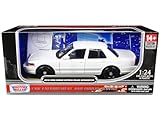
- Brand new box. Real rubber tires. Officially licensed product. Opening hood and front doors. Made of diecast with some plastic parts. Manufacturer's original unopened packaging. Detailed interior, exterior, engine compartment. Dimensions approximately L-8, W-3, H-2.5 inches. PLEASE NOTE: This is a Custom Builder's Kit and requires a drill to attach the included light bar and push bar.
- Material: Metal
- Recommended uses for product: Home
6. Chevrolet Camaro B4C
The Camaro B4C was Chevrolet’s police-package performance coupe. General Motors states that it offered a B4C Camaro for use as a police cruiser in 1991.
Its significance is distinctiveness rather than nationwide fleet volume. A Camaro in police trim looked unlike a conventional patrol sedan and represented the limited but memorable use of performance coupes for police work. Like the Mustang SSP, it should be understood as a specialized vehicle, not the ordinary patrol car.
7. Dodge Charger Pursuit
The Charger Pursuit revived the performance-oriented American sedan for a modern era. The police Charger was introduced for the 2006 model year; the name “Charger Pursuit” became standard after the 2011 redesign. The National Institute of Justice’s 2006 police-vehicle evaluation tested 3.5-liter and 5.7-liter Chargers alongside the Ford Police Interceptor, Chevrolet Impala 9C1, and Chevrolet Tahoe PPV.
Dodge’s heritage material places the Charger within a longer pursuit-car lineage. Its aggressive styling and available V8 helped make it a recognizable successor to traditional American V8 pursuit sedans, while its presence in the NIJ evaluation documents its role among the modern police-vehicle choices of its time.
Free tools Windows power users keep installed
One-click scans. No signup required.
Rank #4
8. Chevrolet Tahoe PPV
The Tahoe PPV represents the move toward full-size police utility vehicles. The National Institute of Justice included the Tahoe PPV in its 2006 evaluation alongside pursuit sedans, and General Motors describes the Tahoe as Chevrolet’s oldest operating police nameplate while continuing to offer a Tahoe Police Package Vehicle.
Agencies may choose an SUV for cargo space, higher seating, traction options, or flexibility for equipment and different assignments. The Tahoe was not a one-for-one replacement for every Crown Victoria; it illustrates how agency needs and vehicle choices broadened beyond the traditional sedan.
Four phases in the American police-car story
- Full-size patrol sedans: The Polara, Monaco, Caprice 9C1, and Crown Victoria represent the long central role of large four-door cars.
- Specialized performance enforcement: The Mustang SSP and Camaro B4C show agencies also used performance cars for specific duties, rather than as standard fleet replacements.
- The modern performance sedan: The Charger brought a contemporary, pursuit-oriented sedan back into the spotlight.
- The police SUV: The Tahoe PPV reflects the growing place of utility vehicles in police fleets.
As federal police-vehicle studies and manufacturer material show, the transition involved more than styling. Police vehicles had to support equipment and demanding service, while agency needs, geography, budgets, and procurement choices varied. No single model defined every department or every era.
Independent reader supportYour contribution helps us test, update, and keep practical guides available for everyone.FAQ
What is the most iconic American police car?
The Ford Crown Victoria Police Interceptor is the clearest overall answer because of its broad fleet presence and familiar appearance. Ford reports that its police package represented 85% of police-pursuit sales in the United States and Canada in 1998, but that does not mean every department used one.
The Tool Desk
Outbyte Driver Updater FREEFix the driver behind crashes, sound loss and screen glitchesFind Drivers →Outbyte PC Repair FREEClear out junk files and repair common Windows errorsFree Scan →Best Value

- Authentic 1:64 scale die-cast collectible model with detailed exterior and realistic proportions.
- Die-cast metal body and chassis with rubber tires designed for display and collection.
- Factory-sealed packaging ideal for long-term collecting and shelf display.
- Limited production release from GreenLight Collectibles
Was the Crown Victoria the only important American cop car?
No. Earlier full-size cars such as the Dodge Polara, Dodge Monaco, and Chevrolet Caprice 9C1 had their own police-service histories. Specialized cars such as the Mustang SSP and Camaro B4C, as well as modern choices such as the Charger Pursuit and Tahoe PPV, show how the role continued to change.
Were the Mustang SSP and Camaro B4C standard patrol cars?
No. The dossier describes them as specialized police or pursuit vehicles, not replacements for the conventional patrol sedan. The Mustang SSP was used for special-service and pursuit duties, and Chevrolet offered the B4C Camaro for police-cruiser use.
Why did police fleets move toward SUVs?
Utility vehicles can offer cargo room, higher seating, traction options, and flexibility for equipment or varied assignments. The Tahoe PPV illustrates this shift, but it did not replace every sedan in every agency.
Is a movie police car evidence that a model was widely used?
No. Film and television can make a vehicle memorable, but a screen appearance does not establish fleet numbers. The Monaco’s The Blues Brothers connection is a cultural contribution, distinct from evidence about police-service use.
Quick Recap
Product prices and availability are accurate as of the date/time indicated and are subject to change. Any price and availability information displayed on Amazon at the time of purchase will apply.