Recommended Free Tools
Armored vehicles are built to solve very different problems: crossing a beach, scouting ahead, carrying infantry, or keeping a crew alive amid mines and blasts. This is a curated selection—not an objective ranking—of 20 machines whose designs reveal those trade-offs. Museum-reported specifications are identified as such; where the available institutional sources establish a vehicle’s role but not detailed specifications, the profile stays focused on that evidence.
Speed and firepower at a price
1. Tiger I
The Tiger I paired an 88 mm cannon with substantial frontal armor, making it one of the most imposing heavy tanks of World War II. The Museum of American Armor also points to its costs: high fuel consumption, track problems, expensive materials, and labor-intensive construction. The museum reports that about 1,500 were built. Its displayed Tiger is an operational replica built from a T-55, not an original Tiger I. Museum of American Armor
2. StuG (Sturmgeschütz)
The StuG was an assault gun built on a tank chassis, with a fixed gun rather than a rotating turret. That simpler, lower-profile arrangement offered a powerful weapon without the cost and complexity of a conventional tank. The Museum of American Armor describes its use against defensive positions and later as an ambush weapon. The trade-off was tactical: its fixed gun and thin armor made it unsuitable for some attack roles. Museum of American Armor
3. M18 Hellcat
The M18 Hellcat was a World War II tank destroyer designed around speed and maneuverability. The Museum of American Armor reports a 76 mm gun, a top speed of 55 mph, and 2,507 built. Its armor was no more than one inch thick, so its mobility came at a serious protection cost: it could move quickly, but could not absorb hits like a heavily armored tank. Museum of American Armor
Do these 3 things before closing this tab:
1Scan for outdated or missing drivers - takes under a minute2Clear out junk files and repair common Windows errors3Fix the driver behind crashes, sound loss and screen glitches#1 Best Overall

- This plastic model requires assembly and painting. Adhesives, tools, paints, etc., sold separately
- 1/35 scale unpainted plastic assembly kit
- Size when assembled: Total length 4.9 inches (124.5 mm) / Total height 2.8 inches (71.4 mm)
- Comes with a variety of accessories such as figures and anti-rebounding guns. The belt is a belt type and comes with 2 types of decals
- Academy ACADEMY (Korea) Import Plastic Model
Reconnaissance and command vehicles
4. M8 Greyhound
The M8 began as a tank-destroyer concept but became better known for reconnaissance and scouting. The Museum of American Armor reports 8,500 built and a top speed of 55 mph. Its story shows how a vehicle’s practical role can diverge from its original design purpose: speed and scouting utility proved more relevant than the initial tank-destroyer concept. Museum of American Armor
5. M20 armored utility car
The M20 shared the M8’s chassis but gave up its turret and 37 mm gun. In their place, it offered additional radios and passenger seats for command and reconnaissance work. That conversion makes the M20 an unusually clear example of role-driven design: rather than adding firepower, its makers prioritized communications and the ability to carry people. Museum of American Armor
Rank #2

- Detailed Military Model Pair - Builders can recreate a Boxer IFV and Stryker MGS with 896 pieces, camouflage-inspired colors, armored shapes, and army vehicle details
- Interactive Features to Explore - Kids can open the Boxer front cabin, turn the turret, roll the tires, and move the vehicles through convoy scenes and pretend missions
- Storytelling and Family Build Time - Parents and young creators can work through the build together, then imagine missions, vehicle displays, and custom army scenes
- Shelf-Ready Collectible Look - Finished models can be placed on a desk, bedroom shelf, bookshelf, or playroom display to decorate a military vehicle collection
- Giftable Army Building Kit - A solid birthday, Christmas, or holiday gift idea for boys and girls ages 8+, teens, builders, and military model fans
6. British Dingo
The Dingo was a two-person reconnaissance vehicle with a particularly unusual transmission: according to the Museum of American Armor, it had five speeds in both forward and reverse. That feature could make retreat or repositioning less awkward for a scout vehicle operating where turning around might be difficult. The museum source describes its role and transmission, but does not provide a speed or production total. Museum of American Armor
7. FV721 Fox
The Fox was a later British 4 × 4 reconnaissance vehicle. The Museum of American Armor says it entered British service in 1975 and left service in 1993–94. Its compact four-wheel-drive layout suited reconnaissance work, a different mobility problem from that of a tracked tank or a troop carrier. Museum of American Armor
Rank #3

- Highly accurate static display model.
Vehicles built to cross water and deliver troops
8. LVT-4 amphibious vehicle
The LVT family was developed for ship-to-shore transport, carrying cargo and troops through water and onto land. The LVT-4’s defining change was a large rear ramp, which made loading and unloading more practical. The Museum of American Armor reports capacity for 30 troops or a 9,000-pound payload, with maximum speeds of 15 mph on land and 7 mph in water. Those figures describe a specialized amphibious carrier, not a fast road vehicle. Museum of American Armor
Unusual defenses and protected passengers
9. Crossley-Chevrolet armored car
Used for security patrols on India’s North-West Frontier, the Crossley-Chevrolet had an extraordinary close-quarters defense: its armor could be electrified to shock people trying to climb onto or overturn the vehicle. The Tank Museum reports 451 produced, a four-person crew, a top speed of 40 mph, and 6 mm of armor. The electrified armor was a specialized deterrent, not a substitute for thick ballistic protection. The Tank Museum
Rank #4
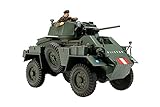
- Plastic TM32587 kit
- Glue and paint sold separately
- Includes torso Commander figure
10. Mercedes-Benz 770 K armored limousine
This heavily protected limousine combined official transport with details aimed at keeping its occupants secure and comfortable. Technik Museum Sinsheim says its example was delivered to the Presidential Chancellery in 1943 and later served, among others, Heinrich Himmler. Its account describes emergency door locking and airflow over the exhaust manifolds to keep armored glass from fogging. The museum reports a 7.7-liter engine and a tire-limited top speed of 80 km/h; ten were built and three survive. These are museum-reported figures, and the page does not show a publication year. Technik Museum Sinsheim
Independent reader supportYour contribution helps us test, update, and keep practical guides available for everyone.Modern protection against mines and blasts
11. Roshel Senator MRAP
The Canadian-built Roshel Senator MRAP is designed for mine and explosive protection. In a report published on 20 May 2026, Ukraine’s Ministry of Defence said 20 vehicles had been delivered to humanitarian mine-clearance units and described a V-shaped hull. The ministry also reported certification to NATO STANAG 4569 Levels 2 and 3; that is the ministry’s stated certification, not a basis for assuming protection against every threat or under every condition. Its reported delivery connects armored-vehicle design to a present-day role: protecting demining personnel while they work. Ukraine’s Ministry of Defence
PC Slower Than It Used to Be?
A free scan shows the junk files, broken settings and background clutter dragging Windows down - then fixes them in one click.Free scan · Windows 10 & 11Outdated Drivers Are Slowing You Down
One free scan finds every outdated or missing driver and matches the right update for your exact hardware.Free scan · exact hardware matchBest Value

- Plastic TM35040 kit
- Includes five (5) figures
- Glue and paint sold separately
Armored vehicles that carry the mission
12. M113A3
The M113A3 is an upgraded version of the widely used M113 family, with aluminum armor. Estrella Warbirds Museum lists a road speed of 38 mph and a capacity of two crew plus 11 infantry. That combination makes its purpose clear: it is an armored personnel carrier for moving a squad, not a tank designed to lead an assault with heavy direct-fire weapons. The museum page does not show a publication year. Estrella Warbirds Museum
13. Ratel 20
The Ratel 20 was developed in South Africa in a context shaped by military threats and UN sanctions. Ditsong Museums curator Michael Tobolo explains that domestic arms development was pursued under those constraints, and that the vehicle was intended to combine firepower with strategic mobility for mechanized infantry operating across southern Africa. Its significance lies not just in a weapon or armor feature, but in the industrial and geographic demands it was designed to meet. Ditsong Museums
Seven more vehicles to complete the selection
The institutional sources available for this selection document thirteen vehicles with enough detail to support specific profiles. They do not establish the histories or specifications of seven additional vehicles. Adding names and claims without evidence would turn a curated list into guesswork, so this article does not invent entries to reach twenty.
How to compare an armored vehicle’s design
A standout feature only makes sense in relation to the job the vehicle had to do. A fast tank destroyer, an amphibious carrier, and a mine-protected truck face different constraints; their speeds, armor, weapons, and crew arrangements are not directly comparable.
What’s actually slowing this PC down?
Pick the symptom - the matching free tool is one click away.
- Role: Was it built for reconnaissance, command, carrying troops, direct fire, or mine clearance?
- Mobility: Consider whether it needed road speed, off-road movement, reverse maneuverability, or the ability to travel through water.
- Protection: Armor thickness alone does not describe protection against every threat. The Hellcat’s speed came with very thin armor, while the Senator’s reported V-shaped hull is part of a design for mine and explosive protection.
- Payload and crew: A carrier’s troop capacity or a command vehicle’s radio and passenger space may matter more than a gun.
- Operating cost and complexity: The Tiger I illustrates how firepower and armor could bring heavy demands for fuel, materials, maintenance, and labor.
That is why “astonishing” is best treated as a way to explore engineering choices, not as a measurable ranking. The vehicles above stand out for different reasons, and a design advantage in one mission can become a limitation in another.
Quick Recap
Product prices and availability are accurate as of the date/time indicated and are subject to change. Any price and availability information displayed on Amazon at the time of purchase will apply.




