Do these 3 things before closing this tab:
1Repair Windows errors before they cause bigger problems2Scan for outdated or missing drivers - takes under a minute3Clear out junk files and repair common Windows errorsThe Porsche 917’s first season exposed a serious high-speed stability problem. Porsche’s short-tail 917K reworked the car’s aerodynamics—and won the 24 Hours of Le Mans in 1970 and 1971 with different crews and engine specifications. The 1969–1971 span therefore covers both the original 917’s introduction and the K’s rise as a Le Mans winner.
What does “917K” mean?
The “K” stands for Kurz, German for “short.” Porsche distinguished the short-tail 917 K from the long-tail 917 LH, or Langheck. The 917 was developed for the five-litre class after the World Sportscar Championship’s displacement limit changed; Porsche says it built 25 cars for homologation. Porsche Stories explains the naming and the car’s development context.

The title range needs a distinction: 1969 marks the 917’s introduction, while the short-tail K is the version associated with Porsche’s Le Mans victories in 1970 and 1971. The 917 family included more than one body and engine configuration, so season figures should not be read as identical specifications for every car.
Why was the original 917 revised?
At high speed, aerodynamic lift made the initial 917 unstable. Porsche says that after the 1969 season it reengineered the nose, rear, sills and wings. The revised short-tail body improved handling and speed, addressing a problem that mattered acutely in endurance racing, where a car had to remain controllable over long stints at high velocity. Porsche’s account of the 1970 winner and its 917 history describe the aerodynamic changes.
#1 Best Overall
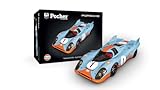
- HK118 Porsche 917K Scale Model Kit: Beaten only by a change in the world championship rules, the Porsche 917K was, for a short time, the most incredible car on the racetrack. It is still one of the most iconic race cars in motorsport history
- Car Model Building Kits: There are a whole range of Pocher plastic model car kits to discover! Spanning across decades of motoring history, there's a classic car model kit for everyone to enjoy with intricate details and unique designs for all
- Women and Mens Hobbies Kits: These large scale model car kits offer more to advanced modelers. Gift auto model kits come with everything you need to bring your model kit car to life, ideal centerpieces for any car collection
- About this Model: Pre-decorated model car kits, ideal model cars for adults to build with some experience in model building. This set has 312 Parts and includes: 1:8 plastic sprues, metal body parts, rubber tyres and decals, plus assembly instructions
- About Pocher: Established in 1966, an Italian model-making brand known for producing highly detailed and precision-engineered scale model kit vehicles. Their iconic craftsmanship appeals to hobbyists and collectors worldwide
How did the 917’s engine specifications change?
The Automobile Club de l’Ouest (ACO), publisher of the 24 Hours of Le Mans site, gives these season-level displacement figures for the 917:
| Season | Displacement listed by the ACO |
|---|---|
| 1969 | 4,409 cm³ |
| 1970 | 4,907 cm³ |
| 1971 | 4,998 cm³ |
These are figures for the season’s 917 specifications, not a claim that every 917 entered in every race that year used the same engine. The ACO separately identifies the 1970 Le Mans winner’s engine as 4.5 litres and the 1971 winning 917 K’s as 4,907 cm³. Those winner-specific descriptions should be kept distinct from the season-level figures. The ACO’s 917 overview provides both sets of figures.
Rank #2

- 1:24 Scale Plastic Model Kit, 119 parts
- Required assembly and painting
- Glue and Paints are not included
- Model length: 176mm/ 6.9"
Who won Le Mans in the 917K?
1970: Herrmann and Attwood in Porsche Salzburg’s No. 23
Hans Herrmann and Richard Attwood won the 1970 24 Hours of Le Mans in the red-and-white Porsche Salzburg short-tail car, No. 23. The ACO identifies the winning car’s engine as 4.5 litres. This victory made the revised short-tail 917 a Le Mans winner after the original 1969 season had revealed its high-speed handling weakness. Porsche’s race history describes the team and car; the ACO account identifies its engine displacement.
1971: Marko and van Lennep in a 4,907 cm³ 917 K
Helmut Marko and Gijs van Lennep won the 1971 race in a 917 K with the 4,907 cm³ engine. Porsche credits the crew with covering 5,335.16 kilometres, a distance record that stood for almost 40 years. The second victory is thus a distinct team and engine story, not simply a repeat of the 1970 win. Porsche’s history of its Le Mans winners gives the distance record; the ACO’s 917 overview states the winning engine specification.
Rank #3

- Hot Wheels Porsche 917K Car Calture Premium 2026 Vintage Racing Series 1:64 Scale Collectible Die Cast Metal Toy Car Model with Rubber Real Riders 2/5
How successful was the 917 in 1970 and 1971?
Porsche reports seven wins from eight races in 1970, and seven from eight again in 1971. These are Porsche’s historical season tallies, rather than an independent recalculation here. The results show that the 917’s significance extended beyond its two Le Mans victories: it was a dominant car across both championship seasons. Porsche’s history page provides the win totals.
Quick Recap
Rank #4

- Create an elite Hot Wheels collection with a Hot Wheels Premium Car Culture vehicle.
- Each 1:64 scale die-cast car or truck has premium execution with Real Riders tires and Metal/Metal body and chassis.
- Different themed mixes are released throughout the year to appeal to collectors and to represent the most on-trend vehicles from around the world.
- The box art enhances collectability, making each one perfect for play or display.
- Each Hot Wheels Car Culture vehicle is officially licensed and designed for the true automobile enthusiast.
Product prices and availability are accurate as of the date/time indicated and are subject to change. Any price and availability information displayed on Amazon at the time of purchase will apply.




