Windows Errors? Fix Them Before They Spread
Repair common Windows errors and clear accumulated junk for a smoother, more stable PC - no reinstall needed.Free scan · no reinstallCrashes, No Sound, or Screen Glitches?
Random freezes, missing sound and display glitches usually trace back to one bad driver. Find and replace yours safely.Free scan · under a minuteTo gain horsepower from a classic Chevy 350, build in sequence: identify the engine, verify its health, remove restrictions, define the rpm range, and then match compression, heads, camshaft, valvetrain, intake, fuel, ignition, exhaust, and supporting systems. There is no guaranteed gain from any one part, and a mismatched combination can lose street torque or reliability while producing a bigger catalog number.
The recommendations below apply to the classic Gen I small-block Chevrolet 350. They do not automatically apply to LS, LT, or every later small-block variant.
As an Amazon Associate I earn from qualifying purchases.
The best way to gain horsepower from a classic Chevy 350 is to build a matched combination, not to bolt on one oversized part. Start by identifying the exact engine and proving that it is healthy. Then match compression, cylinder heads, camshaft, valvetrain, intake, fuel system, ignition, exhaust, gearing, and cooling to the rpm range the vehicle will actually use.
What’s actually slowing this PC down?
Pick the symptom - the matching free tool is one click away.
This article treats the classic 350 as a Gen I small-block Chevrolet engine, not an LS or later LT engine. Even within the Gen I family, block casting, rear-main-seal design, cylinder-head casting, intake-bolt pattern, camshaft type, compression ratio, fuel system, emissions equipment, transmission, and rear gearing can change the correct parts and the final result.
#1 Best Overall

- This rebuild kit kit has all the parts you need to freshen up that worn engine. These parts are manufactured directly from only high quality companies with ISO, QS & TS quality systems in place. These are not cheap Chinese parts, this is a quality kit that will last.
- This rebuild kit will include: Full Gasket Set, 10:1 Flat-Top Pistons, Piston Rings, Main/Rod/Cam Bearings, 3pc Timing Set, High-Volume Oil Pump, Stage-3 HP Camshaft (Lift:480/480 Duration:232/232 C/L Angle:108), Lifters, Freeze Plugs, Valve Stem Seals
- SIZES AVAILABLE: Pistons & Rings:STD, 020, 030, 040, 060 --- Rod/Main Bearings:STD, 010, 020, 030, 040
- AFTER YOU ORDER YOU NEED TO SEND US A MESSAGE LETTING US KNOW WHAT SIZE OF PARTS YOU WANT. THANKS!
- High-Performance Lift (.480”/.480”): Featuring a substantial .480” lift on both Intake and Exhaust, this Stage 3 profile forces maximum air and fuel into the combustion chamber. Why Buy It: This aggressive lift is the key to unlocking big horsepower numbers in the mid-to-upper RPM range, giving you the passing power and strip performance stock cams can't touch.
Chevrolet Performance’s published 350-family examples illustrate the point: a 350 HO combination is listed at 333 horsepower, an SP350/385-style combination at 405 horsepower, and a ZZ6 EFI combination at 420 horsepower. Those engines do not make different power because of one magic bolt-on. Their heads, compression, camshafts, induction systems, fuel delivery, and rpm limits are different. Treat those figures as examples of complete combinations—not guaranteed gains for your engine.
Before buying parts: decide what kind of 350 you are building
A street cruiser, heavy truck, autocross car, drag car, and restoration project need different power curves. Before ordering parts, write down:
- Vehicle weight and tire diameter
- Transmission type and gear ratios
- Rear-axle ratio
- Converter stall speed or clutch characteristics
- Fuel octane that is consistently available
- Target operating rpm
- Acceptable idle quality and vacuum level
- Emissions, catalytic-converter, noise, and inspection requirements
A combination that produces impressive peak horsepower at 6,500 rpm may feel slower in a street car geared to cruise below 3,000 rpm. The goal is usable power across the range that matches the vehicle.
15 must-do steps to gain horsepower from a classic Chevy 350
-
1. Identify the exact engine before buying parts
Do not order parts based only on the fact that the engine is called a 350. Record the block casting number and casting date, crankshaft type, one-piece or two-piece rear-main-seal design, cylinder-head casting numbers, intake-manifold bolt pattern, camshaft type, and whether the block has a mechanical fuel-pump provision. Record piston deck height if it is known.
The intake pattern is especially important. Conventional small-block Chevy heads generally cover earlier applications, while later cast-iron Vortec-style heads use different intake-manifold compatibility rules. Edelbrock’s small-block Chevy application information distinguishes conventional 1955–1986 heads from 1987-and-later Vortec applications. A conventional-head intake is not automatically suitable for Vortec heads, and a Vortec intake is not automatically suitable for earlier heads.
Also verify accessory mounting, water outlets, thermostat housing, alternator position, distributor clearance, spark-plug angle, valve-cover style, and exhaust-port configuration. Photograph and measure the engine before disassembly; a casting number is more useful than a guess based on the vehicle’s model year.
-
2. Establish a baseline with objective tests
Test the engine before modifying it. Perform a compression test with the spark plugs removed, the throttle held open, and the battery fully charged. Compare all cylinders rather than focusing on one number. If results are uneven, use a leak-down test to determine whether the leakage is passing the rings, intake valve, exhaust valve, or head gasket.
Special offer. See more information about Outbyte and uninstall instructions. Please review EULA and Privacy policy.Also check hot oil pressure, cooling-system condition, engine vacuum, ignition output, fuel pressure and volume, and visible oil or coolant contamination. Inspect the timing chain for excessive slack and verify that the distributor is not wandering. A worn ring package, leaking valve, weak spring, inaccurate ignition, or restricted fuel system can erase the benefit of expensive performance parts.
This step may not add theoretical horsepower, but it can restore output that the engine has already lost. There is little value in installing better heads on a short block with poor ring seal or an ignition system that cannot deliver a stable spark.
-
3. Define the use case and operating range
Choose the rpm range before choosing the camshaft or cylinder heads. A mild street 350 usually benefits from strong low- and midrange torque, good idle vacuum, and clean throttle response. A drag or competition engine may be designed to spend much more time at high rpm.
Account for the transmission, rear axle, tire diameter, vehicle weight, fuel octane, converter or clutch, and whether power brakes or other vacuum-operated accessories must work. A large camshaft can reduce idle vacuum and low-speed torque. If the gearing and converter do not let the engine reach the cam’s intended range, the car may feel slower despite a higher peak-dyno number.
Free tools Windows power users keep installed
One-click scans. No signup required.
Special offer. See more information about Outbyte and uninstall instructions. Please review EULA and Privacy policy. -
4. Repair restrictions before adding performance parts
Find and remove restrictions before changing the engine’s basic combination. Confirm that:
Rank #2
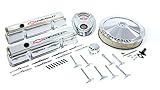 Proform 141-900 Chrome Engine Dress-Up Kit with Black Chevrolet/Red Bowtie Logo for Small Block Chevy
- Package Dimensions: 27.432 H x 52.324 L x 42.418 W (centimetres)
- Package Weight: 18.45 pounds
- Fit type: Vehicle Specific
- Country of Origin : Taiwan
- The air cleaner and filter are large enough and not clogged.
- The throttle blade reaches fully open at the pedal’s full-travel position.
- The fuel pump and lines maintain adequate pressure and volume under load.
- The exhaust is not blocked by a collapsed muffler, damaged converter, or crushed pipe.
- There are no intake-manifold, carburetor, brake-booster, or hose vacuum leaks.
- Distributor bushings, cap, rotor, plug wires, coil, grounds, and charging voltage are sound.
- Valve adjustment and ignition timing are correct.
- The cooling system maintains a stable operating temperature.
These repairs can produce a noticeable improvement because they recover power the engine was supposed to make. They also prevent a false diagnosis in which a new carburetor or camshaft is blamed for a problem that existed beforehand.
-
5. Raise compression only as part of a complete fuel-and-combustion plan
More compression can improve torque and thermal efficiency, but the usable ratio depends on combustion-chamber volume, piston design, piston-to-deck height, head-gasket thickness, camshaft timing, chamber design, fuel octane, and operating temperature. Static compression ratio alone does not determine whether an engine will detonate.
Measure the actual chamber volume and piston-to-deck relationship, or obtain reliable build data, before ordering heads or pistons. Do not assume that a catalog compression number applies to your block, pistons, gasket, and deck height.
Recommended: PC Feels Slow? A Free Scan Shows What's Dragging Windows Down →Recommended: Update Every Outdated Driver on Your PC in One Scan - Free →Special offer. See more information about Outbyte and uninstall instructions. Please review EULA and Privacy policy.Chevrolet Performance’s SP350/385 specification is a useful factory-engineered example: it uses nominal 9.6:1 compression, 62-cc Fast Burn aluminum heads, and premium pump fuel. That is a matched design, not a universal compression target for every classic 350. A similar ratio can behave differently with another piston shape, camshaft, chamber, cooling system, or fuel supply.
When increasing compression, verify piston-to-valve clearance, quench distance, head-gasket fit, fuel quality, and ignition requirements. If premium fuel is not reliably available, build around the fuel you can actually buy.
-
6. Upgrade to cylinder heads that match the displacement and rpm goal
Cylinder heads are often the largest naturally aspirated airflow opportunity on a street 350, but larger ports are not automatically better. Port volume must be matched to displacement, camshaft, compression, intake, exhaust, and rpm. An oversized intake port can reduce airspeed and weaken low- and midrange response.
As a broad application reference, Edelbrock lists small-block Chevy heads with intake-runner volumes such as 165, 170, 185, 210, 220, and 225 cc. That range demonstrates why the head should be selected for the intended rpm rather than simply choosing the largest available runner. A street-focused 350 often benefits from a moderate runner, while a high-rpm competition combination may justify a larger port and a more capable short block.
DriversOutdated Drivers Are Slowing You DownPerformancePC Slower Than It Used to Be?DriversCrashes, No Sound, or Screen Glitches?Special offer. See more information about Outbyte and uninstall instructions. Please review EULA and Privacy policy.When comparing SBC 350 street performance cylinder heads, match all of the following:
- Combustion-chamber volume and piston design
- Intake-runner volume and port shape
- Valve size and valve-to-bore clearance
- Spring pressure, installed height, and camshaft requirements
- Intake-manifold bolt pattern and port alignment
- Accessory mounting and spark-plug compatibility
- Head-bolt size, deck thickness, and gasket compatibility
- Pushrod length, rocker clearance, guide plates, and header fit
Before final assembly, check piston-to-valve clearance, retainer-to-seal clearance, rocker-arm clearance, pushrod alignment, and exhaust-header clearance. A cylinder head that flows well on a test bench can still be the wrong part for a particular engine.
-
7. Choose the camshaft around the whole combination
Choose duration, lift, lobe separation, and hydraulic-versus-mechanical operation only after compression, head flow, intake, exhaust, gearing, converter or clutch, vehicle weight, and idle expectations are known.
Chevrolet Performance’s SP350/385, for example, uses a hydraulic roller camshaft with 0.474-inch intake lift, 0.510-inch exhaust lift, and 208/221 degrees of duration at 0.050 inch. Those specifications work because they are part of that engine’s complete head, compression, induction, and rpm package. They should not be copied blindly into a different 350.
Recommended Free Tools
Special offer. See more information about Outbyte and uninstall instructions. Please review EULA and Privacy policy.A Chevy 350 hydraulic roller cam kit can be an appropriate route for a street build when its operating range matches the rest of the engine. A hydraulic flat-tappet design can also work, but it demands more careful break-in and compatible lifters, springs, and lubricant. Do not select a cam by advertised horsepower or peak-rpm claims alone.
Rank #3
 LowPricedAutoParts Master Engine Rebuild Kit for 1993-1995 Chevy GM 350 5.7L V8 TBI Truck - Premium Rings Standard Size Pistons Bearings Cam Lifters Oil Pump Timing
- Master rebuild kit for 1993-1995 Chevrolet/GM 350 5.7L V8 OHV engines in TBI truck/SUV applications (flat tappet cam; verify VIN/engine code for compatibility)
- Includes pistons and premium rings (upgraded moly/chrome for better sealing and durability in street/stock applications; flat-top cast pistons), rod bearings, main bearings, cam bearings, full gasket set, stock camshaft, hydraulic lifters, timing set, oil pump (3/4" hole), expansion plug kit
- Standard size pistons/rings, rod bearings, and main bearings (for stock bore and journal dimensions; no initial machining required)
- Oversize/undersize options available – you may request your measured bore and crank journal sizes before ordering (pistons/rings up to .060", rod bearings up to .030" undersize, main bearings up to .030" undersize)
- Professional machining and installation recommended – verify cylinder bore, crank journals, and clearances (e.g., typical piston-to-wall 0.002–0.004", bearing crush 0.001–0.0025" per common rebuild guidelines—confirm with piston/bearing manufacturer specs) – not a drop-in kit for worn engines without blueprinting
An excessively large camshaft can reduce low-speed torque, idle quality, throttle response, fuel economy, and power-brake vacuum. For many street cars, a smaller cam that reaches its operating range quickly is faster and more enjoyable than a bigger cam that never gets properly loaded.
-
8. Match springs, retainers, lifters, pushrods, rockers, and distributor gear
The camshaft is not an isolated part; it is the center of a valvetrain system. Use the cam manufacturer’s recommended lifters and springs, and verify spring pressure at the actual installed height. Match retainers, locks, rocker arms, pushrods, guide plates, studs, and valve-cover clearance to the selected head and cam.
High-performance combinations may require screw-in studs, guide plates, hardened pushrods, and appropriate rocker arms. Check rocker geometry rather than assuming that stock pushrods are correct. The wrong pushrod length can produce poor valve-tip contact, accelerated guide wear, or inadequate lifter preload.
Special offer. See more information about Outbyte and uninstall instructions. Please review EULA and Privacy policy.Distributor-gear compatibility is another commonly missed detail. A steel-camshaft Gen I engine needs the correct hardened or melonized distributor gear. Chevrolet warns that an incorrect gear can wear rapidly and damage the engine. Verify the cam core material and the distributor gear material before startup.
-
9. Degree the camshaft and verify mechanical clearances
Do not rely only on lining up the timing-chain dots. Degree the camshaft with a degree wheel and dial indicator, following the camshaft manufacturer’s procedure. This confirms that the cam’s installed position matches its intended intake-centerline specification and can reveal an incorrectly marked or incorrectly manufactured timing set.
During mock-up, check piston-to-valve clearance, retainer-to-seal clearance, spring coil bind, rocker-arm sweep, pushrod length, lifter preload, timing-cover clearance, and any interference between the rotating assembly and the block or pan. Modeling clay can be used to check valve-to-piston clearance, but use the method and safety margin specified by the component manufacturers.
A wideband O2 sensor for carburetor tuning and a suitable timing light are useful during calibration, while a degree wheel, dial indicator, valve-spring compressor, and accurate measuring tools protect the engine during assembly. These tools do not create horsepower themselves; they help ensure that the parts deliver the power they were designed to make.
The Tool Desk
Outbyte PC Repair FREERepair Windows errors before they cause bigger problemsFix Now →Outbyte Driver Updater FREEFix the driver behind crashes, sound loss and screen glitchesFind Drivers →Special offer. See more information about Outbyte and uninstall instructions. Please review EULA and Privacy policy. -
10. Select the intake manifold for the rpm range and head pattern
A moderate dual-plane intake is usually the best starting point for a street-oriented 350 because its divided runners support a broad torque curve and good throttle response. A single-plane intake can be effective when the engine, gearing, and rpm range justify it, but it is not automatically an upgrade for a mild street combination.
Edelbrock application examples rate a Performer-style manifold for approximately idle to 5,500 rpm and a Performer RPM-style manifold for approximately 1,500 to 6,500 rpm. Those are application ranges, not promises, and the correct version still depends on head type, port alignment, carburetor flange, choke and EGR provisions, hood clearance, distributor clearance, water-neck arrangement, and accessory compatibility.
When shopping for a small-block Chevy 350 performance intake manifold, confirm whether the engine uses conventional heads or Vortec-style heads before considering runner design. Check the manufacturer’s exact application listing rather than assuming that every manifold labeled 350 fits every 350. Verify gasket alignment before tightening the bolts.
-
11. Size and tune the carburetor or EFI system
Airflow capacity must be balanced against throttle response and signal quality. Holley’s common airflow calculation is:
Do these 3 things before closing this tab:
1Scan for outdated or missing drivers - takes under a minute2Repair Windows errors before they cause bigger problems3Fix the driver behind crashes, sound loss and screen glitchesSpecial offer. See more information about Outbyte and uninstall instructions. Please review EULA and Privacy policy.Required cfm = cubic inches × maximum rpm × volumetric efficiency ÷ 3,456.
Rank #4
 5.3L High Performance Engine Rebuild Kit | E-1840-P Stage 2 Sloppy HP Camshaft | Flat Top Pistons | Compatible with 2004-2009 Chevrolet LS 325 5.3L 5.3 | LS4 LH8 LH9 LMF LY5 LC9
- The Sloppy Stage 2 Camshaft is a cam with a fairly aggressive profile. It will have a nice Lopey Idle and make tons of power all while keeping costs low. This cam is a great choice for those daily drivers that like a nice Lopey/Choppy idle. Great for Cars, Trucks, SUV's, Street Rods, and LS Swaps. There is no hiding this cam as will will have a muscle car sounds to it. Everyone will take note of this street warrior. Automatic's will perform best with a 2,600-2,800 Stall Converter.
- STOP buying from no-name chinese brands with parts that just break after a few weeks of use. Both Redline USA (Portland, OR) and Enginetech (Dallas, TX) are quality parts distribution companies that use advanced first-world ISO certifications and all parts go through a pre-shipment inspection in addition to our own in-house quality testing.
- THIS LISTING WILL INCLUDE:
- (1) SLOPPY STAGE-2 HIGH-PERFORMANCE CAMSHAFT (.585"/.585")
- (8) HYPER-EUTECTIC FLAT-TOP PISTONS W/ FLOATING PINS & MOLY RINGS (SIZES: STD, 020, 030, 040)
For a mildly modified 350 turning 6,000 rpm at an assumed 85 percent volumetric efficiency, the calculation is about 516 cfm. Holley’s published carburetor material also lists 600-cfm applications for 350 engines. That makes a quality 600-cfm street carburetor a plausible starting point for many mild combinations, not a universal answer. A heavily modified high-rpm engine may need more; a mild engine may respond better to a smaller, well-tuned carburetor.
Tune idle mixture, curb idle speed, accelerator-pump response, power-enrichment circuit, secondary opening, float level, fuel pressure, and jetting using measured results. A large carburetor that has poor signal at low rpm can make the car lazy even if it has enough flow at the top of the tachometer.
For EFI, verify injector sizing, fuel pressure, throttle-body capacity, sensor calibration, fuel-pump volume, and the base and closed-loop tune. A wideband oxygen sensor is valuable for calibration, but it does not replace correct mechanical timing, fuel pressure, ignition operation, or leak-free exhaust.
Quick wins for a faster PC:
Repair Windows errors before they cause bigger problemsFix Now →Scan for outdated or missing drivers - takes under a minuteDriver Scan →Clear out junk files and repair common Windows errorsFree Scan →Special offer. See more information about Outbyte and uninstall instructions. Please review EULA and Privacy policy. -
12. Establish a stable ignition curve
Set initial timing, total mechanical timing, advance rate, and vacuum-advance operation for the actual compression, combustion chamber, fuel, camshaft, and load requirements. Use a timing light and verify that the balancer mark is accurate; a damaged or incorrectly indexed damper can make an apparently correct timing setting misleading.
Chevrolet Performance’s SP350/385 documentation specifies 36 degrees of total timing at 4,000 rpm for that particular engine and states that vacuum advance remains disconnected in that configuration. Do not copy that number to another 350 without testing. Different chambers, compression ratios, fuel, camshafts, distributors, and operating temperatures can require different settings.
Inspect the distributor advance mechanism, cap, rotor, plug wires, coil, grounds, and charging system. Tune for the best safe torque and throttle response without detonation, overheating, excessive cranking effort, or unstable timing. If the vehicle retains emissions equipment, its ignition and vacuum-advance requirements may also be part of legal compliance and drivability.
-
13. Install headers and an exhaust system that do not become the bottleneck
Choose headers with primary-tube dimensions and collector size appropriate to the displacement and rpm goal, then pair them with a properly sized exhaust system, crossover or balance arrangement, mufflers, and tailpipes. The largest tubing available is not automatically the best choice for a street 350; exhaust velocity and scavenging matter as well as peak flow.
Outdated Drivers Are Slowing You Down
One free scan finds every outdated or missing driver and matches the right update for your exact hardware.Free scan · exact hardware matchPC Slower Than It Used to Be?
A free scan shows the junk files, broken settings and background clutter dragging Windows down - then fixes them in one click.Free scan · Windows 10 & 11Special offer. See more information about Outbyte and uninstall instructions. Please review EULA and Privacy policy.Check steering, starter, spark-plug, ground, suspension, oil-pan, clutch-linkage, and floor clearance before final installation. Header fitment can vary with cylinder-head exhaust-port shape, chassis, steering configuration, accessory drive, and oil-pan design.
Check local laws before removing or disabling catalytic converters, EGR, air-injection equipment, or other emissions controls. Street legality depends on the vehicle’s year, jurisdiction, inspection rules, and intended use. A part marketed for competition use is not automatically legal on a road-going vehicle.
-
14. Support the power level with cooling, oiling, fuel, and bottom-end durability
More airflow and higher rpm increase the importance of oil control, cooling capacity, fuel delivery, fasteners, harmonic control, and rotating-assembly condition. Verify oil-pump condition, pickup attachment, pan-to-pickup clearance, windage control, bearing condition, timing-set condition, harmonic damper, water pump, thermostat, radiator, fan, belts, and charging-system output.
Do not assume that a stock short block is suitable for every horsepower or rpm target. If the build moves toward sustained high rpm or substantially higher output, inspect or rebuild the short block. Check the crankshaft, rods, pistons, bearings, block condition, balancing, and clearances rather than relying on the engine’s age or reputation.
The Tool Desk
Outbyte PC Repair FREERepair Windows errors before they cause bigger problemsFix Now →Outbyte Driver Updater FREEFix the driver behind crashes, sound loss and screen glitchesFind Drivers →Special offer. See more information about Outbyte and uninstall instructions. Please review EULA and Privacy policy.Chevrolet Performance’s documented 350 packages specify particular forged or powdered-metal rotating components, balancing methods, accessory requirements, and maximum recommended rpm limits. Those details show that durability is part of the power combination. Competition-oriented parts and specifications should be treated differently from ordinary street recommendations.
Best Value
 Proform 141-758 Black Crinkle Engine Dress-Up Kit with Red Chevrolet/Bowtie Logo for Small Block Chevy
- Package Dimension : 16.4 " L x 21.6 " W x 10.5 " H
- Country of Origin: TAIWAN, PROVINCE OF CHINA
- Model Number : 141-758
- Item Package Weight : 19.2 pounds
-
15. Break in, tune, and verify the finished combination
Before startup, prime the oiling system, confirm fuel and ignition timing, fill the cooling system, check fluid levels, inspect for leaks, and verify that the throttle returns fully closed. Follow the camshaft manufacturer’s exact break-in procedure rather than substituting a generic routine.
Flat-tappet camshafts require particular attention to break-in lubricant, lifter and lobe compatibility, spring selection, and initial operating procedure. COMP Cams warns that incorrect component selection or break-in can cause rapid wear or engine failure. Hydraulic roller combinations have different requirements, but they still need correct lifters, springs, preload, lubrication, and startup checks.
After break-in, tune idle, part throttle, wide-open throttle, fuel delivery, ignition timing, and drivability under controlled conditions. A chassis or engine dyno can compare before-and-after output, but document correction factor, temperature, pressure, fuel, tire, gear, and test procedure. One vehicle’s dyno result is not a universal horsepower gain.
Special offer. See more information about Outbyte and uninstall instructions. Please review EULA and Privacy policy.After the first road miles, recheck valve adjustment or preload, fasteners, fluids, plug condition, cooling behavior, fuel mixture, oil pressure, and signs of leaks. Early inspection can catch a loose rocker, fuel-delivery problem, overheating issue, or valvetrain fault before it becomes an engine failure.
Three sensible Chevy 350 combinations
Street-focused 350
Begin with a healthy short block and compression compatible with the fuel available. A moderate 165–185-cc head, mild hydraulic flat-tappet or hydraulic-roller cam, dual-plane intake, approximately 500–650 cfm carburetion or correctly sized EFI, long-tube headers where legal and practical, and a free-flowing dual exhaust can produce a responsive, enjoyable street engine. The objective is broad torque, easy starting, good vacuum, and drivability—not the highest dyno peak.
Strong street-and-strip 350
Use measured compression, higher-flow heads in an appropriate runner range, a compatible hydraulic roller or carefully selected flat-tappet cam, matched springs and lifters, and a Performer RPM-class dual-plane or suitable single-plane intake. Add sufficient fuel delivery, headers, improved oil control, and gearing or converter support for the intended rpm range. Degree the cam and verify every clearance before operating the engine.
High-rpm or competition-oriented 350
Treat the engine as a complete competition system. Inspect the short block, use stronger rotating components where appropriate, provide the required valve springs and valvetrain hardware, balance and clearance the assembly precisely, and match high-flow induction and exhaust to the rpm target. Chevrolet identifies certain performance engine parts and specifications as competition-oriented, so do not present a race combination as an ordinary street recommendation.
A practical order of attack for a limited budget
- Recover lost power first: compression and leak-down tests, ignition repair, fuel-system checks, vacuum-leak repair, full throttle, cooling-system service, and exhaust inspection.
- Choose the operating range: decide whether the car needs low-speed torque, a broad street curve, or high-rpm power.
- Plan compression and heads together: measure the existing combination before ordering either.
- Match the cam and valvetrain: include springs, lifters, pushrods, rockers, distributor gear, and break-in requirements in the same plan.
- Finish the induction and exhaust: select the intake, carburetor or EFI, headers, and exhaust for the same rpm range.
- Verify and tune: degree the cam, check clearances, establish the ignition curve, tune fuel delivery, and validate the result.
Common mistakes that cost power or engines
- Buying an intake without confirming conventional-head versus Vortec compatibility
- Choosing the biggest cylinder-head runner or carburetor because it has a larger catalog number
- Selecting a cam without considering compression, gearing, converter or clutch, and idle-vacuum needs
- Reusing stock valve springs, pushrods, or rockers with a camshaft that requires different hardware
- Installing a steel camshaft with an incompatible distributor gear
- Trusting timing-chain dots without degreeing the camshaft
- Skipping piston-to-valve and spring-clearance checks
- Using a flat-tappet cam without following the manufacturer’s break-in procedure
- Copying a factory ignition-timing specification from a different 350 combination
- Removing emissions equipment without checking applicable law
- Assuming a stock bottom end is safe at an rpm or output level it was never designed to sustain
- Advertising one dyno result as the horsepower gain every 350 will achieve
Frequently Asked Questions
How much horsepower can these steps add to a Chevy 350?
No single horsepower increase is guaranteed. The result depends on the engine’s starting condition, compression, cylinder heads, camshaft, intake, fuel and ignition tuning, exhaust, rpm range, and test conditions. A baseline dyno test is the only reliable way to measure a specific vehicle’s before-and-after change.
Can I use any 350 intake manifold on my Chevy 350?
Only if the intake manifold matches the head design. Conventional early small-block Chevy heads and later cast-iron Vortec-style heads use different compatibility rules. Check the exact head casting, bolt pattern, port alignment, choke and EGR provisions, and the manifold manufacturer’s application listing.
Is a 600-cfm carburetor too large for a 350?
A quality 600-cfm carburetor is a reasonable starting point for many mild street 350 combinations, but it is not universal. Airflow demand, rpm, volumetric efficiency, camshaft, intake signal, and tuning all matter. A larger carburetor can reduce low-speed response if the combination cannot use its capacity.
What should I consider before choosing a camshaft for a Chevy 350?
Choose the cam only after deciding compression, cylinder heads, gearing, transmission, converter or clutch, desired rpm, idle quality, and fuel. A cam that is too large can reduce low-speed torque, throttle response, idle vacuum, and drivability even if it offers more high-rpm potential.
What’s actually slowing this PC down?
Pick the symptom - the matching free tool is one click away.
Does a performance Chevy 350 need a special distributor gear?
Yes. A steel-camshaft Gen I engine requires the correct hardened or melonized distributor gear. An incompatible gear can wear rapidly and damage the engine. Verify the cam core material and distributor gear specification before startup.
The Bottom Line
Horsepower comes from matching the complete combination. Identify and test the engine first, repair restrictions, then coordinate compression, heads, camshaft, valvetrain, intake, fuel, ignition, exhaust, gearing, and durability. A moderate, correctly matched street 350 will usually deliver more useful performance than a collection of oversized parts—and careful degreeing and tuning are what turn those parts into reliable power.
Quick Recap
Product prices and availability are accurate as of the date/time indicated and are subject to change. Any price and availability information displayed on Amazon at the time of purchase will apply.




