Free tools Windows power users keep installed
One-click scans. No signup required.
American police cars have ranged from big-block sedans and V8 pony cars to turbocharged SUVs and electric crossovers. The quickest-looking car is not always the fastest: a vehicle can win a 0–60 sprint yet lose badly at the top end because of an electronic speed limiter.
This ranking uses the best documented top-speed figure available for each factory police package. Michigan State Police testing is preferred for modern vehicles, while older entries sometimes rely on manufacturer proving-ground results or period police-vehicle testing. The numbers are not perfectly equivalent, so a claimed speed is identified as such rather than presented as laboratory fact.
As an Amazon Associate I earn from qualifying purchases.
How the ranking works
A regular Camaro, Mustang, or Charger with police graphics does not qualify. Every car below had a factory police or special-service package intended for law-enforcement use.
Windows Errors? Fix Them Before They Spread
Repair common Windows errors and clear accumulated junk for a smoother, more stable PC - no reinstall needed.Free scan · no reinstallOutdated Drivers Are Slowing You Down
One free scan finds every outdated or missing driver and matches the right update for your exact hardware.Free scan · exact hardware match“Pursuit-rated” also needs some context. Michigan State Police says there is no single national certification standard or sanctioning body that officially defines the term. “Pursuit capable” is often the more precise description. Equipment load, gearing, drivetrain, speed limiters, tires, test surface, and even the model year can change the result.
#1 Best Overall

- SCALE: Precision-crafted 1:38 scale die-cast metal model of the 2006 Ford Mustang GT, measuring approximately 5 inches in length
- AUTHENTIC DESIGN: Detailed exterior features including realistic headlights, grille, and wheels that mirror the iconic 2006 Mustang GT styling
- FUNCTIONAL FEATURES: Working doors that open and close, plus pull-back action motor for interactive play
- CONSTRUCTION: Durable die-cast metal body with plastic components and premium paint finish
- REALISTIC DETAILS: Features accurate wheel design, distinctive Mustang grille, and authentic body styling of the GT model
The list is ordered primarily by top speed. Acceleration and circuit performance are included where they show why top speed alone does not tell the whole story.
The 15 fastest American police cars
| Rank | Police vehicle | Best published figure | Type of figure |
|---|---|---|---|
| 1 | 2000–2002 Chevrolet Camaro B4C | About 159–163 mph | Contemporary reported figure |
| 2 | 1993½ Chevrolet Camaro B4C | 154 mph | Michigan State Police test |
| 3 | 1994–1996 Chevrolet Caprice 9C1 LT1 | Approximately 150 mph | Period and historical reports |
| 4 | 2020 Ford Police Interceptor Utility 3.0 EcoBoost | 150 mph | Michigan State Police test |
| 5 | 2006 Dodge Charger Pursuit 5.7 Hemi | About 150 mph | Police-vehicle test report |
| 6 | 1969 Dodge Polara Pursuit 440 | 147–149.6 mph | Period/proving-ground result |
| 7 | 2011 Chevrolet Caprice PPV 6.0 | 148 mph | Michigan State Police test |
| 8 | 2013 Ford Police Interceptor Sedan EcoBoost | Approximately 148 mph | Independent and manufacturer information |
| 9 | 2014 Dodge Charger Pursuit AWD 5.7 | Roughly 145–150 mph | Test data; standout road-course result |
| 10 | 2019/2020 Ford Police Interceptor Utility 3.0 EcoBoost | 150 mph | Michigan State Police test |
| 11 | 2026 Ford Police Interceptor Utility 3.0 EcoBoost AWD | 148 mph | Michigan State Police preliminary test |
| 12 | Ford F-150 Police Responder 3.5 EcoBoost | About 150 mph in earlier testing | Earlier test/promotional figure |
| 13 | 1990–1993 Ford Mustang SSP | Approximately 137–140 mph | Contemporary performance references |
| 14 | 2026 Chevrolet Blazer EV Police Package | 130 mph | Michigan State Police preliminary test |
| 15 | 2026 Ford Mustang Mach-E GT eAWD | 124 mph | Michigan State Police preliminary test |
1. 2000–2002 Chevrolet Camaro B4C: about 159–163 mph
The fourth-generation Camaro B4C Special Service Package is the strongest candidate for the fastest mass-produced American police-package car. Earlier LT1 versions were commonly reported at approximately 155 mph, while the later LS1-equipped cars are often credited with speeds around 163 mph.
The important distinction is that “the Camaro B4C” was not one identical car for its entire production run. Engine output, gearing, equipment, and speed-limit programming changed. The frequently repeated 160-mph figure is therefore a range, not a universal Chevrolet rating for every B4C.
What’s actually slowing this PC down?
Pick the symptom - the matching free tool is one click away.
The B4C was based on the Z28, but added police-specific equipment and preparation. That makes it a legitimate police car for this list rather than an ordinary performance coupe wearing a light bar.
2. 1993½ Chevrolet Camaro B4C: 154 mph tested
Michigan State Police recorded 154 mph from the 1993½ Camaro B4C, then described it as a record-setting pursuit vehicle for acceleration and top speed. Its 5.7-liter LT1 V8 produced 275 horsepower, and the car delivered the kind of performance that made a two-door patrol vehicle practical for highway enforcement.
This documented test result is more defensible than assigning every later B4C the same speed. It also explains why the Camaro occupies the first two positions in a model-year-sensitive ranking: the later LS1 cars had a higher reported ceiling, while the 1993½ car has a particularly clear official test result.
3. 1994–1996 Chevrolet Caprice 9C1 LT1: approximately 150 mph
The LT1 Chevrolet Caprice 9C1 was one of the fastest full-size police sedans ever sold. Its 5.7-liter V8 was related to the Corvette LT1 and produced 260 horsepower in police specification.
Do these 3 things before closing this tab:
1Fix the driver behind crashes, sound loss and screen glitches2Clear out junk files and repair common Windows errors3Scan for outdated or missing drivers - takes under a minuteThe 9C1 should not be confused with an ordinary Caprice or with a civilian Impala SS carrying police markings. It had police-specific cooling, suspension, electrical equipment, and durability upgrades. Historical police-car references commonly put the LT1 9C1 near 150 mph, although one standardized top-speed test covering every configuration is difficult to verify.
Rank #2

- AUTHENTIC REPLICA: Highly detailed 1:40 scale model of the iconic 1957 Chevrolet Bel Air Coupe, measuring 5 inches in length with classic finish
- WORKING FEATURES: Functioning doors that open and close, plus pull-back motor action for interactive play value
- QUALITY CONSTRUCTION: Die-cast metal body construction provides durability and authentic feel, enhanced with detailed plastic components
- REALISTIC DETAILS: Features rubber tires for enhanced realism and smooth rolling action on various surfaces
- DISPLAY WORTHY: Perfect size for collectors and enthusiasts, combining playability with showcase appeal
4. 2020 Ford Police Interceptor Utility 3.0 EcoBoost: 150 mph tested
The Ford Police Interceptor Utility moved the pursuit-car formula into a crossover body without giving up serious straight-line speed. In Michigan State Police testing, the 3.0-liter twin-turbocharged V6 reached 150 mph and ran from 0 to 60 mph in 5.77 seconds.
That combination made it the quickest vehicle in the cited evaluation by acceleration, top speed, and average dynamics-lap performance. The turbo V6, all-wheel drive, and police-specific cooling and suspension hardware gave agencies a very different alternative to the traditional rear-drive sedan.
5. 2006 Dodge Charger Pursuit 5.7 Hemi: about 150 mph
The first modern Dodge Charger Pursuit brought a 5.7-liter Hemi V8 and a large performance advantage over the V6 patrol sedans common at the time. Police-vehicle testing reports place its top speed at approximately 150 mph.
That result was significant historically: the Charger was reported to have surpassed the long-standing four-door top-speed mark associated with the 1969 Dodge Polara. It is essential, however, to attach the number to the V8 configuration. Later Charger Pursuits used different engines, drivetrains, and electronic limiters, so a 2006 5.7-liter result cannot be applied to every Charger police car.
6. 1969 Dodge Polara Pursuit 440: 147–149.6 mph
The 1969 Dodge Polara Pursuit was a full-size highway machine powered by a 375-horsepower, 440-cubic-inch V8. Historical accounts cite speeds from 147 mph to Chrysler’s 149.6-mph proving-ground result.
The 149.6-mph number deserves a label. It was a Chrysler test-track result, not necessarily a speed an ordinary, fully equipped patrol car could repeat on public roads. A period road test of a related civilian Polara produced a substantially lower figure. Even with that qualification, the Polara belongs among the fastest American police cars ever built.
7. 2011 Chevrolet Caprice PPV 6.0: 148 mph tested
The Chevrolet Caprice PPV replaced the old domestic full-size patrol formula with an Australian-built sedan sold specifically for U.S. law-enforcement fleets. Its 6.0-liter V8 produced 355 horsepower, and Michigan State Police testing recorded 148 mph and a 0–60 time of 6.15 seconds.
It qualifies as an American police car in the market and law-enforcement sense: Chevrolet developed and marketed it for American police departments. Its manufacturing origin should still be disclosed—the car was built in Australia.
Rank #3

- Official Licensed (Ford and LAPD)
- 1:24 scale measuring approx 8 x 3 x 2.75 inches
- Made of diecast metal with plastic parts, rubber tires
- Openable front doors, detailed interior
- Pre-assembled Model, not a building kit, not a RC, Not Battery Operated, Lights do not turn on
8. 2013 Ford Police Interceptor Sedan EcoBoost: approximately 148 mph
The Taurus-based Ford Police Interceptor Sedan offered a twin-turbocharged 3.5-liter EcoBoost V6 with all-wheel drive. Independent testing recorded 0–60 mph in about 5.3 seconds, and Ford promoted the sedan and its utility counterpart as validated for pursuit use through Michigan State Police and Los Angeles County Sheriff’s Department testing.
Top-speed figures vary with engine, gearing, and test year, so approximately 148 mph is the sensible way to report the high-performance configuration. It is not a claim that every Police Interceptor Sedan, especially a naturally aspirated or differently limited version, could reach that number.
9. 2014 Dodge Charger Pursuit AWD 5.7: roughly 145–150 mph
The 2014 Charger Pursuit AWD is especially notable for its handling. In the Michigan State Police evaluation cited by contemporary reports, it recorded the fastest average lap at Grattan Raceway: 1 minute 34.75 seconds, with a best lap of 1:33.85.
Quick wins for a faster PC:
Clear out junk files and repair common Windows errorsFree Scan →Fix the driver behind crashes, sound loss and screen glitchesFind Drivers →Repair Windows errors before they cause bigger problemsFix Now →Its exact terminal-speed figure depends on configuration and source, but it is generally placed in the 145–150-mph range. This Charger demonstrates why a top-speed list needs a performance footnote. A patrol vehicle spends more time braking, cornering, and accelerating out of turns than it does sitting at its absolute maximum speed.
10. 2019/2020 Ford Police Interceptor Utility 3.0 EcoBoost: 150 mph tested
In the Michigan State Police model-year evaluation published for vehicles sold as 2020 models, the 3.0-liter Police Interceptor Utility reached 150 mph. It also reached 100 mph in 13.59 seconds and 120 mph in 0.44 mile.
This is effectively the same basic performance entry as the 2020 utility listed above, not a wholly different generation of vehicle. It is shown separately here because the published test identifies the model-year result. In a strict one-model ranking, those two entries should be consolidated.
11. 2026 Ford Police Interceptor Utility 3.0 EcoBoost AWD: 148 mph tested
The latest listed Michigan State Police preliminary results put the 2026 3.0-liter EcoBoost AWD Police Interceptor Utility at 148 mph. Its tested 0–60 time was 5.95 seconds, followed by a 0–100 time of 13.87 seconds.
That makes it slightly slower in the published test than the earlier 150-mph vehicle, although it remains the fastest SUV in that evaluation by top speed. Electronic limits, tires, equipment, and test specification can matter as much as engine output when comparing police vehicles separated by several model years.
Rank #4

- SCALE DETAILS: Precisely crafted 1:46 O scale die-cast metal model of the 2019 Dodge Ram 1500 pickup truck, measuring approximately 5 inches in length
- AUTHENTIC DESIGN: Features detailed black exterior finish, realistic wheels, and accurate body styling matching the full-size 2019 Ram 1500 truck
- CONSTRUCTION: Built with durable die-cast metal construction and high-quality plastic components for long-lasting play value
- DISPLAY QUALITY: Perfect for collectors and enthusiasts, with authentic detailing including grille, headlights, and body contours
- RECOMMENDED AGE: Suitable for ages 3 years and up, makes an ideal gift for truck enthusiasts and young collectors
12. Ford F-150 Police Responder 3.5 EcoBoost: about 150 mph in earlier testing
Ford’s F-150 Police Responder was the first factory pursuit-rated pickup truck. Its twin-turbocharged 3.5-liter EcoBoost V6 was reported in earlier Michigan State Police and Los Angeles County testing to approach 150 mph, with a 0–60 time below six seconds.
That is an unusually strong result for a pickup, but it should not be mistaken for the current truck’s tested limit. The 2026 Michigan State Police evaluation recorded 121 mph for its F-150 Police Responder. Different model years and specifications produce dramatically different numbers.
13. 1990–1993 Ford Mustang SSP: approximately 137–140 mph
The Mustang Special Service Package was built from 1982 through 1993 for highway patrol and government agencies. The most relevant cars used the 5.0-liter V8 Mustang platform, with police-specific cooling, electrical, and durability improvements.
Contemporary references generally put the car’s real top speed around 137–140 mph. Some surviving SSPs have 160-mph speedometers, but the graduation on the dial is not proof that the car could reach 160 mph. This is one of the most persistent myths in the police-car world.
14. 2026 Chevrolet Blazer EV Police Package: 130 mph tested
The Blazer EV shows how electric police vehicles can be quick without being top-speed leaders. The all-wheel-drive police package reached 130 mph in Michigan State Police preliminary testing but ran from 0 to 60 mph in just 5.14 seconds.
Its instant electric torque makes it faster off the line than the 2026 Ford Police Interceptor Utility, yet its terminal speed is much lower. For urban response work, that trade-off may be more useful than a higher maximum speed, but it keeps the Blazer EV out of the top tier for highway pursuit speed.
15. 2026 Ford Mustang Mach-E GT eAWD: 124 mph tested
The Mustang Mach-E GT eAWD was the quickest four-wheeled vehicle in the 2026 Michigan State Police evaluation to 60 mph, completing the sprint in 4.03 seconds. Its tested top speed was 124 mph, however, because of its electronic limit.
The Tool Desk
Outbyte Driver Updater FREEFix the driver behind crashes, sound loss and screen glitchesFind Drivers →Outbyte PC Repair FREEClear out junk files and repair common Windows errorsFree Scan →That makes the Mach-E a useful warning against ranking police cars by acceleration alone. It is exceptionally fast from a stop, but the gasoline-powered Camaro, Caprice, Charger, and Police Interceptor variants can continue building speed well beyond the Mach-E’s limit.
Best Value
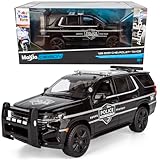
- Licensed Product through Maisto
- 1/26 Scale measuring approx 8x3x3 inches
- Opening front doors, detailed interior, made of diecast metal
- Shipped in a corrugated mailer box for better protection, not a remote control, not a builder kit
Top speed is only one measure of a fast police car
The fastest car depends on what “fast” means:
- Top speed: The Camaro B4C is the leading candidate, with later LS1 cars commonly reported around 159–163 mph.
- 0–60 acceleration: The 2026 Mustang Mach-E GT recorded 4.03 seconds, ahead of the 5.14-second Chevrolet Blazer EV and 5.95-second Ford Police Interceptor Utility in the cited 2026 testing.
- Road-course performance: The 2014 Charger Pursuit AWD recorded the fastest average dynamics lap in the cited Grattan Raceway evaluation.
- Usable pursuit performance: Braking, cooling, tires, suspension, visibility, cargo capacity, and the ability to maintain speed with police equipment installed all matter.
A car with a spectacular unladen proving-ground result may not behave identically once it carries a radio system, computer, partition, push bumper, light bar, and other patrol equipment.
Why some famous claims do not hold up
- The Camaro B4C did not have one universal 160-mph rating. The 1993½ car has a documented 154-mph MSP result, while later LS1 cars are often reported above 160 mph.
- The Mustang SSP’s 160-mph speedometer is not a performance test. Published references generally place its actual top speed at roughly 137–140 mph.
- The Polara’s 149.6 mph was not an everyday patrol-road result. It was a Chrysler proving-ground figure, with other accounts citing lower speeds.
- Not every Charger Pursuit reaches 150 mph. Engine, drivetrain, gearing, tires, equipment, and electronic limiting all change the result.
- “Pursuit rated” is not a national certification. It is a manufacturer and agency performance designation rather than a universally governed standard.
Sources and test references
Modern comparisons are best grounded in Michigan State Police police-vehicle test results, which include methodology, acceleration, top speed, braking, and dynamics data. Historical references include the Office of Justice Programs archive for the 1993½ Camaro B4C test, period reports on the Caprice and Charger, and documented histories of the Mustang SSP and Dodge Polara.
FAQ
What is the fastest American police car ever made?
The fourth-generation Chevrolet Camaro B4C is the best candidate. Later 2000–2002 LS1-equipped cars are commonly reported at about 159–163 mph, while a 1993½ Camaro B4C has a documented 154-mph Michigan State Police test result.
Was the 1969 Dodge Polara really capable of 149.6 mph?
Chrysler recorded 149.6 mph at its proving ground, and historical accounts cite roughly 147–149.6 mph. That figure should be treated as a test-track result rather than a guaranteed speed for every fully equipped patrol car.
Is the Ford Mustang SSP a 160-mph police car?
No. Some SSP cars used a speedometer graduated to 160 mph, but that does not establish a 160-mph top speed. Published performance references generally place the 5.0-liter SSP around 137–140 mph.
Which police car is quickest to 60 mph?
Among the vehicles covered here, the 2026 Ford Mustang Mach-E GT eAWD recorded the quickest 0–60 time at 4.03 seconds in Michigan State Police preliminary testing. Its 124-mph top speed is much lower than the leading gasoline-powered police cars.
The Bottom Line
The Chevrolet Camaro B4C remains the strongest answer to the question of America’s fastest police car, especially in later LS1 form. Its reported 159–163 mph is ahead of the best documented results for the big V8 sedans and modern turbocharged SUVs.
Recommended Free Tools
The most important qualification is that police-car performance is configuration-specific. A 150-mph V8 Charger does not make every Charger Pursuit a 150-mph car, and a 160-mph speedometer does not turn a Mustang SSP into a 160-mph machine. For a fair comparison, always identify the model year, engine, drivetrain, test method, and whether the number came from an official evaluation or a manufacturer proving ground.
Quick Recap
Product prices and availability are accurate as of the date/time indicated and are subject to change. Any price and availability information displayed on Amazon at the time of purchase will apply.




