Yes, the technology is real—but the headline needs qualification. UNIGRID’s Na+ Fleet is a sodium-ion platform designed for 12V starter and auxiliary systems, including hybrid and electric vehicles. UNIGRID says it can deliver more than 5,000 usable cycles and up to 10 times the cycle life of a comparable lead-acid battery. Those are manufacturer claims for a specific platform, not a guarantee that every sodium-ion replacement will last 10 times longer in every EV.
This is about the 12V low-voltage battery that powers vehicle electronics, not the high-voltage traction battery that drives the car.
As an Amazon Associate I earn from qualifying purchases.
What was actually announced?
UNIGRID’s Na+ Fleet uses sodium chromium oxide, or NaCrO2/NCO, chemistry. The platform is aimed primarily at OEMs, integrators, distributors and fleet applications rather than universal consumer retail replacement.
Windows Errors? Fix Them Before They Spread
Repair common Windows errors and clear accumulated junk for a smoother, more stable PC - no reinstall needed.Free scan · no reinstallOutdated Drivers Are Slowing You Down
One free scan finds every outdated or missing driver and matches the right update for your exact hardware.Free scan · exact hardware matchIts intended applications include conventional vehicles, hybrids, EV auxiliary systems, buses, motorcycles, pickups and other vehicles using a 12V battery format. The company describes an operating window of approximately 8–14.4 volts and performance from −40°C to 60°C. It also claims more than twice the cold-cranking performance of lead-acid across that temperature range.
#1 Best Overall

- Long Cycle Life & Reliable Power: Advanced sodium-ion technology delivers over 4000+ charge cycles, maintaining high capacity and consistent voltage. Perfect for users seeking long-lasting and sustainable energy solutions.
- Safe & Eco-Friendly Chemistry: Built with non-flammable materials and zero lithium or cobalt, this sodium battery provides enhanced thermal stability, non-toxic composition, and environmentally responsible energy storage.
- Lightweight & Compact Design: Compared to traditional lead-acid batteries, this 12V 10A Na-ion battery offers higher energy density with reduced weight, making it ideal for portable solar kits, camping gear, and mobility devices.
- Wide Operating Temperature Range: Performs reliably in -4°F to 140°F, ensuring consistent output for off-grid systems, marine applications, and outdoor power stations — even in harsh environments.
- Smart BMS Protection & Versatile Use: Integrated Battery Management System (BMS) protects against overcharge, over-discharge, overcurrent, and short circuit. Suitable for solar energy systems, RVs, LED lighting, backup power, and DIY energy projects.
Those specifications come from the company announcement reported by North American Clean Energy. They should be treated as product claims until a complete independent test report and vehicle-validation data are available.
What the 5,000-cycle number means
A battery cycle generally represents a defined amount of energy discharged and then replenished. A “cycle” is not necessarily one engine start, one drive, or one day. The result depends on the test’s depth of discharge, current, temperature, voltage limits, rest periods and end-of-life definition.
For example, 5,000 complete equivalent cycles would equal roughly 13.7 years if a battery completed one full equivalent cycle every day. That is only a mathematical illustration—not a service-life promise. An EV’s 12V battery may undergo many shallow cycles, spend long periods in standby, experience occasional deep discharges, or be limited by calendar aging rather than cycling.
UNIGRID’s announcement describes more than 5,000 “usable cycles,” but the cited material does not disclose a complete standardized test protocol or capacity-retention threshold. That makes the figure difficult to compare directly with other products.
Why “10× lifespan” is not the same as 10× the years
UNIGRID’s 10× comparison is against a comparable lead-acid baseline. Lead-acid life varies widely depending on whether the battery is used as a lightly cycled starter battery, an AGM auxiliary battery, or a repeatedly discharged deep-cycle battery.
Rank #2

- Proud US Operations and Customer Support. CSI offers nationwide service and warranty support to help customers with troubleshooting any issues.
- Perfect Match – CSI’s 12V Sodium-Ion Battery is the perfect match for heavy-duty and medium-duty truck, vehicle, RVs, marine, and trolling applications. With super powerful cranking amps -1,500 CCA, and high reserve capacity, it is the best option for the industry’s leading engines: Cummins, Detroit Diesel, Paccar, Mack and Volvo engines.
- Highly accurate BMS – CSI’s 12V Sodium-Ion Battery has a highly accurate BMS which provides thermal management, over-charge, over-discharge, short-circuit, over-current protection and energy equalization protection. This prevents battery damage and ensures battery health.
- Easy Installation – No guesswork. CSI’s 12V sodium-ion batteries are 60% lighter than lead-acid or AGM batteries. There’s no need for heavy weight! This makes it easier to lift and install. This also allows for increased vehicle range.
- Jump Start Button – CSI’s Group 31 Sodium Ion starter batteries have a jump start button that will allow the battery to operate below its programmed State of Charge (SOC) limit, so that the battery can supply DC voltage to restart applications.
A careful interpretation is:
UNIGRID says its sodium-ion platform provides more than 5,000 usable cycles—about 10 times the cycle life of the lead-acid benchmark it uses. That does not establish a 10-times-longer calendar life in every EV.
Heat, vibration, vehicle parasitic loads, charging behavior, low state of charge and faults elsewhere in the vehicle can shorten the real replacement interval. A sodium battery also cannot compensate for a defective DC-DC converter, software problem, telematics load or other electrical fault that repeatedly drains the 12V system.
What’s actually slowing this PC down?
Pick the symptom - the matching free tool is one click away.
Other sodium-ion 12V products
UNIGRID is not the only company listing sodium-ion batteries for low-voltage applications. However, the products differ significantly in size, test conditions, temperature limits and buying route.
| Product | Published cycle claim | Published specifications | Buying route |
|---|---|---|---|
| UNIGRID Na+ Fleet | More than 5,000 usable cycles | 8–14.4V; −40°C to 60°C claimed | OEM, integrator or distributor contact |
| AceOn StamiNa+ soft packs | At least 5,000 cycles with at least 70% capacity retained | 12V packs from 10Ah to 30Ah; charge −20°C to 60°C and discharge down to −40°C listed | Custom quote |
| Coulomb Technology Series-S | More than 4,000 cycles at 80% depth of discharge | 12.8V nominal; 14.6V charge; 10.0V cutoff; charging from 0°C to 45°C | Request a quote |
| Ohmmu H4 Sodium | Three to six times the lifespan of traditional sealed lead-acid, according to Ohmmu | −40°F to 172°F claimed; three-year replacement warranty listed | Aftermarket product page |
These numbers are not directly comparable. AceOn’s claim includes a 70% capacity-retention threshold; Coulomb specifies 80% depth of discharge; and the UNIGRID announcement does not provide the same test detail. A larger cycle number is not automatically a better prediction of service life.
Ohmmu listed the H4 battery at $379 on its U.S. product page as observed in August 2026. That page showed contradictory availability messages—“Sold Out” in one location and “In stock” in another—so buyers should confirm stock before ordering.
Rank #3
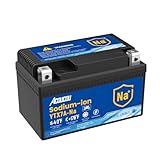
- High-Performance Sodium-Ion: New sodium-ion tech, our Powersports BatteryYTX7A-Na delivers 200 amps for motorcycle starts, 3000+ cycles for longevity. Compared to lead-acid battery, it's 2X more power,10X more starts,and 5X longer life. no activation, no acid, no maintenance and 70% lighter.
- Extreme Temperature: This sodium battery 12V 3.4Ah 40.8Wh YTX7A-Na Reliably operates from -40℉ (-40℃) ~ 176℉ (80℃), delivering stable power in freezing winters or scorching summers, while its maintenance-free design guarantees hassle-free performance. Compared with lithium batteries, it does not bulge or leak, and is safer.
- Wide Compatibility: YTX7A-Na batteryCompatible with most brands and models, motorcycles.
- Dimensions and Lightweight: (L) 5.91 inch x (W) 3.4 inch x (H) 3.7 inch, Item Weight: 2.4 Lbs. YTX7A-Na Replaces battery sizes: YTX7A-4, ETX7A-BS, LTX7A-BS, NTX7A-BS, FTX7A-BS, ENTX7A-BS, GTX7A-BS, MTX7A-BS, CTX7A-BA, M32X7A, MF12V7-2A, MFA127AH, PTX7A-BS, UTX7A, YTZ10S, CTZ10S, CTZ10S-BS, EBZ10-BS, EBZ10A-4, EBZ10A-4-1, FAITZ10S, FAYTZ10S, GTZ10S, LTZ10-4, M7210
- Safe and Fast Charging: Battery ytx7a-bs Charges from 20% to 80% in 15 minutes with built-in smart protection, auto-switching to constant voltage mode for secure, efficient charging and extended lifespan
Why sodium-ion is attractive for EV 12V systems
Cold-weather potential
Cold performance is one of the most relevant claimed benefits. UNIGRID claims operation to −40°C, while AceOn lists discharge operation to −40°C and Coulomb lists a narrower −20°C to 60°C operating range.
Free tools Windows power users keep installed
One-click scans. No signup required.
Discharge and charging limits are different, however. AceOn lists charging from −20°C, while Coulomb lists charging only from 0°C. A battery that can discharge in extreme cold may still require the vehicle to prevent charging until the pack warms up.
Potentially lower reliance on critical minerals
Sodium-ion chemistry uses sodium rather than lithium as the primary ion carrier. AceOn describes its packs as cobalt- and lithium-free. That may reduce dependence on some constrained battery materials, although a complete battery pack still contains other materials and manufacturing inputs.
Less maintenance
Commercial sodium-ion packs generally avoid the watering and acid-maintenance requirements associated with conventional flooded lead-acid batteries. Complete packs may still use electronic protection, balancing or a battery-management system (BMS), depending on the design.
Weight and safety claims
Coulomb lists its 100Ah Series-S battery at 8.5kg and says it can be up to 60% lighter than an equivalent lead-acid battery. That is a product comparison, not a universal characteristic of all sodium-ion batteries.
Recommended Free Tools
Rank #4

- NoLi Sodium 50Ah Limitless Lithium Battery Up to 13,000W 10v-16v
- Compatible with vehicle type: Motorsport
- Item weight: 18.0 pounds
- Voltage: 16.0 volts
UNIGRID describes its NCO chemistry as passive and having no fire risk, while Coulomb markets its chemistry as reducing thermal-runaway risk. These claims should not be interpreted to mean that a complete battery pack, wiring system or vehicle installation cannot fail, overheat, vent or cause damage.
Compatibility matters more than chemistry
A “12V” label and a standard battery shape do not guarantee compatibility with an EV. The replacement must satisfy the vehicle’s mechanical, electrical and control-system requirements.
- Confirm the vehicle: Check the exact make, model, model year and factory battery group.
- Check physical fitment: Verify dimensions, hold-down hardware, terminal type, polarity, terminal location and any required venting or enclosure provisions.
- Compare voltage behavior: Check nominal voltage, maximum charge voltage, low-voltage cutoff and resting-voltage profile. The vehicle’s DC-DC converter must be compatible.
- Verify current capability: Look for continuous discharge current, short-duration peak current, cold-cranking or contactor-closing current, and maximum charging current. Capacity alone is not enough.
- Review temperature limits: Separate charge and discharge limits are essential, especially for vehicles exposed to freezing temperatures.
- Understand the protection system: Determine whether the pack is passive or has an integrated BMS. Check protection against overvoltage, undervoltage, overcurrent, short circuits, reverse polarity and excessive temperature.
- Check vehicle procedures: Some vehicles require battery registration, a reset, a specific battery-monitoring profile or dealer programming after replacement.
- Request evidence: Ask for the full datasheet, cycle-test conditions, capacity-retention threshold, warranty, UN38.3 transport testing, vibration and shock testing, EMC testing and environmental qualification.
“Drop-in” may describe only nominal voltage and mechanical fit. It does not necessarily confirm that the BMS, low-voltage cutoff or charging behavior will work correctly with a particular EV.
Independent reader supportYour contribution helps us test, update, and keep practical guides available for everyone.Special considerations for EV auxiliary batteries
An EV’s 12V battery does not necessarily have the same duty cycle as a conventional engine-starting battery. The high-voltage system normally powers the vehicle’s low-voltage bus through a DC-DC converter, while the 12V battery supports control modules, alarms, locks, lighting, infotainment, computers, contactors and recovery functions.
Do these 3 things before closing this tab:
1Fix the driver behind crashes, sound loss and screen glitches2Repair Windows errors before they cause bigger problems3Scan for outdated or missing drivers - takes under a minuteThe battery may experience shallow cycling, long standby periods and persistent parasitic loads rather than regular deep cycles. Consequently, a deep-cycle laboratory rating may not predict calendar life in an EV.
Best Value

- [Superior Performance]: Discover exceptional performance with our 12V 10Ah LiFePO4 battery. Designed for power wheels and similar applications, it offers high energy density, a long cycle life, and superior safety features. The built-in BMS (Battery Management System) protects against overcharging, over-discharging, over-current, and short circuits. Additionally, the battery's low self-discharge rate allows for hassle-free storage of up to one year. (Note: This battery is not intended for vehicle starting purpose)
- [IP67 Waterproof & Versatile Applications]: Power your devices with the newly upgraded GOLDENMATE 12V 10Ah LiFePO4 lithium battery, now featuring IP67 waterproof protection. Weighing just 3.3 pounds, it’s lightweight and perfect for a wide range of applications, including emergency lighting (LED strips, etc.), 12V routers, RV and outdoor camping, kids’ ride-on toys, power wheels, fish finders, kayaks, small UPS systems, backup power, ham radios, home alarms, remote cameras, fire security systems, and solar/wind power setups
- [5000+ Cycles, 10-Year Lifespan]: Unlike traditional lead-acid batteries, which typically offer a 3-year lifespan and 300-500 cycles, the GOLDENMATE 12V 10Ah LiFePO4 battery stands out with an impressive 10-year lifespan and over 5000 deep cycles. While the initial cost of LiFePO4 batteries may be slightly higher than that of lead-acid alternatives, their extended lifespan and superior cycle performance lead to a lower overall cost of ownership. Choosing the 12V 10Ah LiFePO4 battery ensures long-lasting efficiency and delivers significant savings in both time and money
- [Flexible Expansion, Reliable Recharge]: Need more power? The GOLDENMATE 12V 10Ah LiFePO4 battery offers flexible expansion options, allowing you to easily increase voltage or capacity by configuring the batteries in series or parallel. You can connect up to four batteries in series or parallel, achieving a total capacity of up to 51.2V 40Ah. With a continuous discharge capability of up to 10A, this 12V waterproof battery is well-suited for demanding off-grid applications such as fish finders, camping lights, and kids' ride-on toys
- [Easy to Recharge and Maintain]: The GOLDENMATE 12V 10Ah LiFePO4 battery is simple to recharge using a compatible LiFePO4 battery charger, solar panel with MPPT, or generator. With a maximum charge current of 5A, it’s an excellent choice for users who prioritize quick charging times. Unlike lead-acid batteries, this lithium battery requires no regular maintenance—no need for water refills or other upkeep. This makes it a convenient, hassle-free solution for all your energy storage needs
Vehicles that repeatedly run down their 12V battery should be diagnosed before installing an upgrade. A replacement will not fix a failed DC-DC converter, abnormal sleep-mode draw, charging-control fault or software issue.
Sodium-ion versus AGM, LFP and conventional lead-acid
| Option | Strengths | Limitations |
|---|---|---|
| Factory lead-acid or AGM replacement | Lowest compatibility risk, established service support and usually lower upfront cost | Heavier; may tolerate repeated deep discharge poorly |
| Sodium-ion | Promising cycle life, potentially strong cold-weather performance and reduced reliance on lithium-based materials | Limited independent field data, fragmented supply and vehicle-specific compatibility questions |
| 12V LFP | Mature aftermarket availability, strong cycle life and high usable energy in suitable systems | Requires appropriate BMS and low-temperature charging protection; not universally drop-in |
There is no universal chemistry winner. Factory lead-acid or AGM remains the most conservative choice when compatibility, price and service availability matter most. Sodium-ion may be attractive for a validated application exposed to cold, heat, vibration or repeated auxiliary cycling. LFP can be compelling where the vehicle and BMS are explicitly compatible.
What is available to consumers now?
The market is fragmented. UNIGRID’s Na+ Fleet is presented as an OEM and integrator platform, not a universal online replacement. AceOn’s packs are custom products, and Coulomb uses a quote-based sales route. Ohmmu offers a vehicle-specific aftermarket route, but fitment and stock should be confirmed directly.
That means the most important purchase question is not simply “Which chemistry has the highest cycle count?” It is “Which battery has documented electrical behavior and validated fitment for this exact vehicle?”
The verdict
The 5,000-cycle figure is credible as a published specification for particular sodium-ion 12V products. The “10× lifespan” statement appears to be a cycle-life comparison with a selected lead-acid benchmark, not proof that every EV owner will receive 10 times as many years of service.
Sodium-ion 12V batteries are moving beyond laboratory discussion into commercial automotive and auxiliary products. But buyers should prioritize verified fitment, surge current, charge-temperature limits, protection behavior, warranty and testing data over an impressive headline number.
Quick Recap
Product prices and availability are accurate as of the date/time indicated and are subject to change. Any price and availability information displayed on Amazon at the time of purchase will apply.
The Tool Desk
Outbyte PC Repair FREEClear out junk files and repair common Windows errorsFree Scan →Outbyte Driver Updater FREEScan for outdated or missing drivers - takes under a minuteDriver Scan →



