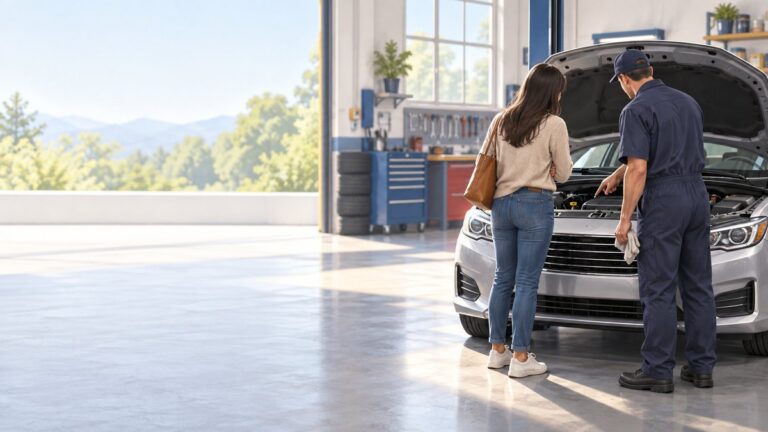
Before you buy a used car, check its records, identity, condition, and sale terms—and arrange an independent inspection. No single check can establish that a car is sound: a history report can miss problems, a visual walk-around cannot diagnose hidden faults, and a test drive is not a substitute for a mechanic’s assessment. Use these ten checks to decide whether to proceed, negotiate, or walk away.
What should you check before buying a used car?
Work through these checks before committing to a purchase. Some are things you can do yourself; others require records, an official lookup, or a qualified mechanic.


-
Match the car to your needs and full budget
Consider how you will use the car, such as commuting, carrying passengers, or driving regularly in heavy traffic. Compare the asking price with the total cost of ownership: include taxes, registration, insurance, fuel, and expected maintenance. Ask the seller for the total price with fees rather than judging the deal by an advertised payment or price alone. Consumer.gov’s car-buying guidance recommends accounting for these costs.
-
Match the vehicle identification number and documents
Check that the vehicle identification number (VIN) on the car matches the VIN on the documents and in any history or recall lookup. Ask to see the title and confirm that the person selling the car has authority to sell it. Title-transfer steps and other requirements vary by location, so check your state or local motor vehicle agency for the rules that apply to your transaction.
What’s actually slowing this PC down?
Pick the symptom - the matching free tool is one click away.
Special offer. See more information about Outbyte and uninstall instructions. Please review EULA and Privacy policy. -
Review a vehicle history report
Look for reported ownership and mileage information, accidents, flood damage, and title or salvage information where available. Report coverage varies, and an event may be missing if it was never reported or recorded. The Federal Trade Commission says, “A vehicle history report is not a substitute for an independent vehicle inspection.” Its used-car guidance explains that a report may help reveal history but cannot establish the car’s current mechanical condition. The FTC identifies NMVTIS-approved providers for title-history reports; it does not endorse a particular commercial provider.
-
Read maintenance and service records
Ask for dated service receipts, maintenance records, and inspection records. Compare the dates and mileage entries, and check whether recommended maintenance appears to have been done. Missing paperwork leaves uncertainty; it does not, by itself, prove the car was neglected. Bring any gaps or conflicting entries to the mechanic you choose for an independent inspection.
-
Check for open safety recalls by VIN
Use the NHTSA recall lookup to check the specific vehicle’s VIN. Ask the seller whether recall repairs have been completed, and confirm with the manufacturer if needed. Recall information is vehicle-specific and can change, so check close to the purchase rather than relying on an old lookup or a seller’s general statement.
-
Walk around the car and check the cabin
Look for visible damage, uneven or unusual wear, warning lights, and anything that seems inconsistent or concerning. Note what you see so you can ask the seller or mechanic about it. A buyer’s visual check can flag questions, but it cannot diagnose hidden mechanical or structural problems or prove the car is roadworthy.
Recommended Free Tools
Special offer. See more information about Outbyte and uninstall instructions. Please review EULA and Privacy policy. -
Compare the odometer with the records and wear
Compare the displayed mileage with dated service or inspection records. Consider whether the visible wear seems plausible for that mileage. The National Highway Traffic Safety Administration advises buyers to look for wear that does not seem consistent with the odometer reading; a mismatch is a reason to investigate, not proof of fraud. See NHTSA’s odometer-fraud guidance.
-
Take a realistic test drive
Drive in conditions similar to your normal use. If your commute involves heavy traffic, include that kind of driving when practical. Pay attention to unusual noises, handling, braking, warning indicators, or other concerns, and share them with the mechanic. A drive can reveal issues worth investigating, but it cannot replace a professional inspection.
-
Arrange an independent mechanical inspection
Choose a mechanic you trust, rather than relying only on the seller’s or dealer’s assessment. Ask for a written report that identifies the car by make, model, and VIN, and request repair-cost estimates for any issues found. The FTC recommends an independent inspection even when a vehicle is described as certified or has already been inspected by a dealer. If the seller will not allow an independent inspection, consider another car; a mobile inspection may be an option. See the FTC’s guidance on buying from a dealer and its used-car advice.
-
Review the sale terms and total price in writing
If buying from a dealer, read the Buyers Guide to see whether the car is sold “as is” or with a warranty, and what repairs or costs the warranty covers. Read the warranty itself; do not assume all used cars have the same protections. For a private-party sale, dealer-specific Buyers Guide requirements do not apply in the same way, and local rules may differ. Ask for the complete price, including fees, and get promises or agreed repairs in writing. Use the inspection report and estimates to decide whether to negotiate or walk away. The FTC explains dealer disclosures in its dealer-buying guidance and Dealer’s Guide to the Used Car Rule.
Do these 3 things before closing this tab:
1Repair Windows errors before they cause bigger problems2Scan for outdated or missing drivers - takes under a minute3Clear out junk files and repair common Windows errorsSpecial offer. See more information about Outbyte and uninstall instructions. Please review EULA and Privacy policy.Best Value
 Detailed Driver's Vehicle Inspection Report, Pre Trip Inspection Book
- These driver's vehicle inspection report (DVIR) books comply with DOT regulations 49 CFR 396.11 and 396.13.
- Our DVIR inspection book contains a vehicle inspection checklist that comprehensively lists specific tractor/truck and trailer parts to help simplify the inspection process. This allows drivers to quickly mark any needed repairs.
- DVIR books include essential DOT regulations which are printed on the inside cover to remind drivers of the DOT-required procedures they must follow. And there are instructions for filling out a DVIR form to simplify the completion.
- This package comes with 10 books. Each book contains 35 sets of DVIR forms, in duplicate. In total, you will receive 350 forms. Compact 8.5" x 5.5" size facilitates easy handling and record-keeping.
- Our inspection report books are made of carbonless, premium paper that withstands daily use. Whether you manage a single vehicle or a large commercial fleet, our DVIR book is an essential tool for ensuring the safety and compliance of your operations.
How do a history report and an inspection differ?
| Check | What it can help establish | What it cannot establish |
|---|---|---|
| Vehicle history report | Reported ownership, mileage, accident, flood, or title information, depending on the report’s coverage. | Complete history or the car’s current mechanical condition. |
| Independent mechanical inspection | A mechanic’s assessment of the vehicle’s present condition and concerns that may need repair, documented in a report. | A complete record of the car’s past or a guarantee that no future problem will occur. |
Use both when possible: one addresses recorded history, while the other evaluates current condition. Neither makes the other unnecessary.
What does “as is” mean on a dealer’s Buyers Guide?
The Buyers Guide tells you whether a dealer is offering the car “as is” or with a warranty, and provides information about which repairs or costs are covered. Read it alongside the actual warranty terms and the written sale documents. Do not assume that the dealer’s certification or inspection means the car has a warranty or that every repair will be covered. Dealer disclosure rules and private-party transactions are not interchangeable, and location-specific requirements may vary.
When should you negotiate or walk away?
Use the findings—not a single clean report or reassuring test drive—to make the decision. Ask questions about inconsistencies, have a mechanic assess concerns, and compare repair estimates with the total price you can afford. If you cannot verify key documents, the seller will not allow an independent inspection, or the written terms do not match what was promised, pause the transaction or consider another car.
A checklist can help you remember questions and observations; the FTC notes that used-car checklists are available in books and other publications. It is an organizing aid, not diagnostic equipment or a replacement for a mechanic’s inspection. See the FTC’s Buying a Used Car booklet.
Quick Recap
Product prices and availability are accurate as of the date/time indicated and are subject to change. Any price and availability information displayed on Amazon at the time of purchase will apply.