Honda’s 2.0-liter VTEC Turbo is distinctive because it pairs turbocharging and direct injection with a specific cam-control strategy, then revises that package across Civic Type R generations. It is not one universal engine specification: output and hardware depend on the application, model year, market, and rating convention.
Here are ten documented points that explain what sets the engine apart, how the Type R version evolved, and how it differs from Honda’s earlier naturally aspirated 2.0-liter VTEC engine.

1. It began as part of a turbo-engine family
Honda’s 2013 VTEC TURBO announcement described a family of direct-injection gasoline turbo engines, including a 2.0-liter four-cylinder—not one fixed specification for every car. Honda said the 2.0-liter version produced more than 280 HP in that launch-era announcement. That figure should not be treated as the rating for every later Type R or other application.
2. VTEC works alongside turbocharging
The combination is more specific than simply adding a turbo to a familiar VTEC engine. Honda’s launch description presented variable valve motion, direct injection, and turbocharging as technologies used together. In the Civic Type R K20C1, Honda describes VTEC on the exhaust cam and VTC, or variable timing control, on both intake and exhaust cams.
Recommended Free Tools
#1 Best Overall

- Package Dimensions: 6.858 L x 22.352 H x 10.922 W (centimeters)
- New and improved formula that meets quality standards
- Improved shift quality
- Lower fluid friction
3. The cam strategy manages valve overlap
Honda’s explanation of the K20C1 describes different valve timing approaches across the rev range. At low-speed wide-open throttle, timing favors scavenging; at high engine speeds, the high-lift exhaust-cam profile is used and valve overlap is reduced. This is Honda’s account of the system’s intended operation, not an independent comparison with rival engines.
4. Turbo response was an explicit design target
Honda’s 2020 U.S. Civic Type R guide credits a small-diameter turbine wheel with helping reduce turbo lag. That is the manufacturer’s explanation of the design, not a measured claim that it responds faster than every competitor. Turbo response should also be understood in the context of a particular Type R generation and its calibration.
5. The U.S. 2020 Type R pairs the turbo with direct injection and an intercooler
For the 2020 U.S.-market Civic Type R, Honda lists direct injection and an intercooler among the engine’s features. These details describe that model-year configuration; they should not be assumed to establish identical specifications for every K20C-family application or market.
Rank #2

- Smooth Gear Shifting: Clutch release fork effectively improves the clutch disengagement effect, making gear shifting smoother and reducing lagging, and improving driving comfort
- Improve Safety: Effectively solve the problem of unstable connection between clutch pedal and pressure plate, protect the engine, and improve driving safety
- Long Service Life: Clutch release fork is made of high-strength metal material, with precision machining and anti-corrosion treatment on the surface, providing strong durability and corrosion resistance, and a long service life
- Compatible with Models: Fit for Honda Accord 2003-2020 (Manual Transmission, 4-Cylinder), Fit for Honda Civic 2002-2015 (Manual Transmission / Si Models), Fit for Honda Civic 2016-2024 (Manual Transmission), Fit for Honda Civic Type R 2017-2021, Fit for Honda Civic Type R 2023+, Fit for Honda CR-V 2002-2006 (Manual Transmission), Fit for Honda Element 2003-2010, Fit for Honda HR-V 2016-2018 (Manual Transmission), Fit for Acura RSX 2002-2006, Fit for Acura TSX 2004-2014, Fit for Acura ILX 2013-2015, Fit for Acura Integra 2023-2026 (6MT), Replace part number: 22821-PPP-000
- Easy to Install: Perfectly compatible with multiple Toyota models, it can be replaced on its own without the need for complex tools or professional skills, saving you time and costs
6. Honda identifies a specific exhaust-valve heat measure
Honda’s 2020 Type R guide cites sodium-filled exhaust valves as a way to conduct heat away from the valve faces and support dependability. This is a documented detail of Honda’s technical description. It does not, on its own, establish a particular service life or prove that the engine is immune to heat-related problems.
Do these 3 things before closing this tab:
1Scan for outdated or missing drivers - takes under a minute2Repair Windows errors before they cause bigger problems3Fix the driver behind crashes, sound loss and screen glitches7. Type R development had more than peak output as a goal
In its 2025 engineering account, Honda says the FK2 Type R development target combined high output and torque with high-rev capability, circuit durability, drivability, and environmental performance. This describes Honda’s stated development aims; it is not independent evidence of reliability under every driving condition.
8. Honda revised the package rather than simply raising boost
Honda says the FL5 Type R’s gains came with a redesigned turbo and changes to the intake, intercooler, exhaust, and controls. Its account says simply increasing boost risked compromising response. The FL5 should therefore be understood as a revised application, not just the same engine turned up.
Rank #3

- Whether it is simple maintenance or complete restoration, do not start work without Clymer, the leader in service manuals
- Save yourself time and frustration with these procedures and techniques used by the professionals
- Comprehensive manuals contain exploded views, drawings, specifications and charts that illustrate each job
- Feature shortcut repairs and high-performance modifications
9. Type R output changed across generations
Honda’s 2025 Type R history reports different outputs for the K20C-powered generations. These are Honda-reported figures with their original units; PS is not interchangeable with U.S. mechanical horsepower, and Nm is not the same unit as lb-ft.
| Type R generation | Honda-reported output | Context |
|---|---|---|
| FK2 | 310 PS / 400 Nm | Honda’s generation account also reports a 7,000-rpm red zone. |
| FK8 | 320 PS | Honda attributes the increase in part to revised exhaust routing and cooling changes. |
| FL5 | 330 PS / 420 Nm | Honda reports revisions to turbo components, intake, intercooler, exhaust, and controls. |
These figures are a generation-by-generation account from Honda, not a controlled test of an unchanged engine. Ratings and specifications can vary by market. For a separate U.S. example, Honda lists the 2020 Civic Type R at 306 hp at 6,500 rpm and 295 lb-ft from 2,500 to 4,500 rpm, using premium unleaded fuel.
10. It is different in character from Honda’s earlier 2.0-liter VTEC
The turbo K20C is not Honda’s first 2.0-liter VTEC engine. Honda’s history lists the naturally aspirated S2000 F20C at 250 PS with a 9,000-rpm redline. That provides a useful contrast in engine concept and operating character: the F20C is naturally aspirated and high-revving, while the K20C Type R applications combine turbocharging with VTEC and cam timing control. They are different engines from different vehicle eras, not successive versions of one design.
Rank #4
FAQ
What makes Honda’s 2.0-liter VTEC Turbo engine unique?
Its documented distinction is the combination of turbocharging and direct injection with Honda’s cam-control approach. In the Type R K20C1, Honda describes exhaust-cam VTEC and VTC on both cams, alongside generation-specific turbo and supporting-hardware revisions.
Does the Civic Type R 2.0-liter turbo still use VTEC?
Yes. Honda says the K20C1 uses VTEC on the exhaust cam, with VTC on the intake and exhaust cams. The cam strategy is part of how the engine manages operation across different engine speeds.
How much horsepower does the Honda 2.0T make?
There is no single answer for every application. Honda lists 306 hp at 6,500 rpm for the 2020 U.S. Civic Type R, while its generation history reports 310 PS for FK2, 320 PS for FK8, and 330 PS for FL5. Those figures use different rating contexts and units, so identify the model, generation, market, and unit when comparing them.
The Tool Desk
Outbyte Driver Updater FREEFix the driver behind crashes, sound loss and screen glitchesFind Drivers →Outbyte PC Repair FREERepair Windows errors before they cause bigger problemsFix Now →Best Value
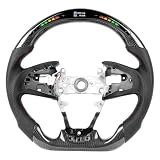
- 3K Carbon Fiber: This steering wheel uses a carbon fiber process process, 3K carbon fiber and resin are mixed and cured under high temperature environment, lightweight and high temperature resistance. Its texture is beautiful, not easy to crack, making it easy for car enthusiasts to upgrade your car interiors
- Unique Design: The handles on both sides are made of perforated leather, which is sweat-absorbent and breathable, giving you a better driving experience. The red hand-stitched thread is hand-sewn by experts, adding some unique style to the interior of the car. D-Shaped flat-bottom design provides more legroom, improves driving comfort
- LED Function: Stay informed with clear and intuitive LED indicators showing speed, RPM, LAP, engine load, water temperature, voltage, and more. LED shift indicators gradually light up green as RPM increases, flashing red when it's time to shift up. It can also change the rpm and the color of the lamp beads by yourself
- Fitment: This steering wheel is suitable for Honda Civic Gen 10th, Type R FK8 2016-2021. Please check your original car steering wheel before purchasing to ensure smooth installation. The item includes 1× steering wheel, 1× OBD box, 1× OBD harness and 1× user manual. We recommend that you go to a professional place for installion
- Our Service: We offer a one-year manufacturer's warranty for all product we sold. If there is any quality or other problem with the product, please reach us
Is the Accord 2.0T engine the same as the Civic Type R engine?
No. Honda describes the Accord K20C4 and Civic Type R K20C1 as related applications, not the same engine specification. Their outputs and vehicle applications should not be conflated.
How is the K20C different from the S2000 F20C?
The F20C is a naturally aspirated 2.0-liter VTEC engine that Honda lists at 250 PS and a 9,000-rpm redline. The Type R K20C combines turbocharging with VTEC and VTC. They illustrate different approaches and are separate engines.
Quick Recap
Product prices and availability are accurate as of the date/time indicated and are subject to change. Any price and availability information displayed on Amazon at the time of purchase will apply.




