Recommended Free Tools
The Ford GT40 is considered a legend because it won the 24 Hours of Le Mans four years in a row, from 1966 through 1969, and because the path to those wins combined a defining rivalry, engineering setbacks, strategic drama and a lasting racing legacy. These ten reasons are an editorial guide, not an official ranking.
1. Four consecutive Le Mans victories
Ford GT40s won the 24 Hours of Le Mans in 1966, 1967, 1968 and 1969. Four straight victories gave the program an exceptional endurance-racing record. The wins came with different cars and teams, however, rather than one unchanged specification or a single continuous factory effort. The Automobile Club de l’Ouest’s account of Ford’s Le Mans legacy and Ford Racing’s chronology document the run.
2. The 1966 podium sweep made the breakthrough unmistakable
In 1966, Ford GT40 Mark IIs finished first, second and third at Le Mans. The sweep was a decisive result for a program that had endured earlier failures, and it made Ford’s challenge to Ferrari visible across the entire podium. Bruce McLaren and Chris Amon were officially declared the winners, as Ford Racing’s record confirms.
3. The 1966 finish turned a victory into a lasting debate
The top two cars reached the finish exceptionally close together. The Le Mans organizer reports a gap of just 20 metres and describes controversy around the team’s finish strategy. The closely grouped cars were part of a planned presentation, but the official result went to McLaren and Amon; Ken Miles was not awarded the overall victory. The controversy is memorable precisely because the finish was both a team achievement and a close sporting outcome. The organizer’s history explains the finish and its controversy.
Quick wins for a faster PC:
Repair Windows errors before they cause bigger problemsFix Now →Scan for outdated or missing drivers - takes under a minuteDriver Scan →Clear out junk files and repair common Windows errorsFree Scan →#1 Best Overall
- SIDE PANEL STRIPES
- MASKING TEMPLATE
- SNAP-TOGETHER ASSEMBLY
- RUBBER TIRES
- CHROME & CLEAR PARTS
4. The Ford–Ferrari rivalry gave the project clear stakes
The GT40’s story is inseparable from Ford’s effort to beat Ferrari at Le Mans. Ford’s history traces its racing push to negotiations with Ferrari that ended in 1963: a May 22 newswire statement said talks toward collaboration had been suspended by mutual agreement. Ford then pursued a racing GT for major road races. That sequence supplies the program with a compelling competitive backdrop without reducing the engineering story to a personal feud. Ford’s account of the 1964 entry and early failure describes the negotiations and subsequent effort.
5. The GT40 was built through a broad collaboration
The car emerged from Ford engineering and outside racing expertise, assembled under a demanding timetable. Ford’s 2019 account identifies Roy Lunn’s engineering work, Eric Broadley’s Lola GT as an influence, John Wyer’s race-management experience and Carroll Shelby’s role in Europe. Lunn lowered the car to 40 inches, a dimension that became part of the GT40 name. The result was not the product of one lone designer or one department, but a coordinated attempt to create a competitive mid-engine racing GT.
Rank #2

- BUILD A RACING LEGEND – Relive motorsport history with the LEGO Technic 1966 Ford GT40 MKII Race Car model kit for adults ages 18 years old and up
- REALISTIC FEATURES & FUNCTIONS – Steer using the knob on top, open the doors to explore the interior, lift the engine cover to reveal the V8 engine, and press the lever inside to open the hood
- AUTHENTIC 1966 DESIGN – This vintage race car model features iconic black and silver design inspired by the real Ford GT40 MKII champion car
- DISPLAY-WORTHY COLLECTIBLE – Showcase this legendary race car as office decor or shelf decor in any room to celebrate one of motorsport's greatest icons
- GIFT FOR MEN & WOMEN – Makes a thoughtful gift for car lovers, racing enthusiasts, and adults who enjoy classic cars and STEM toys
6. Its early failures made the later wins a story of development
The first GT40s had speed, but speed alone could not survive a 24-hour race. Ford’s historical account describes high-speed aerodynamic problems and endurance concerns; early retirements also followed gearbox and suspension failures. Those setbacks are important to the legend because they show the program confronting the difference between a fast car and a reliable one. The Le Mans victories came after a process of identifying and addressing weaknesses, not simply by turning up the engine power.
7. The 427 GT40X showed how far Ford was willing to push development
For 1965, Ford developed the GT40X around a 427-cubic-inch engine. Ford reports that Ken Miles reached 210 mph on the Dearborn test-track straight, and that the car recorded a 3:33 practice lap at Le Mans. Those figures describe testing and practice, not a race result: the 1965 campaign ended in failure amid rushed preparation and mechanical problems. The GT40X is significant as a development step, not as a Le Mans winner. Ford’s 2019 GT40X history gives that context.
Rank #3

- ICONIC SCALE MODEL: KiNSMART Ford GT40 MKII Heritage Edition die cast metal toy car in a 1:32 scale, measuring approximately 5 inches long.
- DIE CAST METAL CONSTRUCTION: Built from high-quality die cast metal for a realistic look and feel, making it a great collectible or play toy.
- PULLBACK ACTION: Features a fun pull-back motor mechanism that lets the car zoom forward on its own with a simple pull and release.
- OPENABLE DOORS & RUBBER TIRES: Doors open for added realism, and rubber tires provide smooth rolling on most flat surfaces.
- RECOMMENDED AGE: Designed for children ages 3 and up. Contains small parts — not suitable for children under 3 years of age.
8. Durability and brake work addressed the realities of 24-hour racing
Ford’s account of its 1966 development effort describes an engine endurance target of up to 48 hours—twice the duration of the race—and work on brake performance, including arrangements intended to make brake changes quicker. These were practical responses to the demands of endurance racing: components had to last, and service work had to be manageable when time mattered. Ford’s historical page reports these development aims; they should be understood as the company’s account rather than an independent test report. Ford’s history of the 1966 campaign describes the engine and brake work.
Independent reader supportYour contribution helps us test, update, and keep practical guides available for everyone.9. The winning cars reflected an evolving program
“The GT40” at Le Mans was not one fixed car. Ford’s chronology identifies different winning models and teams across the four-year streak:
Rank #4

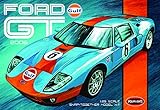
- Details include: depictions of buttresses, door-side air tunnels and underside design.
- Multi-piece depictions of head and taillights for superb realism.
- The interior features depictions of seats with separate parts used to capture door panels, rear view mirror and steering wheel.
- Comes with metal-plated wheel and oil tank parts for a realistic finish.
- Decals included to create various markings, including optional racing stripes.
| Race year | Winning car or entrant | Drivers recorded by Ford Racing |
|---|---|---|
| 1966 | Ford GT40 Mark II | Bruce McLaren and Chris Amon |
| 1967 | Ford Mark IV | Dan Gurney and A. J. Foyt |
| 1968 | Ford GT40 | Pedro Rodríguez and Lucien Bianchi |
| 1969 | Ford GT40 | Jacky Ickx and Jackie Oliver |
The shift from the Mark II to the Mark IV, followed by GT40 wins in 1968 and 1969, captures an evolving effort shaped by engineering, teams and the competitive conditions of each year. The Ford Racing chronology records the winners and models; the 1965 GT40X, by contrast, was a development car rather than one of the four winning entries.
10. John Wyer’s team kept the GT40 winning after Ford’s factory withdrawal
Ford withdrew as a factory constructor in 1968, but the GT40’s Le Mans story did not end with the factory campaign. John Wyer’s program carried the car to victories in 1968 and 1969, with Pedro Rodríguez and Lucien Bianchi winning the first of those and Jacky Ickx and Jackie Oliver the second. The distinction matters: the four-win record belongs to the GT40 program, while the later victories demonstrate that its competitiveness extended beyond Ford’s factory operation. The Le Mans organizer describes Wyer’s role in the later successes.
Crashes, No Sound, or Screen Glitches?
Random freezes, missing sound and display glitches usually trace back to one bad driver. Find and replace yours safely.Free scan · under a minuteWindows Errors? Fix Them Before They Spread
Repair common Windows errors and clear accumulated junk for a smoother, more stable PC - no reinstall needed.Free scan · no reinstallQuick Recap
Product prices and availability are accurate as of the date/time indicated and are subject to change. Any price and availability information displayed on Amazon at the time of purchase will apply.




