The Tool Desk
Outbyte Driver Updater FREEFix the driver behind crashes, sound loss and screen glitchesFind Drivers →Outbyte PC Repair FREEClear out junk files and repair common Windows errorsFree Scan →Short answer: Gasoline cars are still the more practical choice for some drivers, especially those who take frequent long trips, tow, live in rural areas, lack dependable home charging, need a lower purchase price, or want the widest selection of vehicles and repair shops. That does not make gasoline cars universally better. EVs can be cheaper to run, require less routine maintenance, and work extremely well for drivers with reliable home charging and predictable daily routes.
This comparison uses gas cars to mean conventional gasoline-powered vehicles and EVs to mean battery-electric vehicles. The strongest evidence applies to the United States, where charging availability, electricity prices, fuel prices, vehicle inventory, incentives, and repair access vary by region.
As an Amazon Associate I earn from qualifying purchases.
When a gas car is the better fit
The right question is not whether one powertrain wins every category. It is whether the vehicle fits the way you actually travel. A gas car usually has the advantage when you cannot reliably charge at home, regularly drive beyond major highway corridors, tow a trailer, travel in remote areas, or need to minimize the amount financed at purchase.
| Driver situation | Why gasoline may be more practical | What to verify before buying |
|---|---|---|
| Frequent long-distance travel | Shorter, more predictable refueling stops | Fuel availability and the vehicle’s highway range |
| Towing or hauling | Less disruption when the added load reduces range | Payload, tow rating, trailer aerodynamics, and route access |
| Apartment or street parking | No need to arrange a private charging location | Nearby public chargers, pricing, reliability, and wait times |
| Budget-constrained purchase | More choices at lower transaction prices in many markets | Total cost of ownership, incentives, financing, and used inventory |
| Rural or remote driving | Less dependence on public charging infrastructure | Fuel stops, backup routes, and local repair support |
1. Refueling is usually faster and more predictable
A gasoline vehicle can typically add hundreds of miles of driving range during a short stop. Department of Energy materials use an illustrative comparison of roughly 400 miles of gasoline range added in about five minutes, while charging can take much longer depending on the equipment and vehicle.
#1 Best Overall

- FITMENT: This gas pedal compatible with GM, Chevy, Ford, Mopar and other models and is a perfect addition to street rat rod projects. Please make sure your model fits this accelerator pedal before purchasing. The pedal pad measures 1.77"*4.53" and has enough contact surface with your feet to enhance driving control
- HIGH QUALITY MATERIALS: The gas pedal is made of high quality aluminum, light weight but strong performance, not easy to aging, wear-resistant, smooth operation and long service life
- INSTALLATION: This gas pedal does not require a cumbersome installation procedure and uses auniversal firewall mount style. The splines are tightly coupled and will not loosen when tightened and will not impede the movement of the pedal, so there is no need to worry about the use of the pedal
- ADJUSTABLE DESIGN: The angle between the pedal arm and the throttle cable arm can be flexibly adjusted according to the installation needs, up to 360°, matching the driver's habits and comfort. The gas pedal comes with multiple throttle cable holes that can be adjusted to suit specific needs, and is suitable for different settings
- The pedal pads are equipped with non-slip design that enhance contact friction with the foot and ensure proper grip. In addition the metallic look of the gas pedal emphasizes the premium and professional look and adds style to your vehicle
That comparison is not a promise for every gas car or a fixed charge time for every EV. Gasoline refueling varies with tank size, pump speed, station congestion, and how full the tank is. EV charging depends on the battery’s state of charge, temperature, charger output, the vehicle’s maximum charging rate, and its charging curve. A vehicle may accept power quickly at a low state of charge and slow substantially as the battery approaches full. A fast charger that is available in theory may also be occupied, offline, or limited by the car’s own charging capability.
For a driver who values a quick stop and immediate departure, gasoline remains easier to predict. The difference becomes more important on a long trip, when each additional charging stop can add planning and waiting time rather than simply the time needed to connect a hose or cable.
2. Long-distance travel requires less route planning
Gasoline drivers generally plan a long trip around the destination and major fuel stops. EV drivers must plan around more variables: charger locations, connector compatibility, charging speed, station reliability, traffic, weather, elevation, battery state of charge, and the possibility of a queue.
The U.S. charging network is large and expanding. However, the Department of Energy’s Alternative Fuels Data Center distinguishes between charging ports and station locations. A single location can have multiple ports, so a port total is not the same as a station count. Public counts also exclude residential charging, which is where many EV owners do most of their charging. Those definitions make a simple comparison between the number of public charging ports and the number of gasoline stations misleading.
EV route planning can be straightforward on a well-served corridor, particularly when the driver starts with a full battery and has several backup chargers. It is less forgiving when a route has only one usable fast-charging site, when a trailer occupies extra space, or when a charger failure leaves a long gap to the next option. Gasoline’s mature highway network gives it an advantage in convenience and redundancy, even though fuel stations can also be sparse in some remote regions.
3. Gas cars can be more practical for towing and heavy loads
Towing makes any vehicle use more energy. A trailer adds weight, rolling resistance, and aerodynamic drag, and the effect can be especially severe at highway speed. An EV may have strong low-speed pulling power and may be rated to tow, but towing can reduce its usable range enough to require more frequent charging stops.
Those stops are harder to manage than ordinary EV charging. A trailer may block adjacent charging spaces, require the driver to disconnect before charging, or make maneuvering through a busy charging site difficult. A gasoline vehicle also uses more fuel while towing, but it can generally recover a large amount of range during a conventional fuel stop.
Free tools Windows power users keep installed
One-click scans. No signup required.
This is a mission-specific advantage, not proof that EVs cannot tow. Before buying either type of vehicle, check the exact model’s tow rating, payload limit, hitch rating, tongue-weight limit, trailer-brake requirements, and real-world range or fuel-economy expectations with the intended trailer. A small, aerodynamic trailer on a route with reliable pull-through charging is a very different use case from a heavy travel trailer in a remote area.
Rank #2
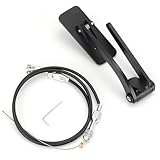
- Compatibility: This is a new black anodized aluminum gas pedal with braided throttle cable,universal pedal for any angle. This gas pedal this firewall bracket universally fits GM, Chevrolet, Ford, and other models. Please make sure your model is suitable for this mounting bracket before purchasing.
- Durable Material: This firewall bracket is made of high quality aluminum alloy, which is lighter in weight but sturdy in performance, more durable and lightweight.
- Enhanced Safety: This pedal can be used as a barrier to protect the driver's side.
- Aesthetically pleasing design: The appearance of black paint, not only enhance the visual appeal of the product, but also can be perfectly integrated with the interior of the vehicle, adding fashion and sporty feeling to the vehicle.
- Simple installation: No tedious installation procedure is required, providing a stable base for installing the throttle pedal and a safety barrier.
4. Gasoline cars are easier for drivers without home charging
Most EV owners do most of their charging at home. That arrangement can be convenient: the car is parked overnight, and the driver starts the day with a full or mostly full battery. But not every driver has a dedicated driveway, garage, or electrical service suitable for charging.
Apartment residents, street parkers, renters, and condominium owners may need permission to install equipment or may have no assigned charger at all. Workplace charging can help, but it depends on the employer, parking access, and the time the vehicle remains there. Public charging makes EV ownership possible without home charging, but possible is not the same as equally convenient. The driver may have to make a separate trip to a charger, wait for an available stall, pay a higher per-kilowatt-hour price, or move the vehicle promptly after charging.
A gasoline car does not require a change to the driver’s parking setup. That makes it the simpler choice for anyone who cannot confirm dependable, affordable charging where the car is parked for several hours.
Windows Errors? Fix Them Before They Spread
Repair common Windows errors and clear accumulated junk for a smoother, more stable PC - no reinstall needed.Free scan · no reinstallCrashes, No Sound, or Screen Glitches?
Random freezes, missing sound and display glitches usually trace back to one bad driver. Find and replace yours safely.Free scan · under a minute5. The upfront purchase price can still favor gasoline
EV affordability is improving, and an EV can cost less to operate over a long ownership period because electricity and routine maintenance may be cheaper than gasoline and conventional service. But purchase price remains a separate issue. The International Energy Agency has reported that the upfront price gap with internal-combustion vehicles remains in most regions, even as lifetime ownership economics improve.
That distinction matters to buyers who are limited by the transaction price, monthly payment, insurance quote, down payment, or available used-car inventory. A less expensive gas car may be the financially workable option today even if a more expensive EV could produce lower operating costs over several years.
Do not assume either powertrain automatically wins on total cost. Compare the purchase price or lease cost, financing, insurance, taxes, incentives, registration fees, electricity rates, gasoline prices, annual mileage, charging location, maintenance, tires, and expected resale value. Incentives and local prices change, so a national estimate should not substitute for a calculation using your own numbers.
6. Gasoline offers a broader choice of vehicle types
Gasoline powertrains remain widely available across compact cars, affordable used vehicles, large SUVs, pickup trucks, vans, sports cars, off-road vehicles, and specialty models. EV choices are expanding quickly, but availability still varies by market, body style, price range, dealer inventory, towing requirement, payload requirement, and desired features.
If you need a particular combination of low price, three-row seating, substantial cargo room, a high payload rating, off-road hardware, a long-distance touring setup, or a specific performance character, gasoline may offer more options to compare. This is a choice-and-fit advantage rather than a claim that gas vehicles outnumber EVs in every category or that EVs lack capable models.
Rank #3

- [Vehicle Fitment]: Compatible with Chevrolet Colorado 2004-2009; Compatible with GMC Canyon 2004-2009; Compatible with Hummer H3 2006-2010, H3T 2009-2009; Compatible with Isuzu i-280 2006-2006, i-290 2007-2008, i-350 2006-2006, i-370 2007-2008
- [Attention]: The accelerator pedal is a critical safety part. Do not operate the vehicle until its function has been verified after installation or maintenance
- [Reference Number]: 699-116, 699116, APS136, 5S7934, AD0444, 25955673, 10376526
- [Specifications]: ①Position Sensor Included: Yes; ②Connector Shape: Rectangular; ③Mounting Bracket Included: No; ④Terminal Quantity: 6 Pins; ⑤Mounting Location: Floor Mounted
- [Directly Fit]: This accelerator pedal assembly is made to the original equipment dimensions for dependable fit and performance
Vehicle availability also matters after the purchase. A gasoline model may be easier to find used, easier to replace after an accident, or easier to source in a specific rural market. The best comparison is local and dated: check the models actually offered by nearby dealers and the used vehicles available within a reasonable distance.
7. Remote and rural travel can be simpler in a gas car
Gasoline vehicles can use the established fuel-delivery network in places where public EV charging is sparse or where a destination has unreliable electrical service. That does not mean EVs cannot travel through rural areas. It means an EV driver may need to verify more conditions before leaving: the distance between chargers, whether the charger is compatible and operational, whether the destination has power, and how much range will remain after arriving.
A route with one dependable fuel station may be manageable in a gas car but uncomfortable in an EV if the nearest fast charger is far away or if winter, headwinds, grades, or a heavy load reduce range. Drivers who regularly visit hunting areas, construction sites, farms, campsites, remote job locations, or rural properties may prefer the lower infrastructure dependence of gasoline.
Recommended Free Tools
Gasoline is not immune to rural limitations. Stations can close early, run out of fuel, or be separated by long distances. The practical advantage is that the existing network is generally more familiar and does not require the same charging dwell time when a driver finds a working station.
8. Cold-weather trips can be less disruptive
Cold weather affects both powertrains. Gasoline cars can lose fuel economy in winter, take longer to warm up, and face problems with the 12-volt battery, fluids, tires, and road conditions. EVs do not stop working in the cold, but low temperatures can reduce available range and increase the energy needed to heat the cabin.
In one Department of Energy test, a fully charged 60-kWh battery-electric vehicle maintaining a 72-degree Fahrenheit cabin lost approximately 8 to 10 miles of range per hour at 20 degrees Fahrenheit and approximately 9 to 12 miles per hour at 0 degrees Fahrenheit under the study’s assumptions. Those figures are test-specific, not a universal deduction for every EV. Actual results depend on the vehicle, battery temperature, heating system, speed, wind, terrain, precipitation, tire choice, and whether the vehicle was preconditioned while plugged in.
The same research found that battery-electric vehicles can maintain cabin heat for long periods and may perform comparably or better in some conditions. The defensible gasoline advantage is therefore not winter reliability versus EV failure. It is easier range recovery and less disruptive trip planning when temperatures reduce efficiency and charging stops take longer than a fuel stop.
What’s actually slowing this PC down?
Pick the symptom - the matching free tool is one click away.
9. Gasoline vehicles fit conventional repair workflows more easily
EVs generally need less routine maintenance because they do not require engine oil changes, spark plugs, exhaust-system service, or many other combustion-related tasks. That is a real EV advantage. However, when an EV does need specialized diagnosis or battery-related work, the owner may have fewer local options.
Rank #4

- Compatibility: This gas pedal compatible with GM, Chevy, F'ord, Mopar Street Rod, Rat Rod and other models.
- Quality assurance: Aluminum Gas Pedal is made of high standard heat treatment forging process, workmanship is fine, strong and durable, not easy to deform, The surface is treated with a black oxide coating to prevent corrosion.
- Product Feature: Pedal surface is anti slip, that enhance contact friction with the foot and ensure proper grip. The pedal pad width 1.97" length 4.41" and has enough contact surface with your feet to enhance driving control
- Easy Installation: No complicated tools or professional techniques are required. The splines are tightly coupled and will not loosen when tightened and will not impede the movement of the pedal.
- Service: Before purchase, please confirm whether the product is suitable for your car. One year have any problems free replacement, if you have any questions, please feel free to contact us, we have a professional after-sales team. I wish you a happy shopping.
Gasoline vehicles have a much larger and longer-established independent repair ecosystem. Many local shops already have the tools, lift equipment, service information, and experience to handle brakes, suspension, steering, cooling systems, fuel systems, emissions components, and driveline repairs. Owners who value a nearby mechanic, DIY access, or the ability to obtain a second opinion may find the conventional workflow more convenient.
This does not mean every gasoline repair is cheap or simple. Modern gas cars contain extensive electronics, turbochargers, emissions equipment, automatic transmissions, and driver-assistance systems. The point is that the repair ecosystem is broader and more familiar, while some EV charging faults, high-voltage systems, and battery-health concerns may require a dealer or trained specialist.
10. Battery replacement is a different kind of used-car concern
EV battery packs generally last a long time, and battery replacement is not a routine event for most owners. Nevertheless, battery capacity declines with age and use, and a replacement pack can be a large, vehicle-specific repair. Consumer Reports has cited historical replacement estimates ranging from approximately $5,000 to $15,000 in some contexts while also emphasizing that replacement was uncommon in its reliability data.
Those figures should not be treated as a universal price. The cost depends on the model, battery size, whether an entire pack or a module can be repaired, parts availability, labor, warranty coverage, and the age of the vehicle. Used-EV shoppers should check the battery warranty, remaining coverage, service history, charging behavior, recall status, and whether a qualified technician can assess battery health.
Quick wins for a faster PC:
Clear out junk files and repair common Windows errorsFree Scan →Scan for outdated or missing drivers - takes under a minuteDriver Scan →Gasoline cars have their own potentially severe repair risks, including engine, transmission, turbocharger, and emissions-system failures. The fair comparison is not battery risk versus no repair risk. It is a different ownership-risk profile: a used EV may have lower routine service needs but a distinct possibility of a high-cost traction-battery repair, while a gas car has more frequent maintenance and many mechanical components that can also fail expensively.
Independent reader supportYour contribution helps us test, update, and keep practical guides available for everyone.What EVs still do better
A credible comparison has to include the reasons an EV may be the better choice.
- Lower routine maintenance: EVs have fewer moving parts and eliminate many combustion-engine services. Tire wear, brakes, suspension, coolant systems, 12-volt batteries, and other components still require attention, but the routine schedule is usually simpler.
- Potentially lower operating cost: Home electricity can cost less per mile than gasoline, and regenerative braking can reduce friction-brake use. The result depends on local energy prices, public-charging rates, vehicle efficiency, mileage, and purchase cost.
- No tailpipe emissions: EVs have no tailpipe emissions while driving. A complete environmental comparison also includes battery and vehicle manufacturing, material extraction, electricity generation, and upstream energy use. EPA guidance treats those lifecycle stages as part of a fair comparison.
- Convenient overnight charging: A driver with a suitable home charger can avoid routine fuel-station visits and begin many days with a full battery.
- Strong urban suitability: Predictable commutes, lower daily mileage, and access to home or workplace charging remove many of the disadvantages described above.
Public charging is also expanding rapidly. The current argument is about convenience, reliability, and mission fit—not whether charging infrastructure exists. For current U.S. infrastructure information, use the Department of Energy’s dated Alternative Fuels Data Center station data and read its definitions carefully; port totals, station locations, public sites, private sites, and residential charging are not interchangeable.
How to decide between gasoline and electric
Choose gasoline first if most of these statements are true
- You regularly drive several hundred miles in a day or take frequent highway trips.
- You tow a trailer or carry heavy loads and cannot accept large range reductions.
- You park on the street or rent without dependable overnight charging.
- You live or work far from reliable public fast chargers.
- Your purchase budget is more important than projected long-term operating savings.
- You need a vehicle category, tow rating, payload rating, or used-car price that is difficult to find as an EV.
- You want broad access to independent repair shops or plan to do some work yourself.
- You frequently travel in cold, remote, or poorly served areas.
Consider an EV first if these statements describe you
- You can charge at home or at work most days.
- Your daily driving is predictable and comfortably within the vehicle’s real-world range.
- You expect to keep the vehicle long enough for fuel and maintenance savings to matter.
- You do not regularly tow or carry loads that sharply reduce range.
- You are comfortable planning longer trips around charging locations and backup options.
- The EV’s purchase price, incentives, insurance, and battery warranty work for your budget.
Questions to answer before buying either type
- Where will the vehicle be parked overnight? If the answer does not include dependable charging for an EV, calculate the time, cost, and inconvenience of public charging using your actual schedule.
- What is the longest regular trip? Use winter conditions, highway speeds, hills, traffic, passengers, cargo, and a sensible reserve—not the most optimistic advertised range.
- Will you tow? Check the exact vehicle and trailer combination, then map fuel or charging stops with the trailer attached.
- What can you afford at purchase? Compare the real transaction price and financing, not only estimated lifetime savings.
- Who will service it? Identify qualified local repair options and ask whether they can handle the vehicle’s high-voltage or advanced electronic systems if you choose an EV.
- What happens if the vehicle is used? For a used gas car, inspect maintenance history and major mechanical systems. For a used EV, add battery health, warranty status, charging performance, and recall checks.
Evidence and scope
The practical claims in this article are grounded in U.S. Department of Energy material on refueling, charging behavior, home charging, towing-related constraints, and cold-weather testing; the DOE Alternative Fuels Data Center’s definitions of charging stations and ports; International Energy Agency analysis of EV affordability and lifetime costs; EPA material on lifecycle emissions and onboard diagnostics; and Consumer Reports reporting on maintenance, battery health, and replacement risk.
Best Value

- Durable Cast Aluminum Construction: Floor-mounted pedal assembly built from high-quality cast aluminum for long-lasting strength and stability, featuring a textured surface for enhanced grip and control.
- Smooth Cam Slot Operation: Full cam slot cable design ensures precise, consistent throttle response with an adjustable stop bolt for accurate pedal travel adjustment.
- Universal Fitment Design: Compact 2.5" x 6" x 1/4" mounting base and 45-degree pedal angle make this assembly adaptable to a wide range of vehicles including street, drag, and custom builds.
- Complete Cable Kit Included: Comes with a heavy-duty 48-inch throttle cable and housing clamp that can be trimmed to fit your specific setup for a clean, professional installation.
- Comfortable and Responsive Travel: Ergonomic pedal layout provides approximately 2 inches of smooth travel, offering improved comfort, control, and consistent throttle response.
Prices, incentives, charging availability, vehicle lineups, and repair coverage change by date and location. Verify those details for the specific model and region before making a purchase decision.
Frequently Asked Questions
Are gas cars always cheaper than EVs?
No. Gas cars often have an upfront-price and used-inventory advantage, but an EV may cost less over time because of lower fuel and routine-maintenance expenses. Compare purchase price, financing, energy, maintenance, insurance, taxes, incentives, and resale value using your own driving pattern.
Can an EV tow a trailer?
Yes, some EVs are designed and rated for towing. The practical issue is that trailer weight and aerodynamic drag can reduce range substantially, while charging with a trailer can be inconvenient. Check the exact tow rating, payload, trailer requirements, and route charging access.
Is it possible to own an EV without home charging?
Yes, but convenience depends on nearby public or workplace chargers. Drivers who park on the street or rent should confirm charger availability, reliability, pricing, wait times, and the time required for charging before choosing an EV.
Do EV batteries need frequent replacement?
Usually not. EV battery packs generally last a long time, and replacement is not a routine repair for most owners. However, battery capacity declines, and a replacement can be expensive and vehicle-specific. Used-EV buyers should check battery health and remaining warranty coverage.
Will a gas car be better than an EV in winter?
Not automatically. Both powertrains lose efficiency in cold conditions, and EVs can use additional energy for cabin heat. A gas car may be easier for a long winter trip because refueling is faster and range recovery is less disruptive, but EV winter performance varies considerably by model and conditions.
The Bottom Line
Gas cars are still better than EVs when convenience means quick refueling, broad route coverage, towing flexibility, purchase-price choice, rural access, or familiar repairs. EVs are better for many drivers with home charging, predictable commutes, and a willingness to trade longer-trip planning for lower routine operating costs. Choose the powertrain that solves your real driving problem rather than the one that wins an abstract comparison.
Quick Recap
Product prices and availability are accurate as of the date/time indicated and are subject to change. Any price and availability information displayed on Amazon at the time of purchase will apply.
The Tool Desk
Outbyte Driver Updater FREEFix the driver behind crashes, sound loss and screen glitchesFind Drivers →Outbyte PC Repair FREERepair Windows errors before they cause bigger problemsFix Now →



