Do these 3 things before closing this tab:
1Repair Windows errors before they cause bigger problems2Fix the driver behind crashes, sound loss and screen glitches3Clear out junk files and repair common Windows errorsNo police or military technology can be counted on to stop every speeding vehicle safely. The available approaches have different jobs: some gradually slow a car, some obstruct its path, some use police-vehicle contact, and others track it so officers may attempt an apprehension later. Here are 10 methods and concepts, with an important distinction: several are established equipment or policy-governed tactics, while others are historical research ideas or fixed-site security measures—not universal pursuit tools.
How the 10 approaches compare
| Approach | Primary purpose and mechanism | Use and maturity |
|---|---|---|
| Tire-deflation devices | Slow a moving vehicle by releasing tire pressure progressively. | Established equipment category; deployment and use are governed by agency policy. |
| Remote deployment of tire-deflation equipment | Place tire-deflation equipment in a vehicle’s path without an officer remaining at the deployment point. | Remote deployment is among the incremental developments noted in NIJ’s 2022 overview; availability and use vary. |
| Roadblocks and removable barriers | Impede or block traffic with signs, equipment, obstructions or barricades. | Policy-dependent intervention; roadway devices differ from engineered site barriers. |
| Pursuit Intervention Technique (PIT) | Vehicle contact intended to make a fleeing vehicle spin and stop. | A police tactic defined and restricted by local policy, not a standalone device. |
| Ramming | Intentional vehicle contact reasonably likely to disable a vehicle. | A high-risk tactic addressed by local policy. |
| GPS vehicle tagging | Attach an adhesive GPS tag so officers can follow a vehicle remotely. | Tracking technology described in NIJ material; it does not physically stop a car. |
| Electromagnetic-pulse concepts | Research concepts intended to disrupt vehicle electronics using electromagnetic energy. | Historical research and testing examples; evidence cited here does not establish a universally deployed operational system. |
| Microwave concepts | Research concepts using directed microwave energy to affect vehicle systems. | Historical development examples, with limitations described by NIJ. |
| Deployable nets | A net-based concept intended to impede a vehicle. | Listed in older NIJ material as an explored idea; current widespread availability is not established here. |
| Fixed vehicle-security barriers | Protect a site by restricting or stopping vehicle access. | Facility-security measure covered by ISO 22343-2:2023 guidance, not a portable pursuit intervention. |
Tools that reduce speed or obstruct a route
1. Tire-deflation devices: spike strips and Stop Sticks
Police tire-deflation devices use hollow spikes that puncture tires and allow air to escape at a controlled rate. The intended effect is gradual slowing, with steering retained during deflation; it is not an instant stop. A vehicle may keep moving, including on its rims, after deployment. Officers also have to account for the hazards of placing equipment in a roadway with other traffic present. NIJ’s Guidebook for Less-lethal Devices describes the mechanism and its limits. “Spike strips,” “Stop Sticks” and “tire deflation devices” refer to terminology used for this general equipment category, not a guarantee of a particular outcome.
2. Remote deployment of tire-deflation equipment
Remote deployment changes how an officer can place or activate tire-deflation equipment; it does not change the basic mechanism or make a vehicle stop immediately. NIJ’s 2022 overview characterizes recent developments in pursuit management as limited and notes incremental value from remote deployment, telematics and telecommunications. It does not establish that every agency has this capability or that it works in every pursuit.
3. Roadblocks and removable barriers
A roadblock may use signs, devices, obstructions or barricades to impede traffic. That broad label covers different equipment and circumstances, so a temporary roadway obstruction should not be treated as interchangeable with a fixed security barrier built to protect a site. Portland Police Bureau and San Francisco Police Department policy materials illustrate that roadblocks and related interventions are subject to local rules; they are examples, not national standards.
Recommended Free Tools
#1 Best Overall

- 2-in-1 emergency-escape tool provides a window hammer and seat-belt cutter; 2-pack
- Tungsten double-head hammer: 1800HV hardness, 3 times stronger than common carbon steel – for instant car-door window breakage
- Sharp blade for easily cutting through a seat belt; bright-orange plastic handle provides a secure grip
- Designed to help escape from a sinking, over-turned, crashed, or burning car
- Protective bracket included for safe storage; store in center console or driver-side door pocket
Vehicle-contact tactics are not gadgets
4. Pursuit Intervention Technique (PIT)
Portland Police Bureau policy describes PIT as vehicle contact intended to cause a fleeing vehicle to spin and stop. It is a trained, policy-governed police tactic, not a generally applicable technique for other drivers or bystanders. Whether it is authorized depends on the agency’s rules and the circumstances.
5. Ramming
Portland’s policy separately defines ramming as intentional contact reasonably likely to disable a vehicle and warns that it can seriously injure a suspect or officers. The term should not be used as if it were simply another name for a low-risk stopping device: it describes a potentially dangerous use of a police vehicle, subject to local authorization.
Rank #2
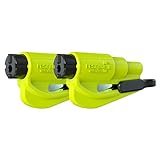
- The original 2-in-1 lifesaving compact car safety tool: this emergency keychain hammer provides peace of mind in case of car entrapment. Can be used in various situations: rollover, electrical system failure, car fire, floods, sinking car accident.
- Jammed seatbelt cutter: the razor-sharp, stainless-steel blade allows to cut a jammed seat belt in no time. Slice the seat belt diagonally for a quick and clean cut. Can be used multiple times.
- Tempered glass window breaker: the solid, heavy-duty, stainless-steel spike easily breaks tempered glass car side windows. Hit preferably one of the corners of the window. Spring-loaded mechanism and resets after each use. Reusable multiple times.
- Made in USA. We pride ourselves in offering efficient and reliable, made in the US, safety tools for the last 20 years.
- Trusted by first responders, Law Enforcement and EMTs and carried by more than 15 million motorists worldwide. The resqme seat belt cutter and window breaker saves a life on average every 15 days. Tested and certified by TUV, a German certification.
Tracking can replace an immediate stop attempt
6. GPS vehicle tagging
NIJ describes a system developed by StarChase that launches an adhesive GPS tag onto a vehicle so officers can track it remotely. The purpose is to maintain a location trail, including when direct visual observation is unavailable—not to bring the car to a halt. NIJ’s case study reports that implementation varied and depended in part on integration into agency policy and practice. A tracking approach may support an alternative to continuing a high-speed pursuit, but it does not itself ensure a safe apprehension.
Research concepts are not proven universal stoppers
7–8. Electromagnetic-pulse and microwave concepts
NIJ’s 2013 technology overview recounts research into short-range electromagnetic pulses and microwave approaches, including prototype tests on specific vehicles. The discussion also identifies limitations, such as the need for proximity or the possibility of affecting multiple vehicles within a device’s radius, and describes further development needs. These accounts document research concepts and tests—not an off-the-shelf system shown to reliably disable any speeding vehicle.
Quick wins for a faster PC:
Repair Windows errors before they cause bigger problemsFix Now →Fix the driver behind crashes, sound loss and screen glitchesFind Drivers →Rank #3

- The original 2-in-1 lifesaving compact emergency car safety tool: this keychain hammer provides peace of mind on the road in case of car entrapment. Can be used in case of rollover, electrical system failure, car fire, floods, sinking car accident.
- Jammed seatbelt cutter: the razor-sharp, stainless-steel blade allows to cut a jammed seat belt in no time. Slice the seat belt diagonally for a quick and clean cut. Can be used multiple times.
- Tempered glass window breaker: the solid, heavy-duty, stainless-steel spike easily breaks tempered glass car side windows. Hit preferably one of the corners of the window. resqme is equipped with a spring-loaded mechanism. Resets after each use. Reusable
- Made in USA. We pride ourselves in offering efficient and reliable, made in the US, safety tools for the last 20 years.
- Trusted by first responders, Law Enforcement and EMTs and carried by more than 8 million motorists worldwide. The resqme seat belt cutter and window breaker saves a life on average every 15 days. Tested and certified by TUV, a German certification
9. Deployable nets
Older NIJ material includes deployable nets among ideas explored for vehicle stoppage. That historical mention does not establish current routine use, broad availability or reliable performance across vehicle types. Portable tire shredders also appear among older concepts, alongside enhanced sirens and vehicle-communication ideas; the cited material does not establish these as widely available current stopping systems.
Fixed barriers protect sites, not moving pursuits
10. Vehicle-security barriers
Vehicle-security barriers are designed for a site—such as a public or private facility—not as equipment an officer deploys during a moving pursuit. ISO 22343-2:2023 provides guidance on selecting, installing and using such barriers to protect people from vehicle attacks. Its subject is facility application, so it should not be read as a standard for police pursuit tactics.
Rank #4

- The information below is per-pack only
- 2-in-1 emergency-escape tool provides a window hammer and seat-belt cutter; 2-pack
- Tungsten double-head hammer: 1800HV hardness, 3 times stronger than common carbon steel – for instant car-door window breakage
- Sharp blade for easily cutting through a seat belt; bright-orange plastic handle provides a secure grip
- Designed to help escape from a sinking, over-turned, crashed, or burning car
Why policy, training and setting change the answer
There is no single international rule for using these interventions. French rules illustrate how requirements can be tied to role and setting: a regulation adopted December 27, 2022, and published January 4, 2023, addresses qualifying military personnel protecting installations in France, including equipment documentation and evaluation of new types before service. A separate French municipal-police regulation adopted July 12, 2023, and published July 14, 2023, sets restrictions and training requirements, including limits on where certain devices may be used. These are French rules, not global standards.
In the United States, Portland and San Francisco policies offer local examples of how agencies place interventions within pursuit and force rules. Their provisions should not be assumed to apply elsewhere, and agency policies can change. A 2023 FEMA EMR-ISAC bulletin summarized guidance developed with input from 48 agencies and 65 recommendations; those figures describe the guidance process, not the success rate of any stopping method.
Free tools Windows power users keep installed
One-click scans. No signup required.
Best Value
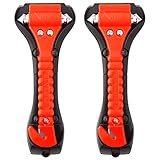
- Car Essential - An invaluable addition to your vehicle safety kit. 2 in 1 window breaker and seatbelt cutter, allowing you to quickly escape in emergency.
- High Quality - High-grade carbon steel double-headed makes the hammer extremely sturdy, easy to break windows and save lives. The Razor-sharp blade mounted in a safe curved hook is made of high quality steel that can cut the seat belt quite easily.
- Well Designed - The bright orange color makes it easy to find in the dark or in a state of panic. It combines a protective bracket for safe storage. Anti-slip handle and light weight make it easy to control.
- Extra Security - Multi-pack safety hammers that can be placed in different parts of your car, ready to be picked up by drivers and passengers in case of emergency. You can also share it as a gift to your family and friends.
- Excellent Service - We offer 90-day returns and free lifetime customer service. If you have any questions, please feel free to contact us, we will try our best to provide you with satisfactory service.
NIJ’s 2022 overview states: “No vehicle-stoppage approach guarantees an efficient, safe resolution to a pursuit.” It also distinguishes force-based stopping tools, which carry greater safety risks to officers, fleeing occupants and bystanders, from tracking technologies. The practical distinction is the purpose of the intervention: slow or obstruct a vehicle, use a policy-authorized contact tactic, protect a fixed site, or track a vehicle for a later opportunity to apprehend it.
Quick Recap
Product prices and availability are accurate as of the date/time indicated and are subject to change. Any price and availability information displayed on Amazon at the time of purchase will apply.




