Outdated Drivers Are Slowing You Down
One free scan finds every outdated or missing driver and matches the right update for your exact hardware.Free scan · exact hardware matchWindows Errors? Fix Them Before They Spread
Repair common Windows errors and clear accumulated junk for a smoother, more stable PC - no reinstall needed.Free scan · no reinstallNotable production motorcycles with forced induction include five early-1980s turbo models and five modern Kawasaki supercharged models. This is a curated list, not a fastest-to-slowest ranking: the examples have no shared test or scoring system, and the Ninja H2 Carbon is a limited-edition variant of the H2 rather than a separate engine platform.
Which motorcycles have turbochargers or superchargers?
The distinction matters. The historic Japanese motorcycles below use exhaust-driven turbochargers; Kawasaki’s modern H2-family motorcycles use a mechanically driven centrifugal supercharger. The entries are grouped by era, not ranked by performance. Historical specifications use different units and conditions, so they should not be treated as directly comparable.
Early-1980s production turbo motorcycles
1. Honda CX500 Turbo
Honda showed the CX500 Turbo at Cologne in 1980 and began production the following year, according to Honda Italia’s April 2025 historical account. Its 80-degree V-twin was paired with a compact IHI turbo, electronic fuel injection and ignition management. Honda reports a declared output of 78 CV at 8,000 rpm and torque of 7.5 kgm at 7,500 rpm.
Honda’s technical account gives the turbo’s hot-side wheel diameter as 50 mm and cold-side diameter as 48 mm, a maximum turbine speed of 180,000 rpm, an operating speed of 130,000 rpm and boost of 1.2 bar. These are manufacturer-reported design figures, not a comparison test against the other motorcycles here.
#1 Best Overall

- Detailed model kit in scale 1:12.
- The high-quality kit from TAMIYA must be assembled by the customer.
- Self-assembly is accompanied by step-by-step and illustrated assembly instructions. The assembly instructions are of course included.
- The precisely fitting individual parts must be assembled according to the assembly instructions. The parts can be painted according to your own idea.
- Tools, glue and paint are not included with the plastic sealant. These should be purchased optionally.
2. Honda CX650 Turbo
The CX650 Turbo followed the CX500 in Honda’s turbo era. Honda Italia’s feature covers both CX Turbo models, while a MOTORRAD retrospective comparison identifies the CX650 Turbo among four factory turbo motorcycles of the period. The cited material does not establish a comparable specification set for this list, so no output or weight figure is assigned here.
3. Yamaha XJ650 Turbo
Yamaha’s official heritage entry for the 1982 XJ650 Turbo describes an air-cooled, 653 cm³ DOHC inline-four and calls it an overseas-market production model. Yamaha lists original-release maximum output of 85.0 PS and maximum torque of 73.6 N·m, with a weight of 225 kg. The company also describes it as featuring the world’s first carburetor turbo system.
Rank #2
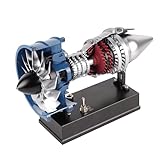
- Realistic & Authentic: The lifelike & visually stunning model provides a realistic depiction of a full-sized engine with main components including a first-stage fan, high-pressure rotor assembly, combustion chamber, high-pressure turbine assembly, low-pressure turbine assembly, and exhaust nozzle.
- High-Quality Construction: Made of high-quality metal, the meticulous model, full of detail and features, undergoes precision casting and CNC machining, along with sandblasting and anodized coloring treatment on the surface, ensuring durability and accuracy the same as the real model.
- Dynamic Display: Featuring a semi-transparent magnetic casing, this model offers a clear view of the engine's internal mechanics in motion when powered by the electric motor. The quick-release magnetic cover allows for effortless assembly and disassembly, making it ideal for demonstrations while protecting delicate components. Equipped with a sturdy mounting bracket and throttle control lever, this kit delivers an immersive hands-on experience with aviation engineering.
- DIY Assembly: Consists of 170+PCS (including screws & nuts) and comes with tools and paper-based English instructions. You will personally experience the entire assembly process, from small parts to the final completed model, constructing an awe-inspiring turbofan engine model.
- STEM Education: As an educational tool, this model unravels the internal workings of a turbofan engine, imparts knowledge about aerospace engineering, and stimulates interest, creativity, and awe for industrial technological achievements
4. Suzuki XN85
The Suzuki XN85 is one of the four factory turbo motorcycles identified in the MOTORRAD retrospective comparison. That source supports its inclusion as a period model, but the material cited here does not establish its production dates or specifications. It is included for historical context rather than a numerical performance comparison.
5. Kawasaki Z750 Turbo
MOTORRAD’s retrospective comparison also names the Kawasaki Z750 Turbo as one of the era’s four factory turbo motorcycles. The cited sources do not establish a model-year range or comparable performance figures for it, so this entry makes no further specification claim.
Quick wins for a faster PC:
Clear out junk files and repair common Windows errorsFree Scan →Scan for outdated or missing drivers - takes under a minuteDriver Scan →Rank #3

- Ultimate Realism:This V-Twin Motorcycle Engine Building Block Model highly restores the mechanical structure of a real V-twin engine. From the crankshaft and connecting rods to the intricate internal components, every detail is accurately replicated. You can disassemble and assemble it by hand to deeply explore the secrets of the "heart of the motorcycle". It’s a must-have collector’s item for mechanics and passionate motorcycle enthusiasts
- Enhance STEM Skills:Suitable for ages 8 and up, this V-Twin motorcycle engine building set comes with abundant parts for an immersive building experience. During assembly, it cultivates spatial thinking, mechanical cognition and hands-on ability, integrating core STEM knowledge (Science, Technology, Engineering, Mathematics) into fun play. More than just a toy, it’s a practical educational tool that brings a great sense of accomplishment to kids and adults alike
- High-Quality Parts:Crafted from premium building block components, this V-Twin motorcycle engine model features tight engagement and exceptional durability. The internal mechanical structure of the model can operate in linkage seamlessly. After assembly, you can intuitively observe the power transmission and working principle of the V-Twin engine, just like owning a miniature "power heart" of a motorcycle. It brings abundant visual enjoyment and logical thinking fun throughout the play process
- Display and Collection: The assembled V-Twin motorcycle engine model in black and silver delivers striking visual impact, ideal as a desktop decoration to boost the mechanical aesthetic of any space. Placed in the study, studio or display cabinet, it’s a one-of-a-kind collection that showcases your mechanical taste and serves as a great topic for discussing mechanical principles with friends
- Perfect Gift Choice: Ideal for motorcycle lovers, mechanics enthusiasts and hands-on teens, this V-Twin motorcycle engine building block model is a thoughtful gift. It fulfills the desire to explore mechanical structures and brings double satisfaction of knowledge and fun through assembly and play
Modern Kawasaki supercharged motorcycles
6. Kawasaki Ninja H2
The road-oriented Ninja H2 is part of Kawasaki’s supercharged H2 family. Kawasaki Motors Europe announced its return for model year 2027 in Europe on 16 September 2026, listing peak power of 209 PS with Ram Air. That figure is Kawasaki’s published claim for the stated model year and condition, not an independent test result. The announcement says to check local availability with a dealer; it does not establish availability in every country. See Kawasaki Motors Europe’s 2027 announcement.
7. Kawasaki Ninja H2 Carbon
The H2 Carbon is a limited-edition carbon-bodywork variant of the Ninja H2, not a distinct engine platform. Kawasaki USA included the H2 Carbon ABS in its 2026 US lineup announcement, alongside the H2 ABS and H2R ABS. Its cited power figure for the 2026 US H2 and H2 Carbon is 239.6 HP. Kawasaki says that figure follows ISO 4106 and cautions that it may be higher than an SAE-standard figure. The announcement’s US ordering window ran from 2 September to 31 October 2025, so it is historical information, not a current ordering offer. Details are in Kawasaki Motors Corp. USA’s 2026 lineup release.
Rank #4

- 【Realistic V-Twin Engine Replica】This motorcycle skull V2 engine model kit contains 1320 precision-engineered ABS parts that accurately replicate the mechanical structure of a real V-twin engine, including crankshaft, connecting rods, and pistons. The assembled V2 engine model features a unique skull design with rotating eyes that emit a striking red glow, delivering an immersive building experience for motorcycle enthusiasts and mechanics
- 【STEM Learning & Skill Development】Designed for ages 14 and up, this V-twin engine building set cultivates spatial thinking, mechanical cognition, and hands-on ability through engaging assembly. The motorcycle skull V-twin engine model kit integrates core STEM principles into fun, hands-on play—making it an educational tool that brings a great sense of accomplishment to both adults and mechanically curious teens
- 【Premium Quality & Smooth Linkage】Crafted from high-quality ABS plastic building components, this motorcycle V-twin engine model features tight engagement and exceptional durability. The internal mechanical structure operates with seamless linkage, allowing you to observe power transmission and working principles of the V2 engine in real time—just like owning a miniature "power heart" of a motorcycle
- 【Striking Display & Collectible Piece】The assembled V2 engine model in black and silver delivers a bold visual impact, making it an ideal desktop decoration to enhance any space. Measuring 11.18 x 8.66 x 7.28, this motorcycle skull V2 engine model kit serves as a one-of-a-kind collectible that showcases mechanical taste—perfect for study, studio, or display cabinet
- 【Perfect Gift for Mechanics & Hobbyists】Ideal for motorcycle lovers, mechanical engineering enthusiasts, and hands-on teens, this V2 engine building set makes a thoughtful gift for birthdays or holidays. It fulfills the desire to explore mechanical structures while delivering knowledge and fun through assembly. For any missing parts or quality issues, please contact us—we're committed to your complete satisfaction
8. Kawasaki Ninja H2R
The Ninja H2R is the track-only member of the family, not a road-legal alternative to the H2. Kawasaki Europe said in its 16 September 2026 announcement that the H2R remained available on an order-only basis in the European context. Kawasaki Heavy Industries’ technical overview describes it as using a mechanical centrifugal supercharger and characterizes the launch model as “the world’s first mass-produced motorcycle to use KHI’s new 998-cm3 four-cylinder engine equipped with a mechanical centrifugal supercharger.” That is Kawasaki’s characterization, not an independently assessed industry-wide finding.
Kawasaki Heavy Industries publishes 228 kW (310 PS) and speeds above 300 km/h for the H2R. These are Kawasaki claims, not independently verified test results. Separately, Kawasaki USA’s 2025 release lists 321.5 HP for the 2026 H2R and says the HP measurement followed ISO 4106, with a warning that it may exceed an SAE-standard figure. Do not treat these different published figures as interchangeable.
Best Value

- V4 Engine, Swing Arm, Front Fork, Side Cowlings And Fuel Tank Are Attached To Frame By Screws
- Side Cowlings And Fuel Tank Are Removable
- Chain Parts Are Split Into Right And Left
- Includes Metal Stickers To Render Mirrors Realistically
- Synthetic Rubber Tires Feature Tread Patterns And Pirelli Logos
9. Kawasaki Ninja H2 SX
The H2 SX brings the supercharged 998 cc inline-four into a sport-touring motorcycle. Kawasaki’s US product-page search text describes it as accommodating passengers and luggage. The available cited material supports those broad characteristics, but not a fuller specification comparison with the other entries.
10. Kawasaki Z H2
The Z H2 is the supercharged naked motorcycle in Kawasaki’s H2 family. Kawasaki’s 2024 European full-line brochure identifies it as supercharged and lists torque, but that brochure is a dated European range document rather than evidence of current availability in every market. See Kawasaki Motors Europe’s 2024 full-line brochure.
Quick Recap
How to interpret the list and its figures
- Induction type: the five early models are turbocharged; the listed modern Kawasaki models are supercharged.
- Not a ranking: the sources provide historical identification and manufacturer specifications, not a common test establishing the fastest or best motorcycle.
- Units and conditions differ: PS, CV, HP, kW and torque figures appear in different source contexts; Kawasaki’s 2027 H2 figure specifies Ram Air, and its 2026 US HP figures cite ISO 4106 with an SAE comparison caveat.
- Availability is regional and time-sensitive: the 2026 US ordering period has ended, while the 2027 H2 announcement concerns Europe. Check with a local Kawasaki dealer for current market status.
- Count the Carbon carefully: this list counts named models and versions; the H2 Carbon is an H2 derivative, so the ten entries are not ten unique engine designs or ten independently ranked platforms.
Product prices and availability are accurate as of the date/time indicated and are subject to change. Any price and availability information displayed on Amazon at the time of purchase will apply.




