Windows Errors? Fix Them Before They Spread
Repair common Windows errors and clear accumulated junk for a smoother, more stable PC - no reinstall needed.Free scan · no reinstallOutdated Drivers Are Slowing You Down
One free scan finds every outdated or missing driver and matches the right update for your exact hardware.Free scan · exact hardware matchWhat are the most innovative Harley-Davidson motorcycles ever? These ten models and platforms stand out because they changed the company’s engine architecture, racing development, chassis design, propulsion or reach into new riding categories—not because they were simply the fastest or most popular. This is an editorial selection, not an official Harley-Davidson ranking; it follows the milestones from the 1909 Model 5-D to the technology-rich Pan America 1250 Special.
How innovation is measured in this list
Each entry is included for a documented change: a new production-engine layout, a racing development, a distinctive chassis or suspension solution, or a move into a new form of motorcycle. Some were road models, some were competition machines, and one began as an electric concept before reaching production. A feature’s significance is different from its marketing: where a performance figure comes from Harley-Davidson, it is identified as a manufacturer claim.
1. 1909 Model 5-D: the production V-Twin foundation
Harley-Davidson Insurance’s historical account identifies the 1909 Model 5-D as the company’s first production motorcycle with a 45-degree V-Twin. That layout became the defining foundation for generations of Harley-Davidson motorcycles. Its importance is historical rather than a claim that the engine represented a modern technical leap: it established a core architecture the company would continue to develop.
2. 1936 Knucklehead-era E: overhead valves for the Big Twin
Harley-Davidson describes the Knucklehead as its first overhead-valve engine and says it introduced the basic architecture for future air-cooled Harley V-Twins. In place of the side-valve approach used on earlier Big Twins, overhead valves marked a major change in how the engine handled its intake and exhaust. The E model made that new architecture a production milestone.
What’s actually slowing this PC down?
Pick the symptom - the matching free tool is one click away.
#1 Best Overall

- Collectible quality True-to-scale detailed vehicle
- Die-cast metal body with plastic parts
- Officially licensed Harley Davidson product by Maisto International
- Highly-detailed die-cast precision model for collectible or play
- Detailed die-cast precision model
3. 1957 XL Sportster: overhead valves in a new middleweight line
The XL Sportster arrived in 1957 with more displacement than the K model and, crucially, overhead valves in place of the K’s side-valve engine. It was a new engine direction within a lighter, sport-oriented line, not merely a larger version of the K. The Sportster family then served as a platform for further changes: the XLH added electric start in 1967, the Sportster Evolution engine family arrived in 1986, and a five-speed transmission and belt drive were listed for 1991 in Harley-Davidson’s timeline.
4. 1970 XR-750: a Sportster-derived racing engine built for dirt track
Harley-Davidson introduced the XR-750 for dirt-track racing in 1970, adapting a de-stroked Sportster-derived engine to competition. Its significance lies in purposeful racing development: it took a production-engine family and reshaped it for a demanding discipline. Harley-Davidson says the XR-750 was winning Grand National Championship season titles within two years of its introduction.
Rank #2
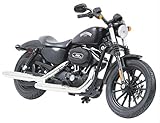
- 2014 Harley Davidson Sportster Iron 883 Motorcycle Model 1/12 by Maisto 32326
5. 1984 FXST Softail: rear suspension behind a hardtail look
The FXST Softail paired a hardtail-like silhouette with concealed rear suspension. Rather than exposing a conventional-looking rear suspension system, the design hid it beneath the frame and seat area, preserving a clean custom-bike profile while giving the rear wheel suspension travel. The company-affiliated history also connects the 1984 Softail with the debut of the Evolution engine, making the model a notable chassis and powertrain milestone.
6. 1991 FXDB Dyna Glide Sturgis: computer-aided design and an isolated engine
Harley-Davidson identifies the FXDB Dyna Glide Sturgis as its first motorcycle designed with computer-aided design. Its engineering changes also included a two-point engine-isolation system and an internal steel frame. Together, those details make the Sturgis significant beyond its name or styling: it represents the use of digital design tools and a distinct approach to managing engine vibration within the chassis.
Rank #3
- Officially Licensed Replica – Authentic styling and branding from the original manufacturer
- Die-Cast Metal Construction – Durable metal body with detailed plastic components
- Highly Detailed Design – Realistic exterior styling and interior details
- Free-Rolling Wheels – Smooth movement for display or play
- Perfect for Collectors & Kids – Great gift for automotive fans
7. 2002 VRSCA V-Rod: a different Harley engine formula
What made the V-Rod different from other Harleys was its Revolution engine. Developed with Porsche’s assistance, the 69-cubic-inch (1,131 cc) V-Twin departed from the familiar 45-degree, air-cooled layout with a liquid-cooled 60-degree configuration, dual overhead camshafts, four-valve heads, fuel injection and internal counterbalancing. Harley-Davidson’s engine-history page lists output at 115 hp at 8,200 rpm. The V-Rod was not a refinement of the classic Big Twin formula; it was a conspicuous alternative to it.
8. 2018 Softail generation: hidden monoshock, revised frame and Milwaukee-Eight
The 2018 Softail redesign brought together Softail styling and the performance aims associated with the Dyna range. Harley-Davidson said the new platform used a lighter, stiffer frame, a hidden adjustable rear monoshock and Milwaukee-Eight engines. These changes made the Softail more than a styling update: frame and suspension design were reworked around a unified platform.
Rank #4

- Officially Licensed Replica – Authentic styling and branding from the original manufacturer
- Die-Cast Metal Construction – Durable metal body with detailed plastic components
- Highly Detailed Design – Realistic exterior styling and interior details
- Free-Rolling Wheels – Smooth movement for display or play
- Perfect for Collectors & Kids – Great gift for automotive fans
In its 2017 announcement, Harley-Davidson claimed the Milwaukee-Eight 107 accelerated 10 percent quicker from 0–60 mph than the High Output Twin Cam 103 and was 16 percent faster from 60–80 mph in fifth gear. These are company-published comparisons, not independent test results. The announcement also said the 2018 Fat Boy was 31 pounds lighter than its predecessor and described its 160 mm front tire as the widest ever fitted to a production Harley at that time.
Independent reader supportYour contribution helps us test, update, and keep practical guides available for everyone.9. LiveWire: electric propulsion from concept to production
Harley-Davidson revealed Project LiveWire in 2014; the production motorcycle arrived for model year 2020. It marked a fundamental change in propulsion: an electric motor delivered immediate torque, and riding required neither a clutch nor gear changes. That transition mattered as much as any single specification because it brought Harley-Davidson into electric motorcycles as a production manufacturer.
Best Value

- Collectible quality True-to-scale detailed vehicle
- Die-cast metal body with plastic parts
- Officially licensed Harley Davidson product by Maisto International
- Highly-detailed die-cast precision model for collectible or play
- Detailed die-cast precision model
Harley-Davidson Insurance reported that the 2020 LiveWire could reach 60 mph in under three seconds, made 105 hp and had a 146-mile city range. Those are figures reported by that company-affiliated publisher for the 2020 model, not independently verified results. In announcing the project, then-president and chief operating officer Matt Levatich called it “another exciting, customer-led moment in our history.”
10. Pan America 1250 Special: adventure touring with integrated electronic systems
The Pan America expanded Harley-Davidson into adventure touring, a category far removed from the company’s traditional cruiser image. Its Revolution Max engine is a stressed, load-bearing part of the chassis, and the platform combines that structural role with rider-focused electronics and suspension technology.
The current 2025 Pan America 1250 Special page lists semi-active suspension, Adaptive Ride Height, nine selectable ride modes, cornering rider-safety systems and a 6.8-inch display. These are 2025 model-year specifications; they should not be assumed to describe every original 2021 configuration or every market. The innovation is the combination of an adventure-bike platform with integrated systems designed to adapt the motorcycle to riding conditions and rider needs.
Which Harley-Davidson changed the company the most?
The answer depends on what “changed” means. The 1909 Model 5-D established the 45-degree V-Twin production foundation; the Knucklehead shifted the Big Twin to overhead valves; and the Sportster and XR-750 connected a road-going engine family to a long-running racing development. The V-Rod challenged the traditional engine formula, while LiveWire and Pan America represent major expansions in propulsion and motorcycle category. There is no single measure that makes one of these changes universally greater than the others.
Quick Recap
Product prices and availability are accurate as of the date/time indicated and are subject to change. Any price and availability information displayed on Amazon at the time of purchase will apply.




