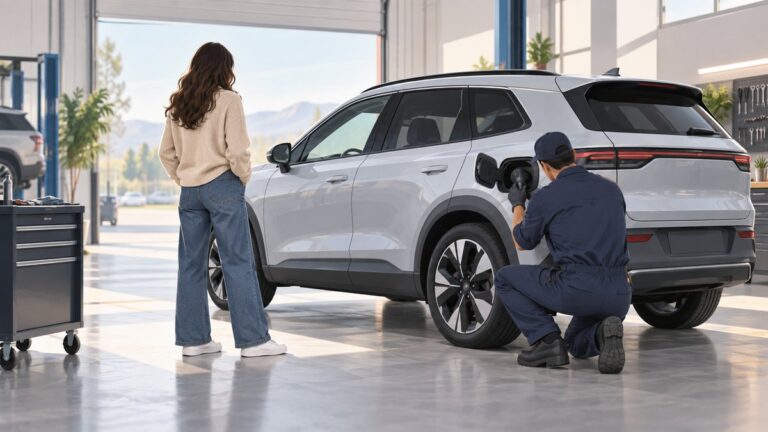
Hybrid vehicles can develop problems in both their gasoline and electric-drive systems, but there is no verified fleet-wide ranking showing which failures are most common across all makes and model years. The ten items below are practical trouble categories, not an incidence ranking; a problem reported for one model or year does not mean every hybrid shares it.
Ten hybrid problems and trouble spots
Hybrids combine conventional vehicle systems with components that manage electric propulsion. Designs vary, so symptoms need model-specific diagnosis rather than assumptions based on the word “hybrid.”
1. Traction-battery capacity loss or failure
The high-voltage traction battery supplies energy to the electric motor. Reduced electric assist, changing fuel economy, warning messages, or a hybrid-system fault can have several causes and do not prove that the battery has failed. Age, temperature, chemistry, design, and operating conditions can affect battery behavior; there is no single lifespan or replacement cost that applies to every hybrid. A defect can also trigger a recall rather than reflect gradual aging. See NHTSA’s electric and hybrid vehicle guidance.
2. A discharged or failing 12-volt battery
The low-voltage 12-volt battery powers items such as lighting and instrumentation. If it is discharged, the car may not enter its normal operating state even when the traction battery is charged. In many cases the 12-volt battery can be jump-started much like one in a conventional vehicle, but use only the connection points and steps specified in the owner’s manual. A jump-start does not recharge or jump-start the high-voltage traction battery.
#1 Best Overall

- ✅Batter dimensions: 10.75" L x 6.81" W x 8.98" H, Terminal: Tapered terminal (Left negative (-), Right positive (+)). ✅Please ensure to verify the dimensions and terminal position before making a purchase to guarantee compatibility with your vehicle to avoid any fitment issues.
- With a 70AH capacity and 710 cold cranking amps (CCA). Provides reliable performance and long service life, Up to 2 times the cycle life of conventional batteries. If your car's original battery is an AGM type, you must continue using an AGM battery, as your car will not accept a "downgrade" to a flooded battery. Nominal Voltage:12V. Charging Voltage:14.4~15.0V. Acceptable Charging Current:0~21A. Operating Temperature Range: -22°F~158°F.
- Heat / Cold Resistance: The materials used in the construction of AGM batteries (such as glass fiber mats and specialized separators) have better heat resistance. This allows AGM batteries to maintain their performance and capacity even in the hottest climates, They are also more resistant to extreme temperatures, making them ideal for hot or cold regions.
- Low Self-Discharge: AGM batteries have lower self-discharge rates compared to flooded batteries. Self-discharge refers to the loss of capacity that batteries experience over time when not in use. In hot climates, when the battery may need to be stored for extended periods or not frequently used, AGM batteries can better maintain charge, providing higher voltage output and easier engine start-up in any climate.
- Enhanced Safety: AGM batteries have a lower risk of acid leaks and spills compared to flooded batteries. This is because the acid is absorbed and held within the glass fiber mats, reducing the risk of corrosion or damage to surrounding components,this makes AGM batteries more durable and long-lasting, is also two to three times longer than flooded batteries. AGM batteries also have a lower risk of explosion and are safer to handle, making them ideal for high-performance vehicles.
3. DC-DC converter or low-voltage charging trouble
Many hybrid-electric vehicles use a DC-DC converter, rather than a conventional alternator, to step voltage down from the traction battery and recharge the 12-volt system. That means an alternator diagnosis or replacement is not automatically the right answer when a hybrid’s 12-volt battery keeps going flat. The vehicle’s architecture and diagnostic results matter.
4. Inverter or electric-motor faults
The inverter converts current between the traction battery and the motor or generator. A fault in the inverter or motor can affect propulsion and may bring warning lights or reduced power, but those symptoms are not a diagnosis by themselves. These are high-voltage components: NHTSA warns, “You should never try to service the traction battery without proper training and specialized equipment.” Seek a technician qualified to work on the vehicle’s hybrid system.
5. Engine problems and start-stop behavior
A hybrid still has a gasoline engine and ordinary engine-related systems that can need repair. In a hybrid electric vehicle, the engine may shut off at a stop and restart when needed; that can be normal operation, not a fault. An engine warning or irregular running should be investigated on its own merits rather than automatically blamed on the traction battery.
Rank #2

- Fast Starting Power: This 12V 70Ah 760 CCA delivers strong, steady starts is ready for any weather in any season.
- Made to Last: With its 120-minute Reserve Capacity supports longer run times and a longer overall battery lifespan.
- All Power, No Mess AGM Design: Sealed and spill-proof, the MM-H6 is built with high discharge output and deep discharge recovery to keep power steady when it counts.
- Strength That Starts on the Inside: The rugged construction resists shock, vibration, and harsh conditions, delivering reliable performance across a wide range of temperatures and tough environments.
- Tested Tough & Certified Safe: Mighty Max batteries are built in an ISO-certified facility and meet CE standards for quality, safety, and reliability
6. Transmission or transaxle concerns
Transmission trouble appears among the general trouble-spot categories in Consumer Reports’ vehicle reliability material. Hybrid drivetrains differ, however, and not every hybrid uses a conventional automatic transmission. A sound or drivability symptom that points to a transmission in one design may have a different cause in another, so diagnosis should be specific to the make, model, and year.
Recommended Free Tools
7. Brake feel, wear, or noise
Regenerative braking uses the electric motor to slow the vehicle and recover energy. Conventional friction brakes still operate in some situations, including emergency braking and when the battery is fully charged. Regenerative braking therefore does not eliminate brake maintenance. Have a change in pedal feel, a brake warning, or abnormal noise inspected.
8. Traction-battery cooling or airflow problems
Battery temperature affects performance, and the battery-management system relies on model-specific hardware and software. Cooling layouts and maintenance needs differ among vehicles; there is no universal fan-cleaning interval or one failure pattern that can be applied to every hybrid. Follow the owner’s manual and have a battery-system warning checked by a qualified technician.
Rank #3

- Some GM Genuine Parts may have formerly appeared as ACDelco GM Original Equipment (OE)
- Easy Installation
9. Control electronics, sensors, or warning-light faults
Hybrids use controls and software to coordinate gasoline and electric power, alongside the electronics found in other vehicles. A warning light should be read using the vehicle’s diagnostic information; a generic OBD-II reader should not be treated as sufficient for high-voltage diagnosis. Consumer Reports also includes in-car electronics among its general vehicle reliability trouble spots.
10. Recall defects and repair complications
Recall defects depend on the exact model, production range, and VIN. In a November 2024 notice, Honda said the negative terminal or busbar inside the high-voltage lithium-ion battery could break in certain 2023 CR-V Hybrid vehicles because of inadequate thickness from manufacturing. Honda said a break could make the vehicle undriveable and, if energized, create a spark with increased fire, crash, or injury risk; its notice provided a free battery replacement. This is a specific recall example, not evidence of a defect affecting all CR-V Hybrids or hybrids generally. Check NHTSA’s recall lookup by VIN and contact the manufacturer or dealer about a possible open recall.
How to tell normal hybrid operation from a problem
- Often normal: the gasoline engine stops at a standstill and restarts as needed, or the car uses regenerative braking during ordinary slowing.
- Needs attention: a warning indicator, persistent loss of power, abnormal brake feel or noise, irregular engine operation, or a no-start condition.
- Not enough to diagnose: a single symptom such as lower fuel economy or a silent engine. Hybrid control strategy and system design vary by vehicle.
Use the owner’s manual for the meaning of a warning and the appropriate next step. Do not open, probe, or repair high-voltage components yourself. NHTSA warns that an unqualified attempt to service a traction battery can cause severe injury or death.
Rank #4

- High density negative paste, improves performance and increases battery life
- Enhanced life alloy or Silver Calcium stamped alloy increases cycle life and improves performance, High density plate oxide provides for maximum power-per-pound and dependable high cycling service
- Calcium Lead positive grid, maximizes conductivity and allows for low resistance
- Robust Envelope Separator with puncture-resistant back, allows for increased acid circulation and prevents shorts. Improved acid circulation, helps the battery to remain cool, and extend battery life
- Vent cap design that resists acid leakage
Why a hybrid may not start even when its traction battery is charged
The traction battery and 12-volt battery perform different jobs. A charged traction battery does not rule out a discharged 12-volt battery, which supports low-voltage systems needed for the vehicle to enter its normal operating state. A fault elsewhere in the starting, control, or hybrid system may also prevent the car from operating. Check the manual’s no-start guidance and arrange a vehicle-specific diagnosis; do not infer that the traction battery needs replacement from this symptom alone.
Can you jump-start a hybrid battery?
The high-voltage traction battery cannot be jump-started like a conventional 12-volt battery. The 12-volt battery can often be jump-started, but procedures and designated connection points vary by vehicle. Follow the owner’s manual, and use a portable 12-volt jump starter only if the manual’s procedure allows it. It will not fix a high-voltage fault.
What to do when a hybrid has a warning or suspected battery fault
- Read the vehicle’s warning and manual. Record the exact message or indicator and follow the manual’s instructions for whether to stop driving or seek service.
- Separate low-voltage symptoms from high-voltage warnings. For a no-start, do not assume the traction battery is at fault simply because the car is a hybrid.
- Use qualified service for hybrid components. High-voltage battery, inverter, and motor work requires appropriate training and equipment.
- Check recall status by VIN. If a lookup result is unclear or you suspect an unresolved defect, contact the manufacturer or dealer.
- Treat smoke, flooding, collision damage, or suspected high-voltage battery damage as a safety issue. Seek emergency or qualified professional help rather than treating it as an ordinary 12-volt battery problem.
How to check a hybrid before buying
A reliability survey cannot guarantee the condition of an individual used car. Assess the specific vehicle rather than relying on a general claim about hybrids:
The Tool Desk
Outbyte PC Repair FREEClear out junk files and repair common Windows errorsFree Scan →Outbyte Driver Updater FREEFix the driver behind crashes, sound loss and screen glitchesFind Drivers →- Verify the make, model, year, hybrid architecture, and VIN.
- Check for open recalls and confirm any stated remedy with the manufacturer or dealer.
- Review service and repair records, including any battery or hybrid-system work.
- Have a qualified technician inspect the vehicle, including the hybrid system if indicated.
- Confirm the warranty terms that apply in your location and whether suitable hybrid service is available nearby.
Consumer Reports publishes reliability survey material, but survey averages are not a promise about a particular model or used vehicle. Model-specific condition, service history, recall status, and inspection findings are more useful for an individual purchase.
Quick Recap
Product prices and availability are accurate as of the date/time indicated and are subject to change. Any price and availability information displayed on Amazon at the time of purchase will apply.