Quick wins for a faster PC:
Repair Windows errors before they cause bigger problemsFix Now →Scan for outdated or missing drivers - takes under a minuteDriver Scan →Clear out junk files and repair common Windows errorsFree Scan →There is no single adventure motorcycle that delivers every kind of freedom: a bike that is easy to manage on technical trails may give up highway comfort, passenger space or long-range touring equipment. This shortlist names ten widely recognized candidates across different riding styles, but it is not a ranked, specification-verified buying guide: the available evidence establishes detailed facts for only a few models, not consistent current specifications for all ten. Treat the list as a starting point for choosing test rides, and confirm the exact model year, trim and local availability before you buy.
Start with the ride you actually want
“Adventure motorcycle” covers everything from comparatively dirt-capable machines to large touring bikes designed primarily for paved roads and gravel detours. Before comparing horsepower or features, decide how much of your riding will be highway, maintained gravel and rough trail. Then assess whether you can comfortably manage the bike at a stop and at walking pace, especially with a passenger or luggage.
- Mostly pavement and long distances: prioritize wind protection, seat comfort, passenger accommodation, luggage options and relaxed highway manners.
- Frequent gravel and moderate trails: consider wheel and tire configuration, suspension, low-speed control and how manageable the bike feels when standing or turning around.
- Technical off-road riding: prioritize rider fit and control over engine output or touring amenities; a heavy, powerful motorcycle can be demanding when the surface gets difficult.
These are practical categories, not claims that every bike in one category behaves identically. Equipment and handling can change substantially between trims.
Ten motorcycles to put on a test-ride shortlist
The models below are candidates across the adventure spectrum, not a definitive ranking. The sources available for this article do not establish current, market-specific specifications for every entry, so verify model year, trim, price and availability with the manufacturer or a local dealer.
Recommended Free Tools
#1 Best Overall

- Polycarbonate/ABS Shell construction
- Integrated face shield
- Height adjustable helmet shield
- Padded Chin Strap with Double-D safety lock
- Meets DOT FMVSS 218 and ECE 22.05 safety standards
1. Honda Africa Twin
A mid-to-large adventure bike to consider if you want a machine with both road and off-pavement intent. Honda’s 2026 specification release lists a 1,084 cc liquid-cooled four-stroke parallel twin and distinguishes wheel configurations by variant: the standard model has a 21-inch front wheel, while Adventure Sports ES configurations use a 19-inch front wheel. The distinction matters when comparing intended road-to-dirt balance; don’t assume every Africa Twin has the same setup. Honda lists manual and DCT transmission options for standard and Adventure Sports ES models, and describes six selectable riding modes and seven HSTC settings on its product page. Confirm the configuration and year being offered in your market. Honda’s 2026 specifications; Honda’s product page.
2. BMW R 1300 GS
A premium, road-capable adventure-tourer that appears in a recent UK comparison alongside Ducati’s Multistrada V4 S and KTM’s 1390 Super Adventure S. Motorcycle News reported a 266 kg test kerb weight for the BMW R 1300 GS in that specific comparison; this is a test figure, not a universal manufacturer weight for every configuration. Use it as a prompt to check the bike’s real low-speed feel rather than as a proxy for off-road suitability. Motorcycle News’ May 27, 2026 comparison.
3. BMW R 1300 GS Adventure
The larger-touring branch of BMW’s GS family is worth considering if your priorities include long-distance travel and substantial touring capability. BMW Motorrad USA lists rated output of 145 hp at 7,750 rpm and maximum torque of 110 lb-ft at 6,500 rpm. BMW Group PressClub USA’s 2024 release gives suspension travel as 8.3 inches at the front and 8.7 inches at the rear. Those figures apply to the specified Adventure model and source context; they do not establish that it is the right choice for frequent technical trails. BMW Motorrad USA technical data; BMW Group PressClub USA’s 2024 release.
Rank #2

- SHELL: Advanced Polycarbonate Shell developed and engineered, by ScorpionEXO to be lightweight, strong and maximize impact displacement. CAD-refined aerodynamics result in a streamlined profile and balanced footprint, minimizing both lift and turbulence for a smoother, quieter, and more stable ride. Advanced multi-layer EPS provides superior energy absorption and channels throuhgout EPS foam provide increased airflow.
- COMFORT: Aero-tuned ventilation system features one large intake vent on top, forcing cool air in, while exhaust vents maximize movement of hot air out of the helmet. Dual Position mouth vent allows the 1st position to act as a defroster and 2nd position acts as defroster & ventilation (closeable from the inside). KwikWick C moisture wicking liner fabric keeps you cool and dry. Liner is easily removable and washable. KwikFit 3D sculpted cheek pads accommodate most eyeglasses.
- VISION: Everclear shield offers fog-free technology. Anti-scratch hardened coating. 95% UV-A & UV-B protection. ScorpionEXO’s shield system pulls the shield securely against the eye port, ensuring a proper seal. Wide eye port allows for greater peripheral vision and downward visibility. When the shield is removed the eye port accommodates most sizes and brands of goggles (Eyeport is 11cm Tall). Retractable interchangeable Speedview drop down sun-visor with an easy-sliding mechanism.
- VERSATILITY: Easy-use Flip-up Chin Bar features a single lever release which allows the chin bar to be raised or lowered with either hand. External peak visor can be easily removed to improve the aerodynamics for long distance touring. Block off plates included for use when visor is not on helmet. Includes breath deflector and aero skirt (chin curtain) helps reduce wind noise. Seamlessly integrates with the EXO-COM Communicator Kit or your favorite Bluetooth system (sold separately).
- SAFETY: Speaker pocket Size: 50mm/5mm (round). Weight: ± 1858 grams / 4.09 lbs. (size medium). 5-year warranty. Equipped with U.S. DOT Certification and the ECE 22.06 Safety standard, which requires a wider range of testing than the previous 22.05 certification.
4. Ducati Multistrada V4 S
A premium, road-oriented adventure-tourer to evaluate if fast paved-road travel and touring are more central to your plans than demanding trail riding. Motorcycle News included it in its 2026 UK comparison and reported a 267 kg test kerb weight for the tested bike. That number describes the test configuration, not every trim or market version. A test ride can help establish whether its size and low-speed balance suit your routes and experience. Motorcycle News’ May 27, 2026 comparison.
5. KTM 1390 Super Adventure S
Consider this as a high-performance, road-biased adventure-tourer rather than assuming that the adventure label makes it a lightweight trail bike. In Motorcycle News’ specific 2026 UK comparison, the KTM’s test kerb weight was 247 kg, compared with 266 kg for the BMW R 1300 GS and 267 kg for the Ducati Multistrada V4 S. These are test-specific weights for the bikes compared, not official figures for every version. Motorcycle News’ May 27, 2026 comparison.
6. Yamaha Ténéré 700
A candidate for riders seeking a simpler, more dirt-oriented middleweight alternative to large touring machines. Confirm the wheel and suspension configuration, seat reach and current trim in your market, and pay particular attention to how the bike feels when turning or stopping on loose ground.
Rank #3
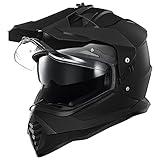
- Meets FMVSS-218 and DOT Safety Standards.Made of ABS shell and EPS foam to maximize protection in the event of a crash.
- Dual Visor System: Oversize, removable outer visor over an ultra-wide eye port that gives excellent peripheral vision compatible with Pinlock 30 (not included in package). Internal drop-down sunshield keeps the sun out of your eyes.
- Ventilation: The seven-position vent around this dual sport helmet in the ventilation system ensures appropriate air intake.
- The comfort removable inner lining pads have fewer seams in it to mitigate stress points on the wearer’s scalp.
- Quick Release Clasp and Removable Chin Curtain.
7. Suzuki V-Strom 800DE
A middleweight option to investigate if your routes mix paved travel with gravel and occasional rougher surfaces. Compare its exact market-specific equipment and ergonomics with the other bikes on your shortlist; the name alone does not establish its suitability for a particular trail or rider.
8. Triumph Tiger 900
The Tiger 900 family offers a candidate for riders balancing touring and mixed-surface use. Check the exact version and model year: trim-level equipment can alter the road-to-dirt emphasis, and published family-level information may not describe the bike a dealer actually has in stock.
9. Aprilia Tuareg 660
A middleweight model to consider if off-pavement riding is a meaningful part of the plan and a large touring bike feels like too much motorcycle. Verify local availability, seat fit and luggage or passenger needs before treating it as an all-purpose touring choice.
Rank #4

- Integrated drop-down sun shield eliminates the need for changing face shields in varying light conditions
- Kinetic Polymer Alloy (KPA) shell provides superior impact protection while remaining lightweight
- Emergency release system allows first responders to safely remove cheek pads in case of an accident
- Secure DOT and ECE approved quick-release chin strap for convenience and safety
- Multiple intake and exhaust ports deliver effective ventilation through the EPS liner for rider comfort
10. Royal Enfield Himalayan
A smaller-displacement candidate for riders who value an approachable scale and mixed-surface exploration more than premium touring performance. Check the current model and local specifications, and assess whether its highway pace, passenger accommodation and luggage setup match the distances you intend to cover.
Independent reader supportYour contribution helps us test, update, and keep practical guides available for everyone.How to compare the candidates fairly
Published output figures cannot tell you whether a motorcycle fits your body, routes or ownership constraints. Use the same questions for each exact model and trim so that a showroom comparison remains meaningful.
- Rider fit: Can you reach the ground confidently? Can you move the bike backward, hold it at a stop and make a slow U-turn without strain? Seat height alone does not settle these questions.
- Wheels, tires and suspension: Confirm front and rear wheel sizes, the tires fitted to the exact trim, suspension adjustability and travel, and whether the setup suits your road-to-dirt mix. Honda’s 2026 Africa Twin specifications show why a family name is not enough: standard and Adventure Sports ES versions differ in front-wheel size.
- Engine and transmission: Think about controllability as well as power. On the Africa Twin, Honda lists both manual and DCT choices; ride the transmission you are considering rather than assuming one suits every kind of riding.
- Touring needs: Check standard and optional luggage, passenger space, wind protection, fuel capacity and the range you can reasonably expect for your riding. The sources cited here do not establish comparable range or luggage figures across all ten candidates.
- Ownership in your area: Ask about local dealer access, scheduled service, parts availability, warranty terms and the installed cost of the configuration you want. Prices and availability are not established consistently for this shortlist.
What the published weight comparison can—and cannot—tell you
Motorcycle News’ May 2026 UK comparison is useful for a narrow question: how three specific premium, road-biased adventure bikes compared in that test. It reports test kerb weights of 266 kg for the BMW R 1300 GS, 267 kg for the Ducati Multistrada V4 S and 247 kg for the KTM 1390 Super Adventure S. The KTM was lighter by that test’s measure, but a three-bike comparison does not make it the lightest adventure motorcycle overall, prove which bike is easiest to handle, or predict every rider’s experience. Conditions, equipment and trim matter, and weight is only one part of low-speed manageability.
Quick Recap
A practical way to narrow the list
- Choose your dominant surface. Write down whether most of your riding is pavement, gravel or rough trail, then eliminate bikes whose size and touring focus do not fit that use.
- Pick the exact trim and transmission. Compare the model year and equipment you can actually buy locally, not a family name or a different-market specification.
- Try a low-speed fit check. Sit on the bike, lift it off the stand, walk it backward and practice slow turns where a dealer permits. Bring the boots and luggage you expect to use.
- Ride your likely use case. On a test ride, assess highway comfort, slow-speed response and control on the surfaces you regularly encounter, where permitted.
- Compare ownership realities. Get local, written prices for the bike and needed touring equipment, and check dealer distance and service support before choosing.
Product prices and availability are accurate as of the date/time indicated and are subject to change. Any price and availability information displayed on Amazon at the time of purchase will apply.




