Why was the Concorde discontinued, and how many crashed when in operation? Concorde was retired in 2003 because high operating and maintenance costs, expensive fares, and declining premium demand made service uneconomical. Only one Concorde crashed during passenger operation: Air France Flight 4590 in 2000, killing 109 aboard and four people on the ground.
Key takeaways
- Concorde had one crash during passenger service: Air France Flight 4590 at Gonesse, France, on July 25, 2000.
- The Gonesse accident killed all 109 people aboard and four people on the ground, for 113 fatalities in total.
- The BEA investigation traced the accident sequence to runway debris, tire destruction, fuel-tank damage, fuel ignition, fire, and loss of engine thrust.
- The crash did not immediately end Concorde: service resumed after safety modifications, while Air France stopped commercial flights on May 31, 2003, and British Airways withdrew Concorde on October 24, 2003.
- High operating costs, high fares, declining demand—especially business demand—and sharply rising maintenance costs made Concorde’s commercial model unsustainable.
Why was the Concorde discontinued?
Concorde was discontinued because its aging aircraft and expensive supersonic operation no longer produced a sustainable commercial return. Concorde’s high operating costs required very high fares, which restricted the number of potential passengers. Demand and premium business traffic weakened, while maintenance and support costs increased as the fleet grew older.
The UK Parliament’s 2009 aviation briefing summarizes the problem as a structural mismatch between the aircraft’s costs and its revenue. Air France’s own 2003 explanation also pointed to deteriorating results on the transatlantic Concorde route, falling demand—particularly from business travelers—and substantially higher maintenance costs after the aircraft returned to service.
Concorde was therefore a technological success but a difficult airline business. The aircraft could offer extraordinary speed, but the speed came with costly fuel consumption, specialized maintenance, limited aircraft availability, high fares, and a restricted route network. A smaller pool of customers could afford those fares, and a shrinking premium market made it harder for the aircraft to cover its fixed and operating costs.
Free tools Windows power users keep installed
One-click scans. No signup required.
#1 Best Overall

- Revell Plastic Model Airplane Kit #85-5512 is skill level 4 and contains 147 parts. Recommended for ages 12 and up.
- 1:48 scale model, Length 14-1/4", Wingspan 16.75"
- Crew figures and weighted tires. Machine guns mounted in glass nose.
- Decals included to build one of two variants from the 345th Bomb Group, the Air Apaches.
- Molded in light gray and clear. Paint and glue not included.
Airbus President Noël Forgeard captured the aging-fleet issue in a statement reported in the parliamentary briefing: “But the costs of maintenance of the aircraft increase rapidly as the years go by.” That observation supports maintenance as an important part of the retirement decision, but maintenance alone was not the whole explanation. Demand, revenue, business travel, and the general commercial climate also mattered.
Was the Concorde crash the reason it was retired?
The July 25, 2000, crash was a major safety and reputational shock, but the crash alone did not immediately retire Concorde. Air France and British Airways suspended operations, safety changes were introduced, and Concorde later returned to commercial service. Permanent withdrawal followed after the aircraft’s already difficult economics had deteriorated further.
The sequence of events is important. If the crash alone had caused retirement, Concorde would have ended in July 2000. Instead, Air France operated its final commercial Concorde flight nearly three years later, and British Airways continued until October 2003.
| Date | Event | Why it matters |
|---|---|---|
| July 25, 2000 | Air France F-BTSC crashed at Gonesse after departing Paris Charles de Gaulle. | The only Concorde crash during passenger operation occurred. |
| January 16, 2002 | The BEA made its final accident report public. | The official investigation documented the accident sequence and safety findings. |
| May 31, 2003 | Air France completed its final commercial Concorde flight. | Air France ended service after the route’s economic deterioration. |
| October 24, 2003 | British Airways withdrew Concorde. | The world’s only scheduled supersonic passenger service ended. |
The dates for Air France and British Airways are recorded in the airlines’ historical accounts: Air France identifies May 31, 2003, as the end of its commercial Concorde operation, while British Airways records October 24, 2003, as Concorde’s withdrawal date. The National Air and Space Museum describes Concorde as having provided passenger service for 27 years.
The Tool Desk
Outbyte PC Repair FREEClear out junk files and repair common Windows errorsFree Scan →Outbyte Driver Updater FREEFix the driver behind crashes, sound loss and screen glitchesFind Drivers →How many Concordes crashed when in operation?
One Concorde crashed during its passenger-service era. The aircraft was Air France F-BTSC, operating Flight 4590, which crashed shortly after takeoff from Paris Charles de Gaulle Airport at Gonesse on July 25, 2000. The BEA accident record lists 100 passengers, nine crew members, and four people on the ground killed—113 fatalities altogether.
Rank #2

- Revell Model Kit #85-5810, Skill Level 4, Contains 66-Parts, Recommended for ages 12 and up
- Accurate surface details
- Includes GTD-21 surveillance drone with cart
- Decals with authentic U.S. Air Force markings
- Molded in black and clear. Paint and glue required(not included).
That is the clearest answer to “how many Concordes crashed when in operation?”: one crash, with 113 fatalities. The figure does not mean Concorde had only one safety-related event. The BEA’s prior-events analysis recorded 57 tire-deflation or tire-destruction events, including 12 with structural consequences. Those were incidents and maintenance or safety events, not 57 additional crashes.
Airbus also describes the Gonesse accident as Concorde’s only crash. The distinction between a crash and an incident matters because describing every tire event as a crash would substantially misstate Concorde’s operational history.
What caused the Air France Concorde crash?
The BEA investigation found that a metal strip on the runway began a chain of failures that Concorde could not overcome during takeoff. The strip damaged and destroyed a tire; fragments then struck and damaged a fuel tank, causing fuel to leak and ignite. The resulting fire caused the loss of thrust on one engine and then another while the aircraft was still unable to recover safely.
Quick wins for a faster PC:
Repair Windows errors before they cause bigger problemsFix Now →Fix the driver behind crashes, sound loss and screen glitchesFind Drivers →Clear out junk files and repair common Windows errorsFree Scan →The sequence was not presented as a single isolated mechanical failure. According to the BEA’s preliminary report, the accident involved runway debris, tire destruction, fuel-tank damage, fuel leakage, ignition, a sustained fire, and engine-thrust loss. The BEA made its final accident report public on January 16, 2002.
The BEA’s report was an aviation-safety investigation. Its purpose was to establish what happened and help improve safety, rather than to assign individual blame. The accident led to safety changes and the eventual resumption of Concorde flights, which is another reason the crash should not be described as the sole cause of the aircraft’s retirement.
Rank #3

- Revell Model Kit #15873, Skill Level 4, Contains 40-Parts, Recommended for ages 12 and up
- Movable propeller plus long range fuel tank
- Detailed cockpit and optional position landing gear
- Authentic markings for BF 109G-10, IV./JG301, Stendal, Spring 1945
- Molded in light gray and clear. Paint and glue required(not included).
Did Concorde have more than one crash?
No. Concorde had one crash during passenger operation, but it experienced other tire and operational incidents. The BEA recorded 57 tire-deflation or tire-destruction events before the Gonesse accident, and 12 of those had structural consequences. Those figures describe a history of tire-related events, not additional Concorde crashes.
| Term | Concorde record | Accurate interpretation |
|---|---|---|
| Passenger-service crashes | 1 | Air France Flight 4590 at Gonesse on July 25, 2000. |
| People killed aboard | 109 | 100 passengers and nine crew members. |
| People killed on the ground | 4 | Fatalities outside the aircraft in the Gonesse accident. |
| Total fatalities | 113 | 109 people aboard plus four people on the ground. |
| Prior tire-deflation or tire-destruction events | 57 | Incidents recorded in the BEA’s prior-events analysis, not additional crashes. |
Why did Concorde stop flying if it was so popular?
Concorde’s fame did not guarantee enough profitable demand. Concorde’s speed made it desirable to a small premium market, but the aircraft’s high cost forced airlines to charge fares that many travelers could not or would not pay. When business traffic and premium demand weakened, the aircraft had too few customers to offset its expensive operation.
Concorde also operated as a small, aging fleet rather than as a mass-market aircraft. That limited economies of scale and made replacement parts, engineering support, inspections, and maintenance more difficult and expensive over time. The result was a feedback loop: high costs required high fares; high fares restricted demand; lower demand reduced service and revenue; and an older fleet continued to become more expensive to support.
Noise restrictions and route limitations were additional practical constraints on supersonic passenger service. Concorde could not simply fly every route at supersonic speed or use every airport in the same way as a conventional wide-body aircraft. Faster airborne travel therefore did not automatically translate into the best overall commercial proposition for every traveler or route.
What can Concorde’s retirement teach about supersonic aircraft?
Concorde’s retirement shows that speed alone is not enough to sustain an airline service. Any successor would need to balance operating cost per passenger, achievable fares, passenger demand, maintenance and parts support, sonic-boom and airport restrictions, fuel and environmental constraints, route access, total journey time, and safety certification.
Rank #4
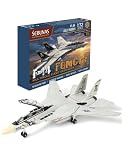
- Experience the legendary F-14 Tomcat through a highly detailed model designed for aviation collectors and hobby enthusiasts. The finished model becomes a striking desktop or showcase centerpiece.
- This 3D puzzle is designed for beginner-level assembly enthusiasts, offering an immersive hands-on building experience that helps cultivate patience, concentration, and mechanical problem-solving skills.
- This product is manufactured using high-quality, environmentally friendly plastic and employs an ultra-fine etching process to ensure durability, structural precision, and realistic aircraft details.
- Encourages understanding of aircraft engineering concepts while improving hand-eye coordination and spatial thinking through engaging mechanical assembly.
- Ideal gift for childs, engineers, collectors, model builders, and puzzle lovers for birthdays, Children’s Day, Christmas, or special hobby occasions.
| Decision factor | Question a supersonic service must answer | Why Concorde’s experience matters |
|---|---|---|
| Operating cost | Can each flight carry enough paying passengers to cover its costs? | Concorde’s high operating costs required high fares. |
| Demand and fares | Will enough travelers pay the required premium? | A shrinking premium and business market weakened the commercial case. |
| Maintenance | Can the aircraft and its specialized parts be supported affordably as it ages? | Maintenance costs increased substantially after Concorde returned to service. |
| Noise and route access | Where can the aircraft fly supersonically and which airports can it use? | Sonic-boom and airport restrictions limit route flexibility. |
| Safety and certification | Can the aircraft demonstrate acceptable emergency performance and meet certification requirements? | The Gonesse investigation shows how a complex failure sequence can affect both safety and public confidence. |
| Total journey time | How much time is actually saved from departure to arrival? | Airborne speed must be weighed against airport access, routing, and ground time. |
How can someone preserve Concorde’s history at home?
Readers interested in Concorde as an engineering and aviation artifact can choose a building set, a scale model, or a history book rather than treating the aircraft only as a retired airline. The official LEGO Concorde 10318 product page identifies a physical LEGO Icons building set for adult aircraft and model enthusiasts; it is a collectible display product, not an operating aircraft product.
Do these 3 things before closing this tab:
1Repair Windows errors before they cause bigger problems2Scan for outdated or missing drivers - takes under a minute3Clear out junk files and repair common Windows errorsA more traditional modeling option is the Revell Concorde 1:144 scale model kit. Revell’s 2023 catalog lists 67 parts and a finished length of 433 millimeters, while the official Revell instructions identify the British Airways Concorde subject and its four Olympus 593 engines. Model-kit difficulty, availability, paint requirements, and final appearance should be checked before purchase because those details can vary by retailer and edition.
For historical context, Last Days of the Concorde: The Crash of Flight 4590 and the End of Supersonic Passenger Travel examines the accident and the end of supersonic passenger travel, according to Smithsonian Books’ announcement. Smithsonian Libraries also catalogs Kenneth Owen’s Concorde: Story of a Supersonic Pioneer, a 318-page history.
Museum-retail options may include Concorde memorabilia, die-cast models, books, and other aviation gifts from the Aerospace Bristol shop and the Imperial War Museums shop. Inventory and shipping availability can change, so those stores should be checked directly before publication or purchase.
What is the final answer?
Concorde was discontinued primarily because its commercial economics no longer worked: operating and maintenance costs were too high, fares were necessarily expensive, and demand—especially premium business demand—declined. The 2000 Air France crash damaged confidence and exposed serious safety risks, but Concorde returned to service afterward. The aircraft had one crash during passenger operation, killing 109 people aboard and four people on the ground. Air France ended service on May 31, 2003, and British Airways ended the era on October 24, 2003.
Best Value

- IFF antenna array in front of the cockpit distinguishes this CCIP-equipped model from other F-16s.
- Curved form of the F-16 accurately reproduced with trademark Tamiya precision.
- Moveable horizontal stabilizers. "Flaperons" can be modelled in the up or down positions.
- Full ordnance load including AGM-88 HARM, AIM-120C AMRAAM, AIM-9M/X Sidewinder, ECM pod, and fuel tanks included.
- Centerline and inner wing pylons as well as tail assembly feature polycaps to allow easy detachment for storage.
Frequently Asked Questions
How many Concordes crashed?
Concorde had one crash during its passenger-service era: Air France Flight 4590 at Gonesse on July 25, 2000. The accident killed all 109 people aboard and four people on the ground, for 113 fatalities.
Was the Concorde crash the reason it was retired?
The Concorde crash was not the sole reason Concorde was retired. Flights resumed after safety changes, but the aircraft’s high operating and maintenance costs, high fares, and declining premium demand made continued service commercially unsustainable.
What caused the Air France Concorde crash?
The BEA found that runway debris destroyed a tire, tire fragments damaged a fuel tank, leaking fuel ignited, and the resulting fire caused the loss of thrust on one engine and then another.
When did Concorde stop flying?
Air France completed its final commercial Concorde flight on May 31, 2003, and British Airways withdrew Concorde on October 24, 2003. British Airways’ withdrawal ended the world’s only scheduled supersonic passenger service.
Recommended Free Tools
The Bottom Line
Bottom line: Concorde did not retire because it suffered many crashes. It had one passenger-service crash—the Air France Flight 4590 disaster in 2000—but the final shutdown in 2003 followed a broader commercial problem: high operating and maintenance costs, high fares, and a shrinking premium market.
Quick Recap
Product prices and availability are accurate as of the date/time indicated and are subject to change. Any price and availability information displayed on Amazon at the time of purchase will apply.