Crashes, No Sound, or Screen Glitches?
Random freezes, missing sound and display glitches usually trace back to one bad driver. Find and replace yours safely.Free scan · under a minuteWindows Errors? Fix Them Before They Spread
Repair common Windows errors and clear accumulated junk for a smoother, more stable PC - no reinstall needed.Free scan · no reinstallSubaru’s boxer engine is easy to overlook in a horsepower comparison, yet its horizontally opposed layout helps the company place the engine low, balance its mass and package it naturally with Symmetrical AWD. Those choices can make a car feel more stable, predictable and responsive. That is a vehicle-system advantage—not proof that a boxer is universally superior to every inline or V engine.
Why does Subaru use a boxer engine?
A boxer engine puts opposing cylinders on opposite sides of the crankshaft. The pistons move toward and away from each other in a punch-counterpunch pattern, rather than all moving in the same vertical bank. Subaru has used this architecture for more than 50 years, according to Subaru Canada’s technology material.
As an Amazon Associate I earn from qualifying purchases.
Low installation and even mass
The cylinders spread outward, allowing the engine to sit low in the chassis. Subaru’s technical explanation identifies that intentionally low placement and even weight distribution as the reasons a boxer can achieve a lower center of gravity than other engine types. Lower mass in the vehicle reduces the leverage that encourages body roll and helps suspension tuning produce more consistent steering response.
Quick wins for a faster PC:
Scan for outdated or missing drivers - takes under a minuteDriver Scan →Repair Windows errors before they cause bigger problemsFix Now →Natural fit for longitudinal AWD
Subaru mounts its powertrain longitudinally and pairs the boxer with Symmetrical AWD. The compact front-to-back shape leaves a coherent path for the transmission and driveshafts, while the engine’s left-right symmetry complements the driveline layout. The benefit is cumulative: the engine, transmission, differentials and suspension are designed as one package rather than selected independently.
#1 Best Overall
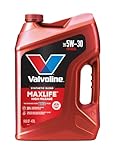
- Formulated for engines with 75,000 miles or more, Valvoline MaxLife High Mileage synthetic blend is formulated with seal conditioners to help prevent oil leaks and reduce oil consumption
- Delivers 20% better wear protection and 15% better sludge defense than industry standards to help prevent engine breakdown
- Extra detergents safeguard against friction, corrosion and deposits to keep high-mileage engines clean
- Advanced friction-fighting additives help maximize performance and improve fuel efficiency
- Provides performance benefits for high mileage, new and re-built engines alike
Opposed motion and smoothness
Because opposing pistons counter one another’s movement, the layout has inherently favorable vibration characteristics. That does not eliminate every vibration source—turbocharging, mounts, accessories and combustion still matter—but it gives engineers a smooth mechanical starting point.
What is special about a Subaru boxer engine?
The distinctive feature is not a magic power advantage. It is the way the flat engine changes the vehicle’s proportions and mass placement. A lower center of gravity can make load transfer more predictable, and balanced left-right mass helps the chassis behave consistently in corners. Those effects support grip and driver confidence, especially when the AWD system can distribute torque to use the available traction.
Is a boxer engine better for handling?
It can help handling, but the engine alone does not determine it. Tire compound, suspension geometry, alignment, differential calibration, steering tuning and electronic controls all influence cornering. A boxer gives Subaru a favorable platform for that work; it does not guarantee shorter lap times than a well-engineered car with an inline or V engine.
Recommended Free Tools
Rank #2

- Designed for vehicles with 75,000 miles or more, Valvoline MaxLife Full Synthetic High Mileage Motor Oil helps maximize engine life and performance for the many miles still ahead
- Formulated with seal conditioners to help prevent oil leaks, reduce oil consumption, and improve fuel economy
- Delivers 50% stronger wear protection than industry standards for superior defense against friction and wear
- Provides 20% stronger sludge defense than industry standards to protect against harmful buildup and deposits
- Offers 2.5X better heat protection than industry standards to safeguard engines in extreme conditions
Are Subaru boxer engines good for performance?
Yes, when performance is judged as a complete car. The low, symmetrical package supports stable turn-in and predictable behavior while turbocharging supplies the torque modern performance drivers expect. The strongest case is therefore system-level: Subaru engineers can tune the engine, AWD and chassis around the same center-of-gravity and packaging targets.
The 2026 WRX is the current proof point
Subaru of America’s current U.S. 2026 WRX page lists a 2.4-liter direct-injection turbocharged SUBARU BOXER engine producing 271 horsepower and 258 pound-feet of torque. The same page reports a 5.5-second 0–60 mph result for a manual-transmission WRX, a Car and Driver test result as presented by Subaru.
Why are WRX engines flat-four?
The WRX uses a horizontally opposed four-cylinder because the configuration preserves Subaru’s low engine placement and works with its longitudinal Symmetrical AWD architecture. The 2024 WRX brochure describes the same basic 2.4-liter DOHC, direct-injection, intercooled, 16-valve opposed-four design with a twin-scroll turbocharger and the 271-horsepower/258-pound-feet output. Engine specifications can vary by market and model year, so an imported or older WRX should be identified by its actual engine code.
Rank #3
- Formulated for engines with 75,000 miles or more, Valvoline MaxLife High Mileage synthetic blend is formulated with seal conditioners to help prevent oil leaks and reduce oil consumption
- Delivers 20% better wear protection and 15% better sludge defense than industry standards to help prevent engine breakdown
- Extra detergents safeguard against friction, corrosion and deposits to keep high-mileage engines clean
- Advanced friction-fighting additives help maximize performance and improve fuel efficiency
- Provides performance benefits for high mileage, new and re-built engines alike
From EJ20 to FA engines
Subaru Australia credits the 1994 Australian WRX introduction and the combination of Symmetrical AWD with a compact 2.0-liter EJ20 turbo boxer as central to the model’s early success. Subaru’s global technology history describes the EJ20 as a long-running development symbol and the FA20 as a newer boxer concept aimed at output, emissions performance and an even lower center of gravity. This is an evolution, not a claim that every country received the same engine at the same time.
Boxer vs. inline vs. V engines
There is no universally best cylinder layout. The right comparison is how each architecture affects the finished vehicle.
| Factor | Boxer (Subaru flat-four) | Inline engine | V engine |
|---|---|---|---|
| Center of gravity | Wide, low cylinder banks allow a low installation and balanced left-right mass. | Narrow bank simplifies packaging, but a taller engine can raise the installation height. | Two banks can keep length short; height and width depend on the V angle and accessories. |
| Vibration and balance | Opposed piston motion provides inherently favorable primary balance and smoothness. | Balance varies greatly by cylinder count and crank design; inline-fours commonly need more attention to vibration control. | Balance depends on bank angle, crank design and cylinder count. |
| Width and access | Wide engine can restrict side access and requires two cylinder heads. | Usually offers straightforward access along one cylinder bank. | Two banks add components and can crowd the valley or sides. |
| AWD/transmission integration | Pairs naturally with Subaru’s longitudinal Symmetrical AWD package. | Can be integrated with many driveline layouts, depending on vehicle architecture. | Often favors short, high-output packaging but requires layout-specific engineering. |
| Real-world performance | Low mass placement and balanced packaging can support predictable response; output still depends on turbo, tune and chassis. | Can be efficient, light and powerful in a broad range of applications. | Can deliver high displacement or cylinder count in a compact length, with weight and complexity varying by design. |
The boxer’s advantage is strongest when the entire vehicle is engineered around it. A flat engine does not automatically make more power, and a different layout can be the better choice for a particular cost, space or performance target.
Rank #4

- 6X better wear protection on critical engine parts than industry standards**
- 1.3X better sludge protection than industry standards*
- 3X Stronger against viscosity breakdown than leading full synthetic^
- Protection for 10,000 miles between oil changes
- Meets or exceeds the following specifications: API SP/SN PLUS/SN | ILSAC GF-6 | GM dexos1 Gen 3 | Meets Ford WSS-M2C947-B1 | Meets Ford WSS-M2C962-A1 |
Are Subaru boxer engines hard to work on?
They can be more labor-intensive in specific jobs, mainly because the cylinder banks extend toward both sides of the engine bay. Subaru South Africa notes that the width can restrict access to components, while Subaru’s comparison material identifies spark-plug replacement as an example that may be more arduous. Two cylinder heads also mean additional head-specific components compared with a single-bank inline-four.
What that means for owners
- Access and labor time depend on the vehicle, engine generation and the technician’s procedure; difficulty is not the same as unreliability.
- Use the correct spark plug, gap specification and tightening method for the exact engine code. A plug listed for an EJ engine should not be assumed to fit an FA20 or FA24.
- When buying tools, verify clearance for the specific WRX chassis. A slim spark-plug socket, suitable extension and a torque wrench may be necessary where a conventional socket will not fit.
- Follow the model-year service schedule and use the specified fluids. Subaru states that long-term reliability depends on regular servicing, correct fluids, driving habits and adherence to the recommended maintenance plan.
Trade-offs, not fundamental disadvantages
The wider engine and two-head arrangement are engineering trade-offs created by the same layout that enables the low, symmetrical package. They should be considered when estimating maintenance time or engine-bay access, not treated as evidence that boxer engines are inherently fragile.
What’s actually slowing this PC down?
Pick the symptom - the matching free tool is one click away.
How to judge the boxer when choosing a performance Subaru
- Identify the exact engine. Confirm the model year, market and engine code before ordering plugs, filters, gaskets or service tools.
- Evaluate the complete chassis. Look at tires, brakes, suspension condition, alignment and AWD operation; these determine how effectively the engine’s low placement becomes usable grip.
- Check maintenance history. Look for documented oil changes, correct fluids and scheduled inspections rather than relying on the boxer layout as a reliability guarantee.
- Match expectations to the evidence. The current U.S. WRX’s 271 horsepower, 258 pound-feet and reported 5.5-second manual 0–60 mph result describe one current specification and test, not every Subaru boxer-powered model.
The bottom line on Subaru’s “secret”
Subaru’s boxer remains a performance advantage because it lets the company build around a low center of gravity, even mass distribution and a naturally compatible AWD layout. Its value appears in the car’s balance and predictability more than in a single horsepower figure. The same design brings wider packaging and more involved access for some repairs, but those are manageable trade-offs when maintenance is performed for the exact engine and model year.
Quick Recap
Product prices and availability are accurate as of the date/time indicated and are subject to change. Any price and availability information displayed on Amazon at the time of purchase will apply.




