Electromagnetic compatibility (EMC) testing helps verify that a vehicle’s electronic systems can operate amid electromagnetic disturbances without creating unacceptable interference for other equipment. For semi-autonomous cars, where multiple connected and safety-related electronic functions share a vehicle, that evaluation belongs in development and validation—not just at final approval. It is one part of engineering assurance, not proof by itself that an automated driving system is safe or capable.
Why EMC matters in electronically dense vehicles
EMC covers two related questions: what electromagnetic disturbance a vehicle or component emits, and how it behaves when exposed to disturbance from outside or elsewhere in the vehicle. In a car with numerous electronic functions, incompatibility can undermine intended operation or interfere with other equipment. Testing gives engineers a structured way to evaluate those behaviors and address problems during development.
“High-bandwidth” describes the topic’s engineering context, but it does not by itself establish a particular network design, data rate, or failure mechanism. The cited regulatory and standards material does not document a specific interference incident affecting an advanced driver-assistance feature, nor does it provide failure statistics. Claims that a particular bus or sensor will fail in a particular way therefore require separate technical evidence.
What the main references cover
| Reference | Role in automotive EMC |
|---|---|
| UN Regulation No. 10 | UNECE’s vehicle regulation for electromagnetic compatibility. The applicable series and amendments depend on the approval market and date. UNECE regulations index |
| CISPR 25 | Addresses radio disturbance characteristics for protecting receivers used on board vehicles and related equipment. UNECE regulatory materials |
| ISO 11451 | A family of road-vehicle test methods for electrical disturbances from narrowband radiated electromagnetic energy at vehicle level. UNECE regulatory materials |
| ISO 11452 | A family of component test methods for electrical disturbances from narrowband radiated electromagnetic energy. UNECE regulatory materials |
| ISO/IEC 17025 | Addresses competence requirements for testing and calibration laboratories; laboratory competence is a separate consideration from the method being applied. UNECE regulatory materials |
These references orient the reader to disturbance emissions, receiver protection, immunity, and testing at different levels. They do not, on their own, establish the detailed limits, frequency ranges, severity levels, or pass/fail criteria that apply to a particular approval. Those details must be taken from the applicable regulation and the relevant editions of the standards.
What’s actually slowing this PC down?
Pick the symptom - the matching free tool is one click away.
#1 Best Overall

- 【PRECISE READOUTS & CLEAR DIGITAL DISPLAY】Bright LED display shows highly clear readings in any lighting condition, 0.1V resolution gives you reliable indication and shows you the voltage number easily & quickly. Bidirectional light emitting diode on the circuit board for easy battery load testing, red light indicates positive polarity, green light indicates negative polarity.
- 【QUICK DETECTION & EXTENSIVE USE】WINAMOO auto circuit tester helps you to quickly test car battery voltage and diagnoses issues in 3V-48V systems, including alternator tester functionality of car/truck/SUV/boat charging systems. Also to inspect circuit tester integrity of headlights, taillights, turn signal circuits, faulty sockets, fuse connections and more.
- 【SHARP PROBE & ANTI-LOST PROTECTIVE SLEEVE】Sharp stainless steel probe for piercing insulation with ease, also for hard to reach tight areas. Integrated anti-lost protective sleeve to secure the probe during storage and safeguarding against damage, making sure no stab and wound and won't be lost wherever you go.
- 【EXTENDED SPRING WIRE & LARGE ALLIGATOR CLIP】High quality 96 inch long enough spring wire increases flexibility to access across broad areas when testing. Attaching with large crocodile clip for easy single-handed operation, which is boosting the efficiency for car battery capacity checks and beyond.
- 【ULTRA-DURABLE & SAFE CONSTRUCTION】This voltage tester pen adopts ergonomic handle for comfort and safe grip. Constructed with premium ABS body with higher transparency, shatter-proof and durable. Ensuring reliable battery meter and circuit analysis for safe operation, making them an essential tool in electrical troubleshooting.
Vehicle-level and component-level testing answer different questions
Vehicle-level evaluation
ISO 11451 represents methods applied at vehicle level. This perspective can evaluate a vehicle in its broader configuration, where installed systems and their interactions matter. Vehicle-level assessment is not interchangeable with testing an individual electronic component.
Component-level evaluation
ISO 11452 represents component-level methods. Component testing can assess an electronic unit under defined test conditions before or alongside vehicle integration. It can help identify susceptibility or emissions concerns earlier, but a component result alone does not establish how the completed vehicle behaves.
Rank #2

- Reliable Fault Detection Performance:Accurately locate circuit and motherboard faults, measure coil status precisely, quickly screen out defective components, and deliver stable and reliable test data for daily maintenance work.
- Wide Compatibility & Multi-Scenario Use:Suitable for chip-level maintenance and circuit fault troubleshooting, compatible with various equipment motherboard detection needs, flexible to adapt to different repair scenarios and common device models.
- Simple Operation & Instant Feedback:No complicated settings required, real-time detection feedback helps quickly find fault points, easy to operate for beginners and professional maintenance personnel, with accurate testing results.
- Compact & Portable Design:Solid lightweight body, small size does not take up space, easy to put into maintenance tool kits, convenient to carry and use for indoor and on-site coil testing work.
- Efficient Electromagnetic Induction Testing:Adopt electromagnetic induction sensing technology to realize fast fault inspection, shorten motherboard and circuit detection time, greatly improve maintenance efficiency and work productivity.
Emissions and immunity are complementary
Emissions or radio-disturbance evaluation considers disturbance produced by equipment and the potential effect on receivers. Immunity evaluation considers behavior when equipment is exposed to electromagnetic disturbance. A sound EMC program considers the relevant sides of compatibility rather than treating low emissions as proof of immunity, or immunity as proof that emissions are acceptable.
How to plan EMC work for a semi-autonomous vehicle
- Identify the approval market and timing. Determine which jurisdiction’s requirements govern the vehicle and when approval is sought. Use that information to identify the applicable UN Regulation No. 10 series and amendments rather than assuming one revision applies everywhere.
- Map vehicle and component scope. Identify which vehicle configurations and electronic components need evaluation, then distinguish vehicle-level methods from component-level methods.
- Define the required evidence. Consult the applicable regulation and editions of the referenced standards for test procedures, limits, severity levels, and acceptance criteria. The broad descriptions of the standards are not a substitute for those requirements.
- Select a competent test facility. Establish that the laboratory’s competence and accreditation scope, where relevant, fit the specific methods and work required. ISO/IEC 17025 addresses testing and calibration laboratory competence, but the reference to it alone does not verify any particular provider or scope.
- Integrate results into development and approval. Use component and vehicle evidence for their respective purposes, and assess the completed vehicle against the requirements that apply to its approval. EMC results address electromagnetic compatibility; they do not replace other safety engineering or validation of automated-driving functions.
Distinguish an adopted requirement from a proposed change
UNECE’s current regulations index identifies UN Regulation No. 10 as the vehicle EMC regulation. A separate UNECE page published in 2026 describes a proposed supplement to the 07 series of amendments. A proposal is not automatically an adopted requirement: confirm formal adoption, entry into force, and applicability to the market and approval date before treating it as binding. UNECE proposed supplement document
Windows Errors? Fix Them Before They Spread
Repair common Windows errors and clear accumulated junk for a smoother, more stable PC - no reinstall needed.Free scan · no reinstallOutdated Drivers Are Slowing You Down
One free scan finds every outdated or missing driver and matches the right update for your exact hardware.Free scan · exact hardware matchRank #3

- High-Definition Scale Display: This package included 1 car battery load tester. Features a high-definition scale display with three different color codes to indicate battery status, green indicates that the battery is normal, yellow indicates that the battery may be defective or not fully charged, and red indicates that the battery may be defective or completely drained, helping you quickly determine whether the battery is faulty. Keep you fully informed about the condition of your car battery.
- High Quality Material: The car battery load tester is crafted from iron and copper materials. The iron case is high impact resistance, drop-proof and effectively protects internal precision circuits from damage. It also has excellent electromagnetic shielding capability, effectively isolates electromagnetic interference generated by other devices, ensuring the accuracy of detection data. The copper-plated clips ensure low-resistance contact, reducing testing errors in battery testers.
- Wide Application: Measuring of 11.4 x 4.17 x 2.36 inches, the car battery load tester is compact design with a handle for easy storage and portability, suitable for testing 6V and 12V batteries and voltages in various vehicles such as cars, pickup trucks, SUVs, motorcycles, RVs, boats and beach bikes. Whether it's routine maintenance or emergency repairs for your car battery, it's the ideal choice for you. Supports operation in high-temperature conditions up to 48℃.
- Simple Test Method: The product with red positive and black negative rubber grips copper clip, can easily clip the battery terminals on the test position. First, turn off the engine. Then, connect the tester, with the red clip connected to the positive terminal of the battery and the black clip connected to the negative terminal, ensuring that the connection is secure. Finally, determine the health status of the battery based on the color coding displayed on the tester screen.
- Practical Function: The car battery load tester adopt high-quality casing with ventilation holes on the surface improves heat dissipation performance, prevents equipment overheating during testing, and ensures safe and stable operation. The clamp features recessed tooth design with ultra-strong clamping force, allowing it to easily secure various types of automotive batteries. These designs improve the testing performance of the tool, helping you quickly and efficiently detect battery voltage.
What EMC testing does—and does not—establish
EMC testing provides standardized evidence about electromagnetic disturbance behavior at the component or vehicle level, under the applicable methods and criteria. It supports development and regulatory approval by revealing whether the tested subject meets the relevant requirements. It does not establish the complete safety, operational competence, or real-world performance of a semi-autonomous driving system; those require other forms of engineering validation and evidence.
Quick Recap
Best Value
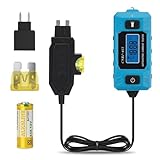
- 🔋 Locate the Exact Fuse Causing Battery Drain: Stop guessing which circuit is draining your battery. This tester allows you to pinpoint the specific fuse responsible for abnormal parasitic current draw—fast, accurate, and without disconnecting the battery.
- 🔎 Direct Fuse-Level Current Analysis: Test individual fuse circuits in real time and observe actual load behavior under operating conditions. Instantly identify which circuit is drawing abnormal current without removing the battery connection.
- 📊 Stable & Accurate Real-Time Current Measurement: Measures 0.01A–20A current with clear real-time display. Provides reliable data for diagnosing parasitic drain, circuit overload, and abnormal electrical behavior.
- ⚡ Easier Than Using a Multimeter: No loose probes or unstable contacts. Simply plug into the fuse slot to get steady real-time current readings without disconnecting the battery.
- 🛡Maintains Factory Circuit Protection: The fuse-inline design measures current through the vehicle’s original fuse, keeping factory circuit protection active while monitoring current during diagnostics.
Rank #4

- Seamless Circuit Board Diagnostics: Featuring an integrated design, the inductor tester supports multiple parameter without requiring tool changes, ensuring and reliable testing for inductance capacitance in diverse repair environments
- Streamlined Repair Process: This inductance tester improves repair workflow through advanced in-circuit testing , allowing technicians to locate faults quickly without removing components, making it ideal for environments requiring rapid troubleshooting and minimal downtime
- Simplified Testing Solution: Designed as a beginner-friendly tool, the in-circuit electromagnetic inductance tester ease of use with a comfortable handheld structure, enabling seamless functionality for both novice and experienced users alike
- Phone Repair Compatibility: With its advanced inductance detection technology, this tool ensures seamless phone operations while doubling as an electrician testing device for circuit board debugging and home electronics evaluations, meeting diverse repair and learning needs
- Anti-Interference Capability: Designed to provide accurate and stable readings, the induction tester minimizes errors by interference, proving itself as a must-have instrument for electronics enthusiasts diagnosing complex circuits or troubleshooting devices effectively
Product prices and availability are accurate as of the date/time indicated and are subject to change. Any price and availability information displayed on Amazon at the time of purchase will apply.




