What’s actually slowing this PC down?
Pick the symptom - the matching free tool is one click away.
Most gasoline engines are built to ignite their fuel with a spark, not with the heat of compression, because autoignition that starts on its own, before the spark-timed flame arrives, is what engineers call knock. Gasoline is not physically incapable of igniting under compression. That tendency is the problem a conventional gasoline engine is designed to prevent. Engineers can build systems that deliberately use compression ignition with gasoline, but controlling when and how fast the mixture burns across the whole operating range is the hard part.
Two ways to start combustion
Both gasoline and diesel engines compress a charge inside a cylinder, but they start the burn in different ways. The difference comes down to what enters the cylinder and what triggers the flame.
| Approach | What enters the cylinder | How combustion begins | Main control concern |
|---|---|---|---|
| Conventional spark-ignition gasoline | Premixed fuel and air | A timed spark starts a flame that spreads through the charge | Keeping unburned mixture from autoigniting ahead of the flame (knock) |
| Conventional diesel compression ignition | Air first, then fuel injected into the hot, compressed air | Injected fuel ignites in the hot air | Timing the injection so the fuel burns at the intended point |
| Gasoline HCCI and related compression-ignition concepts | A premixed, often diluted, fuel and air charge | Compression raises charge conditions until the whole mixture autoignites | Setting the autoignition timing and limiting how fast heat is released |
The table shows why the question is less about gasoline’s chemistry and more about the engine’s design. A diesel engine avoids premixing the fuel with the air, so compression only heats the air and the injected fuel ignites where it is sprayed. A gasoline spark engine premixes the fuel and relies on a flame to do the burning, so a compression-triggered ignition would happen in the wrong place and at the wrong time.
What a spark-ignition engine is built to do
The U.S. Department of Energy’s Internal Combustion Engine Basics describes the sequence plainly: “In a spark ignition engine, the fuel is mixed with air and then inducted into the cylinder during the intake process.” The piston then compresses that mixture, a spark plug fires at a chosen point, and a flame front travels outward through the chamber, pushing the piston down as it burns.
Recommended Free Tools
#1 Best Overall

- GET HANDS ON with Playz V8 engine model kit that works for adults and kids alike. Engage young minds into STEM with a working replica of a classic 8-cylinder internal combustion car engine, while adults enjoy the rewarding experience of building their own mini V8 engine kit that runs like a dream.
- REALISTIC MODEL THAT WORKS: Deliver the action of a classic car engine with powerful pistons and interactive cables! Watch the motor fans turn on with real engine sounds from your visible V8 engine model kit, making it a perfect STEM toy for curious minds seeking a fun blend of education and entertainment.
- FUEL THE FUN: Our complete toy V8 engine assembly kit provides hours of fun as you tinker with cranks, pulleys, belts, and exhaust valves, bringing this miniature engine kit to life before your very eyes! Conquer long boring days with a small V8 engine kit that runs. (Requires 3x AA Batteries not included)
- CHALLENGE ACCEPTED: Supercharge your critical thinking skills with our mini engine build kit! Expand your creativity, think logically, and refine your motor skills as you build a model V8 engine kit all while having fun. Get ready for a brain-boosting build challenge that works wonders!
- POPULAR GIFT THAT INSPIRES: Make the world of STEM amazing with our DIY engine kits for adults, teens, young boys and girls! Whether it's for birthdays, holidays, or any special occasion, Playz V8 model engine kit will keep them captivated as they build and operate their own engine from start to finish.
That design gives the engine control. The spark can be timed for the best power, efficiency and emissions at a given speed and load. The flame does the work of consuming the mixture in an orderly way, which is why the spark plug, not the pressure in the cylinder, decides when the power stroke begins.
Why uncontrolled autoignition is a problem: knock
The EIA’s Gasoline explained: Octane in depth describes knock as autoignition of the unburned charge ahead of the flame. As the flame pushes into the chamber, it compresses and heats the remaining mixture, the so-called end gas. If that end gas reaches its autoignition point before the flame reaches it, it ignites all at once. The result is a second, uncontrolled combustion event and a sharp pressure spike.
Rank #2

- 🔍 [Transparent Operation Demonstration] This four-stroke gasoline engine model features open design and visual working components, allowing clear observation of the complete combustion process including piston movement, valve operation and spark ignition simulation.
- 🎓 [Educational STEM Teaching Tool] Perfect for physics classrooms and STEM education, this internal combustion engine demonstrates intake, compression, power and exhaust cycles through electric-powered operation with light indicators showing ignition timing.
- ⚙️ [Precision Metal Construction] Crafted from high-quality metal components, this durable engine model features realistic mechanical details and reliable operation, making it suitable for repeated classroom demonstrations and hands-on learning experiments.
- 🔧 [Interactive Learning Experience] Users connect power and manually rotate the crank to observe the entire four-stroke process. The engine provides practical understanding of mechanical principles without requiring actual gasoline operation.
- 🎁 [Ideal Educational Gift] This functional demonstration model serves as an excellent gift for science enthusiasts, engineering students, and educators. It combines decorative appeal with practical educational value for mechanical principle learning.
The pressure spike is what makes knock harmful. Repeated, severe knock loads pistons, rings, bearings and the cylinder head far beyond their design intent. Light knock is mostly a noise and an efficiency penalty, but heavy or sustained knock can damage hardware, which is why engine management is built to suppress it.
How modern engines avoid knock
Knock control is largely a feedback loop. The EIA describes the common approach: when the engine detects knock, the spark is delayed (retarded) so combustion finishes later in the cycle, when the end gas is cooler and less likely to autoignite. The Department of Energy’s Co-Optima material on knock notes the cost of this approach. A retarded spark reduces the work the piston gets from each burn, so avoiding knock often gives up some efficiency.
PC Slower Than It Used to Be?
A free scan shows the junk files, broken settings and background clutter dragging Windows down - then fixes them in one click.Free scan · Windows 10 & 11Outdated Drivers Are Slowing You Down
One free scan finds every outdated or missing driver and matches the right update for your exact hardware.Free scan · exact hardware matchRank #3

- 1:4 SCALE MODL WITH MOVING PARTS; Clear Engine Casing So You Can See All the Parts Move, LED Lights Simulate Spark Plugs Firing; Fan Spins, Crank Turns, Just like Original
- 100 PAGE COLLECTOR'S BOOK; Full Color Photos, History and Facts about the Ford Mustang, Clear Instructions for Building
- NO GLUE REQUIRED; Builds in a Couple Hours with the Included Tools.
- ELECTRONIC SOUND MODULE: Electric Display Base Plays Sounds Recorded From Actual 1965 Ford Mustang
Why not simply raise compression until gasoline ignites?
Higher compression raises the temperature and pressure of the charge, which improves thermal efficiency in a spark engine. It also brings the unburned mixture closer to its autoignition point. In a conventional engine, that trade-off is managed by a fixed set of design choices: compression ratio, combustion chamber shape, valve timing, and the spark-timing strategy. Pushing compression far enough to autoignite gasoline on purpose would trigger knock across much of the engine’s range, not just at one point in the cycle, and the spark system would no longer be in charge of combustion.
This is also why changing a spark engine’s compression alone is not a route to compression ignition. The engine would need a different charge preparation, a different way of controlling the burn, and calibration that works at every speed and load. The sources cited here describe purpose-designed strategies, not a modification that can be applied to a production gasoline engine.
Rank #4
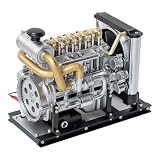
- Exquisite Mechanical Decoration: The ingeniously designed mini OHV inline four-cylinder diesel model, with premium quality & extremely textured metal parts, briefs you on the wonderful world of mechanical engineering in an immersive environment.
- All Included For Building This Engine Model: The engine consists of 300+pcs parts and comes with a paper English instruction manual. You will personally experience the whole process of assembling from small parts to the finished product and build a shocking engine model.
- Superb STEM Activity: The wonderful activity allows adults to cooperate with children for assembly to spend their leisure time, which enhances parent-child interaction, walks children through popular industrial knowledge, increases their knowledge and imagination, develops mental and logical thinking as well as improves innovation and creativity.
- Special Gifts: This engine will make great industrial technology in the form of inheritance in the hands of every owner. Packed in a high-end gift box, the product makes a perfect gift for children or adults that is irresistible and satisfying.
- Applicable age:14+
What octane does and does not tell you
Octane rating is a standardized measure of a fuel’s resistance to knock. The EIA explains that it is determined by testing against reference fuels, so a higher number means the fuel resists autoignition better under test conditions. Octane is not a measure of energy content, and a higher number does not by itself turn a spark-ignition engine into a compression-ignition engine.
Knock resistance matters because it sets how far an engine can be pushed before knock appears. The Co-Optima material notes that a knock-resistant fuel can shift the knock limit, but realizing efficiency gains also requires an engine with suitable compression and calibration. In practice, a higher-octane fuel only helps an engine designed to use it. Fuel chemistry, engine design and control all contribute to the result, so two gasolines with similar ratings may not behave identically in every engine.
Quick wins for a faster PC:
Clear out junk files and repair common Windows errorsFree Scan →Scan for outdated or missing drivers - takes under a minuteDriver Scan →Best Value

- ✨【Exquisite Craftsmanship】Beautifully crafted from brass, stainless steel, and wood, this mini engine offers high quality, reliability, and detailed mechanical operation, perfect for display
- ⚙️【Easy Operation】Simple to start with clear instructions. Requires only 3 AA batteries and 95 gasoline. Enjoy the process of manually turning the flywheel and powering up the engine
- 🌟【Compact and Functional】Small in size (150*120*135mm), making it a great desk accessory. The engine size is 85*70*105mm with a flywheel diameter of 56mm, ideal for hands-on enjoyment
- 🎁【Perfect Gift Idea】An ideal present for DIY enthusiasts, collectors, and anyone who appreciates fine mechanical models. Suitable for ages 16 and up, making it a fun and educational gift
- 🔧【Adjustable Carburetor】Fine-tune the carburetor’s oil needle for optimal fuel-to-air ratio. Ensure smooth operation by adjusting as needed for a better running experience
Where gasoline compression ignition does exist
Gasoline can be compression ignited in engineered systems. The DOE’s Advanced Combustion Strategies overview describes low-temperature combustion approaches in which a diluted charge is compressed toward autoignition. The aim is to control combustion timing and the rate of heat release so the burn is not destructively rapid.
Homogeneous-charge compression ignition (HCCI)
HCCI mixes fuel and air well before ignition and compresses the charge until it autoignites throughout the chamber at once. Because there is no flame front to guide the burn, the timing depends directly on charge temperature, charge dilution and fuel chemistry. The SAE 2002 paper On the Nature of Autoignition Leading to Knock in HCCI Engines focuses on exactly this relationship, including the knock limits that appear as load increases.
PCCI, RCCI and related concepts
The DOE overview also lists partially premixed compression ignition (PCCI) and reactivity-controlled compression ignition (RCCI) among low-temperature combustion approaches. The DOE material presents these as related strategies that adjust mixing, dilution or fuel reactivity to manage when autoignition happens. The SAE 2020 paper Real Fuel Modeling for Gasoline Compression Ignition Engine identifies HCCI, gasoline compression ignition (GCI) and RCCI as research modes for gasoline engines and discusses the temperature and fuel requirements for HCCI autoignition.
Why these systems are hard to control
- Load range. Autoignition timing depends on charge conditions, so a setting that works at light load can knock or misfire at higher load.
- Power ceiling. The technical literature identifies knock as a limit at high power, because the rate of heat release rises with the load.
- Fuel dependence. Fuel chemistry changes autoignition behavior, so the controller must account for the fuel actually in the tank.
- Dilution and temperature. Diluting the charge slows the burn but also changes how easily it ignites, forcing a balance between stability and control.
Production availability is outside what the cited sources establish. The DOE and SAE material describes these strategies as engineering approaches and research modes. Treat any claim that a specific mass-market gasoline car uses compression ignition as needing its own verification from the manufacturer.
What this means if you own a gasoline car
- Use the octane grade listed in your owner’s manual. The engine’s knock control was calibrated for that fuel.
- Do not remove spark plugs or raise compression to try for compression ignition. The conventional system relies on the spark to control combustion, and the modifications needed for compression ignition go well beyond a hardware swap.
- Pay attention to persistent pinging or knock under load. It usually indicates a fuel, timing or maintenance issue rather than a sign that the engine is close to compression ignition.
- Keep the ignition system in good condition. The automotive spark plugs and ignition components are the parts that set the timing that keeps knock in check.
The short answer is that gasoline engines are designed around a spark-timed flame because uncontrolled autoignition is knock, and knock is harmful. Compression ignition with gasoline is possible in purpose-built systems, but controlling it across all speeds and loads is the reason it is not the standard design.
Quick Recap
Product prices and availability are accurate as of the date/time indicated and are subject to change. Any price and availability information displayed on Amazon at the time of purchase will apply.




