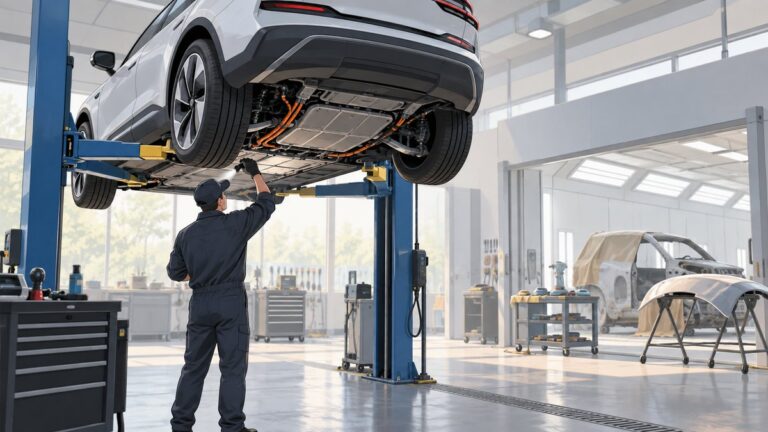
An electric car’s quoted range is a standardized test result, not a promise about every journey. Your actual distance per charge can be lower when your speed, weather, route, load or climate-control use makes the car consume energy faster than the test conditions did.
What a quoted range tells you—and what it cannot
A range figure is useful because it gives drivers a consistent basis for comparing vehicles. It does not predict exactly how far a particular car will travel on a particular day. A laboratory test cannot reproduce every driver’s route, speed, temperature, driving style, cargo or use of heating and air conditioning.
As an Amazon Associate I earn from qualifying purchases.
Range depends on how quickly a car uses the energy stored in its battery. When a trip requires more energy per mile than the pattern represented by the rating, the car can cover fewer miles before needing a charge. The size of the difference depends on the vehicle and the journey; the official sources cited here do not establish one percentage that applies to all EVs.
The US Environmental Protection Agency (EPA) describes its range estimates as general guidelines and identifies cold weather, accessory use and high-speed driving as factors that can significantly lower range. Australia’s Department of Climate Change, Energy, the Environment and Water also identifies speed, terrain, weather, vehicle load, driving style and heating or air conditioning as influences on actual range. EPA consumer guidance and the Australian government’s overview of electric-vehicle types and test standards explain why a published number should be treated as a comparison point, not a trip guarantee.
#1 Best Overall

- 2 Modes of Operation: There are two ways to operate the 12V electric stroller, which can be operated by the child himself by manipulating the steering wheel and foot pedal. If the child can not drive, the parents can control the direction and speed by remote control
- 3-Speed & Smooth Start: The remote control provides 3-speed adjustment and manual operation provides 2-speed adjustment to ensure the safety of children, while equipped with a smooth start design to ensure the safety of your kids. The maximum speed can reach 3Mph
- Realistic Experience: The power wheel car comes with bright headlights and realistic taillights that look like real models, built-in music, voltage display, USB and AUX connectors, volume control, TF card slot and speakers, along with a widened seat and adjustable seat belt design to ensure a safe and comfortable experience for children
- Rechargeable & Durable: The battery type is 12V, the time required for charging is 8-12 hours, and it can run for 1-2 hours when fully charged, suitable for both indoor and outdoor use
- Age and Weight Capacity: This children's car has a maximum weight capacity of 55Lbs, suitable for children from 3 to 5 years old, with excellent reliability of use
How the US EPA range figure is calculated
The EPA tests a fully charged EV in a laboratory on a dynamometer, which allows the vehicle to follow defined driving cycles. Under the single-cycle approach described by the agency, the car is driven on the EPA city cycle until it can no longer continue; the process is then repeated on the highway cycle. An optional multi-cycle method is also available. This is the US EPA method, not a description of how every country produces its range figures.
EPA applies adjustments for real-world factors that its laboratory cycles do not fully represent, including air conditioning, cold temperatures, and high-speed or aggressive driving. The agency describes 0.7 as the most common adjustment factor among the regulatory options. In its example, a 200-mile highway laboratory result becomes a 140-mile adjusted highway result. That calculation is part of EPA’s rating method; it does not mean every driver should expect to receive 70% of the label range.
For the combined EPA label figure, adjusted city and highway range values are weighted 55% and 45%, respectively. The agency’s testing page also lists 20°F cold and 95°F hot conditions among five defined fuel-economy test cycles. Those temperatures are elements of EPA’s testing framework, not a claim that every trip or every range test takes place at either temperature. The agency’s explanation of the method and its figures is at Fuel Economy and EV Range Testing.
Recommended Free Tools
Rank #2

- Licensed Chevrolet Design: Electric car for kids is officially licensed, Chevrolet ride-on car features the same styling as the real car, such as a racing steering wheel, slim body, smooth lines, 2-speed, dual door safety locks and LED lights for a realistic driving experience for your little one
- Dual Control Methods: Kids electric car supports pedal operation and remote control operation. Remote control operation supports 3 speed switching, which improves the safety of children
- Enhanced Entertainment Features: Toy cars for toddlers comes with Bluetooth functionality and a built-in music player, allowing kids to play their favorite songs and stories on outdoor trips, with real speaker sound on the steering wheel to make the experience even more enjoyable
- Advanced Safety Features: Electric car is equipped with soft start, rear wheel shock absorbers, and a safety belt design, lockable double doors, and ASTM and CPSIA certified. All functions are ready for children's safe travel
- Age Appropriate Specifications: Ride on car is suitable for children over 3 years old, can bear a maximum weight of 66LBS, is equipped with 2x25W motors and a rechargeable battery, and only needs to be fully charged for 8-12 hours for 1 hour of play
The test is designed to be controlled and repeatable, so the result can support comparisons. Its adjustments do not turn the rating into a forecast for every combination of driver, weather and road. A driver who spends a trip at sustained high speed, for example, is using a different pattern from one that matches the city-and-highway test cycles.
Why your route and conditions can use range faster
Speed and driving style
High-speed driving can significantly lower range, according to the EPA. Speed matters because the car must use energy to keep moving at the pace and under the conditions of the trip; the test rating represents defined cycles, not every possible cruising speed. Driving style also matters: Australia’s energy department includes it among the factors affecting actual range, while EPA’s adjustment framework specifically accounts for high-speed or aggressive driving.
This is why two journeys of the same distance need not have the same range effect. A route with sustained high-speed driving may demand more energy than a route whose driving pattern is closer to the rated cycle. The sources do not provide a single speed threshold or a universal range reduction, so a precise percentage cannot be applied to every car.
Rank #3

- 【Official Mercedes-Benz License + Dual Safety Certifications】1:1 replica of the classic G63 design with authentic brand logo, certified by both ASTM and CPSC. No sharp edges or corners, giving parents complete peace of mind.
- 【Dual-Mode Operation + Anti-Misoperation Design】Supports independent driving for kids (ages 3-6) and parental remote control (ages 0-3). One-click emergency stop on the remote prevents accidental collisions effectively.
- 【Safe Battery Life + Charging Protection】12V high-capacity battery delivers up to 120 minutes of continuous use (far exceeding competitors' average 80 minutes). Built-in overcharge/overtemperature protection chip ensures safe charging.
- 【Authentic Driving Experience + Multifunctional Entertainment】Equipped with LED running lights, simulated engine sounds to replicate the real Mercedes driving feel. built-in USB/Bluetooth connectivity—supports music playback from phones or USB drives, doubling the driving fun.
- 【Upgraded Core Components & Premium Build Quality】Reinforced upgraded body (thicker than standard models for better impact resistance), high-torque upgraded motor (smoother acceleration, no stalling), and wear-resistant tires (enhanced grip for all-terrain use)—outperforming ordinary kids' ride-on cars in durability and performance.
Cold, heat and climate control
Cold weather can significantly reduce range, and using heating or air conditioning adds another variable. The EPA names cold conditions and accessory use; the Australian government names weather and heating or air conditioning. Their effects depend on the vehicle and trip, so a published rating cannot tell you exactly how much range a particular cold or hot day will cost.
When comparing vehicles for your own use, account for the climate you actually drive in and how much you rely on cabin heating or cooling. A rating produced under one standardized procedure should not be read as a guarantee for a trip with different weather and climate-control demands.
Hills, load and the combination of demands
Terrain and vehicle load also affect the distance available from a charge. Hills, heavy cargo and substantial heating or air-conditioning use are specifically identified by the US Department of Energy’s Alternative Fuels Data Center (AFDC) as reasons to leave extra range buffer. Australia’s energy department likewise lists terrain and vehicle load among the influences on actual range.
Rank #4

- 【Officially Licensed McLaren765LT】: It captures the details of the real car, designed in a 1:1 scale model to replicate every detail of the real car. It features one-button design, authentic engine sounds, LED headlights, providing a truly comfortable driving experience.
- 【Safe & Comfortable】: Made with durable and non-toxic plastic with ASTM certification for greater reliability. Adjustable seat belt and lockable doors offer better protection for kids. Non-slip PP tires, Spring suspension and slow start function offers a gentle and safe acceleration. The car supports a maximum weight capacity of 66Lbs, 16" Wider Seater, suitable for children from 3 to 6 years old. Toy car size is 45.9" x 23.6" x 11.4" (L x W x H).
- 【Parent Remote & Manual Mode】: By using the parent remote control, parents can stop the vehicle in an emergency or completely control it remotely with 3 speeds. Manual mode would be more enjoyable for kids who loves independent steering driving fun by the steering wheel and pedals.
- 【Premium Performance】: Comes with a charger and a rechargeable 12V battery, the charging time of 8-12 hours, which allows for 1-2 hours of continuous use. With 2 x 30W motors, it provides ample power of speed 1.86-3.1mph, allowing the car for kid to navigate easily on grass, mud, and asphalt surfaces.
- 【Ideal Gift for Kids】: The Licensed McLaren765LT kids electric vehicle comes with bright headlights, realistic taillights, built-in music, car horn and engine sound, bluetooth function and etc., which will give kids a real driving experience. It is an ideal gift for children on birthdays, Thanksgiving, Christmas, New Year's, etc.
Trip conditions can occur together: a loaded car may be driven over hills in cold weather with the heater running. The official guidance identifies these as relevant demands, but does not give a formula for adding them together or a fixed amount to subtract from the vehicle’s rating. Treat the combination as a reason to plan more cautiously, not as a basis for an invented percentage.
Independent reader supportYour contribution helps us test, update, and keep practical guides available for everyone.EPA, WLTP, NEDC and CLTC are not interchangeable figures
Before interpreting a quoted range—or comparing two cars—check which test protocol produced it. Australia’s government identifies EPA, WLTP, the older NEDC, and China’s CLTC among commonly used standards, and notes that the same vehicle can have different figures under different cycles. Its practical recommendation is to compare figures based on the same testing standard whenever possible.
Do these 3 things before closing this tab:
1Fix the driver behind crashes, sound loss and screen glitches2Clear out junk files and repair common Windows errors3Scan for outdated or missing drivers - takes under a minute| Figure or method | What the available guidance establishes | How to use it |
|---|---|---|
| EPA | For the US method, EPA describes laboratory dynamometer testing, adjustments for selected real-world factors, and a combined value weighted 55% city and 45% highway. | Compare EPA figures with other EPA figures. Do not treat the label as a guarantee for a specific trip. |
| WLTP | Australia’s government lists it as a common range standard and says the same vehicle may have different figures under different test cycles. It characterizes WLTP as often considered closest to real-world range, but that does not guarantee a match to any individual journey. | Compare WLTP with WLTP where possible; still account for your route and conditions. |
| NEDC | Australia’s government identifies it as an older standard. The available guidance does not provide a conversion from NEDC to another protocol. | Do not assume an NEDC figure is directly comparable with EPA, WLTP or CLTC. |
| CLTC | Australia’s government identifies it as a common standard used in China. The available guidance does not provide a conversion from CLTC to another protocol. | Compare like with like rather than treating a CLTC number as an EPA or WLTP result. |
WLTP being described as often closer to real-world range is a general characterization, not a promise that a particular WLTP-rated car will match your driving. Speed, terrain, weather, load and climate-control use still vary from trip to trip. The Australian government’s guidance on standards and range factors is available at Types of electric vehicles.
Best Value

- FOR KIDS 3 YEARS & OLDER: This small yet powerful ride-on is perfect for your little racers who want to start driving like the grownups do!
- POWERFUL 12V & REALISTIC DESIGN: Adjustable seatbelt, bright LED headlights, lockable doors, and grid windshield for off-road style, with a 12V motor and traction tires to ride on different terrains
- MANUAL AND PARENT CONTROL: Let your child drive manually or use the remote control to safely guide them yourself; remote has forward/reverse controls
- SAFE & DURABLE: Includes plastic wheels that will never deflate, plus a spring suspension system and safe, 2.8mph max speed for smooth rides on outdoor adventures
- CONNECT YOUR MUSIC: A built-in AUX outlet allows kids to plug in media devices to drive while jamming to their own selection of music; OVERALL DIMENSIONS: 39.25"(L) x 26"(W) x 26"(H); Weight Capacity: 61 lbs.
How to compare a quoted range with the driving you actually do
- Identify the test protocol. Find out whether the quoted figure is EPA, WLTP, NEDC or CLTC. If you are comparing vehicles, put figures from the same standard side by side; unlike cycles do not make an apples-to-apples comparison.
- Describe your typical routes. Consider whether you regularly drive at sustained high speed, climb hills, carry heavy cargo or travel in weather that requires frequent heating or air conditioning. These are among the conditions official guidance identifies as range-relevant.
- Match the vehicle to your use. Consider your daily distance and longer journeys alongside the conditions above. AFDC advises comparing vehicles in light of driving needs and says to leave extra range buffer for hilly terrain, heavy loads or substantial HVAC use. Its consumer guidance is at Electric Vehicles for Consumers.
- Plan for the demanding trip, not only the rating. If a journey includes several range-reducing conditions, allow more buffer than you would for an easier route. The sources do not prescribe one universal buffer size, so do not treat a single percentage as right for every car and itinerary.
- Use the rating as a starting point. The EPA says its estimate is a general guideline and actual results vary. Use it to compare vehicles under a shared standard, then judge suitability against your routes, climate, load and charging needs.
What you can—and cannot—conclude from a lower result
A lower-than-quoted result is consistent with demanding trip conditions or with comparing figures based on different test protocols. It does not, by itself, show that the quoted figure was meant to predict your exact journey: the EPA explicitly frames its estimate as a general guideline, and the Australian government notes that the same vehicle can have different range figures under different standards.
Nor does the available official guidance support a blanket claim that every EV falls short by a particular percentage. It identifies factors that can significantly lower range and explains how ratings are produced, but does not establish a representative average gap across vehicles, routes and climates. A specific prediction requires evidence for the particular vehicle and conditions rather than an all-purpose discount.
For a practical decision, keep three questions separate: Are the quoted figures based on the same test cycle? Does your normal driving include conditions that use range faster? And does the vehicle’s range, with an appropriate buffer for your demanding journeys, fit your charging and driving needs? That approach makes the number useful without mistaking a standardized rating for a promise.
Free tools Windows power users keep installed
One-click scans. No signup required.
Quick Recap
Product prices and availability are accurate as of the date/time indicated and are subject to change. Any price and availability information displayed on Amazon at the time of purchase will apply.