RPM means revolutions per minute when the subject is a car, engine, motor, wheel, shaft, or other rotating machine. It tells you how many complete turns occur in one minute. Online publishing uses the same abbreviation for revenue per mille, so the surrounding context matters.
RPM usually means revolutions per minute
RPM is a measurement of rotational speed: how many complete turns a shaft, wheel, engine, motor, or other rotating object makes in one minute. One RPM means one revolution every minute. In a car, the tachometer uses RPM to show how quickly the engine’s crankshaft is turning.
As an Amazon Associate I earn from qualifying purchases.
RPM does not, by itself, tell you how much power an engine is making, how much torque is available, which direction a shaft is turning, or whether a particular speed is safe. Those answers depend on the machine, load, gearing, temperature, balance, lubrication, and manufacturer’s limits.
There is another important meaning online: revenue per mille, a digital-publishing metric for estimated revenue per 1,000 impressions, page views, queries, or video views. The surrounding words usually reveal which meaning applies:
#1 Best Overall
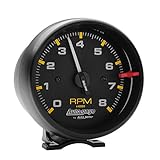
- Traditional incandescent lighting illuminates around the perimeter of the dial
- Compatible with 2 - 4 pulse ignition signals (4-8 cylinder engines) with points, electronic, and most 12V high-performance racing ignitions.
- 12 and 16 volt compatible, well-suited with nearly every street car or race car electrical system
- Engine, crankshaft, motor, wheel, gearbox, shaft, or spindle: rotational speed.
- Views, impressions, page views, CPM, advertising, or monetization: revenue per mille.
What RPM tells you in a car
A car’s tachometer reports engine speed, normally in revolutions per minute. If the gauge reads 2,000 RPM, the engine is completing approximately 2,000 crankshaft revolutions per minute. The transmission then uses gears to relate that engine speed to the speed of the wheels.
Engine RPM changes with throttle position, vehicle load, road speed, and transmission gear. In a manual car, pressing the accelerator in a low gear can raise RPM quickly. Selecting a higher gear generally lowers engine RPM at the same road speed. In an automatic, the transmission may change gears or allow some torque-converter slip, so engine RPM and road speed do not always change in a perfectly fixed ratio.
RPM can help a driver understand whether the engine is idling, accelerating, pulling a load, or approaching the manufacturer’s maximum recommended speed. It is a useful operating measurement, but it is not a complete diagnosis of engine condition or performance.
The Tool Desk
Outbyte Driver Updater FREEScan for outdated or missing drivers - takes under a minuteDriver Scan →Outbyte PC Repair FREERepair Windows errors before they cause bigger problemsFix Now →RPM, angular velocity, and linear speed
RPM counts rotations per minute. Physics often expresses the same rotational speed as angular velocity in radians per second:
- Revolutions per second = RPM ÷ 60
- Angular velocity in radians per second = RPM × 2π ÷ 60
- RPM = angular velocity in radians per second × 60 ÷ 2π
NASA explains that angular velocity describes the rotation of the object, while tangential velocity describes how fast a particular point travels along its circular path. Points on the same rigid rotating object share angular velocity, but a point farther from the axis travels a greater distance during each revolution and therefore has a higher linear speed. NASA’s explanation of angular velocity provides the distinction.
For a wheel, tangential speed can be found from its circumference and RPM:
Linear speed = π × diameter × RPM
when diameter is expressed in distance units per revolution and the result is interpreted per minute. For example, a wheel with a 0.60-meter diameter turning at 600 RPM has an ideal rim speed of approximately 18.85 meters per second, or about 67.9 km/h. A real vehicle’s road speed may differ because of tire deformation, slip, gearing, and the fact that the tire’s effective rolling radius is not always its unloaded radius.
Why RPM matters
1. It identifies operating speed
Every rotating machine has an intended operating range and, usually, a maximum rated speed. Engines, electric motors, pumps, fans, drills, saws, grinders, turbo-machinery, centrifuges, and spindles are designed around particular speeds.
Rank #2
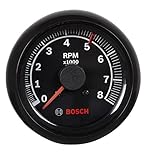
- 2-5/8" black dial face with 250 degree sweep and black bezel with mounting hardware
- 0-8000 RPM range, driven by Air Core motor
- Adjustable redline pointer
- Compatible with 4, 6, and 8 cylinder engines
- Functions with breaker points, electronic, and most aftermarket ignition systems (not magnetos)
Running below the intended speed can reduce a machine’s flow, cooling, cutting speed, process rate, or output. Running above its rating can increase vibration, heat, wear, and the risk of component failure. For a car engine, the appropriate RPM range depends on the engine design, lubrication system, load, temperature, transmission, and the vehicle manufacturer’s instructions. There is no universal “safe RPM.”
2. RPM works together with torque and power
Torque is twisting force. RPM is rotational speed. Power combines the two. For rotating machinery:
P = Tω
where P is mechanical power in watts, T is torque in newton-meters, and ω is angular velocity in radians per second. Using torque in newton-meters and speed in RPM:
Do these 3 things before closing this tab:
1Scan for outdated or missing drivers - takes under a minute2Repair Windows errors before they cause bigger problems3Fix the driver behind crashes, sound loss and screen glitchesPower in watts = torque × π × RPM ÷ 30
In commonly used imperial units, an approximate relationship is:
Horsepower = torque in pound-feet × RPM ÷ 5,252
The relationship is why RPM alone cannot tell you an engine’s power. An engine producing the same torque at twice the RPM produces approximately twice the mechanical power, assuming it can operate at that speed and ignoring losses. Conversely, at a fixed power output, torque generally decreases as RPM increases.
A stationary engine or motor can have torque applied to its shaft, but it is not delivering mechanical power through rotation until the shaft is turning. For the underlying power-and-torque relationship, see this power, torque, and angular-velocity reference.
3. Gears trade RPM for torque
Gearboxes, pulleys, and belts allow designers to exchange rotational speed for turning force. In an ideal gear or belt system, reducing the output speed generally increases output torque, apart from friction and other losses.
Crashes, No Sound, or Screen Glitches?
Random freezes, missing sound and display glitches usually trace back to one bad driver. Find and replace yours safely.Free scan · under a minutePC Slower Than It Used to Be?
A free scan shows the junk files, broken settings and background clutter dragging Windows down - then fixes them in one click.Free scan · Windows 10 & 11For a simple belt-and-pulley arrangement:
Driver diameter × driver RPM ≈ driven diameter × driven RPM
Rank #3

- 【RPM Range】 This tachometer features an RPM range from 0 to 8000 RPM, rpm tachometer providing a comprehensive view of your vehicle's engine speed. Whether your engine is idling or running at high revs, tach gauge accurately tracks and displays the rotational speed.
- 【Adjustable Shift Light Alarm Trigger Value】 Tachometer gauge for car equipped with an adjustable shift alert function, the alarm range is set between 2000 - 8000 RPM. By simply turning the knob on the instrument panel, you can customize the shift alert value of tachometer gauge for car according to your driving preferences. When the engine RPM exceeds the preset alarm range, the shift light of rpm gauge will promptly illuminate, reminding you to shift gears for optimal performance.
- 【Applicable Range】 RPM tachometer is designed to be compatible with 12V, 1 - 8 cylinder gasoline-powered vehicles. By setting the number of cylinders to make the tachometer compatible with your gasoline engine, the rotational speed readings can be accurately displayed.This wide applicability makes rpm tachometer a versatile choice for various gasoline automobiles, (Please make sure that your engine is a gasoline engine with 1 to 8 cylinders before purchasing a tachometer.)
- 【Adjustable Backlight Brightness】 The tachometer for car is equipped with adjustable backlight. The backlight offers 5 levels of brightness adjustment. With a short press of the small button on the instrument panel of rpm gauge, you can easily cycle through the different brightness settings to suit your driving environment, be it bright daylight or dark nights.
- 【Tachometer Setup Instructions】 1. To set the number of cylinders: Long press the small button on the instrument panel of tachometer for 6 seconds to enter the cylinder number setup mode. 2. To adjust the shift alarm value: Rotate the knob on the instrument panel. 3. To toggle the backlight brightness: Briefly press the small button on the instrument panel.
A smaller driven pulley turns faster; a larger driven pulley turns slower. Belt slip, mechanical losses, and changing loads mean the real result may not exactly match the ideal calculation. The same basic principle applies to vehicle transmissions: a lower gear gives the engine more mechanical advantage at the wheels, while a higher gear allows lower engine RPM during cruising.
See this pulley-speed relationship for the idealized calculation.
4. Electric-motor RPM depends on frequency and poles
For an AC induction motor, theoretical synchronous speed is determined by supply frequency and the motor’s total number of stator poles:
Ns = 120f ÷ P
Ns is synchronous speed in RPM, f is frequency in hertz, and P is the number of poles. A two-pole motor supplied with 60 Hz power has a theoretical synchronous speed of 3,600 RPM.
An induction motor normally runs somewhat below synchronous speed. This difference is called slip, and it is necessary for the motor to produce torque. A representative full-load speed for a two-pole, 60 Hz motor is near 3,550 RPM, rather than exactly 3,600 RPM. The U.S. Department of Energy explains synchronous speed and slip in its motor reference material.
5. Higher RPM increases mechanical stress
Rotating parts experience centripetal acceleration. For a point at radius r:
a = ω2r
Because angular velocity is squared, increasing RPM increases centripetal acceleration disproportionately. Doubling angular speed produces four times the centripetal acceleration at the same radius. The actual stress in a component also depends on its material, shape, mass distribution, balance, construction, temperature, and how it is supported.
What’s actually slowing this PC down?
Pick the symptom - the matching free tool is one click away.
This is one reason a manufacturer’s speed rating matters. Do not assume that a wheel, pulley, fan, grinding disc, or other component is safe simply because a motor can physically spin it faster.
Rank #4
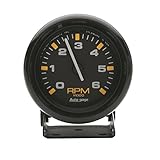
- Traditional incandescent lighting illuminates around the perimeter of the dial
- Compatible with 2 - 4 pulse ignition signals (4-8 cylinder engines) with points, electronic, and most 12V high-performance racing ignitions.
- 12 and 16 volt compatible, well-suited with nearly every street car or race car electrical system
RPM versus related measurements
| Measurement | What it describes | Why it is not the same as RPM |
|---|---|---|
| RPM | Rotational speed | Counts complete revolutions per minute. |
| Torque | Turning force | A shaft can have torque while stationary; torque alone does not specify speed or power. |
| Power | Rate of doing mechanical work | Depends on both torque and rotational speed. |
| Frequency | Cycles per second, measured in hertz | Electrical frequency can help determine a motor’s theoretical speed, but it is not automatically the same as mechanical RPM. |
| Linear or tangential speed | Distance traveled per unit of time | Requires RPM plus the rotating part’s radius or diameter. |
| Redline or maximum speed | An application-specific operating limit | It depends on the equipment maker, component rating, load, temperature, balance, and other conditions. |
How to measure RPM
A tachometer measures rotational speed. A non-contact optical or laser tachometer is often useful for a shaft, pulley, fan, engine component, or other rotating part because it can read speed without touching the moving equipment.
- Stop the machine. Read the tachometer instructions and identify a suitable measurement point.
- Apply reflective tape while the equipment is stopped. The tape gives the optical instrument a contrasting target. Use reflective tachometer tape only as directed by the instrument manufacturer.
- Replace guards and clear the area. Do not operate exposed machinery merely to make measurement easier.
- Restart the equipment using the normal procedure.
- Aim the tachometer at the reflective target from the specified distance and hold it steadily.
- Compare the reading with the machine’s rated range. For variable-frequency-drive applications, take readings under the relevant loads and operating conditions because speed can change with the drive command and load.
Fluke’s tachometer documentation describes this reflective-target procedure and recommends tachometer measurement for variable-frequency-drive applications. A laser tachometer can be a practical choice when you need non-contact RPM measurement, but the correct instrument depends on the required range, target, distance, environment, and accuracy.
Safety comes before the reading
Never attach reflective tape, touch a shaft, hold a contact probe against a rotating part, remove a guard, or lean near moving machinery while it is operating. Stop the equipment before setting up the measurement. Follow the manufacturer’s instructions and applicable workplace procedures.
Free tools Windows power users keep installed
One-click scans. No signup required.
OSHA identifies entanglement, nip-point, crushing, cutting, and similar hazards around rotating machinery. Hair, jewelry, gloves, and loose clothing can be caught and pulled into moving parts. Use proper guards, lockout/tagout procedures when required, training, and a safe measurement position. OSHA’s guidance on hazardous machine motions and actions explains why an informal close-range measurement is not worth the risk.
Independent reader supportYour contribution helps us test, update, and keep practical guides available for everyone.RPM in digital advertising: revenue per mille
In online publishing and creator analytics, RPM means revenue per mille. “Mille” means one thousand. The metric estimates how much revenue is generated for every 1,000 relevant page views, ad impressions, queries, or video views.
The general formula is:
Revenue RPM = estimated revenue ÷ relevant audience or impression count × 1,000
For example, $180 in estimated revenue from 45,000 impressions gives:
Recommended Free Tools
$180 ÷ 45,000 × 1,000 = $4.00 RPM
That does not necessarily mean the publisher received exactly $4 from a particular block of 1,000 impressions. RPM is a normalized comparison metric. It helps compare periods, pages, videos, channels, or traffic mixes even when their total audience sizes differ.
AdSense RPM and YouTube RPM are not interchangeable
Google AdSense defines RPM using estimated earnings divided by a relevant count—such as page views, impressions, or queries—multiplied by 1,000. The denominator must be identified before comparing one RPM figure with another. Google’s AdSense RPM definition gives the calculation and examples.
YouTube’s creator RPM has a different scope. It represents total revenue after YouTube’s revenue share per 1,000 video views and can include advertising, YouTube Premium, channel memberships, Super Chat, and Super Stickers. It includes all views, including views that were not monetized. That is why creator RPM is generally lower than advertiser-facing CPM, which is based on advertising economics rather than the creator’s total revenue per view. See YouTube’s explanation of creator RPM.
Best Value

- 2-5/8" white dial face with 250 degree sweep and black bezel with mounting hardware
- 0-8000 RPM range, driven by Air Core motor
- Adjustable redline pointer
- Compatible with 4, 6, and 8 cylinder engines
- Functions with breaker points, electronic, and most aftermarket ignition systems (not magnetos)
Do not compare a YouTube RPM directly with an AdSense page RPM unless you have confirmed both the denominator and which revenue sources are included. Labels such as page RPM, ad RPM, query RPM, ad-session RPM, and YouTube RPM describe different calculations. Google has also stated that AdSense session-related metrics were scheduled for retirement from September 2025, so ad-session RPM should not be treated as a universally current metric without checking the specific reporting product and date. The current reporting definition is more important than the acronym alone.
Quick wins for a faster PC:
Scan for outdated or missing drivers - takes under a minuteDriver Scan →Clear out junk files and repair common Windows errorsFree Scan →Fix the driver behind crashes, sound loss and screen glitchesFind Drivers →Why revenue RPM rises or falls
A higher revenue RPM may reflect higher-value advertising, a different audience geography, stronger advertiser demand, more monetized views, seasonal changes, or the addition of other eligible revenue sources. A lower RPM may result from more unmonetized views, changes in traffic mix, seasonality, content-eligibility limits, advertiser demand, or a change in the revenue mix.
RPM is a summary metric, not a diagnosis. YouTube specifically cautions that RPM alone cannot identify which underlying revenue source caused a change. Publishers and creators need to examine the relevant traffic, monetization, content, and revenue reports.
Why RPM matters: the quick test
When you see “RPM,” look at the surrounding terms:
- If the text mentions an engine, tachometer, crankshaft, wheel, motor, gearbox, shaft, fan, or spindle, RPM means revolutions per minute.
- If it mentions revenue, impressions, page views, queries, video views, CPM, ads, or monetization, RPM means revenue per mille.
For a car, RPM is primarily the engine’s rotational speed. It matters because it affects gearing, acceleration, power delivery, fuel use, mechanical stress, and the point at which the manufacturer tells you to shift or reduce load. But higher RPM is not automatically better: the appropriate speed is the one that suits the engine, gear, load, temperature, and rated operating limits.
Frequently Asked Questions
What does RPM mean in a car?
In a car, RPM means revolutions per minute—the number of times the engine’s crankshaft turns in one minute. The tachometer displays this speed so the driver can understand engine load, gear selection, acceleration, and proximity to the manufacturer’s maximum recommended speed.
Is RPM the same as horsepower or torque?
No. RPM measures rotational speed, while torque measures twisting force. Power depends on both: power equals torque multiplied by angular velocity. An engine’s RPM alone cannot tell you how much power it is producing.
Is higher RPM always better?
RPM is not automatically good or bad. The correct range depends on the engine or machine, load, temperature, lubrication, balance, gearing, and manufacturer’s rating. Excessive RPM can increase heat, vibration, wear, and mechanical stress.
What does RPM mean on YouTube or AdSense?
In digital advertising, RPM means revenue per mille, or estimated revenue per 1,000 relevant impressions, page views, queries, or video views. The exact denominator and included revenue must be identified before comparing RPM figures.
The Bottom Line
RPM most commonly means revolutions per minute—the number of times a rotating object turns in one minute. In a car, it tells you engine speed, but meaningful performance information comes from RPM together with torque, power, gearing, and operating limits. Online, RPM can instead mean revenue per mille, so always identify the denominator and context before interpreting the number.
Quick Recap
Product prices and availability are accurate as of the date/time indicated and are subject to change. Any price and availability information displayed on Amazon at the time of purchase will apply.




