Volkswagen’s ID. Buzz AD is being developed as part of a fleet-based autonomous mobility service, not as a self-driving option for private buyers. In the passenger test phase reported in Lake Nona, Florida, invited riders travel with trained human operators onboard. That makes it a real-world service trial, but not an unsupervised, fully driverless public ride.
Is the Volkswagen ID. Buzz self-driving?
The ID. Buzz AD is designed for autonomous mobility services and uses a self-driving system supplied by Mobileye, according to MOIA. But “autonomous” describes the technology and intended service model, not the supervision arrangements in every current deployment. MOIA’s September 24, 2026 update says trained human operators are onboard during Lake Nona passenger rides. The Los Angeles validation announced in April 2026 also involves human operators.

MOIA said in 2025 that certification for driverless operation in the European Union and United States was planned. The later testing announcements establish supervised trials, not that the vehicle is now certified for unrestricted driverless operation in either region.
What makes the ID. Buzz AD a mobility service platform?
MOIA presents the vehicle as one part of a package for fleet operators. Its description combines the ID. Buzz AD, Mobileye’s self-driving system, MOIA’s AD MaaS software platform, and Operator Enablement. The latter includes simulation, training, deployment, and monitoring support.
Quick wins for a faster PC:
Clear out junk files and repair common Windows errorsFree Scan →Scan for outdated or missing drivers - takes under a minuteDriver Scan →#1 Best Overall

- Collectible quality True-to-scale detailed vehicle
- Die-cast metal body with plastic parts
- Officially licensed product by Maisto International
- Highly-detailed die-cast precision model for collectible or play
- Detailed die-cast precision model
MOIA says its software is intended to manage fleets, assist passengers, support safety processes, and connect with booking apps. Volkswagen Group likewise describes MOIA’s software as controlling the fleet in real time and integrating with existing booking applications. These are company descriptions of the system’s capabilities, not independent assessments of its performance.
Sensor configuration
MOIA reported that the ID. Buzz AD has 27 sensors: 13 cameras, nine LiDARs, and five radars. The company says their arrangement provides a redundant 360-degree view. That specification describes the equipment; on its own, it does not demonstrate real-world safety or establish how the vehicle performs in every operating condition.
Rank #2
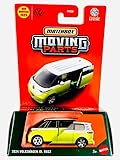
- Authentic Match Box Design: Premium-quality die-cast replica of the Volkswagen ID Buzz (Green) featuring realistic detailing and moving parts.
- Functional Moving Parts: Includes opening and closing features for added realism — perfect for collectors and imaginative play.
- Premium Finish: Eye-catching metallic blue paint with detailed interiors and authentic branding for a true-to-life look.
- Ideal Gift for Kids & Collectors: Great choice for children aged 3+ and adult collectors who love Hot Wheels & Match Box scale models.
- Durable & Collectible: Built from sturdy materials, perfect for long-lasting use, playtime adventures, or proudly displaying in your die-cast collection.
Where are Volkswagen’s autonomous vans being tested?
The programs differ in purpose and passenger access. The announced fleet figures and timelines below are plans, not evidence that the stated fleets have already been deployed.
| Location or program | Service purpose | Reported status |
|---|---|---|
| Hamburg | MOIA autonomous mobility pilot | Volkswagen Group describes testing transport and passenger-service functions and integrating MOIA software. This is a pilot, not an unrestricted driverless service. |
| Lake Nona, Florida | Community microtransit with Beep | By September 24, 2026, invited passengers were booking through the Beep app and riding on three planned routes, using dedicated pickup and drop-off points. Trained human operators are onboard. |
| Los Angeles | Ride-hailing with Uber | MOIA America and Volkswagen Group reported on-road validation with human operators. Their April 8, 2026 announcement said more than 100 vehicles were planned for the validation phase and Uber-platform rides were planned for late 2026. |
| Beep partnership in the United States | Transit for communities and campuses | MOIA America and Beep announced a goal of scaling up to 5,000 autonomous ID. Buzz vehicles over the next decade. This is a long-term target, not a current fleet count. |
Can you ride in the autonomous ID. Buzz?
In Lake Nona, invited passengers can take part in the Beep service test by booking through the Beep app. The service uses designated pickup and drop-off locations along three planned routes, with trained human operators onboard. The announcement describes invited-rider access; it does not establish that anyone can book a public ride or that the service is operating without an onboard operator.
Outdated Drivers Are Slowing You Down
One free scan finds every outdated or missing driver and matches the right update for your exact hardware.Free scan · exact hardware matchPC Slower Than It Used to Be?
A free scan shows the junk files, broken settings and background clutter dragging Windows down - then fixes them in one click.Free scan · Windows 10 & 11Rank #3
Los Angeles is a separate effort: the reported activity is on-road validation with Uber, and the April announcement characterized rides booked through Uber as planned for late 2026. It does not confirm that those rides have begun.
When will the ID. Buzz robotaxi launch?
There is no single launch date covering all the programs. Lake Nona had begun carrying invited passengers by September 24, 2026, under supervised test conditions. For Los Angeles, the April 8 announcement set out a plan for Uber-platform rides in late 2026, but that announcement alone does not confirm a launch. The Beep partners’ target of up to 5,000 vehicles is a goal for the next decade, not a deployment schedule for a public fleet.
Rank #4
![Hot Wheels VW ID. Buzz Bomb Van [White & Purple] HW Euro 4/10, 86/250, New for 2026! 1:64 Scale Diecast Toy Vehicle](https://m.media-amazon.com/images/I/51o+EZcwtVL._SL160_.jpg)
- Volkswagen ID. Buzz Bomb Van in a Stylish White & Purple Finish!
- Number 4/10 in the HW Euro Set! Number 86/250 in the Overall Series!
- 1:64 Scale Diecast Toy Vehicle
What “redefines autonomous mobility” means in practice
The significant idea is the attempt to package a purpose-built van with the vehicle software and operator support needed to run a fleet service. That makes the ID. Buzz AD relevant chiefly to mobility operators—such as transit agencies, municipalities, communities, campuses, and fleet businesses—rather than to consumers shopping for a personal van with autonomous-driving features.
For an operator, adopting such a service involves more than acquiring vehicles. The announced package points to needs including dispatch and passenger software, operator training, deployment support, monitoring, booking integration, and routes suited to the service. The trials show different ways partners are exploring that model: community microtransit in Lake Nona, ride-hailing validation in Los Angeles, and a mobility pilot in Hamburg.
Best Value
![Matchbox Moving Parts 2024 Volkswagen ID. Buzz [Orange] 03/50, 1:64 Scale Diecast Vehicle](https://m.media-amazon.com/images/I/41olzyOSkBL._SL160_.jpg)
- 2024 Volkswagen ID. Buzz in a Vibrant Orange Finish!
- Number 03/50 in the Moving Parts Series! The Door Opens!
- 1:64 Scale Diecast Toy Van
MOIA and Volkswagen Group’s announcements describe the product and its plans, but do not independently establish safety outcomes, reliability, economics, or comparative service quality. The clearest conclusion is that the ID. Buzz AD is being developed as an integrated fleet platform and is already carrying invited passengers in a supervised Florida test—not that driverless public service has broadly arrived.
Quick Recap
Product prices and availability are accurate as of the date/time indicated and are subject to change. Any price and availability information displayed on Amazon at the time of purchase will apply.




