Quick wins for a faster PC:
Clear out junk files and repair common Windows errorsFree Scan →Fix the driver behind crashes, sound loss and screen glitchesFind Drivers →Repair Windows errors before they cause bigger problemsFix Now →The Volkswagen Beetle became one of the world’s most widely produced cars, but its story began as a Nazi state project and the factory used forced labor during the Second World War. Civilian production did not start until 1945, under British trusteeship. The car then went on to be made for decades, with production ending in Mexico in 2003.
Who designed the Volkswagen Beetle?
The idea of an affordable car for ordinary people predated the Nazi regime. The Beetle’s particular development program, however, was taken up and reshaped by the Nazi state. Ferdinand Porsche’s design office received the prototype-development contract in 1934; that does not establish that Porsche alone originated every feature of the car’s design.
From a people’s-car brief to prototypes
On January 17, 1934, Porsche submitted a “Memorandum on the construction of a German People’s Car” to Germany’s Reich Ministry of Transport. It described a practical car for four people, with a cruising speed suited to the autobahn. On June 22, the Reich Automotive Industry Association commissioned Porsche’s independent design consultancy to develop and build prototypes.
A V3 prototype series underwent 50,000-kilometre tests in October 1936. Volkswagen’s corporate chronology says the tests established the car’s adequacy in principle, while financing and raw-material constraints remained obstacles to profitable mass production. The NSU Type 32, which was not put into production, had an air-cooled rear engine, torsion-bar suspension and a rounded rear—features resembling those of the later Volkswagen. The available account does not settle the authorship of every individual design feature.
#1 Best Overall

- Car Size: Long 13cm , Width 5.5cm , Hight 5.5cm
- Product Material:zinc alloy plastic rubber
- Color: Black , Yellow , Beige , Red , Pink , Blue , Skyblue
- Car doors can be opened, pull back action drives car forward
- It is perfect for collector's display and also can be used as a toy or gift.
Was the Beetle originally a Nazi project?
The affordable-car idea was older, but the Volkswagen company and factory project were organized under Nazi rule and tied to the regime’s propaganda apparatus. The German Labour Front founded the company preparing the German People’s Car on May 28, 1937. At the factory’s foundation ceremony on May 26, 1938, Hitler named the vehicle the KdF-Wagen, after “Kraft durch Freude” (“Strength through Joy”), the Nazi organization associated with leisure activities.
The savings scheme and an undelivered promise
The regime promoted a savings plan through which prospective buyers could make payments toward a car. Volkswagen’s chronology describes the scheme as propaganda-laden and says the proposed price was still realistically unaffordable for industrial workers. About 336,638 people joined, but no cars were delivered to savers by the end of the war. The United States Holocaust Memorial Museum likewise notes that most people who completed savings books never received a car.
Rank #2

- Die-cast metal body with plastic parts
- Opening doors and engine compartment
- Detailed chassis
- Item Package Weight: 1.28 pounds
The factory redirected to war production
When the war began on September 1, 1939, Volkswagen says it had not produced a single car. The plant’s work was redirected to the armaments economy: activities included aircraft repairs and components, military utility vehicles, amphibious carriers and other armaments. Civilian Beetle series production did not take place during the war.
Forced labor at the Volkswagen plant
The factory increasingly relied on forced labor from summer 1940. Volkswagen’s chronology says this began with Polish women at the main plant. The United States Holocaust Memorial Museum describes the wider groups of people deployed there: prisoners of war, concentration camp inmates, including Jews, and growing numbers of Soviet and Polish civilian forced laborers. This was part of the Nazi system of coercion and exploitation, not ordinary employment. Volkswagen opened a permanent memorial exhibition on the factory site in 1999.
Windows Errors? Fix Them Before They Spread
Repair common Windows errors and clear accumulated junk for a smoother, more stable PC - no reinstall needed.Free scan · no reinstallOutdated Drivers Are Slowing You Down
One free scan finds every outdated or missing driver and matches the right update for your exact hardware.Free scan · exact hardware matchRank #3

- package height : 7.111 cm
- package length : 29.718 cm
- package width : 19.05 cm
- Product type : TOYS AND GAMES
How did Beetle production restart after the war?
US troops occupied the plant in April 1945; the British Military Government took it under trusteeship in June. On August 22, Major Ivan Hirst secured an initial order for 20,000 sedans, primarily for occupation needs and rural health services. Civilian Type 1 series production began on December 27, 1945. Shortages of materials and energy constrained output: only 55 cars were made by the end of that year.
Exports began in 1947, and the company was transferred to German hands in October 1949. The British-run restart was therefore distinct from the wartime factory operation: it began civilian production after the war, initially to meet practical occupation requirements. Volkswagen historian Dr. Manfred Grieger later credited the “robust Saloon” with helping the British Military Government carry out its administrative functions, while describing Hirst as “the right man at the helm.” That is Volkswagen’s corporate-history assessment of the restart.
Rank #4
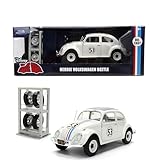
- Iconic movie styling – Features Herbie's #53 livery, racing stripes, and vintage license plate for screen-accurate authenticity
- Premium die-cast build – Crafted from sturdy metal with high-quality paint execution; perfect for display or play
- Dynamic functionality – Opening doors, hood, and decklid reveal interior and engine details; adds interactive realism
- Collector-ready extras – Includes bonus tire rack accessory for added diorama flair or shelf appeal
- Jada Toys – Trusted by collectors and fans for delivering high-detail, officially licensed pop culture vehicles
What made the Beetle distinctive?
Volkswagen’s heritage account describes the Beetle as compact and practical, with curved bodywork, rear-wheel drive and a small air-cooled engine. The company characterizes the shape as aerodynamic and the air-cooled engine as easy to maintain and fix. Those are Volkswagen’s appraisals; the available sources do not provide controlled comparative tests against named contemporary cars.
The model acquired different names in different markets, including Käfer, Vocho, Coccinelle, Fusca and Maggiolino. Its recognizability and broad geographic reach were part of its cultural significance, but the “people’s car” label should be read alongside its political origins: a Nazi propaganda promise that failed to deliver cars to its savers, followed by a postwar civilian life built on a very different production system.
Do these 3 things before closing this tab:
1Repair Windows errors before they cause bigger problems2Scan for outdated or missing drivers - takes under a minute3Clear out junk files and repair common Windows errorsBest Value

- CLASSIC REPLICA: Authentic 1:32 scale die-cast metal model of the iconic 1967 Volkswagen Classic Beetle in a beautifal paint finish
- DETAILED DESIGN: Features include chrome-style bumpers, realistic headlights, detailed wheels, and accurate body styling
- DIMENSIONS: Approximately 5 inches in length, perfect size for display or play
- INTERIOR FEATURES: Detailed cabin with beige interior, visible dashboard, and clear windows
- CONSTRUCTION: Durable die-cast metal body with plastic components and rolling rubber wheels
When did Beetle production end?
Volkswagen says production ended in Puebla, Mexico, in July 2003, after 21,529,464 cars had been made worldwide. About 15.8 million of them were produced in Germany. That final total reflects the model’s extended postwar production life across multiple locations.
A separate milestone came on February 17, 1972, when the Beetle reached 15,007,034 cars produced and passed the Ford Model T production record as it stood at that time. The 1972 figure is the record-passing total, not the Beetle’s eventual production total.
Why is the Beetle considered game-changing?
Its significance lies in the scale and duration of its civilian success: a car whose production was interrupted by war became a high-volume model, spread internationally, and remained in production until 2003. The record milestones and its many local names help show that reach. But the full history cannot be told as an uncomplicated celebration of a popular car: the project was bound to Nazi propaganda, its wartime plant produced armaments, and the factory exploited forced labor.
Quick Recap
Product prices and availability are accurate as of the date/time indicated and are subject to change. Any price and availability information displayed on Amazon at the time of purchase will apply.
Recommended Free Tools




