The right things to keep in your car are the supplies that help you be seen, call for help, stay warm and hydrated, and handle a limited battery or tire problem safely. A practical kit is more useful than a large collection of unrelated gear—and it must be matched to your vehicle, climate and passengers.
The essentials: what to keep in your car
The best car emergency kit is not a survivalist storage bin. It is a compact set of supplies that helps you stay visible, communicate, stay warm and hydrated, and handle limited problems while you wait for roadside assistance. At minimum, carry:
As an Amazon Associate I earn from qualifying purchases.
- A charged phone, vehicle charger and backup power bank
- A flashlight or headlamp with spare batteries
- Reflective warning triangles or another suitable warning device
- A first-aid kit and any personal medication you may need
- Jumper cables or a charged portable jump starter
- A tire-pressure gauge and the equipment required by your vehicle for a flat tire
- Work gloves, basic tools, duct tape, cable ties and shop towels
- Drinking water and nonperishable snacks
- An emergency blanket, warm clothing and rain protection
- Your owner’s manual and a paper map for unfamiliar or remote routes
Keep communication and visibility equipment within reach of the driver. Store heavier tools low and secure them so they cannot become projectiles in a collision. The kit should never interfere with airbags, pedals, visibility, emergency exits or access to the spare tire.
1. Visibility and communication supplies
Phone, charger and backup power
Keep a mobile phone charged before a long trip and carry the correct charging cable or vehicle charger in the passenger compartment. A compact power bank adds useful redundancy if the car battery is dead, the charging system has failed or you need to leave the vehicle to seek help.
#1 Best Overall

- The Road Guardian- The portable roadside assistance kit is designed and hand picked by a group of experienced veterans and experts to provide every essential tools you need in roadside emergencies. The automotive safety bag contains accessories such as repair cable ties, bungee cords, electrical tape, space blanket, rain poncho, reflective warning triangle, glass breaker, seatbelt cutter, safety gloves, tow rope and more to get your vehicle back on the road and continue your travel.
- Top-Notch Digital Auto Tire Inflator- lightweight and compact air compressor can inflate your standard vehicles tire in seconds. With auto shutoff function, simply plug it into the 12v power outlet and attach the stem to the tire valve, preset the tire pressure and press the power button. The compressor starts the inflating process and stop once your tire reaches at your preset level. This cool gadget also has led light for winter nighttime and three extra nozzles for inflammable bed, others
- Copper-Clad Aluminum 12 Feet 8 Gauge Jumper Cable- A durable battery starter cable is a must-have for your trip. Unlike other kits on the market, our jumper cable has reasonable length to get your cars connected. 8 gauge wires and 300 amp output is more than enough to get your standard vehicle started. UL listed heavy-duty battery jumper cables make you physically and environmentally safer and more reliable.
- Completed 108 Pieces First Aid Kit- By having a completed first aid kit, provide you and your family proper basic wound/hygiene treatment before it possibly get worsened during your road trip. Our kit includes alcohol pads, bandages, cotton tips, knuckle bandages, butterfly bandages, wound pad, sting relief pads, gloves, tape, dressing, PBT bandage, CPR mask, tweezer, safety pins, soap wipe, disinfect wipe, adhesive wound pad, triangular bandage, finger bandage.
- Veteran Owned Company 5-Star Customer Support- Everlit is committed into providing the most comprehensive customer service. We proudly offer the exclusive 60-days hassle-free return among all products. We stand behind the quality of our inventory; all original Everlit products are covered with a 1-year satisfaction warranty.
Do not rely on a phone alone in a remote area. Cellular coverage may be unavailable, and a dead phone cannot communicate your location. For rural or unfamiliar routes, consider a paper map and, for longer trips, a battery-powered or hand-crank radio.
Flashlight or headlamp
A flashlight helps other drivers see you and lets you inspect the vehicle at night. A headlamp is particularly practical because it leaves both hands free when checking a tire, opening the hood or using a tool. Keep spare batteries with a conventional flashlight, or check the charge regularly if you use a rechargeable model.
Reflective warning equipment
Reflective warning triangles, approved flares or another high-visibility warning device can make a disabled vehicle easier for approaching traffic to identify. Use them only when deploying them does not require standing in an active traffic lane or walking into an unsafe area.
What’s actually slowing this PC down?
Pick the symptom - the matching free tool is one click away.
When a breakdown occurs, move as far from traffic as safely possible, turn on the hazard lights and avoid standing in front of or behind the vehicle. If you cannot get safely off the road, remain buckled inside with the doors locked when that is safer than exiting. Call emergency services if there is immediate danger, an injury, a crash, fire or a serious exposure risk.
2. First aid and personal safety
A compact first-aid kit should cover minor injuries, not replace medical care. Useful contents include:
- Adhesive bandages in several sizes
- Sterile gauze and medical tape
- Antiseptic wipes or suitable wound-cleaning supplies
- Disposable gloves
- Scissors and tweezers
- Burn and blister supplies where appropriate
Add prescription medication, allergy supplies and other medically necessary items according to their storage instructions. Do not leave temperature-sensitive medicine in a hot or freezing vehicle unless a pharmacist or the medication’s instructions say that storage is acceptable. Replace used, damaged or expired items during each inspection.
Work gloves protect your hands from sharp metal, dirt and hot components. A pair of sturdy shoes, spare socks, a rain poncho and a tarp can also matter if you must wait outside in bad weather.
3. Dead-battery equipment
Jumper cables are useful, but they require a second compatible vehicle and correct connection procedure. A portable lithium jump starter can work without another vehicle, making it more convenient for many drivers, but it must remain charged and be used exactly as its instructions specify.
Rank #2

- Portable & Compact: The car safety kit is designed to fit neatly into an organizer bag, allowing for easy storage in either the backseat or trunk of your vehicle. This ensures that all essential safety items are kept together and easily accessible in case of an emergency. By keeping the kit organized and readily available, you can be better prepared for unexpected situations while on the road
- Fully Prepared: This kit should include essential tools and supplies to help you in case of an emergency. By being prepared, you can feel more secure while driving and have the necessary resources to handle unexpected situations
- Multi-Purpose Emergency Kit: This emergency kit contains everything you need for emergencies. It's suitable for different occasions such as winter weather, commuting and road trips
- Premium Material: The cable surface is covered by PVC material and the interior is made of premium copper wire. The use of premium materials can significantly enhance the overall quality and value of a product. This universal cable is suitable for small vehicles
- Wonderful Car Safety Kit: This kit is ideal for family and friends, especially for teenagers who are about to own their first car. It's a thoughtful and practical present that will undoubtedly be appreciated by the recipient
If you are shopping for equipment, a portable jump starter is most useful when it is compatible with your vehicle’s engine requirements, has protected terminals and can be stored where its charge can be checked easily. Do not assume every jump pack is suitable for every car, truck, hybrid or commercial vehicle.
Before attempting a jump-start, consult the owner’s manual. Battery locations, connection points and procedures vary. Electric and hybrid vehicles may have a 12-volt auxiliary battery as well as a high-voltage traction battery; do not improvise around orange high-voltage cables or components.
4. Flat-tire and wheel equipment
A tire-pressure gauge is inexpensive and useful both during an emergency and for routine maintenance. Check tire pressure when the tires are cold and follow the pressure listed on the vehicle’s door-jamb label or in the owner’s manual, not the maximum pressure molded into the tire sidewall.
Do these 3 things before closing this tab:
1Repair Windows errors before they cause bigger problems2Scan for outdated or missing drivers - takes under a minute3Clear out junk files and repair common Windows errorsVerify what your vehicle actually carries before buying tire equipment. Depending on the model, you may have:
- A full-size or temporary spare tire, jack and lug wrench
- Run-flat tires
- A tire-inflation compressor and sealant kit
- No spare tire at all
Check the spare’s air pressure and condition, confirm that the jack and lug wrench are present, and learn the correct jack points. A ground mat or firm lifting surface can help prevent a jack from sinking into soft ground. Never crawl under a vehicle supported only by its emergency jack.
A tire inflator for a car can restore pressure in a slow leak long enough to reach a safe repair location, but it cannot repair a severely damaged tire. Tire sealant and plug products are temporary measures only, and they must be compatible with the tire and used according to the tire, vehicle or product manufacturer’s guidance. Stop and call for help if the tire is shredded, the wheel is damaged or changing it would place you close to moving traffic.
5. Water, food and warmth
Keep drinking water and shelf-stable snacks such as protein bars in the vehicle. The right quantity depends on the number of passengers, trip length, climate and how isolated the route is. A driver on a short urban commute needs less than a family crossing a remote area in winter.
Recommended Free Tools
Water containers can leak or suffer heat damage. Inspect them periodically, follow the container’s storage and expiration guidance, and rotate food and water rather than treating either as permanently shelf-stable. Avoid leaving perishable food, aerosols, electronics or temperature-sensitive medication in a hot car without checking their storage requirements.
Rank #3
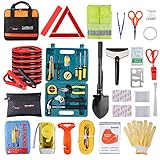
- ESSENTIAL RESOURCES: Packed with practical supplies from jumper cables, reflective triangle and vest to tow rope, and tire presure gauge, we've got everything you need to stay safe during an roadside emergency. But that's not all - it also includes rarely used but essential items like safety hammer, emergency blanket, and survival whistle. With these, you'll be prepared for almost everything the road throws your way.
- RELIABLE JUMPER CABLES: Say goodbye to uncoated jumper cable clamps! Our clamps are fully covered with premium PVC material to protect you from electrical shocks and make sure you can use them safely. The four giant alligator clamps are equipped with strong jagged teeth and springs for an excellent grip force. With a 6 gauge thick inner core, our cables are reliable even in cold winter weather.
- FOLDABLE SURVIVAL SHOVEL: At 16.5 inches, it's a portable size and comes with a carrying pouch. Its versatile design allows for shoveling, digging, hoeing, sawing, and chopping, making it the perfect tool to get you out of any tight situation.
- CAR REPAIR TOOL SET: This handy kit contains all the necessary tools for emergency vehicle repairs and basic household DIY projects, including hammer, wrench, plier, tape measure, PVC tape, digital display test pen, 3 screwdrivers, and 5 hex key. Each tool is neatly organized in a handy case for easy storage and portability.
For warmth and weather protection, consider:
- An emergency Mylar blanket or compact sleeping bag
- A warm hat, gloves and spare socks
- A rain poncho
- A tarp or ground sheet
- Hand warmers where cold exposure is likely
These supplies are intended to make waiting safer and more tolerable. They do not make it safe to remain in a dangerous location indefinitely. If severe weather, flooding, fire or extreme temperatures create an immediate threat, contact emergency services and follow their instructions.
6. Basic tools and temporary repairs
A small tool kit can help with limited, non-structural tasks. Useful contents include screwdrivers, pliers, an adjustable wrench, cable ties, duct tape, spare vehicle-specific fuses, shop towels and work gloves.
Duct tape or cable ties may temporarily secure loose trim, a splash shield or a hose until you reach a repair facility. They are not a safe substitute for replacing a damaged brake line, tire, belt, steering component, coolant hose or other safety-critical part. Never attempt a roadside repair while exposed to traffic, beneath an improperly supported vehicle or near high-voltage electrical components.
Quick wins for a faster PC:
Scan for outdated or missing drivers - takes under a minuteDriver Scan →Clear out junk files and repair common Windows errorsFree Scan →Do not carry gasoline in the passenger compartment. If you choose to carry an empty fuel container for a remote trip, keep it secured and follow local rules and the container manufacturer’s instructions. Fuel delivery is generally safer than transporting fuel inside the cabin.
Build your own kit or buy a preassembled one?
A preassembled car emergency kit is a convenient starting point, especially if you are missing basic lighting, first aid, warning and warmth supplies. Check its contents rather than assuming it includes everything your vehicle needs. Many general kits will not include the correct lug wrench, spare-tire equipment, jump-start solution or personal medication for your specific car and household.
Building your own kit takes longer but lets you match the contents to your vehicle, climate and passengers. A practical shopping list is:
| Problem | Useful equipment | Important caveat |
|---|---|---|
| Other drivers cannot see you | Flashlight or headlamp, hazard lights, reflective warning triangles | Never deploy equipment from an unsafe position in traffic. |
| You need to call for help | Charged phone, vehicle charger, power bank, paper map | Coverage and battery life can fail in remote areas. |
| The battery is discharged | Jumper cables or portable jump starter | Follow the owner’s manual and jump-starter instructions. |
| The tire has lost pressure | Pressure gauge, suitable spare equipment, tire inflator | An inflator does not fix a destroyed tire. |
| You must wait in bad weather | Emergency blanket, warm clothing, poncho, tarp, water | Extreme exposure requires emergency assistance, not just gear. |
| You have a minor injury | First-aid kit, gloves, wipes, gauze and tape | Call for medical help when the injury is serious. |
Amazon is one place to compare these product categories, including a preassembled roadside emergency kit, but compare contents and vehicle compatibility rather than choosing solely by appearance or item count.
The Tool Desk
Outbyte Driver Updater FREEScan for outdated or missing drivers - takes under a minuteDriver Scan →Outbyte PC Repair FREEClear out junk files and repair common Windows errorsFree Scan →What belongs in the glove compartment versus the trunk?
Keep within the driver’s reach
- Phone charger and power bank
- Flashlight or headlamp
- Owner’s manual or a practical digital copy
- Emergency contact and insurance information
- Small first-aid supplies
- Reflective vest or other compact visibility equipment
Secure in the trunk or cargo area
- Jumper cables or jump starter, where accessible and safely secured
- Tire inflator, pressure gauge and vehicle-specific tire tools
- Gloves, tools, tape, ties and towels
- Water, food, blankets and seasonal clothing
- Shovel, traction material and snow brush in winter
Do not bury critical equipment under luggage. In a hatchback or SUV, use a restrained container, cargo net or other suitable method to prevent loose items from moving through the cabin during hard braking or a collision. A waterproof bag protects supplies from leaks and improves organization; a reflective strip makes the container easier to identify after dark.
Rank #4

- If your car is parked at the scene of an accident waiting to be rescued, you may need this car emergency kit
- If this roadside assistance kit can help a novice driver or a family member or friend in the event of an accident on the road, they will surely thank you for gifting him this car emergency kit
- Lightweight and compact tire inflator inflates standard vehicle tires in seconds. The surface of the reinforced cable is made of high-quality PVC, which has the characteristics of anti-freezing, anti-cracking, and anti-tangling
- Roadside emergency car kits come in handy during winter weather, hiking, camping, road trips, or traveling in a car or other vehicle
- All of our products are stowed inside a high quality bag to keep our products in the trunk. Perfect for teens, novices, and experienced car enthusiasts
Seasonal and vehicle-specific additions
Winter driving
Add an ice scraper, snow brush, compact shovel, extra gloves, hat, warm socks, blankets and hand warmers. Sand or non-clumping cat litter can provide limited traction under a driven wheel when appropriate. Use winter-rated windshield-washer fluid and keep the fuel tank sufficiently supplied for the route and conditions.
Snow chains are not universal equipment. The chain size, tire clearance, driven wheels and vehicle manufacturer’s instructions all matter, and some roads or vehicles prohibit or restrict their use. Check local requirements before a winter trip instead of carrying the wrong size and assuming it will fit.
Summer and hot climates
Consider additional water, sunscreen, a hat and cooling towels. Families may also need child-appropriate drinks and snacks. Pets may need extra water, a leash, waste bags and a familiar comfort item.
Do not leave heat-sensitive medication, pressurized aerosols or perishable food in a hot vehicle without confirming that storage is safe. Ask a pharmacist about medication exposed to excessive heat or cold.
Long trips and remote roads
For remote travel, increase water and food supplies and add sturdy footwear, extra clothing, a paper map and a hand-crank or battery radio. A traction aid or tow strap may be useful in some situations, but towing points and strap ratings are vehicle-specific. Never use a tow strap casually on a vehicle without confirming the correct recovery points and safe procedure.
Tell someone your route when traveling through isolated areas, keep the vehicle maintained before departure and check weather and road conditions. Extra gear does not remove the risks of getting stranded far from services.
Children, pets and medical needs
Customize the kit for the people who actually travel in the vehicle. Add diapers, wipes, child-friendly snacks, comfort items, spare clothing and required medication. For pets, carry water, a collapsible bowl, a leash, waste bags and any necessary medication. Rotate these supplies as children grow, dietary needs change or prescriptions are replaced.
Free tools Windows power users keep installed
One-click scans. No signup required.
Vehicle checks before you buy emergency gear
The owner’s manual should decide what equipment is appropriate for your car. Before purchasing, confirm:
Best Value

- 【Things you may need】: This roadside assistance packages is a perfect gift.Contain the necessary roadside kits, snow shovel, flashing lights, reflective triangle warning signs, advanced jumpers (8.2 foot), powerful towing rope, safety hammer and seat belt cutters, life blankets, raincoats, compasses and more!
- 【Safe and durable】: UL certified jumper cables are safer and more reliable than other non-UL certified cables. Four huge alligator clips provide excellent grip. The grip of the clip is covered with an insulating rubber sleeve. The surface of the reinforced cable is made of high-quality PVC, which has the characteristics of anti-freezing, anti-cracking, and anti-tangling.
- 【Car repairs tool box】: Small and compact, suitable for any place, the tools are neat and orderly. Including hammer, pliers, utility knife, tape measure, PVC tape, digital display test pen, 3 screwdrivers. Each kit has a separate location. Clean, safe, convenient, light and strong plastic shell can withstand pressure
- 【Upgrade kit】: Our hammer head is made of high-quality high-carbon steel, with a pointed and flat hammer. It helps to use any side of the car escape tool to quickly break the window in an emergency. We provide raincoats and reflective safety clothing, which can be safer to wear when you repair a broken down car.
- 【Emergency car kit】: This emergency kit car, It’s lightweight, compact. that can fit anywhere in your backseat, trunk or even in your spare tire compartment, can handle unexpected things,it also includes preparedness survival tools for outdoor activities like camping, hiking, hunting, act. perfect for family use at home.
- Whether the vehicle has a spare, run-flat tires or an inflation-and-sealant kit
- Where the 12-volt battery and approved jump points are located
- Which jack points and lug-wrench size the vehicle uses
- Whether the car has special towing or recovery points
- Which fluids, fuses and replacement parts are vehicle-specific
- Whether a hybrid or electric vehicle has special roadside procedures
- Whether cargo space allows the kit to be secured without blocking safety equipment
For electric and hybrid vehicles, do not treat the high-voltage system like a conventional engine bay. Follow the manual and roadside provider’s instructions, and do not touch high-voltage cables or components.
When roadside assistance is the safer choice
Emergency equipment should buy you time and improve your position while help is coming; it should not pressure you into making a repair you cannot perform safely. Stop and request professional help when:
- The vehicle is in or near moving traffic and cannot be moved safely
- There has been a collision, injury, fire, smoke or fuel leak
- You are on an unstable shoulder, bridge, blind curve or other dangerous location
- The tire, wheel, brakes, steering or suspension is seriously damaged
- You would need to work beneath the vehicle
- You are unsure how to jump, tow, lift or repair the vehicle
- Weather or temperature creates a risk of hypothermia, heat illness or flooding
AAA roadside assistance and similar regional services may provide towing, flat-tire help, lockout service, fuel delivery and battery assistance. Coverage, eligibility, limits and membership terms vary by location, so check the current terms for your region. Roadside assistance is a useful complement to a car kit, not a reason to skip the phone, visibility supplies, water and weather protection.
How often should you inspect the kit?
Inspect it at least twice a year and before every major road trip. A quarterly check is even better for vehicles used heavily or exposed to severe weather. During each inspection:
- Charge the jump starter and power bank, and test the flashlight
- Replace weak batteries
- Check water containers for leaks, heat damage and storage dates
- Rotate food before its quality or expiration guidance becomes a concern
- Replace used, expired or damaged first-aid supplies
- Review medication storage and expiration dates
- Check the spare tire, tire pressure, jack and lug wrench
- Replace seasonal clothing and supplies as conditions change
- Confirm that tools, fuses and cables match the vehicle
- Make sure everything remains secured and accessible
After using the kit, restock it immediately rather than waiting for the next inspection. Also recheck it after changing vehicles, tires, passengers, pets or the routes you normally drive.
Frequently Asked Questions
What are the most important things to keep in your car?
At minimum, carry a phone charger, flashlight, reflective warning device, first-aid kit, jumper cables or a jump starter, tire-pressure gauge, suitable spare-tire equipment, work gloves, basic tools, water, snacks and an emergency blanket. Add supplies for your climate, passengers, pets and routes.
How often should I check my car emergency kit?
Inspect the kit at least twice a year and before major road trips. Check the charge on electronic equipment, replace used or expired medical supplies, rotate food and water, inspect the spare tire and confirm that seasonal equipment still fits your needs.
Outdated Drivers Are Slowing You Down
One free scan finds every outdated or missing driver and matches the right update for your exact hardware.Free scan · exact hardware matchPC Slower Than It Used to Be?
A free scan shows the junk files, broken settings and background clutter dragging Windows down - then fixes them in one click.Free scan · Windows 10 & 11Are jumper cables or a portable jump starter better?
A jump starter can start a vehicle without a second car, while jumper cables require another compatible vehicle. Either option must be used according to the vehicle owner’s manual; a jump starter also needs regular charging and vehicle compatibility.
Do I need to carry a spare tire and jack?
That depends on the vehicle. Some cars have a full-size or temporary spare, while others use run-flat tires or a tire-inflation kit. Check the owner’s manual, inspect what is actually stored in the vehicle and learn the correct jack points before an emergency.
Can a car emergency kit replace roadside assistance?
No. An emergency blanket, tire inflator, jump starter and first-aid kit provide limited assistance, but they do not replace professional roadside help. Call for assistance when there is immediate danger, serious damage, an injury or any repair that would put you near traffic or beneath an unsupported vehicle.
The Bottom Line
Keep a small, accessible and secured car kit with a charged phone, lighting, warning equipment, first aid, battery and tire supplies, water, food and weather protection. Match the equipment to your vehicle and season, inspect it twice a year, and call professional help whenever roadside work would expose you to traffic or an unsafe repair.
Quick Recap
Product prices and availability are accurate as of the date/time indicated and are subject to change. Any price and availability information displayed on Amazon at the time of purchase will apply.




