Recommended Free Tools
Samsung SDI has a genuine all-solid-state battery program, but the “600-mile battery” is not a verified production-EV result. Samsung’s official materials describe a technology called SolidStack, a reported volumetric energy density of 900 Wh/L, pilot-line production, customer samples, and a target to begin mass production in the second half of 2027. They do not, in the sources reviewed, identify a production vehicle that has driven 600 miles on a standardized test cycle.
The 600-mile number is best understood as a reported application projection—not a battery currently available for purchase.
As an Amazon Associate I earn from qualifying purchases.
Samsung SDI has a genuine all-solid-state battery program, but the “600-mile battery” is not a verified production-EV result. Samsung’s official materials describe a technology called SolidStack, a reported volumetric energy density of 900 Wh/L, pilot-line production, customer samples, and a target to begin mass production in the second half of 2027. They do not, in the sources reviewed, identify a production vehicle that has driven 600 miles on a standardized test cycle.
The most accurate way to describe the headline is therefore: Samsung SDI is developing a serious solid-state battery platform with the potential for very long-range electric vehicles; 600 miles is a reported application projection, not a currently purchasable or independently validated vehicle specification.
#1 Best Overall
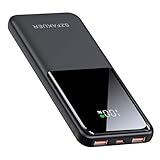
- Ultra-Slim & Light weight Design: At just 0.63 inches thick and 8.11oz, this is the slim and light 10000mAh power bank. Perfect for travel, it easily fits in your pocket or bag without adding bulk.
- 22.5W USB-C Fast Charging: Equipped with USB-C input and output, this power bank supports PD3.0 and QC4+ fast charging, delivering up to 22.5W of power. Charge your iPhone to 65% in just 30 minutes or power up multiple devices quickly.
- 3 Output & Dual Input: Features 3 outputs (2 USB-A + 1 USB-C) and 1 inputs (USB-C ), allowing you to charge up to three devices simultaneously. Ideal for smartphones, tablets, earbuds, and more.
- Wide Compatibility: Works seamlessly with a wide range of devices,Compatible with iPhone 17/16/15/14/13/12, Samsung Galaxy, Google Pixel, iPads, AirPods, Android tablets, and other USB-C devices.
- Advanced Safety & LED Display: Built with an 8-Layer Protection System to prevent overcharging, overheating, and short circuits. The LED digital display shows the remaining battery percentage, so you’re never caught off guard by a low battery.
First, this is Samsung SDI—not Samsung Electronics
The company behind the technology is Samsung SDI, Samsung’s battery business. It should not be confused with Samsung Electronics, the consumer-electronics division associated with phones, televisions, appliances, and storage products.
Samsung SDI has been developing an all-solid-state battery at its S-Line pilot facility in Suwon, South Korea. Samsung describes the pilot line as covering approximately 6,500 square meters. The company says it produced customer samples there in 2023 and has used the facility to advance the technology toward mass production.
Crashes, No Sound, or Screen Glitches?
Random freezes, missing sound and display glitches usually trace back to one bad driver. Find and replace yours safely.Free scan · under a minutePC Slower Than It Used to Be?
A free scan shows the junk files, broken settings and background clutter dragging Windows down - then fixes them in one click.Free scan · Windows 10 & 11At InterBattery 2026, Samsung gave the platform the name SolidStack and showed both prismatic and pouch-type all-solid-state battery forms. Samsung says the technology is intended for electric vehicles and for physical-AI applications such as humanoid, mobile, and industrial robots.
What Samsung has actually announced
| Claim or milestone | What it means | What it does not prove |
|---|---|---|
| 900 Wh/L | Samsung’s reported volumetric energy density for the all-solid-state technology | It is not a vehicle-range rating or a pack-level test |
| Anode-less design | A battery architecture intended to reduce anode volume and leave more room for active cathode material | It does not by itself establish cost, durability, charge rate, or range |
| S-Line pilot facility | A 6,500-square-meter pilot operation in Suwon that has produced customer samples | A pilot line is not the same as high-volume commercial production |
| SolidStack branding | The name Samsung used for the platform displayed at InterBattery 2026 | The branding does not identify a finished retail battery pack or a production vehicle |
| Second half of 2027 | Samsung SDI’s current stated target for all-solid-state mass production | It is not a promise that a consumer car using the battery will be available by that date |
Samsung’s March 2026 shareholder-meeting materials described a 2027 mass-production goal and said the company was pursuing electric-vehicle and humanoid-robot supply opportunities. Its 2026 exhibition announcement gave the timing more precisely as the second half of 2027.
Where the 600-mile number comes from
The 600-mile figure is widely repeated in secondary automotive and technology coverage. Those reports generally describe a projected premium-EV battery capable of roughly 900 to 1,000 kilometers, sometimes alongside claims about rapid charging and very long service life.
That range of figures is important. Nine hundred kilometers is approximately 559 miles, while 1,000 kilometers is approximately 621 miles. Depending on rounding and the test cycle being discussed, a report describing a 900-to-1,000-kilometer vehicle may become a headline about “more than 600 miles.”
Samsung’s official materials reviewed for this article focus on energy density, battery architecture, pilot production, customer samples, and the manufacturing roadmap. They do not provide all the information needed to call 600 miles a verified vehicle result:
- A named production or prototype vehicle
- A final battery-pack capacity and usable-energy figure
- A stated test cycle, such as EPA or WLTP
- Test conditions, speed, temperature, wheels, tires, and vehicle configuration
- An independent test report or regulatory range certification
- Confirmation that the result came from a production-intent pack rather than a cell-level projection
That is why “Samsung has built a 600-mile production battery” goes beyond the evidence. “Samsung’s SolidStack technology has been associated with a projected 600-mile premium-EV application range” is more defensible.
Why 900 Wh/L does not automatically mean 600 miles
Wh/L measures energy per unit of volume. It tells us how much energy can theoretically be stored in a given amount of battery volume. It does not directly tell us how far a particular vehicle will travel.
Samsung reports 900 Wh/L and describes that figure as approximately 40 percent higher than prismatic batteries that were then in mass production. That would be a significant improvement in packaging potential. An automaker could use higher energy density to fit more energy into a similar space, reduce the physical size of a pack with the same capacity, or potentially improve vehicle packaging.
But a vehicle’s range depends on the complete system. A simplified relationship is:
Driving range = usable battery energy × vehicle efficiency.
Both terms conceal important variables. Usable battery energy is not necessarily the same as the cell’s theoretical or nominal energy. Energy is lost in modules, pack structure, cooling equipment, wiring, battery-management hardware, and power electronics. Automakers also reserve part of a pack’s capacity to protect the cells and maintain performance over time.
Vehicle efficiency varies with body shape, mass, motors, software, tires, wheels, weather, terrain, speed, and heating or air-conditioning use. A dense battery installed in a heavy, inefficient vehicle will not deliver the same range as the same battery installed in a lighter, more aerodynamic model.
The Tool Desk
Outbyte Driver Updater FREEFix the driver behind crashes, sound loss and screen glitchesFind Drivers →Outbyte PC Repair FREEClear out junk files and repair common Windows errorsFree Scan →Most importantly, 900 Wh/L is a volumetric figure, not a vehicle-range certification. It should not be converted directly into miles without pack-level and vehicle-level data.
Rank #2
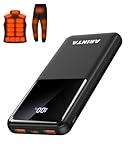
- 📱 Compatible with 5V USB Heated Clothing – This battery is compatible with 5V heated vests, jackets, and other heated clothing. Its professionally customized chip provides continuous, stable output, making it safe and reliable. The 10000mAh capacity gives you up to 7 hours of power, while the slim body makes it easy to carry in your pocket.
- ⚡PD Super-Fast Charging: Rapidly power up compatible devices with USB-C Power Delivery (PD 20W)—recharge an iPhone 15 to 60% in~30 minutes. Dual USB-A ports also deliver 22.5W speeds for Android Smartphones.
- 🔋 2-3 Full Phone Charges: The 10,000mAh high-capacity battery reliably recharges an iPhone 15 twice, a Samsung Galaxy 1.8 times, or an iPad once—perfect for travel or daily use.
- 🔌 Triple-Port Simultaneous Charging: Power 3 devices at once with dual 22.5W USB-A ports + 20W USB-C PD port. Ideal for phones, tablets, earbuds, or smartwatches without slowdowns.
- 📊Precision LED Digital Display: Track exact remaining power down to 1%—no guessing. Includes a visual fast-charge indicator (e.g., green light for PD/QC activation).
What the all-solid-state design changes
Conventional lithium-ion batteries use a liquid electrolyte to move lithium ions between the cathode and anode. An all-solid-state battery replaces that liquid electrolyte with a solid electrolyte.
Samsung identifies two principal goals for the design:
- Improved safety: Replacing a liquid electrolyte can reduce reliance on a flammable liquid component, although the safety of a complete battery still depends on its materials, manufacturing quality, thermal controls, protection systems, and crash performance.
- Higher energy density: The solid-state architecture may allow more compact cell construction and more active battery material in the same space.
Samsung also describes an anode-less architecture. In broad terms, the design is intended to reduce the volume occupied by the anode and increase the proportion of the cell devoted to active cathode material. That helps explain why the company connects the design with higher energy density.
Do these 3 things before closing this tab:
1Fix the driver behind crashes, sound loss and screen glitches2Clear out junk files and repair common Windows errors3Scan for outdated or missing drivers - takes under a minuteThose are engineering objectives, not automatic guarantees. Solid-state chemistry does not, by itself, guarantee a particular driving range, nine-minute charging time, low price, or 20-year service life. Each of those outcomes requires testing of the complete cell, pack, vehicle, and production process.
The nine-minute charging claim is a separate issue
Samsung SDI has presented several next-generation battery technologies at its industry events. These include all-solid-state batteries, ultra-fast-charging batteries, and ultra-long-life batteries.
In the company’s EVS37 announcement, the all-solid-state battery was presented separately from technologies associated with nine-minute charging and more than 20 years of life. That distinction matters because headlines can easily combine several Samsung technologies into one imagined product.
There is no basis in the reviewed material for saying that the same SolidStack cell has already demonstrated all three of these specifications:
What’s actually slowing this PC down?
Pick the symptom - the matching free tool is one click away.
- A 600-mile vehicle range
- A nine-minute recharge
- A service life of more than 20 years
A fast-charge figure also needs a precise definition. It could refer to the time needed to add a certain percentage of charge under controlled conditions, rather than charging from empty to full. It could apply to a cell, module, or pack instead of an entire vehicle. The result would also depend on charger power, battery temperature, starting state of charge, charging curve, and the vehicle’s thermal-management system.
Even if SolidStack ultimately supports faster charging, it would need compatible high-power charging equipment and an appropriate vehicle electrical system. The charging claim should therefore remain separate until Samsung publishes a specification explicitly combining it with SolidStack and a defined vehicle application.
Commercialization status: real development, not retail availability
As of August 12, 2026, Samsung’s latest official materials reviewed here consistently describe SolidStack as a development and commercialization program with a mass-production target in the second half of 2027.
The evidence shows meaningful progress:
- A dedicated pilot facility exists in Suwon.
- Samsung says the facility produced customer samples in 2023.
- The company has publicly described the battery architecture and reported its 900 Wh/L volumetric energy density.
- Samsung has given the platform the SolidStack name and displayed multiple cell formats.
- The company is pursuing automotive and robotics customers.
- Samsung continues to identify 2027 as its mass-production target.
But the reviewed sources do not establish that SolidStack is being sold as a replacement battery, available for consumer purchase, or installed in a mass-produced vehicle.
Free tools Windows power users keep installed
One-click scans. No signup required.
The Solid Power and BMW evaluation
Samsung SDI also entered a 2025 joint evaluation arrangement involving Solid Power and BMW. Under that arrangement, Solid Power would provide a sulfide-based solid electrolyte for Samsung SDI to integrate into cells. The resulting cells would be evaluated against agreed performance requirements and could potentially be used in a demonstration vehicle.
This is useful evidence that validation work is active and that Samsung is working with industrial partners on solid-state materials and automotive requirements. It is not proof that a retail vehicle has achieved 600 miles, nor does it establish which production vehicle—if any—will be the first to use SolidStack.
What has not been disclosed
The most important unanswered questions behind the headline are still commercial and vehicle-level questions:
- Which automaker will use the cells? Samsung identifies electric vehicles as a target market but has not publicly identified a production vehicle allocation in the materials reviewed.
- What will the final pack contain? Cell energy density is only one part of the pack design. The final pack’s usable capacity, cooling system, structural components, and safety hardware remain unknown.
- What range test produced 600 miles? No named vehicle, test cycle, test date, or independent report was identified.
- What will the battery cost? Pilot-line success does not establish the cost or manufacturing yield required for competitive mass production.
- How will it age? A long-life claim must specify the number of cycles, remaining capacity, charging conditions, temperature, and definition of end of life.
- What charging equipment will be required? A high-rate battery cannot deliver a short charging stop if the vehicle and charging network cannot supply the necessary power.
These are not minor details. They determine whether a promising cell technology becomes a useful, affordable product.
What Samsung’s 2027 target really means
A target to begin mass production in the second half of 2027 refers to Samsung SDI’s manufacturing objective. It does not mean that a 600-mile electric car will necessarily reach dealerships in 2027.
Rank #3

- Up to 3.5 Phone Charges On the Go: Compact and easy to carry, this 15,000mAh power bank keeps you powered for travel, commuting, and emergencies. Charges iPhone 17 up to 3.5 times, Samsung S26+ up to 2.5 times, and AirPods Pro up to 20 times.
- 40% Smaller, 45% Lighter: Designed for power without the extra bulk, this compact power bank is 40% smaller and 45% lighter than conventional models, making it easy to carry for travel and daily use. Built-in USB-A, Type-C, iOS, and Micro cables keep your devices ready to charge—no extra cables needed.
- Airline-Safe Power, Trusted Worldwide: Safe charging you can trust. Join over 50 million users worldwide who rely on our safety-focused design for worry-free charging and carry-on travel.
- 50% Power in 30 Minutes: Get fast, convenient charging when you need it most. This 22.5W portable charger powers your phone up to 50% in just 30 minutes, ideal for busy days and travel.
- Charge 6 Devices at Once: With 6 outputs and a bi-directional Type-C port, this portable charger powers multiple devices at the same time. Compact enough for your pocket or bag.
Between a battery entering mass production and a consumer vehicle becoming available, an automaker would still need to select the cells, complete pack and vehicle engineering, validate safety and durability, certify the vehicle, establish supply and service arrangements, and begin production. The timing of those steps depends on the OEM and the specific vehicle program.
The first commercial applications could also be limited to particular premium vehicles or fleet and industrial customers before the technology becomes broadly available. That is a possibility, not a confirmed Samsung product plan.
How to evaluate the next SolidStack announcement
The 600-mile claim will become substantially more credible if Samsung or an automaker publishes the following information together:
- A named vehicle: The model, battery configuration, wheel and tire setup, and production status should be clear.
- A defined test cycle: EPA, WLTP, or another recognized procedure should be identified. A laboratory projection and a customer-facing range rating are not interchangeable.
- Pack-level specifications: The announcement should distinguish cell energy density from pack energy density and state nominal and usable capacity.
- Test conditions: Temperature, speed, route, payload, charging state, and other important conditions should be disclosed.
- Charging definitions: A claim such as nine minutes should explain how much energy was added, over what state-of-charge window, and at what charging power.
- Durability data: A 20-year claim should state the test method and the battery capacity retained at the end of the test.
- Independent or regulatory confirmation: Third-party testing or an official vehicle certification would be stronger evidence than a technology demonstration alone.
The practical takeaway for EV buyers
There is no Samsung SolidStack battery that a consumer can currently order as a replacement pack, and there is no confirmed production EV with a Samsung-verified 600-mile range in the materials reviewed.
For buyers shopping for an electric vehicle now, SolidStack should be treated as future battery technology rather than a current purchasing option. Existing EV range figures, charging speeds, warranties, and battery-life expectations remain specific to the vehicles and packs being sold today.
For readers watching the technology, the encouraging part is that Samsung SDI has moved beyond a laboratory-only discussion. It has a pilot facility, customer samples, a named platform, partner evaluations, and a stated manufacturing goal. The unresolved part is whether Samsung can scale the cells economically and whether an OEM can turn the cell-level promise into a validated, durable, fast-charging vehicle.
Final verdict
Samsung’s solid-state battery effort is real and commercially serious. The company reports a 900 Wh/L volumetric energy density, describes an anode-less design, has produced customer samples, and is targeting mass production of SolidStack in the second half of 2027.
Quick wins for a faster PC:
Repair Windows errors before they cause bigger problemsFix Now →Scan for outdated or missing drivers - takes under a minuteDriver Scan →Clear out junk files and repair common Windows errorsFree Scan →The “600-mile” description is different. It is a widely reported projection for what a premium EV might achieve with the technology, not a production-vehicle range test identified in Samsung’s official materials reviewed here. The nine-minute charging and 20-year-life claims should also be treated as separate elements of Samsung’s broader next-generation battery roadmap unless the company publishes data explicitly combining them with SolidStack.
The breakthrough is credible as a battery-development and manufacturing roadmap. The consumer promise remains conditional on pack design, vehicle testing, scale-up, cost, charging infrastructure, and OEM deployment.
Frequently Asked Questions
Is Samsung’s 600-mile solid-state battery real?
Yes, the program is real. Samsung SDI has a Suwon pilot facility, says it produced customer samples in 2023, and has named the platform SolidStack. However, the 600-mile figure is not a confirmed production-EV result.
Has Samsung verified a 600-mile driving range?
No. Samsung reports 900 Wh/L volumetric energy density for the technology, but the official materials reviewed do not identify a vehicle, pack specification, standardized test cycle, or independent range test showing 600 miles.
Does 900 Wh/L automatically mean a 600-mile EV?
No. Wh/L measures energy stored per unit of battery volume. Vehicle range also depends on usable pack capacity, pack overhead, vehicle efficiency, aerodynamics, mass, tires, weather, speed, and the test procedure.
When will Samsung’s SolidStack battery be available?
Samsung SDI is targeting mass production in the second half of 2027. That is a manufacturing target, not a confirmed dealership date for a consumer vehicle. Samsung has not identified a production car using SolidStack in the sources reviewed.
Will the same battery charge in nine minutes and last 20 years?
Not based on the information reviewed. Samsung has presented nine-minute charging and more-than-20-year-life technologies separately from its all-solid-state battery announcements. Those specifications should not be combined with SolidStack without a product specification explicitly doing so.
Which Samsung company is developing the battery?
Samsung SDI is the battery company developing SolidStack. It is separate from Samsung Electronics, the consumer-electronics division.
Free tools Windows power users keep installed
One-click scans. No signup required.
The Bottom Line
Bottom line: Samsung SDI’s SolidStack is a real all-solid-state battery program targeting mass production in the second half of 2027. Its reported 900 Wh/L density is not the same as a verified 600-mile vehicle range, and no production car or independent test establishing that result was identified in the official material reviewed.
Quick Recap
Product prices and availability are accurate as of the date/time indicated and are subject to change. Any price and availability information displayed on Amazon at the time of purchase will apply.




