The first Devel Sixteen test proved that a prototype could run and accelerate—but not that the promised 5,007-hp road car was complete. The public footage showed limited vehicle movement, while the famous power figure came from a separate Steve Morris Engines dyno demonstration.
There is no reliable evidence in the reviewed record that the tested car reached 350 mph, completed a 1.8-second 0-to-62-mph run, or used the full quad-turbo V16 in a production-ready configuration.
As an Amazon Associate I earn from qualifying purchases.
The short answer
The Devel Sixteen’s first test showed that a prototype could move and accelerate under its own power. It did not prove that a complete road car produced 5,007 horsepower, reached 350 mph, achieved a 1.8-second 0-to-62-mph time, or entered production with the advertised quad-turbo V16.
That distinction matters because the famous 5,007-hp figure belongs primarily to an engine-dyno result. The vehicle tests were separate, more limited milestones. One acceleration video showed a prototype running at approximately 20 percent throttle, while a later test in Italy was reportedly conducted without the quad-turbo system installed.
#1 Best Overall
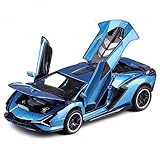
- Material:This model car is made of zinc alloy body,rubber tires and plastic parts.With Detailed interior and exterior trim, It is very sturdy.Car gets multiple processing, grinding sharp corners to prevent cuts child.
- Sound and light:Car doors,hood and trunk can be opened, accompanied with lights&sounds.Press the car body and open the doors can trigger the lights and real sounds.
- Pull back Cars:Place the car on the ground,just pull it back ,the model car will drive forward.Your kids can use it to play a chasing game with their friends.
- Size:Lamborghini Sian FKP37 is 1 /32 scale,Approx.6.3 * 2.7 * 1.6 inches.The size is similar with adult hands.It is very suitable for little boys and girls to grip.
- Gift:Fine workmanship,exquisite box with a display base,ideal birthday gift and holiday gift for kids boys and men who like collect model car.
There are two “first tests” in the Devel Sixteen story
Coverage of the Devel Sixteen often collapses several events into one. In reality, the public record describes at least two different vehicle-testing moments:
| Event | What was shown | What it did not establish |
|---|---|---|
| 2018 acceleration video | A prototype gathered speed after an initial pause. The Drive reported that it was operating at roughly 20 percent throttle. | A full-throttle launch, a timed acceleration result, a top-speed run, or production readiness. |
| 2021 Italian test | Devel released video of a prototype moving during testing in Italy. Autoevolution described it as the car’s first test. | That the advertised 5,007-hp configuration was installed. The report said the quad-turbo system was not fitted. |
| Engine dyno testing | Steve Morris Engines reportedly demonstrated approximately 5,007 hp from the V16 engine on a dyno. | That the complete car could transmit, cool, control, and safely use that output on the road. |
The most accurate description is therefore: the first public vehicle test showed a Devel prototype moving under its own power on a limited acceleration run.
What the 2018 acceleration video proved
The Drive’s 2018 report was significant because the Devel Sixteen had spent years existing mainly as a dramatic concept-car reveal, computer imagery, and claims about extreme performance. The video provided stronger evidence than a static show car: at least one prototype could run, move, and accelerate.
But the same report put the footage in context. The car was described as using approximately 20 percent throttle, and the clip was not a measured performance test. There was no independently documented 0-to-62-mph time, no full-throttle launch data, no verified terminal speed, and no evidence that the engine was producing anything close to its claimed maximum output.
A car gathering speed in a video is an important development milestone. It is not the same as demonstrating what happens when 5,000 horsepower is delivered through the drivetrain.
What the 2021 Italian test added—and what it took away
In August 2021, Autoevolution reported on video released by Devel from testing in Italy. Devel presented the footage as the Sixteen’s first test and said the car was being prepared for a future arrival.
The video mattered because it showed the prototype operating in a real test environment rather than sitting on a display stand. However, the report also said that the prototype was tested without its quad-turbo system installed. The footage did not reveal enough detail to establish the exact engine output, drivetrain configuration, or performance data.
What’s actually slowing this PC down?
Pick the symptom - the matching free tool is one click away.
Rank #2

- 1. Product size: 5.34 * 2.36 * 1.57 inches ,Weight: 0.55 pounds ,Outer packaging: exquisite color translucent packaging box
- 2. Material: Die-cast car model, made of zinc alloy, with plastic parts, rubber tires, detailed interior and exterior trim.
- 3. Function: Press the two wheels of the front car to trigger the engine sound and lights, and open the door to trigger the lights of the front and rear lights. Place the car on the ground, hold down the car body and pull it back, the car will drive forward. (With pull back function)
- 4. This Bugatti 1/32 car model pull back car is very suitable for children to play. It contains a display base and is also very suitable for car model lovers to collect as a decoration.
- 5. Exquisite packaging, which can be used directly for children over three years. Used as a model display as a gift for adults.
That makes the 2021 run evidence of vehicle function, not evidence of a 5,007-hp vehicle test. It demonstrated that the prototype could operate in a limited configuration. It did not demonstrate the final powertrain that made the Devel Sixteen famous.
Where the 5,007-hp figure came from
The headline figure originated from the engine-development program associated with Steve Morris Engines’ Devel V-16 project, rather than from a completed car measured at speed.
Autoevolution reported that an engine-dyno video from 2015 showed more than 4,000 hp and that a later Steve Morris Engines video from 2017 showed the engine producing 5,007 hp. Steve Morris Engines identifies the project as the “SME/DEVEL V-16” and describes its work as custom engine development. The company also says it builds bespoke combinations exceeding 5,000 hp.
That is meaningful evidence that the engine reached the claimed figure under controlled dyno conditions. It is not the same as an independent test of a finished Devel Sixteen.
Engine-dyno validation and vehicle validation are different milestones. An engine dyno tests the engine in a controlled environment. A complete-vehicle test must also prove that the transmission, driveshafts, differential, cooling system, electronics, tires, suspension, brakes, aerodynamics, and chassis can work together at the required output.
Even if the dyno number is accepted as genuine, power is only useful to a car if the vehicle can control and survive it. The dyno result does not tell us how much power reached the tires, how the transmission behaved under load, how quickly the car generated heat, or whether the chassis could remain stable at extreme speed.
What Devel says the prototype makes
Devel’s current prototype page lists the Sixteen with the following manufacturer-stated figures:
Rank #3

- AUTHENTIC DESIGN: Meticulously detailed 1:38 scale die-cast metal model of the 2016 Pagani Huayra BC supercar with stunning metallic finish and precise exterior details
- INTERACTIVE FEATURES: Working doors that open and close plus pull-back motor mechanism allows the car to zoom across smooth surfaces
- PREMIUM CONSTRUCTION: Built with durable die-cast metal body, rubber tires, and detailed plastic components for lasting quality and play value
- PERFECT DISPLAY SIZE: Compact 5-inch length makes it ideal for collectors while maintaining impressive detail and proportion
- QUALITY MATERIALS: Manufactured using safe, high-grade materials suitable for ages 3 and up, combining durability with authentic styling
| Specification | Devel-listed figure | How to interpret it |
|---|---|---|
| Engine | 16 cylinders | A claimed prototype specification, not proof that every displayed or delivered car used the same engine. |
| Power | 5,007 hp | A manufacturer-listed figure associated with the V16 project and supported by reported engine-dyno footage, but not independently established as vehicle output. |
| Torque | 3,757, as displayed by Devel | The page’s stated torque figure; the available evidence does not establish it as a production-car measurement. |
| Weight | 2,300 kg | A listed prototype weight, not necessarily the final weight of a homologated road car. |
Older reporting also described a proposed three-level range rather than one single specification. The Drive reported plans for an approximately 2,000-hp V8 road model, a roughly 3,000-hp road-going V16, and a 5,000-hp track-only version. That proposed split is important: the 5,000-hp configuration was not necessarily intended to be the same road-legal car that customers would drive on public roads.
Crashes, No Sound, or Screen Glitches?
Random freezes, missing sound and display glitches usually trace back to one bad driver. Find and replace yours safely.Free scan · under a minuteWindows Errors? Fix Them Before They Spread
Repair common Windows errors and clear accumulated junk for a smoother, more stable PC - no reinstall needed.Free scan · no reinstallThe specification history has changed over time. Autoevolution previously reported approximate dimensions of 5.30 meters long, 2.41 meters wide, 1.27 meters tall, and a 3.46-meter wheelbase, along with the 2,300-kg weight. The same report noted that the V16 displacement and final technical details had changed or were not clearly published. These figures should be treated as historical or manufacturer-provided specifications, not as an independently verified final vehicle data sheet.
What the first test did not answer
The limited run left the central engineering questions unresolved.
1. Was the 5,007-hp V16 installed?
There is no clear, independently documented evidence that the car shown in the limited vehicle footage contained the complete 5,007-hp quad-turbo V16 installation. The 2021 report specifically said the quad-turbo system was absent. A video showing the vehicle moving cannot identify the exact engine configuration by itself.
2. How much power reached the wheels?
An engine-dyno figure describes the engine test. It does not establish the power delivered through the transmission and final drive. Drivetrain losses, traction limits, gearing, electronic controls, and tire performance all affect what the vehicle can actually do.
The Tool Desk
Outbyte PC Repair FREEClear out junk files and repair common Windows errorsFree Scan →Outbyte Driver Updater FREEFix the driver behind crashes, sound loss and screen glitchesFind Drivers →3. Could the transmission and driveline survive?
A 5,000-hp powertrain imposes extraordinary loads on the clutch or torque-converter system, gearbox, driveshafts, differentials, half-shafts, hubs, and tires. The published footage did not provide a documented durability test or a verified drivetrain specification capable of answering that question.
4. Could the car manage heat?
High-output dyno operation and a road car running repeatedly at high load create different thermal problems. A finished vehicle would need to manage engine, turbocharger, transmission, differential, brake, and tire temperatures while also providing consistent performance. No public test data reviewed here demonstrates sustained full-power operation.
Rank #4
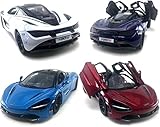
- Realistic Replica: This 1:36 scale die-cast metal model car is a detailed miniature replica of the iconic McLaren 720s supercar.
- Opening Doors: The model features opening doors that allow you to admire the intricate interior detailing.
- Pull-Back Action: Engaging the pull-back mechanism enables this toy car to zip across smooth surfaces.
- Vibrant Color: Showcasing a rich white hue, this miniature captures the sleek and stylish design of the full-size McLaren.
- Compact Size: Measuring approximately 5 inches in length, this model is perfectly sized for display or playtime.
5. Could the tires and aerodynamics support the claimed speed?
Claims around 350 mph require much more than horsepower. The tires must be rated for the load and rotational speed, and the body must remain stable as aerodynamic forces increase. A low-throttle acceleration clip says nothing about whether the production body, underbody, cooling openings, suspension, and tires were validated for such a speed.
6. Was there a repeatable, independently measured performance test?
The public clips did not show a standardized, independently timed full-throttle acceleration run or a verified top-speed attempt. For the Devel Sixteen’s headline claims to become established facts, readers would need to see a clearly identified vehicle, a confirmed engine configuration, instrumentation, repeatable runs, and credible independent reporting.
The engineering partners were real, but partnership is not completion
The Devel project was not merely an engine-video exercise. It involved named technical partners, but their involvement should not be confused with proof that the final production car was completed.
Steve Morris Engines’ custom engine-development work is the documented source of the Devel V16 program and its extreme dyno figures. The company is based in Muskegon, Michigan, and publicly lists engine development, parts, and dyno-related capabilities. That supports the reality of a serious high-output engine project; it does not show that a road-legal Devel Sixteen with that engine was delivered.
Manifattura Automobili Torino’s special-project engineering covers design, engineering, prototyping, production, validation, testing, and homologation. Its capabilities make it a plausible and relevant engineering partner for an exotic prototype. The public company material reviewed here does not independently document the completion and homologation of a production Devel Sixteen.
Independent reader supportYour contribution helps us test, update, and keep practical guides available for everyone.What happened after the test?
The latest status in the reviewed reporting remains uncertain. In a January 4, 2025 report, Motor1 said that a handful of Devel prototypes appeared to exist, but that it was difficult to determine how many had been built or how many were genuinely driveable.
Do these 3 things before closing this tab:
1Clear out junk files and repair common Windows errors2Fix the driver behind crashes, sound loss and screen glitches3Repair Windows errors before they cause bigger problemsMotor1 also reported that the first example believed to have been delivered, in 2022, used a V8 rather than the advertised V16. The report found no information establishing that the 5,000-hp V16 had been installed in a finished Devel Sixteen. Images posted online showed cars with different equipment, but those images did not verify what engines were under their bodywork.
Best Value

- AUTHENTIC DESIGN: Highly detailed 1:36 scale die-cast metal replica of the Lamborghini Veneno supercar with striking finish and Italian flag striping
- FUNCTIONAL FEATURES: Working doors that open and close, plus pull-back action motor for interactive play value
- PREMIUM CONSTRUCTION: Die-cast metal body with plastic components and rubber tires for durability and realistic appearance
- PERFECT SIZE: Compact 5-inch length makes it ideal for display or play while maintaining impressive detail and proportion
- QUALITY MATERIALS: Constructed using high-grade die-cast metal and quality materials for long-lasting performance and safety
Devel’s website remained live and continued to promote the Sixteen, but a live website is not a production record. Based on the latest reliable reporting reviewed for this article, the defensible conclusion is that the project produced prototypes and was associated with a real high-output V16 engine program. A production 5,007-hp V16 road car has not been independently established.
What would count as proof of the full-power Devel Sixteen?
The project would move from “running prototype” to “validated hypercar” only after several pieces of evidence appeared together:
- A confirmed powertrain: clear documentation that the tested car contains the quad-turbo V16, not a lower-output V8 or development configuration.
- Complete-vehicle instrumentation: measured power or acceleration data tied to an identified chassis and test date.
- Repeatable performance: multiple full-throttle runs, not one edited clip or a partial-throttle pass.
- Drivetrain and thermal durability: evidence that the gearbox, cooling systems, chassis, brakes, and other components survive the intended operating envelope.
- Tire and aerodynamic validation: proof that the vehicle is stable and appropriately equipped for any claimed top-speed attempt.
- Road-car documentation: credible evidence of production specification, homologation where applicable, customer delivery, and service support.
Until then, the correct story is not that the Devel Sixteen failed to move or that the engine number was necessarily fabricated. The correct story is that the project cleared the much smaller hurdle of making a prototype run, while the far more demanding task—turning the 5,007-hp concept into a complete, repeatable, road-capable car—remains unproven in the available record.
Free tools Windows power users keep installed
One-click scans. No signup required.
A collectible is easier to verify than the production car
For readers who want a tangible connection to the project without treating marketing claims as test data, a Devel Sixteen building-block model is a more honest collector option than an alleged production component. A 1:8 building-block representation has appeared in marketplace research, but the exact offer, seller, price, and availability should be checked before purchase. It represents the design; it is not an official Devel production-car part and does not confirm the full-size V16’s status.
Frequently Asked Questions
Did the first Devel Sixteen test use the full 5,007-hp engine?
No. The 5,007-hp figure is associated with a Steve Morris Engines engine-dyno test. The documented vehicle footage showed a prototype moving in a limited configuration, and the 2021 test was reportedly conducted without the quad-turbo system installed.
Did the Devel Sixteen reach 350 mph?
No verified source reviewed for this article documents the Devel Sixteen reaching 350 mph. The available footage was not a top-speed test.
Was a production 5,000-hp Devel Sixteen delivered?
Motor1 reported in January 2025 that the first example believed to have been delivered, in 2022, used a V8. The report found no information establishing that a finished production car with the 5,000-hp V16 had been delivered.
Quick wins for a faster PC:
Fix the driver behind crashes, sound loss and screen glitchesFind Drivers →Clear out junk files and repair common Windows errorsFree Scan →Why is an engine-dyno result not the same as a car-performance test?
An engine dyno measures an engine in a controlled test environment. A vehicle test must additionally demonstrate that the transmission, driveline, cooling system, tires, aerodynamics, chassis, and controls can safely use that output.
The Bottom Line
Verdict: The Devel Sixteen’s first vehicle test proved that a prototype could move and accelerate in a limited configuration. The 5,007-hp number came from an engine-dyno demonstration, not a verified full-power road test. The available evidence still does not establish a 350-mph run, a 1.8-second 0-to-62-mph time, or delivery of a production Devel Sixteen with the advertised quad-turbo V16.
Quick Recap
Product prices and availability are accurate as of the date/time indicated and are subject to change. Any price and availability information displayed on Amazon at the time of purchase will apply.




