What’s actually slowing this PC down?
Pick the symptom - the matching free tool is one click away.
These ten cars matter for different reasons: some advanced front-drive engineering, others made the layout practical for more buyers, new vehicle classes or new markets. This is an editorial ranking, not a settled historical consensus. It distinguishes early front-drive experiments from mass-produced cars and from the transverse-engine layout that later became common.
What front-wheel drive changed
Front-wheel drive (FWD) sends engine power to the front wheels, which also steer the car. In the familiar transverse layout, the engine sits sideways and connects to a transaxle that combines transmission and differential functions. Compared with a rear-drive arrangement, this can reduce driveline hardware and free space for passengers and cargo; a flatter floor is another possible benefit. With much of the powertrain’s weight over the driven wheels, FWD can also help traction on slippery surfaces. These are design tendencies, not guarantees that every FWD car will outperform every rear- or all-wheel-drive car in every condition.
The ten entries below are ranked for their combined engineering, packaging, market and performance significance. A car’s place here does not mean it was first in every respect.
The 10 most important front-wheel-drive cars
1. Citroën Traction Avant
History.com credits the 1934 Traction Avant as the world’s first mass-produced front-wheel-drive car. That qualification matters: front-drive experiments and vehicles existed earlier, so the claim is about mass production, not the first vehicle ever to send power to its front wheels. The Traction Avant combined front drive with unibody construction, independent suspension and hydraulic brakes, making it an important milestone in integrating modern engineering into a production car. History.com’s car-history timeline supplies the first-mass-produced attribution.
Do these 3 things before closing this tab:
1Clear out junk files and repair common Windows errors2Scan for outdated or missing drivers - takes under a minute3Repair Windows errors before they cause bigger problems#1 Best Overall
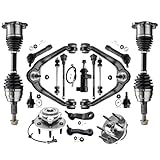
- Notice: Excludes HD Models; 4-Groove Pitman Arm; 4WD Models with 6-Lug Wheels; 0.71 inch (18mm) Thread at Centerlink; Fits Models with 4.15 inch (105mm) Length Lower Ball Joints ONLY!!!
- Front Suspension Kit Replacement for 2002-2006 Cadillac Escalade - [2003-2006 Cadillac Escalade ESV] - 2002-2006 Cadillac Escalade EXT - [2002-2006 Chevrolet Avalanche 1500] - 1999-2006 Chevrolet Silverado 1500 - [2000-2006 Chevrolet Suburban 1500] - for 2000-2006 Chevrolet Tahoe (2000: BASE-LS-LT) - [1999-2006 GMC Sierra 1500] - 2000-2006 GMC Yukon (2000: Excluding Denali) - [2000-2006 GMC Yukon XL 1500]
- CV Axle Kit Includes: 2x Front CV Axle Shafts + 2x Front Wheel Bearing Hubs + 2x Front Upper Control Arms w/ Ball Joints + 2x Front Lower Ball Joints + 2x Front Sway Bars + 4x Front Inner Outer Tie Rods + 1x Pitman Arm + 1x Front Steering Idler Arm + 1x Idler Arm Assembly
- Axle Specifications: Overall Length: 21 "| Inner Spline: Bolt-on 6 Holes| Outer Spline: 33| Inner Shape: Can
- Hub Specifications: Position: Front| Lugs: 6 Bolt| ABS Type: Sensor Wire| Flange Type: 3-Bolt Triangular
2. BMC Mini
The 1959 Mini made the packaging case for front drive unusually clear. Its engine sat transversely under a short hood and drove the front wheels through a transaxle, eliminating the long driveshaft through the cabin. Automotive historian Michael Lamm’s essay for the Studebaker National Museum estimates that about 80% of the Mini’s footprint served people and cargo. Lamm also gives its production span as 1959–2000 and says approximately 5.3 million were sold; those figures are his retrospective, not a cross-model production comparison. The Mini did not invent FWD, but its compact, influential arrangement became a template for later transverse-engine cars. Read Lamm’s Mini history.
3. Mini Cooper S
The Cooper S showed that a small front-drive car could be more than a clever packaging exercise. BMW Group’s 1999 retrospective records BMC’s Monte Carlo Rally wins with the Mini Cooper S in 1964, 1965 and 1967. Those victories gave the Mini’s layout motorsport credibility and helped establish a memorable performance identity. The wins belong to those event years; they are not a claim that the Mini dominated every rally season. BMW Group’s history of the Mini documents the results.
Rank #2

- 23 PCS Bearing Puller Set: Our 23-piece front wheel drive bearing puller set is a complete package designed for various front wheel drive vehicles and light trucks. It includes 13 bushings, 4 sleeves, 2 sleeve plates, a 3/4"-10UNC sliding screw, and a 3/4" nut, providing 13 common sizes to work with almost any front wheel drive vehicle.
- Easy Disassembly and Installation: This wheel bearing tool kit allows for both disassembly and installation, reducing the need for hammering and front alignment. It's designed to make hub bearing removal and installation quick and easy while preventing damage to other parts of the car.
- Heavy-Duty Construction: Crafted from high-hardness steel, the wheel bearing press kit is built to withstand heavy use. The sliding screw undergoes a heat treatment process to enhance hardness and prevent breakage. The 8.8-grade screw and nut feature precision threads for robust force application.
- Rust-Resistant Coating: The bushings and sleeve plates are designed to resist high working loads, ensuring they won't deform or fracture during bearing removal. Additionally, the front wheel bearing press tool set features electrophoretic rust prevention, making them resistant to wear and corrosion from chemical oil.
- Convenient Storage: To make storage hassle-free, we provide a high-toughness, waterproof plastic box that neatly organizes the bushings, sleeves, and sleeve plates by size. This ensures the secure storage of each component and makes it easy to transport wherever you need it.
4. Oldsmobile Toronado
The 1966 Toronado brought front drive into a large, desirable American production car. Its significance was not simply that it used the layout, but that it demonstrated FWD could serve a class commonly associated with rear drive and substantial power. Car and Driver frames it as GM’s first major attempt to make front drive work in this kind of car. The Toronado therefore widened the perceived possibilities of the layout beyond small, economy-minded vehicles. Car and Driver’s discussion of FWD provides that framing.
5. Citroën 2CV
The 2CV made front drive part of a radically practical, low-cost people’s car. Its importance lies in bringing the layout to a different purpose from the Traction Avant: not a technically advanced family sedan, but a lightweight, economical vehicle designed around basic transportation needs. It helped show that front drive could underpin a mass-market car whose appeal rested on utility and accessible motoring, not prestige.
Rank #3

- Wheel Bearing Hubs CV Axles Replacement for 2007-2014 Cadillac Escalade (AWD) - [2007-2014 Cadillac Escalade ESV (4WD)] - 2007-2013 Cadillac Escalade EXT (4WD) - [2007-2013 Chevrolet Avalanche (4WD)] - 2007-2013 Chevrolet Silverado 1500 (4WD(New Body Style); Excludes Classic Models)
- Wheel Bearing Hubs CV Axles Replacement for 2007-2014 Chevrolet Suburban 1500 (4WD) - [2007-2014 Chevrolet Tahoe (4WD)] - 2007 2008 2009 2010 2011 2012 2013 GMC Sierra 1500 (4WD; Excludes Classic Models) - [2007-2014 GMC Yukon (AWD; 4WD)] - 2007-2014 GMC Yukon XL1500 (AWD; 4WD)
- Wheel Bearing Hubs Kit Includes: 2x Front Wheel Bearing Hubs + 2x Front CV Axles
- Hub Specifications: Position: Front | Lugs: 6 | Drive: 4WD, AWD | ABS Type: Sensor Wire | Flange: 3-Bolt Triangular
- Axle Specifications: Overall Length: 22 15/16" | Inner Spline: Bolt on 6 Holes | Outer Spline: 33 | Inner Shape: Can
6. Honda Civic
The Civic helped establish front drive as a compelling choice in the expanding Japanese compact-car market. Its importance is regional as well as technical: FWD was not only a European engineering story, but also a route to efficient packaging in a high-volume compact from a Japanese automaker. The Civic belongs in this ranking for helping bring the layout to a broad audience in a market that would become central to the global car industry.
7. Volkswagen Golf
The 1974 Golf carried front drive into Volkswagen’s highest-volume class and became the company’s mass-market successor to the Beetle. It was not Volkswagen’s first front-drive model: Volkswagen identifies the K70, introduced in 1970, as its first front-engine, front-drive car. The Golf’s significance was its scale and role in the range, not priority. Volkswagen says the first-generation Golf sold about 6.9 million units, counting derivatives and the contemporary identical Jetta; it also records celebrating the millionth Golf in October 1976. These are Volkswagen’s model-family figures and should not be treated as directly comparable with differently scoped totals for other cars. The first series-production Golf was built at Wolfsburg at the end of March 1974, according to Volkswagen’s Golf archive.
Rank #4

- Revell Model Kit #14557, Skill Level 4, Contains 154-Parts, Recommended for ages 12 and up
- Choice of newly tooled old-school 5-spoke mag wheels or finely detailed wire wheels with separately molded three-bar spinners
- Custom low-profile tires with factory-printed whitewall detailing
- Highly detailed 327-cubic-inch small-block V-8 engine with Powerglide transmission
- Multi-piece front and rear suspensions can each be assembled in one of three positions: lowered, normal, or raised.
8. Cord L-29
The Cord L-29, introduced in 1929, was an early American production-car demonstration of front-wheel drive. Its place in the story is as a high-profile engineering experiment before the layout became a mass-market norm. It showed that the concept could be applied to a distinctive, luxury-oriented car, even though it did not make FWD the default for American automakers.
9. Chrysler Omni and Plymouth Horizon
Chrysler’s Omni and Horizon helped carry the transverse-engine, front-drive formula into American compact-car production in the late 1970s. Their importance was practical: they made a European-style packaging approach relevant to U.S. buyers and manufacturers at a time when American cars were beginning to adopt FWD more broadly. They were among the later cars influenced by the Mini’s compact layout, alongside the Golf/Rabbit and GM’s X-cars and Chrysler K-cars.
The Tool Desk
Outbyte PC Repair FREERepair Windows errors before they cause bigger problemsFix Now →Outbyte Driver Updater FREEFix the driver behind crashes, sound loss and screen glitchesFind Drivers →Best Value

- Revell Model Kit #14531, Skill Level 5, Contains 77-Parts, Recommended for ages 13 and up
- Detailed 440+6 V-8 engine, hood scoop that can be positioned open or closed
- Detailed interior with separate side panels and a front bench seat
- Molded in white and clear with chrome plated parts and black vinyl tires
- Illustrated assembly instructions. Requires paint and glue. (not included)
10. GM X-cars
GM’s X-cars helped normalize front drive across a major American automaker’s mainstream lineup. Their significance was less a single engineering breakthrough than the scale of the transition they represented: FWD was moving from a specialty or compact-car solution toward a central architecture for everyday vehicles. That shift made the layout familiar to millions of U.S. drivers and competitors alike.
Independent reader supportYour contribution helps us test, update, and keep practical guides available for everyone.Why the Mini remains the pivotal packaging example
The Mini’s enduring lesson is how drivetrain placement can reshape a car’s interior. With the engine and transaxle grouped at the front and no driveshaft running to the rear wheels, designers could devote more of a very small footprint to occupants and luggage. The Studebaker National Museum essay’s estimate that roughly 80% of the Mini’s footprint served people and cargo illustrates that specific car’s packaging efficiency; it is not a general statistic for FWD vehicles.
The formula influenced a generation of transverse-engine front-drive designs, including the Volkswagen Golf/Rabbit, Chrysler Omni/Horizon, GM X-cars and Chrysler K-cars. That influence is distinct from inventing the layout: the Traction Avant and other earlier cars had already established front drive in production.
How to interpret the ranking
There is no single objective measure of historical importance. These cars represent separate kinds of influence: the Traction Avant’s integrated production engineering; the Mini’s compact packaging; the Cooper S’s competition record; the Toronado’s expansion into a large American car; and later models’ success in bringing FWD into high-volume segments and markets. Available production totals use different scopes and sources, so they are not a sound basis for a numerical league table.
Quick Recap
Product prices and availability are accurate as of the date/time indicated and are subject to change. Any price and availability information displayed on Amazon at the time of purchase will apply.




