Verdict: misleading. Tesla has said that more than 95% of the parts in Model 3 and refreshed Model Y vehicles built at Gigafactory Shanghai came from Chinese suppliers. That is a specific claim about Shanghai-built cars—not evidence that nearly every Tesla worldwide, or every Tesla sold in the United States, is made almost entirely in China.
What Tesla actually said
On May 6, 2025, Tesla’s Chinese social-media account said that more than 95% of the parts in each Shanghai-produced Model 3 and refreshed Model Y were made in China. The statement applies to vehicles manufactured at Tesla’s Shanghai plant and, in practical terms, to the supply chain serving that production operation.



As an Amazon Associate I earn from qualifying purchases.
That is an unusually high localization rate. Shanghai uses a large network of Chinese suppliers, which helps Tesla avoid importing many components and keeps production closely tied to China’s automotive manufacturing base.
Do these 3 things before closing this tab:
1Fix the driver behind crashes, sound loss and screen glitches2Clear out junk files and repair common Windows errors3Scan for outdated or missing drivers - takes under a minuteBut the wording matters. The statement did not say:
#1 Best Overall
- 95% of parts in every Tesla are Chinese;
- 95% of parts in U.S.-built Teslas are Chinese; or
- 95% of Tesla’s global components come from China.
Why the global claim does not hold
Tesla operates vehicle and component production across several countries. Its 2025 annual report identifies manufacturing operations in the United States, China and Germany. U.S. facilities include factories in California, Nevada, New York and Texas, while the international vehicle plants are in Shanghai and Berlin.
Tesla also describes its supply chain as involving thousands of suppliers worldwide. The company has been localizing production in different regions and trying to reduce supply-chain risks, so the parts mix depends heavily on the factory, model, market and production year.
Tesla’s installed annual capacity figures reported in July 2025 illustrate the multinational footprint:
Recommended Free Tools
| Factory | Vehicle | Installed annual capacity |
|---|---|---|
| Fremont, California | Model 3 and Model Y | More than 550,000 |
| Fremont, California | Model S and Model X | 100,000 |
| Shanghai | Model 3 and Model Y | More than 950,000 |
| Berlin | Model Y | More than 375,000 |
| Austin, Texas | Model Y | More than 250,000 |
| Austin, Texas | Cybertruck | More than 125,000 |
These are installed capacity figures, not actual production or delivery totals. They nevertheless show why a Shanghai-specific parts percentage cannot be applied to Tesla’s entire output.
What the U.S. labeling data shows
For U.S.-market model-year 2026 vehicles, National Highway Traffic Safety Administration data lists substantial U.S. and Canadian parts content across Tesla’s lineup:
| Tesla model | U.S./Canadian content by value | Largest listed foreign source | Final assembly |
|---|---|---|---|
| Model 3 RWD/AWD | 75% | Mexico, 20% | United States |
| Model 3 Performance | 70% | Mexico, 20% | United States |
| Model Y AWD/Performance | 70% | Mexico, 20% | United States |
| Model Y RWD/Long Range RWD | 70% | Mexico, 25% | United States |
| Cybertruck | 65% | Mexico, 25% | United States |
| Model S | 65% | Mexico, 25% | United States |
| Model X | 60% | Mexico, 25% | United States |
Those figures are parts content by value, not a count of individual components. A high-value battery or drive unit can affect the percentage much more than numerous inexpensive parts.
Rank #3
The figures also have limits. NHTSA rounds percentages to the nearest five points, reports by carline rather than by every individual vehicle and lists foreign countries that contribute at least 15% of equipment content, with no more than two such countries shown. Therefore, the table does not prove that U.S.-built Teslas contain no Chinese inputs. It does show that China is not the dominant disclosed source for these U.S.-market models.
How much of Tesla is tied to China?
Shanghai is not a minor regional plant. It is one of Tesla’s largest manufacturing hubs and a major export center. Chinese government reporting said the factory accounted for approximately 52% of Tesla’s global vehicle deliveries in 2025, while retaining a localization rate of about 95%.
That combination explains why the claim can sound plausible: a very large share of Tesla’s volume may pass through a factory whose supply chain is overwhelmingly Chinese. Still, 52% refers to the factory’s share of vehicle deliveries, not to the percentage of Chinese-made parts in every Tesla. Nor does it mean that all Tesla cars sold globally were assembled in Shanghai.
Rank #4
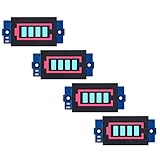
- The 2S battery capacity indicator module can be used to display lithium battery, lead acid battery, and Ni-MH battery.
- Clear and bright display, outline red, display block Blue. The different electricity quantity will illuminate corresponding blocks electricity quantity.
- How to use it: Connect the positive and negative terminals of the display board to the positive and negative terminals of the battery under test. The digital tube displays the real-time battery power.Note : after connecting a few series of lithium batteries in series, it is necessary to connect t-i-n to the corresponding pads.For example if a 2S battery is measured (two 3.7V lithium batteries are connected in series), a short circuit on the pad corresponding to S2 of the board is required.
- Widely applications: Can be widely applied to portable mobile equipment, electro mobile, balance car, cleaning machine, measuring equipment etc. battery capacity indicator.
- Note: The electricity quantity parameter is a reference value, there will be about 2% error range; This model is not waterproof, the electronic components should be used in a dry environment; The number of corresponding battery strings and use them within the corresponding voltage range. Do not exceed a voltage of 4.3*N at most.(for example, if the t-i-n on the pad of S3 is selected, the maximum voltage detected by the module should not exceed 4.3*3=12.9 V).
“Made in China” can describe different things
There are at least three separate questions hidden in the claim:
- Where was the vehicle finally assembled? A Shanghai-built Model 3 is a different manufacturing case from a Model 3 assembled in Fremont.
- Where did the parts come from? Final assembly country and parts origin are not the same thing.
- How is domestic content measured? A percentage based on dollar value will produce a different impression from a percentage based on the number of parts.
A Tesla exported from Shanghai can therefore be accurately described as having a highly China-localized supply chain, while a U.S.-assembled Tesla can have a majority of its parts value sourced from the United States and Canada. Both statements can be true at the same time.
Quick wins for a faster PC:
Scan for outdated or missing drivers - takes under a minuteDriver Scan →Repair Windows errors before they cause bigger problemsFix Now →The accurate version of the claim
A precise headline would be: “More than 95% of the parts in certain Shanghai-built Model 3 and refreshed Model Y vehicles came from Chinese suppliers.”
It is not accurate to say that Tesla cars and components are almost entirely made in China without specifying the factory and models involved. Tesla is a U.S. company with a global supply chain and manufacturing in multiple countries. Some Shanghai-produced cars are exceptionally China-localized; that does not make the entire Tesla range, or U.S.-market Teslas, Chinese-made.
FAQ
Are Tesla cars mostly made in China?
Some Shanghai-built Model 3 and refreshed Model Y vehicles are. Tesla said more than 95% of their parts came from Chinese suppliers. That figure does not apply to all Tesla vehicles worldwide.
Are Teslas sold in the United States made in China?
Many U.S.-market Teslas are assembled in the United States. For model-year 2026, NHTSA lists U.S./Canadian content ranging from 60% for the Model X to 75% for the Model 3 RWD/AWD, measured by value.
Does 95% mean 95% of Tesla’s individual parts are Chinese?
Not necessarily. Tesla’s statement describes the share of parts produced in China for specified Shanghai-built vehicles, but the public claim does not establish a universally applicable counting method for every Tesla component.
Which Tesla models are built at the Shanghai factory?
Tesla’s Shanghai facility produces Model 3 and Model Y vehicles, including the refreshed Model Y referenced in Tesla’s 2025 localization statement. Exact production and market allocations can change over time.
The Bottom Line
Bottom line: The claim is true only when narrowed to particular Model 3 and refreshed Model Y vehicles produced at Gigafactory Shanghai. It is false or seriously misleading when used to describe all Tesla cars, all Tesla components or Teslas built for the U.S. market.
Quick Recap
Product prices and availability are accurate as of the date/time indicated and are subject to change. Any price and availability information displayed on Amazon at the time of purchase will apply.
The Tool Desk
Outbyte Driver Updater FREEScan for outdated or missing drivers - takes under a minuteDriver Scan →Outbyte PC Repair FREERepair Windows errors before they cause bigger problemsFix Now →



