The Tempest 6th-gen fighter jet concept features next-gen power and aeros, but the aircraft is not operational or a locked production design: Tempest is the UK aircraft in the Japan-UK-Italy Global Combat Air Programme (GCAP), with unusually high electrical-power ambitions and a 2035 service-entry target.
In practical terms, Tempest is a developing future combat-aircraft concept, not a fighter with publicly fixed dimensions, engine, speed, range, weapons, or combat performance. The modern programme is also separate from the historical Hawker Tempest, the Second World War fighter.
As an Amazon Associate I earn from qualifying purchases.
Key takeaways
- Tempest is the UK’s proposed fighter aircraft within the Japan-UK-Italy Global Combat Air Programme (GCAP), not a separate operational aircraft programme.
- The official GCAP objective is to deliver or place the next-generation fighter in service in 2035, but 2035 is a programme target rather than a guaranteed delivery date.
- “Next-gen power” means fighter propulsion plus unusually high electrical-generation capacity for radar, sensors, computing, communications, electronic warfare, and future systems.
- BAE Systems’ aerodynamic development process has included digital twins, high-performance computing, simulator assessment, 3D-printed scale models, and wind-tunnel testing at Warton.
- BAE Systems says the proposed radar is designed to provide 10,000 times more data than current systems; that figure is a vendor claim, not an independently verified operational result.
What is the Tempest sixth-generation fighter jet?
Tempest is the UK designation for the future crewed combat aircraft being developed through GCAP, the trilateral programme involving the United Kingdom, Japan, and Italy. GCAP is the multinational programme and governance framework; Tempest is the UK name most closely associated with the fighter aircraft at its centre.
The Tool Desk
Outbyte Driver Updater FREEScan for outdated or missing drivers - takes under a minuteDriver Scan →Outbyte PC Repair FREEClear out junk files and repair common Windows errorsFree Scan →The UK, Japan, and Italy signed the GCAP treaty on December 14, 2023. The treaty established the framework for a next-generation fighter, designated the programme headquarters in the UK, and identified 2035 as the intended service-entry objective. The UK Government’s GCAP treaty announcement and the Japanese Ministry of Defense’s trilateral statement describe that agreement.
#1 Best Overall

- Experience the legendary F-14 Tomcat through a highly detailed model designed for aviation collectors and hobby enthusiasts. The finished model becomes a striking desktop or showcase centerpiece.
- This 3D puzzle is designed for beginner-level assembly enthusiasts, offering an immersive hands-on building experience that helps cultivate patience, concentration, and mechanical problem-solving skills.
- This product is manufactured using high-quality, environmentally friendly plastic and employs an ultra-fine etching process to ensure durability, structural precision, and realistic aircraft details.
- Encourages understanding of aircraft engineering concepts while improving hand-eye coordination and spatial thinking through engaging mechanical assembly.
- Ideal gift for childs, engineers, collectors, model builders, and puzzle lovers for birthdays, Children’s Day, Christmas, or special hobby occasions.
Tempest should therefore be understood as a developing future-aircraft concept and programme identity, not as a production fighter with a final public specification. Public concept images illustrate possible design directions, but they do not establish the final aircraft’s dimensions, engine, speed, range, weapons, or combat performance.
| Term | What it means | Current status |
|---|---|---|
| Tempest | The UK name for the proposed fighter aircraft in GCAP | Future aircraft under development; not operational |
| GCAP | Global Combat Air Programme, the Japan-UK-Italy partnership and programme framework | Treaty-based multinational development programme |
| GIGO | The international government organisation established to manage the programme | Formally established on December 10, 2024 |
| Hawker Tempest | A separate high-speed fighter and ground-attack aircraft from the Second World War | Historical aircraft, unrelated to modern GCAP Tempest |
Is Tempest the same as GCAP?
Tempest is not exactly the same as GCAP: Tempest is the UK aircraft designation, while GCAP is the three-country programme developing the future fighter and its associated technologies.
The distinction matters because the programme includes more than the airframe. GCAP also involves propulsion, sensors, software, digital networks, uncrewed systems, weapons integration, industrial workshare, security arrangements, and political decisions about exports and future partners. Calling the entire programme “Tempest” can obscure that wider multinational structure.
Free tools Windows power users keep installed
One-click scans. No signup required.
Which Tempest does this article mean?
This article concerns the modern GCAP Tempest concept, not the Hawker Tempest that served during and after the Second World War. BAE Systems’ Hawker Tempest heritage page identifies the historical aircraft as a high-speed fighter and ground-attack aircraft that evolved from the Hawker Typhoon.
The two aircraft share a name but belong to different eras, technologies, and programmes. A Hawker Tempest book, model kit, poster, paint set, or historical aviation accessory is not a direct product representation of the modern GCAP aircraft.
When will the Tempest fighter enter service?
The current official objective is 2035, but the 2035 date should be treated as a planned service-entry or first-deployment target rather than a guaranteed delivery date.
The programme has passed important legal and organisational milestones. Japan’s 2025 defence-white-paper material states that the GCAP treaty entered into force on December 10, 2024, after the three countries deposited their ratification instruments, and that the Global Combat Air Programme International Government Organisation, or GIGO, was formally established on that date. The Japanese Ministry of Defense account of GIGO’s establishment provides those dates.
Do these 3 things before closing this tab:
1Clear out junk files and repair common Windows errors2Fix the driver behind crashes, sound loss and screen glitches3Repair Windows errors before they cause bigger problemsThose milestones show that GCAP has moved beyond a purely political announcement. They do not prove that the final design, cost, capability requirements, or schedule are risk-free. Large combat-aircraft programmes can continue changing after governance bodies, industrial contracts, and technology-development work are in place.
Rank #2

- 【Highly Detailed 1:72 Scale F-14 Tomcat Model】This precision-crafted replica captures every authentic detail of the iconic fighter jet, from cockpit to wing sweep mechanisms, offering military enthusiasts a true-to-life display piece rich in realism and historical accuracy.
- 【Realistic Battle-Ready Paint Finish】Features a professionally applied metallic paint coating with subtle weathering effects, showcasing the classic navy gray livery and authentic squadron insignia. The included 360° rotating display stand allows full viewing from every angle
- 【Durable & Display-Ready Construction】Made from high-strength ABS plastic with fade-resistant finishes and reinforced joint design, this model maintains its integrity over time. The smooth surface resists dust and wear, ensuring your collection remains vibrant for years.
- 【 Interactive Assembly Experience】Ideal for solo projects or collaborative building sessions with family and friends. This model offers an engaging hands-on activity that combines fun with skill development—and results in a proud, display-ready testament to your patience and dedication.
- 【Multi-Scenario Display & Educational Value】This model isn’t just decor—it’s a conversation starter and an educational tool that sparks interest in aviation history, engineering, and military technology among viewers of all ages.
| Date | Milestone | What the milestone demonstrates |
|---|---|---|
| December 14, 2023 | UK, Japan, and Italy signed the GCAP treaty | The three countries created the formal programme framework and retained a 2035 objective |
| December 10, 2024 | The treaty entered into force and GIGO was established | GCAP gained its international government organisation |
| April and July 2026 | GIGO and Edgewing signed integration contracts, according to a July 2026 Japanese update | Government and industrial integration work had progressed |
| July 21, 2026 | Canada was described as a GCAP observer | Canada could study programme structure and possible participation without becoming a founding development partner |
| July 22, 2026 | BAE Systems reported a £708 million UK Ministry of Defence contract extension | UK concepting and critical technology-development work received further funding; the figure is not the total cost of GCAP |
A July 2026 Japanese Ministry of Defense update reported the April and July 2026 GIGO–Edgewing integration contracts. A separate joint ministerial statement described Canada’s observer participation. Observer status gives Canada insight into GCAP’s structure, capabilities, industrial participation, and security requirements; it does not make Canada one of the three core founding development partners.
On July 22, 2026, BAE Systems announced that the UK Ministry of Defence had awarded a £708 million contract extension for concepting and development of critical sixth-generation sovereign combat-air technologies underpinning the UK’s GCAP role. BAE Systems said the work covers software, digital networks, digital engineering, physical infrastructure, uncrewed systems, and future weapons integration. The BAE Systems contract announcement reports the figure and scope. The £708 million is a contract-extension value, not a complete Tempest or GCAP programme price.
The UK Government has also published a Team Tempest recruitment-drive announcement, showing that the programme includes a workforce and skills effort as well as aircraft design and procurement activity.
What’s actually slowing this PC down?
Pick the symptom - the matching free tool is one click away.
What does “next-gen power” mean on Tempest?
On Tempest, “next-gen power” means the aircraft must produce both fighter-level propulsive thrust and enough electrical power to operate demanding sensors, computers, communications, electronic-warfare equipment, and future systems.
Propulsive power is the familiar requirement: the engine must produce thrust and support high-G fighter manoeuvres. Electrical power is a separate requirement. A modern combat aircraft uses electricity for radar, passive sensors, mission computers, data links, cockpit displays, communications, navigation, electronic warfare, and cooling-related systems. A future aircraft may also need electrical capacity for systems that are not yet publicly confirmed for the final Tempest.
BAE Systems lists “Efficient Power” among Tempest’s technology areas and states: A world first electrical starter generator saves space and provides the massive amounts of power required.
That is an attributed BAE Systems description from its official Tempest technology page, not a released final generator specification.
Rolls-Royce describes the requirement in similar terms: Tempest also requires large levels of electrical power – more than has ever been produced by a jet engine before.
The statement comes from the company’s official Tempest power-and-propulsion article. Rolls-Royce’s wording explains the scale of the design ambition, but it does not publish a final electrical-output figure.
Recommended Free Tools
| Power issue | Why Tempest needs it | What the public material establishes |
|---|---|---|
| Propulsive power | Thrust, acceleration, sustained flight, and high-G fighter manoeuvres | A fighter-level engine requirement is described; no final engine designation or thrust figure is public in the supplied material |
| Electrical power | Radar, sensors, computing, communications, cockpit systems, electronic warfare, and future high-demand equipment | BAE Systems and Rolls-Royce describe unusually large electrical-power requirements; no final output figure is public |
| Thermal management | Removing heat from electrical systems, computing, sensors, and power electronics | Higher electrical generation creates an integration and cooling challenge; final thermal architecture is not public |
| Space and packaging | Fitting generation, distribution, cooling, avionics, fuel, propulsion, and mission equipment into a fighter airframe | BAE Systems says the starter-generator saves space; final dimensions and internal arrangement are not public |
How does Tempest generate so much electrical power?
Public descriptions point to an integrated engine-and-power architecture centred on a high-output electrical starter-generator, but they do not disclose the final engine model or electrical-output rating.
Rank #3

- The Boeing F/A-18F Super Hornet are supersonic twin-engine, carrier-capable multirole fighters that entered service in the U.S. Navy fleet in 1999
- 1:100 Scale Military Die-cast Plane Model. The size of the aircraft model is 7.5*5.7*2.2 inches, the weight is 0.45 pounds. This F-18 aircraft model requires no assembly and can be displayed directly after purchase
- The fighter casing is a high quality alloy, The tire and the propeller is engineering plastic. The stand base keeps the model plane in good condition
- F-18 military aircraft model accurately reproduces the appearance and details of the real jet airplane, including the visible cockpit, missiles hanging from the bottom, smooth lines and glossy curved surface
- Metal Airplane model is an excellent gift for aerospace enthusiasts, making it a fantastic birthday present and keepsake. It is suitable for display in the living room, study, or office
A starter-generator can perform two related jobs: it can help start the engine and then generate electricity once the engine is running. Integrating that function into the propulsion architecture is intended to save space and make more electrical capacity available to the aircraft’s mission systems. The important point is that the power system is being designed as part of the aircraft’s overall propulsion, space, and thermal architecture rather than treated as an afterthought.
More generation also creates engineering trade-offs. Power must be routed through the aircraft, converted for different systems, protected from faults, and cooled. The generator, power electronics, wiring, radar, processors, electronic-warfare equipment, and thermal-management hardware all compete for mass, volume, and cooling capacity. Those are design implications of the stated power requirement, not confirmed Tempest specifications.
No responsible description should attach a final engine name, thrust value, range, speed, combat radius, or electrical-power number to the production aircraft unless a newer official release provides it. The supplied official material supports the direction of development, not a completed public specification.
What do the “aeros” of the Tempest concept actually show?
Tempest’s publicly described aerodynamic work shows an iterative engineering process rather than a confirmed final performance advantage: engineers used digital twins, high-performance computing, simulator assessment, 3D-printed scale models, and wind-tunnel testing.
BAE Systems reported that engineers used digital-twin technology and high-performance computing to design and test different Tempest concepts. Test pilots assessed those concepts in a ground-based simulator. After digital testing, engineers used 3D-printed scale models in wind tunnels at Warton, Lancashire.
According to BAE Systems’ 2020 report, the scale models were tested at wind speeds of more than twice the speed of sound. The BAE Systems report on the digital design concepts describes that workflow.
- Digital concepts: Engineers explored different aircraft arrangements using digital models rather than committing immediately to one visible shape.
- Computational analysis: High-performance computing helped test and refine concepts before physical models were built.
- Human assessment: Test pilots used a ground-based simulator to examine how proposed designs behaved from the cockpit and flight-control perspective.
- Physical validation: 3D-printed scale models were tested in wind tunnels at Warton, creating a physical check on the digital work.
- Iteration: Results from simulation and testing could feed back into the next design cycle.
This makes the concept more than a computer illustration, but it does not make the published shape a final production aircraft. Tempest’s advertised aerodynamic advantage is best understood as an engineering process—digital twins, computational analysis, simulation, scaled physical testing, and rapid iteration—rather than as a confirmed final performance figure.
What makes Tempest a sixth-generation fighter?
Tempest is called sixth generation because GCAP presents it as a combination of advanced power, sensors, software, connectivity, adaptability, and crewed-uncrewed cooperation; “sixth generation” is not a universally fixed technical standard.
Rank #4
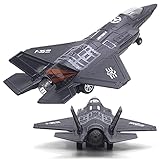
- AIR FORCE FEATURES REALISTIC DETAIL. F-35 is one of the most advanced fighter jet currently in the air. OTONOPI F-35 fighter jet designed base on the real one, 1:72 in scale, 8.7*5.5*2.4inches in size, fits well in little hands.
- PULL BACK & RELEASE AIRPLANE. OTONOPI fighter aircraft comes with pull back and release function, kids would be thrilled by pulling back then letting go and watching it roll forward by itself.
- BOMBER PLANE WITH LIGHTS & SOUNDS. With a slight press of the nose of the military airplane, three lights would flash along with the sounds effect. Kids would be delighted by such an additional highlight.
- SPECIAL ROTATING ENGINE. The Model F-35 is a short takeoff and vertical landing aircraft, it can hover in the air thanks to its special rotating engine. The engine can be rotated for 90 degree, kids could learn more from this fighter jet.
- COMES WITH DISPLAY STAND. F-35 attack plane comes with a display stand. It can be used as exquisite decorations and collection for offices, homes, and it is also a perfect gift for aviation enthusiasts, military personnel or collectors.
The label is therefore shorthand for a capability set rather than a checklist that guarantees every advertised feature will reach production. The relevant question is not simply whether the aircraft looks different from an earlier fighter, but whether its power, data, software, sensors, networks, and human-machine architecture can work together and remain upgradeable.
| Capability direction | What it is intended to provide | What is not yet proven publicly |
|---|---|---|
| Next-generation radar | Much greater data collection and processing for the aircraft’s sensing and decision-making | Operational detection range, accuracy, reliability, and combat performance |
| High electrical capacity | Power for radar, computing, communications, electronic warfare, and future systems | Final generator output, engine model, and thermal limits |
| Open systems architecture | Software and mission systems that can be updated or replaced as threats change | Final interfaces, software architecture, upgrade schedule, and delivered configuration |
| Integrated sensors and communications | Combining information from onboard and networked systems | Final sensor suite, data-link performance, and network resilience |
| Advanced digital cockpit | Presenting mission information to the crew in a more integrated and adaptable way | Production cockpit hardware, displays, controls, and workload in operational conditions |
| Human-machine teaming | Allowing the crewed fighter to work with uncrewed systems and autonomous functions | Final uncrewed aircraft, autonomy rules, control methods, and weapons integration |
BAE Systems says the Tempest radar is designed to provide 10,000 times more data than current systems. That is a BAE Systems capability claim from its official technology material, available in 2026, and should not be presented as an independently verified operational result. The company’s Tempest technology description also presents the aircraft as adaptable and connected, with open systems architecture, integrated sensors and communications, and an advanced digital cockpit.
More data does not automatically mean a particular detection range or guaranteed combat advantage. The value of sensor data depends on processing, fusion, identification, communications, electronic-warfare conditions, software, crew decisions, and the performance of the wider network.
Who is building the GCAP Tempest fighter?
The GCAP Tempest fighter is being developed through a government and industry partnership involving the UK, Japan, and Italy, with GIGO providing the international government structure and named companies contributing technology and industrial work.
| Participant or organisation | Documented role in the supplied material |
|---|---|
| United Kingdom | GCAP partner, host of the designated programme headquarters, and sponsor of UK sovereign combat-air technology work |
| Japan | GCAP partner and participant in the treaty, GIGO, ministerial oversight, and programme integration decisions |
| Italy | GCAP partner and signatory to the treaty and subsequent ministerial programme decisions |
| GIGO | International Government Organisation formally established on December 10, 2024, to provide the programme’s government structure |
| Edgewing | Industrial organisation that signed integration contracts with GIGO in April and July 2026, according to Japan’s July 2026 update |
| BAE Systems | UK industrial participant publishing Tempest technology work and reporting the £708 million UK contract extension |
| Rolls-Royce | Named industrial participant explaining Tempest’s power-and-propulsion requirements |
The table identifies roles documented by the supplied official sources; it is not an exhaustive list of every supplier, subcontractor, research institution, or future industrial partner. The multinational structure means GCAP’s outcome will depend on technical integration as well as governance, workshare, export rules, security requirements, and national funding decisions.
How should Tempest be compared with other future fighter programmes?
Tempest should be compared with other future fighter programmes by maturity and systems architecture, not by concept-art appearance or the “sixth-generation” label alone.
| Comparison axis | Question to ask | Why it matters |
|---|---|---|
| Power and thermal capacity | Can the aircraft generate, distribute, and cool enough power for sensors, computing, electronic warfare, and future systems? | Electrical capacity can limit what the aircraft can operate, upgrade, and sustain |
| Sensor and data architecture | How are information collection, processing, fusion, and sharing handled? | A large data claim is useful only if the aircraft can turn data into reliable decisions and network effects |
| Human-machine teaming | How does the crewed aircraft work with uncrewed systems and autonomy? | The crewed fighter’s effectiveness may depend on systems beyond its own airframe |
| Adaptability | Can open software and modular systems be updated as threats change? | Upgrade speed can matter as much as the initial specification over a long service life |
| Programme maturity | Is the competing aircraft a concept, demonstrator, development aircraft, test aircraft, or operational fleet? | Claims made at concept stage carry more uncertainty than results from an operational aircraft |
| Industrial and political structure | Who owns the programme, controls workshare, sets export rules, and carries schedule risk? | Multinational governance can provide resources and expertise while adding integration and political complexity |
What is still unknown about the Tempest fighter?
The final production Tempest remains publicly unspecified in several decisions that determine real-world combat capability, cost, and schedule.
PC Slower Than It Used to Be?
A free scan shows the junk files, broken settings and background clutter dragging Windows down - then fixes them in one click.Free scan · Windows 10 & 11Outdated Drivers Are Slowing You Down
One free scan finds every outdated or missing driver and matches the right update for your exact hardware.Free scan · exact hardware match| Unknown item | Why concept art or a technology claim cannot answer it |
|---|---|
| Final production airframe | Digital concepts and scale models show development directions, not necessarily the aircraft that will be built |
| Definitive dimensions and weight | No final public airframe dimensions or production mass are established in the supplied official material |
| Engine designation and thrust | The power requirement is described, but no final engine model or thrust figure is released |
| Speed, range, and combat radius | No official final performance figures are provided |
| Payload and weapons suite | Future weapons integration is part of the reported UK technology work, but the final weapons load is not public |
| Operational radar performance | The 10,000-times-more-data statement is a BAE Systems claim, not a published operational test result |
| Unit cost and fleet quantity | The £708 million figure is a UK contract extension, not the total programme cost or aircraft price |
| Final configuration | Not every feature shown in early concepts is guaranteed to survive into production |
| Delivery schedule | 2035 remains an official objective, not proof of guaranteed service entry |
The most accurate current description is therefore conditional: Tempest is a planned sixth-generation combat-aircraft programme with ambitious power, sensing, networking, and digital-engineering goals. The programme’s 2023 treaty, 2024 GIGO establishment, 2026 integration contracts, and 2026 UK contract extension demonstrate continuing institutional progress, but they do not turn a developing concept into a combat-proven production fighter.
The Bottom Line
Bottom line: Tempest is the UK fighter aircraft at the centre of GCAP, the Japan-UK-Italy programme targeting service entry in 2035. Its defining public ideas are high electrical power, advanced sensors and networking, open software, human-machine teaming, and digitally iterated aerodynamics. The aircraft is not operational, and its final engine, performance, weapons, price, dimensions, and production configuration remain undisclosed.
Quick Recap
Product prices and availability are accurate as of the date/time indicated and are subject to change. Any price and availability information displayed on Amazon at the time of purchase will apply.




