Free tools Windows power users keep installed
One-click scans. No signup required.
A straight-pipe exhaust can make a car louder, but its effect on power depends on the vehicle and the parts changed. The term can mean removing only a muffler or removing the catalytic converter and other components too; those setups have different mechanical and legal consequences. Before choosing a change, identify what will be removed and check the requirements where the car is driven.
What does “straight pipe” mean?
“Straight pipe” is an informal term, not one precise exhaust specification. Some people use it for a muffler delete; others mean replacing a larger section of exhaust, potentially including the catalytic converter and resonator. Do not assume the phrase tells you which parts are gone.
A muffler is designed in part to reduce exhaust noise. A catalytic converter is an emissions-control device. Removing one does not have the same effect or legal implications as removing the other.
| Configuration | Likely change | Key consideration |
|---|---|---|
| Muffler delete | Usually louder exhaust sound | Check local noise and equipment rules; sound varies by vehicle and system. |
| Catalytic converter removed or replaced with plain pipe | Changes emissions control as well as exhaust flow and sound | Can constitute emissions tampering under U.S. federal law; check the exact vehicle and applicable rules. |
| Multiple components removed | Effects depend on the components, layout, and vehicle | Confirm what remains, including required emissions controls, before comparing performance claims. |
Pros and cons at a glance
| Potential benefit | Trade-off or risk |
|---|---|
| A louder exhaust character if sound-attenuating components are removed. | The tone and level are vehicle-specific; louder does not necessarily mean better-sounding or suitable for road use. |
| A simpler exhaust section when parts are removed. | Simplicity does not establish that the result is properly designed, compliant, or better for the engine. |
| Possible exhaust-flow changes in a particular engineered application. | There is no universal horsepower, torque, or fuel-economy gain supported for all cars. |
| Customization options for a project vehicle. | Noise, inspection, and emissions rules depend on the parts, vehicle, and jurisdiction. |
Sound: what changes when a muffler is removed?
Removing a muffler generally removes a component whose purpose includes reducing engine exhaust noise. The actual sound depends on the engine, exhaust geometry, component placement, and gas-flow and exhaust-pulse noise. Without measurements for the specific vehicle, do not assume a particular decibel increase or that the result will have a preferred tone.
The Tool Desk
Outbyte PC Repair FREEClear out junk files and repair common Windows errorsFree Scan →Outbyte Driver Updater FREEScan for outdated or missing drivers - takes under a minuteDriver Scan →#1 Best Overall

- T-304 Stainless Steel
- Bolt On Installation
- All Welded Construction
- Made In USA
- Classic BORLA Sound
SAE research describes mufflers as playing a major role in reducing engine noise and examines noise sources on a specific 1.0-liter naturally aspirated petrol engine. Its findings are not a sound prediction for every vehicle. SAE’s stationary exhaust sound procedure provides a way to measure sound over an engine-speed sweep; it does not set a general legal noise limit. SAE research on tailpipe noise and SAE J1492 provide more detail.
Power, torque, and fuel economy
A less restrictive exhaust can change exhaust flow, but that does not establish a predictable performance gain. Engine design, pipe dimensions, component locations, tuning, and operating speed all matter. The SAE studies in this review examine particular designs and engines; they do not establish a typical gain or loss for a reader’s car.
It is also inaccurate to say that engines generally need backpressure. Exhaust design involves trade-offs, and “less backpressure equals more power” is not a reliable universal rule. The reviewed sources do not quantify a general fuel-economy effect or establish that a straight pipe routinely improves or worsens low-speed torque.
Rank #2

- T-304 Stainless Steel
- Bolt On Installation
- All Welded Construction
- Made In USA
- Classic BORLA Sound
For a meaningful comparison, look for before-and-after measurements for the same engine and configuration, with the test conditions and parts identified. Treat generic horsepower, torque, or MPG claims cautiously.
Crashes, No Sound, or Screen Glitches?
Random freezes, missing sound and display glitches usually trace back to one bad driver. Find and replace yours safely.Free scan · under a minutePC Slower Than It Used to Be?
A free scan shows the junk files, broken settings and background clutter dragging Windows down - then fixes them in one click.Free scan · Windows 10 & 11Catalytic converters, emissions, and U.S. law
If a setup removes a catalytic converter required for the vehicle, it is not just a sound modification. The U.S. Environmental Protection Agency says removing a catalytic converter without replacing it with an approved replacement is tampering and illegal under federal law. State or local requirements may also apply. The applicable rules depend on the vehicle, parts, and location, so this general explanation is not legal advice. Read the EPA’s transportation and air-pollution FAQ and check the rules where the vehicle is operated.
An EPA report describes tests on three passenger cars and one light-duty truck in which the catalytic converter was replaced by unrestricted straight pipe. In that four-vehicle sample, all four exceeded the report’s hydrocarbon standard, two exceeded its nitrogen-oxides standard, and one exceeded its carbon-monoxide standard. Those are results from that report’s vehicles and standards, not a modern fleet average or a prediction for every car. Read the EPA report.
Rank #3
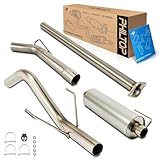
- Vehicle Fitment - The Catback System exhaust kit compatible with 2005-2009 2011-2015 Toyota Tacoma 4.0L V6
- Engineering Excellence - Vehicles are all about dependability and capability, which is why MagnaFlow engineers every one of our durable, corrosion resistant stainless-steel exhausts to last the lifetime of your vehicle
- Reduce Noise - The larger pipes, low-restriction mufflers, and tuned resonators of a well-designed performance exhaust system can make stunned effect on your vehicle: lower auto exhaust back pressure and a much better sound
- Premium Materials - Made of high quality T-304 stainless steel with computerized mandrel-bends for strength and durability; TIG welded CNC machine flange for resistance against pressure and corrosion
- Easy to Install - Direct bolt-on. No drilling or modifications needed for installation. Gaskets and hardware are Included
A muffler-only change should not automatically be described as catalyst removal or federal emissions tampering. Identify the actual parts involved, and check local noise, equipment, emissions inspection, and registration rules for the vehicle’s use.
What to compare before changing your exhaust
- List the parts involved. Confirm whether the proposal changes the muffler, resonator, catalytic converter, or another emissions-control component.
- Set the goal. Decide whether you want a different sound, a repair, or a performance change; each calls for a different comparison.
- Check vehicle-specific evidence. Compare measured sound or performance for the exact vehicle and configuration rather than relying on generic claims.
- Check fitment and rules. Consider pipe dimensions and component placement, then verify applicable local noise, emissions, and inspection requirements.
- Choose an appropriate solution. For a sound change, compare vehicle-specific replacement mufflers while retaining required emissions equipment. For a missing or failing converter, consult a qualified repair provider about an appropriate approved replacement.
Alternatives to a full straight-pipe setup
If the goal is a different exhaust sound, a vehicle-specific replacement muffler can change sound while leaving emissions equipment in place. Compare representative recordings or measurements for the same vehicle, and check applicable noise rules.
If a catalytic converter is missing or failing, a plain pipe is not an emissions-system repair. Ask a qualified exhaust or emissions repair provider about the appropriate approved replacement for the vehicle. SAE exhaust-design research considers performance and acoustic constraints together, which is one reason a component-by-component comparison is more useful than assuming that removing every restriction improves the result. See the SAE studies on exhaust-system design and engine performance and exhaust-system design optimization.
Rank #4

- T-304 Stainless Steel
- Bolt On Installation
- All Welded Construction
- Made In USA
- Classic BORLA Sound
FAQ
Is a muffler delete the same as a straight pipe?
Not necessarily. “Straight pipe” is informal and can mean a muffler-only change or removal of a much larger section, including the catalytic converter. Confirm which parts are actually being removed.
Will a straight pipe make my car faster?
There is no universal answer or guaranteed horsepower gain. Exhaust design and results depend on the vehicle and configuration; look for credible measurements for the exact engine and parts.
Does straight piping remove the catalytic converter?
Some setups do and some do not. The term alone does not specify the parts. Ask for a clear list of components being retained and removed.
What’s actually slowing this PC down?
Pick the symptom - the matching free tool is one click away.
Best Value
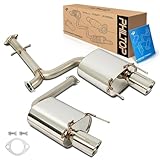
- Vehicle Fitment - The Catback System exhaust kit compatible with 2006-2010 Lexus IS250/IS350
- Engineering Excellence - Vehicles are all about dependability and capability, which is why MagnaFlow engineers every one of our durable, corrosion resistant stainless-steel exhausts to last the lifetime of your vehicle
- Reduce Noise - The larger pipes, low-restriction mufflers, and tuned resonators of a well-designed performance exhaust system can make stunned effect on your vehicle: lower auto exhaust back pressure and a much better sound
- Premium Materials - Made of high quality T-304 stainless steel with computerized mandrel-bends for strength and durability; TIG welded CNC machine flange for resistance against pressure and corrosion
- Easy to Install - Direct bolt-on. No drilling or modifications needed for installation. Gaskets and hardware are Included
How loud will a straight pipe be?
Removing a muffler generally makes exhaust noise louder, but the level and tone depend on the vehicle and exhaust design. Use vehicle-specific sound measurements or representative recordings rather than assuming a particular decibel change.
Is removing a catalytic converter legal in the United States?
The EPA says removing a catalytic converter without an approved replacement is federal emissions tampering. State and local requirements may also apply; check the rules for the exact vehicle and where it is operated.
Will a straight-piped car pass inspection where I live?
That depends on the vehicle, which parts were changed, and local inspection and equipment rules. Check with the relevant local authority or a qualified repair provider before modifying the system.
Quick Recap
Product prices and availability are accurate as of the date/time indicated and are subject to change. Any price and availability information displayed on Amazon at the time of purchase will apply.
Recommended Free Tools




