Quick wins for a faster PC:
Scan for outdated or missing drivers - takes under a minuteDriver Scan →Repair Windows errors before they cause bigger problemsFix Now →Silicon batteries are real, but the name is often misleading. In most cases, a “silicon battery” is still a conventional lithium-ion battery that uses silicon—usually blended with graphite or embedded in carbon—as part of its negative electrode, or anode.
Silicon can store far more lithium than graphite, potentially increasing EV range, smartphone runtime, and charging performance. The trade-off is difficult expansion and contraction during charging, which can cause swelling, capacity loss, manufacturing problems, and shorter service life. Silicon-containing cells are already entering smartphones, wearables, drones, aerospace products, and other premium applications. They have not yet broadly replaced graphite in mainstream U.S. electric vehicles.
What is a silicon battery?
A rechargeable lithium-ion cell contains a cathode, an anode, an electrolyte, a separator, current collectors, and protective packaging. Lithium ions move between the cathode and anode as the cell charges and discharges.
Most current lithium-ion batteries use graphite for the anode. A silicon-anode battery partially or substantially replaces graphite with silicon. Silicon stores lithium through an alloying reaction, rather than graphite’s intercalation mechanism.
What’s actually slowing this PC down?
Pick the symptom - the matching free tool is one click away.
#1 Best Overall

- BUILT-IN 4-CABLE DESIGN: This 10,000mAh portable charger features three built-in output cables and one built-in USB-A input cable for recharging the power bank, helping you charge multiple devices without carrying extra cables. Compatible with iPhone 17/16/15 series, Samsung Galaxy S26/S25/S24/S23/S22/S21/S10/S9/S8, Galaxy Z Flip7/Z Fold7, Galaxy A55/A54/A53/A52/A51, Galaxy Note20/Note10, and many other smartphones and USB-C devices.
- UP TO 22.5W FAST CHARGING: Deliver up to 22.5W fast charging to compatible smartphones and other mobile devices. Quickly restore power when you are commuting, travelling, working, attending events, or away from a wall outlet. Charging speed varies depending on the connected device, charging protocol, cable, and number of devices being charged.
- FAST RECHARGING IN 2.5 HOURS: Recharge the power bank in as little as 2.5 hours using the built-in USB-C cable or the USB-C input port with a compatible 18W PD/QC charger. You can also recharge it through the built-in USB-A cable in approximately 6 hours. Actual charging time may vary depending on the charger and power source used.
- AIRLINE-APPROVED & SAFETY PROTECTION: Intelligent safeguards help protect against overcharging, overvoltage, overcurrent, short circuits, and overheating, providing reliable charging for your devices. With a capacity below 100Wh, the power bank is suitable for carry-on travel under standard airline battery guidelines.
- LED DISPLAY & COMPACT: The digital LED display shows the remaining battery level as a percentage, helping you know when it is time to recharge. Its compact design fits easily into a purse, backpack, work bag, or travel bag.
Commercial designs commonly use:
- Silicon–graphite blends
- Silicon–carbon composites
- Silicon monoxide or silicon oxide, written as SiO or SiOx
- Porous, hollow, or coated silicon particles
- Silicon nanoparticles or nanowires
- Silicon embedded in a carbon scaffold
These are generally material and electrode improvements to lithium-ion technology—not automatically a new battery chemistry. Silicon also does not automatically mean solid-state. A silicon anode can operate with a liquid, gel, or solid electrolyte.
For background, see the U.S. Department of Energy’s silicon-anode overview and this Nature Energy review.
Why manufacturers want silicon
Much higher theoretical capacity
Silicon’s theoretical specific capacity is approximately 3,500–3,600 mAh/g, compared with about 372 mAh/g for graphite. That is roughly a tenfold active-material advantage.
It does not mean a silicon-powered EV will have ten times the range. The complete cell also includes the cathode, electrolyte, separator, current collectors, casing, cooling equipment, safety systems, and inactive materials. Cathode capacity, electrode balance, voltage limits, lithium loss, durability, and packaging all constrain the final result.
As the Nature Communications research and other reviews emphasize, the theoretical capacity of an electrode is not the same as the energy density of a finished cell or battery pack.
Higher energy density
If engineers can use more silicon without sacrificing durability, the battery may store more energy by weight or volume. In an EV, that could mean:
- More range from a similarly sized battery pack
- The same range from a lighter pack
- Fewer cells for a given energy target
- More room for crash structures, cooling, or passenger space
In a smartphone, the manufacturer could increase capacity without making the phone thicker, or preserve capacity while reducing the battery footprint.
Potentially faster charging
Silicon can support high lithium-storage capacity and may enable fast-charging cell designs. However, charging speed is a full-cell and pack-level property. It also depends on the cathode, electrolyte, temperature, charging software, cell format, thermal management, state of charge, and lithium-plating limits.
The Tool Desk
Outbyte Driver Updater FREEScan for outdated or missing drivers - takes under a minuteDriver Scan →Outbyte PC Repair FREEClear out junk files and repair common Windows errorsFree Scan →A phone or EV with a silicon-containing anode is therefore not automatically an extremely fast-charging product.
Potential supply-chain benefits
Silicon is abundant and could reduce dependence on graphite, whose processing is concentrated outside the United States. Companies such as Sila and Group14 are developing silicon-based anode materials partly around this supply-chain opportunity.
Rank #2

- 【Strong Magnetic Charger for MagSafe】Built with upgraded N52 magnets that snap firmly into place for stable magnetic wireless charging. Designed to align automatically with compatible magnetic phones and cases, ensuring secure attachment during commuting, travel, and daily use. No slipping, no adjusting—just instant, reliable magnetic power.
- 【22.5W Fast Charging & 10000mAh Capacity】Features USB-C PD fast charging and a 22.5W USB-A output to deliver rapid power when you need it most. The high-density 10000mAh battery provides multiple full recharges for most smartphones, making it ideal for business trips, outdoor activities, and emergency backup.
- 【Safe Charging & Wide Compatibility】Multiple built-in safety protections help provide dependable charging during everyday use. Compatible with iPhone 17/16/15/14/13/12 series, MagSafe-compatible cases, AirPods and other USB-powered devices through wired charging. Designed for work, travel, commuting and everyday convenience.
- 【Slim, Lightweight, and Travel-Ready】Engineered to be thin, compact, and easy to carry—slips into pockets, handbags, and travel pouches without bulk. The 10000mAh capacity meets airline carry-on requirements, making it an excellent companion for commuting, flights, and on-the-go workflows. Matte texture reduces fingerprints for a clean, premium feel.
- 【Foldable Stand for Hands-Free Convenience】Includes a durable foldable kickstand that lets you enjoy hands-free viewing while charging. Ideal for video calls, browsing, or streaming—supports both vertical and horizontal positions. Adds functional value by turning your phone into a mini workstation or entertainment hub.
That does not automatically make a battery domestic, cheaper, or more sustainable. A U.S.-based company may still rely on overseas feedstocks, processing, partners, or manufacturing. Cost and supply-chain benefits must be judged at the finished cell and pack level.
The central problem: silicon expands dramatically
Silicon can expand by approximately 300% or more as it absorbs lithium during charging. It contracts again during discharge. Repeating that movement can:
- Crack or pulverize silicon particles.
- Break electrical connections inside the electrode.
- Cause the electrode to delaminate.
- Rupture the solid-electrolyte interphase, or SEI.
- Consume electrolyte and active lithium as the SEI reforms.
- Increase resistance, swelling, and capacity loss.
The SEI is a protective layer that forms on the anode during early operation. With silicon, expansion and contraction can repeatedly damage it. That lowers coulombic efficiency, increases impedance, generates additional stress, and can shorten cycle life.
Research on silicon expansion and interface instability is summarized in Nature Communications, this related study, and the 2024 analysis of silicon-anode failure mechanisms.
How engineers manage the problem
Silicon–graphite blends
Blending silicon with graphite retains some of graphite’s established conductivity and cycling behavior while adding capacity. It is a comparatively practical path to manufacturing, but it preserves some graphite dependence and does not eliminate swelling.
Silicon–carbon composites
Carbon can provide a conductive framework around silicon, maintain electrical contact, create expansion space, and limit direct electrolyte exposure. This approach is used in proprietary materials from companies including Sila and Group14.
Nanowires and porous particles
Nanowires, hollow particles, and porous structures can give silicon room to expand while preserving conductive pathways. The disadvantage is that empty space and added structure reduce active-material packing density and can increase cost.
The DOE has described a specific silicon-nanowire development program reaching approximately 300 Wh/kg at the cell level. That historical, program-specific result is not a current benchmark for every commercial EV battery. See the DOE discussion.
SiOx, binders, additives, and pressure control
Silicon oxide can offer a compromise between pure silicon’s capacity and graphite-like durability, although it can suffer significant first-cycle lithium loss. Advanced binders and electrolyte additives help stabilize the electrode and SEI. Controlled compression, stronger packaging, additional void space, and software limits can also manage swelling.
Every solution introduces trade-offs in cost, manufacturing complexity, usable capacity, weight, or volume.
PC Slower Than It Used to Be?
A free scan shows the junk files, broken settings and background clutter dragging Windows down - then fixes them in one click.Free scan · Windows 10 & 11Outdated Drivers Are Slowing You Down
One free scan finds every outdated or missing driver and matches the right update for your exact hardware.Free scan · exact hardware matchRank #3
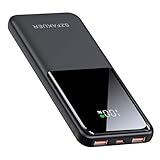
- Ultra-Slim & Light weight Design: At just 0.63 inches thick and 8.11oz, this is the slim and light 10000mAh power bank. Perfect for travel, it easily fits in your pocket or bag without adding bulk.
- 22.5W USB-C Fast Charging: Equipped with USB-C input and output, this power bank supports PD3.0 and QC4+ fast charging, delivering up to 22.5W of power. Charge your iPhone to 65% in just 30 minutes or power up multiple devices quickly.
- 3 Output & Dual Input: Features 3 outputs (2 USB-A + 1 USB-C) and 1 inputs (USB-C ), allowing you to charge up to three devices simultaneously. Ideal for smartphones, tablets, earbuds, and more.
- Wide Compatibility: Works seamlessly with a wide range of devices,Compatible with iPhone 17/16/15/14/13/12, Samsung Galaxy, Google Pixel, iPads, AirPods, Android tablets, and other USB-C devices.
- Advanced Safety & LED Display: Built with an 8-Layer Protection System to prevent overcharging, overheating, and short circuits. The LED digital display shows the remaining battery percentage, so you’re never caught off guard by a low battery.
Advantages for electric vehicles
More range or a lighter battery
Higher cell-level energy density could allow an automaker to increase range without proportionally enlarging the pack. Alternatively, it could retain range while reducing battery mass, which may improve efficiency.
The practical question is not whether silicon has greater anode capacity. It is whether the complete pack can deliver that advantage while meeting warranty, safety, thermal, cycle-life, and cost requirements.
Potentially shorter charging stops
Silicon may help enable high-rate charging, potentially making smaller packs more useful. But EV buyers should compare the actual charging curve—particularly the time from 10% to 80%—rather than a maximum charging-rate claim.
Strong fit for weight-sensitive vehicles
High-energy cells can be especially valuable in drones, aviation, electric vertical-takeoff aircraft, performance vehicles, and some delivery applications. These customers may accept higher prices or more frequent battery replacement in exchange for lower weight.
That is why aviation and aerospace adoption does not by itself prove that the same cell is ready for a high-volume passenger EV.
Disadvantages for electric vehicles
- Cycle-life risk: EV packs must endure repeated cycling over many years, not merely produce impressive initial capacity.
- Calendar-life risk: Batteries degrade while parked, especially at high states of charge and elevated temperatures.
- Swelling: Expansion may require compression systems, stronger cases, extra void space, or pack-level monitoring.
- Manufacturing yield: Specialized particles, binders, coatings, additives, formation cycles, and inspections can make production more difficult.
- Cold-weather limitations: Charging and power performance still depend on temperature and lithium-plating constraints.
- Safety validation: Silicon is not inherently safer. Thermal, crush, overcharge, short-circuit, and propagation testing remain essential.
- Cost uncertainty: Abundant silicon can still become expensive when converted into engineered, coated, porous, or nanostructured anode material.
For an EV, demand evidence at the pack level: usable energy, charging time under stated conditions, retained capacity after specified cycles, calendar-life data, low-temperature performance, abuse testing, warranty terms, and production scale.
Advantages for smartphones
Phones place a high value on energy per cubic centimeter. Silicon-containing cells may provide:
- Longer runtime in the same phone size
- Thinner designs at similar capacity
- More capacity for displays, cameras, processors, and local AI workloads
- Faster charging when paired with suitable hardware and software
- More design freedom for cooling and other components
Group14 describes its silicon technology as enabling greater power in the same footprint, including thinner designs and longer battery life. That is a supplier claim, not a universal measured result.
Enovix’s filings describe a silicon-anode platform for smartphones, smart eyewear, and AI-enabled devices and report a 935 Wh/L result for an AI-1 smartphone battery. This is a company-reported platform result and should not be generalized to all silicon batteries or all U.S. smartphones. See the Enovix filing.
Independent reader supportYour contribution helps us test, update, and keep practical guides available for everyone.Disadvantages for smartphones
Phone users face many of the same issues as EV users, although the requirements differ:
Rank #4

- 2-Pack Super-mini Charger: Seamlessly fit Miady 5000mAh portable iphone charger for travel into your pockets or bags, thanks to its compact dimensions of 3.6*2.5*0.4 in, weight: 4.2 Oz. The lightweight design lets you take it out without pressure. Our 2 pack power bank would make a great gift for your families or friends.
- 12W Rapid Charging Speed: This portable phone charger is also equipped with 2 ports (USB A output, USB C input/output), providing 5V/2.4A high-speed charging to save time. It can charge 2 devices at the same time. You and your families or friends never have to worry about the power of phones during the trip.
- Airline Approved Capacity: All external batteries with capacity under 27027mAh / 100 watt hours can legally and safely be taken on a plane. The capacity of it is 5000mAh / 18.5 watt hours, so it is allowed on a plane. Our mini portable charger is not only an energy supply station for your smart devices, but also a reliable partner for you to explore the world.
- Universal Widely Compatibility: This usb c portable charger widely compatible with iPhone 18/17/16/15/14/13/12/11 Series, XR, XS Max, Galaxy S24, S22, S21, S20, A52, A32, Z fold series, Z flip series, and Pixel series, and other andorid phones, iPad, tablets, etc... It's stylish and simple appearance can better match your mobile phone or other devices.
- What You Get: 5000mAh Portable Phone Charger (Black+White) * 2; USB-C Cable * 2; User Manual * 1. This charging bank comes with friendly customer 24/7 service. If you have any questions, please contact the Miady's store first for a solution, we will be sure to provide a satisfying solution for you. Your satisfaction is our greatest recognition and support.
- Fast charging and heat can accelerate degradation.
- Swelling is difficult to accommodate in thin, tightly packaged devices.
- Battery-replacement options may be limited by glued construction and proprietary parts.
- Brands often disclose neither the exact silicon percentage nor the cell supplier.
- A phone advertised with silicon-carbon technology in one country may use a different cell or not be sold in the U.S.
- A higher-capacity cell may be used to make a phone thinner rather than to extend runtime.
Consumers should judge the complete phone by verified runtime, charging time, thickness, weight, heat behavior, battery warranty, and repairability—not by the phrase “silicon battery” alone.
Silicon versus graphite
| Criterion | Graphite anode | Silicon-containing anode |
|---|---|---|
| Theoretical capacity | About 372 mAh/g | About 3,500–3,600 mAh/g for silicon |
| Commercial maturity | Highly mature | Mixed; composite approaches are emerging |
| Swelling | Relatively low | Potentially very high |
| Cycle-life confidence | Strong, with extensive field experience | Highly dependent on architecture and operating conditions |
| Energy-density upside | Lower | Higher |
| Manufacturing complexity | Established | Generally higher |
| Supply-chain diversification | Continues graphite dependence | May reduce some graphite demand |
| Consumer retrofit availability | Established replacement ecosystem | Generally unavailable |
U.S. commercialization as of August 18, 2026
The U.S. market has genuine silicon-anode development and early commercial activity, but the sector is not yet equivalent to mainstream automotive battery production.
Do these 3 things before closing this tab:
1Repair Windows errors before they cause bigger problems2Fix the driver behind crashes, sound loss and screen glitches3Clear out junk files and repair common Windows errorsSila
Sila markets Titan Silicon anode material for consumer electronics, EVs, mobility, aerospace, robotics, and other applications. Its Moses Lake, Washington facility is presented as a major western silicon-anode manufacturing site. These are company-reported positioning and facility claims; the company’s commercial route is B2B engagement rather than retail battery sales.
Group14
Group14 markets silicon-carbon materials and reports 10 GWh of material capacity online, with a target of 20 GWh by 2027. These figures are company-reported material-production capacity, not equivalent U.S. EV battery-cell capacity.
Amprius
Amprius is among the more visible U.S. companies with commercial silicon-anode cells, particularly for aviation, drones, and aerospace. Its SEC filings state that SiCore batteries launched commercially in January 2024 and describe more than 2 GWh of annual production access through owned, partner, and contract arrangements as of March 31, 2026.
The filing also acknowledges that cycle life, cost, and production quantity must improve for broader EV competition. Product-specific cycle-life figures, such as up to 500 cycles for specified formats, should not be treated as representative of every silicon cell or equivalent to an automaker’s complete-pack warranty target. See the March 2026 filing and 2025 annual filing.
Recommended Free Tools
Enovix and OneD Materials
Enovix is focused on compact electronics, including smartphones, smart eyewear, and AI devices. OneD Materials develops SINANODE, which combines silicon nanowires with graphite for lithium-ion applications. Development results and company capacity claims should always be separated from mass-market availability.
Other developers—including Enevate, Nexeon, and StoreDot—have different product statuses, customers, geographies, and production arrangements. A company list is not proof that all technologies have reached equal commercial maturity.
What buyers should check
For an EV
- Actual EPA range and independent real-world range testing.
- 10%–80% charging time, including temperature and charger-power conditions.
- Usable pack energy rather than only nominal capacity.
- Battery warranty and capacity-retention terms.
- Cold-weather charging and performance.
- Serviceability, replacement cost, and field degradation data.
- Whether the claimed energy-density figure is for an anode, cell, module, or pack.
For a smartphone
- Measured runtime, not only mAh or Wh/L.
- Charging time with the supplied charger and protocol.
- Phone thickness and weight.
- Battery-replacement availability and repair cost.
- Thermal behavior during fast charging and demanding workloads.
- U.S. regional availability and the exact model’s battery specification.
Consumers generally cannot retrofit an existing EV or smartphone with a silicon-anode battery. Battery chemistry, packaging, battery-management software, thermal systems, and safety validation are selected as an integrated product by the manufacturer.
Outlook
The most likely path is gradual adoption through silicon–graphite and silicon–carbon composites, rather than an immediate industry-wide switch to pure silicon. Smartphones, drones, aerospace products, and other premium devices can justify the cost and accept different durability requirements sooner than mass-market passenger EVs.
Free tools Windows power users keep installed
One-click scans. No signup required.
Silicon is therefore a credible near-term battery improvement, not a guaranteed revolution. Its success will be measured by complete products: usable range or runtime, charging performance, retained capacity, safety, warranty life, cost, and manufacturing volume.
Quick Recap
Product prices and availability are accurate as of the date/time indicated and are subject to change. Any price and availability information displayed on Amazon at the time of purchase will apply.




