Rocker-bogie suspension is a passive, six-wheel articulated system that helps planetary rovers keep their wheels loaded on rough ground while reducing the motion transferred to the rover body. It does this with two long rocker arms, two trailing bogies, and a central differential linkage—not with conventional springs and shock absorbers.
The design gives Mars rovers impressive low-speed mobility over rocks, ledges, depressions, and soft soil. It is not an all-terrain guarantee, however: wheel size, motor torque, traction, center of gravity, joint angles, and software limits still determine what the rover can safely cross.
What does rocker-bogie mean?
The name describes two different articulated members on each side of the rover:
- Rocker: the longer arm that connects the rover body to the front wheel and to the rear bogie.
- Bogie: the trailing link that carries the middle and rear wheels.
- Differential: a separate passive linkage near the top center of the rover that connects the left and right rocker assemblies and moderates their opposing motion.
Viewed from the side, the front wheel sits at the end of the rocker. Behind the rocker’s body pivot, a second pivot supports the bogie. The bogie then carries the middle and rear wheels. The same arrangement is mirrored on the other side, producing six wheels in total.
#1 Best Overall

- Remote Control and Hand Gesture Control:This gesture sensing robot not only can be controlled by infrared controller, but also can turn left ,turn right, slide backward, and slide forward according to how your hand gesture commands; Multi function includes auto display and obstacles avoidance as well;The toy robot’s eyes light up with bright blue illuminating LED when it moves;
- Intelligent Programming: This smart robot toy can demonstrating a set of 50 actions inputted by the user.If you switch programming function,this Interactive robot will playback using its moves record feature to repeat the movement one by one as you created like turn left+turn right+walk forward+walk backward+patrol+dance+and many others action mode you selected;
- Premium Material:This Remote Control Robot is made of non-toxic ABS plastic, with flexible multi-joint in shoulder,elbows and thumbs ,and the bottom skating wheels are pretty sturdy to well carry out a various combination of moves;This playful robot really entertain your kids and bring you endless joys;
- Convenient Rechargeable Robot Toy:this RC robot is powered by built-in batteries.Directly connect to USB charging interface like your power bank,plug,computers.Rechargeable way saves your money for batteries and you only recharge the robot about 2 hours, and its playtime is about 60 minutes;
- Ideal Birthday Xmas Gift & Kids Intimate Companion : The infrared control Robot is versatile and vivid can dance,sing,walk,patrol,even can speak with a charming accent;Don’t scratch your head to search gifts but directly pick this intelligent robot for your kids;It is an amazing gift kids will be thrilled with and this robot will entertain you so much.
When a wheel encounters a rock or drops into a depression, the links rotate in response to the terrain. The rocker-bogie joints normally have no springs or dedicated motors that independently raise and lower the wheels. The system is therefore called passive, even though the rover still has powered wheel drives, steering actuators, angle sensors, navigation hardware, and mobility software.
How the suspension moves over an obstacle
Imagine the front wheel on one side approaching a rock:
- The front wheel climbs the obstacle.
- The rocker rotates around its attachment to the rover body.
- That motion changes the position of the bogie, allowing the middle and rear wheels to follow the terrain instead of forcing the entire rover body to rise and fall with the front wheel.
- The opposite rocker responds through the central differential, which couples the two sides and limits how independently they can move.
- The wheel motors continue providing drive torque while the suspension links find a mechanically constrained position around the obstacle.
This is not the same as a vehicle actively commanding each wheel to a particular height. The terrain supplies the suspension movement. The geometry determines how much of that movement reaches the body and how the wheel loads are shared.
Recommended Free Tools
Why six wheels and articulated links work on Mars
Keeping the wheels loaded
A rover needs more than wheels that touch the ground visually. Each wheel must carry useful normal force so it can transmit driving torque without simply spinning or sinking. The rocker-bogie layout helps equilibrate wheel pressure across uneven ground.
On soft terrain, distributing the rover’s weight across six wheels can reduce the pressure concentrated under any one wheel. That can reduce sinking compared with a layout that leaves only a small number of wheels carrying most of the load. On hard, rocky terrain, nominal contact by all six wheels helps preserve traction and motive force.
That wording matters: the system is designed to encourage wheel contact, but it does not guarantee that all six wheels remain firmly planted on every surface. A deep hole, sharp ridge, wheel slip, or an excessive suspension angle can still leave a wheel lightly loaded or cause the rover to stop its drive.
Reducing body tilt
The rover body carries sensitive and expensive equipment. Excessive pitch or roll can complicate navigation, pointing, communications, and science operations, while also increasing the risk of a tip-over.
The Tool Desk
Outbyte PC Repair FREEClear out junk files and repair common Windows errorsFree Scan →Outbyte Driver Updater FREEScan for outdated or missing drivers - takes under a minuteDriver Scan →Because the rocker and bogie links absorb much of the individual wheel movement, the body does not have to follow every rock and depression directly. The central differential further constrains the relationship between the left and right suspension sides. Curiosity engineering documentation describes the rocker angles as being coupled so that their differential motion has equal magnitude and opposite sign. In practical terms, one side’s movement is balanced against the other rather than allowing the deck to copy every independent wheel movement.
Rank #2

- [Telescope Suction Cup Robot Toy] The coolest Telescope Suction Cup Robot Toy of 2026, which combines the pop tube into limbs and uses suction cups instead of palms and soles of feet. Allow toddlers to freely explore their designs, improve their fine motor skills, or simply calm down while airplane traveling
- [Autism Sensory Toys for Classroom] Pop, wrinkle, pull, stretch! The continuous popping sound will excite toddlers. The bottom suction cup can be connected to smooth surfaces such as mirrors, windows, and tiles. Children can enjoy their playtime in classroom, home, restaurant, airplane and road trip.
- [Road Trip Travel Activities Essentials] The telescopic suction cup robot toy can pop, stretch, twist, and wrap, helping to cultivate children's fine motor skills and creative thinking. Helping children relieve stress and calm down during the plane/car journey and restaurant, especially suitable for ADHD and autism
- [2026 Small Cool Toy Set] Equipped with 4 different colors, made of high-quality ABS and lead-free plastic, it has sufficient toughness and durability to withstand long-term play, fully meeting the safety standards of American children's toys
- [Easter Basket Stuffer For Kids] Telescopic suction cup toys can effectively help focus and promote sensory development. This is an fun and cool Easter Basket Essentials for kids、toddlers and grandkid. Perfect as a gift for birthdays, Valentine's Day Classroom, Easter, Christmas, Thanksgiving, or Halloween
The suspension does not keep the deck perfectly level. It reduces body motion and helps manage the rover’s attitude within a useful range.
Climbing obstacles roughly as large as a wheel
Perseverance uses wheels measuring 20.7 inches, or 52.5 centimeters, in diameter. NASA describes its mobility system as capable of negotiating obstacles or depressions approximately as large as a wheel. That is a description of the rover’s designed capability under appropriate conditions—not a promise that it can climb a vertical step of that size on any soil or approach angle.
Actual performance depends on the shape of the obstacle, the contact angle, wheel torque, available traction, rover attitude, center of gravity, and the allowable motion of the suspension joints.
The differential: stabilizer, not motor or shock absorber
The differential is often misunderstood because the word also appears in automotive drivetrains. A rover’s rocker-bogie differential is not an engine component, wheel-drive differential, shock absorber, or active leveling motor.
On the classic NASA arrangement, it is a passive geometric coupling. Mounted near the top center of the rover body, it connects the left and right rockers. If one rocker moves relative to the body, the differential transfers and constrains that motion in relation to the other rocker. This helps prevent the rover deck from following the full independent movement of both sides.
The differential’s purpose is body stabilization through linkage geometry. The wheels are driven by separate actuators, and steering is handled by separate steering hardware.
Rocker-bogie is not conventional car suspension
For readers familiar with cars, the most important distinction is that rocker-bogie suspension is primarily a low-speed articulated mobility system, not a spring-and-damper suspension designed to isolate a vehicle traveling quickly over pavement.
| Feature | Typical passenger-car suspension | Rocker-bogie rover suspension |
|---|---|---|
| Primary method of movement control | Springs, dampers, control arms, and compliant tires | Articulated rocker and bogie links |
| Typical operating environment | Roads and off-road travel at comparatively high speeds | Slow, carefully controlled travel over irregular terrain |
| Suspension actuation | Usually passive springs and dampers, sometimes active or adaptive systems | Normally passive joint articulation caused by terrain |
| Wheel propulsion | Powered through the vehicle drivetrain | Planetary rovers commonly use independently driven wheels |
| Steering | Usually front-wheel steering or another dedicated steering layout | Separate steering actuators; Curiosity has steering on its front and rear wheels |
Perseverance’s published top speed on flat, hard ground is just under 0.1 mph, or approximately 152 meters per hour. Its mobility system prioritizes stability, wheel contact, controllability, and energy efficiency rather than the rapid suspension response required by an automobile.
NASA’s Mars rover lineage
Sojourner and Pathfinder
Sojourner arrived on Mars with the Pathfinder mission on July 4, 1997, using a six-wheel rocker-bogie mobility system. Contemporary JPL descriptions emphasized that the joints could conform to uneven ground without conventional springs and that six wheels improved stability compared with a four-wheel arrangement.
Rank #3
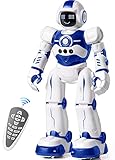
- Remote Control and Hand Gesture Control:This gesture sensing robot not only can be controlled by infrared controller, but also can turn left ,turn right, slide backward, and slide forward according to how your hand gesture commands; Multi function includes auto display and obstacles avoidance as well;The toy robot’s eyes light up with bright blue illuminating LED when it moves;
- Intelligent Programming: This smart robot toy can demonstrating a set of 50 actions inputted by the user.If you switch programming function,this Interactive robot will playback using its moves record feature to repeat the movement one by one as you created like turn left+turn right+walk forward+walk backward+patrol+dance+and many others action mode you selected;
- Premium Material:This Remote Control Robot is made of non-toxic ABS plastic, with flexible multi-joint in shoulder,elbows and thumbs ,and the bottom skating wheels are pretty sturdy to well carry out a various combination of moves;This playful robot really entertain your kids and bring you endless joys;
- Convenient Rechargeable Robot Toy:this RC robot is powered by built-in batteries.Directly connect to USB charging interface like your power bank,plug,computers.Rechargeable way saves your money for batteries and you only recharge the robot about 2 hours, and its playtime is about 60 minutes;
- Ideal Birthday Xmas Gift & Kids Intimate Companion : The infrared control Robot is versatile and vivid can dance,sing,walk,patrol,even can speak.Each robot measures 5.9 x 3.3 x 10.6 inch.
Sojourner helped establish the architecture as a practical planetary mobility solution rather than merely a laboratory mechanism. NASA educational material later described the system as successful on Pathfinder and scaled for subsequent Mars rovers.
Spirit and Opportunity
The Mars Exploration Rovers Spirit and Opportunity, which landed in January 2004, used a design derived from the Sojourner-style rocker-bogie system. Their suspension was not simply a larger copy. Mission requirements added joints and structural features for launch stowage, deployment after landing, and absorption of landing-related loads.
What’s actually slowing this PC down?
Pick the symptom - the matching free tool is one click away.
The suspension structures also had to manage bending and torsional forces while remaining light enough for a planetary spacecraft. NASA’s MER design descriptions discuss lightweight titanium box-beam structures as part of that solution.
Curiosity
Curiosity retained the rocker-bogie architecture for the much larger Mars Science Laboratory rover. Its mobility subsystem includes six independently driven wheels, six drive actuators, four steering actuators, the rocker-bogie suspension, an inertial measurement unit, angle-resolver sensors, and software for mobility and navigation.
Curiosity’s resolvers monitor suspension and differential-related angles. This provides the rover and its operators with information about the actual mechanical position of the suspension, rather than relying only on wheel commands or visual estimates.
Curiosity also illustrates an important limitation: a drive can terminate when a bogie angle exceeds a programmed suspension limit even when the rover is not in immediate danger. The limit is a protective operating boundary, not proof that the rocker-bogie mechanism has failed.
Free tools Windows power users keep installed
One-click scans. No signup required.
Perseverance
Perseverance is based on the Curiosity rover configuration and retains the same fundamental rocker-bogie approach. NASA identifies its three major suspension components as the differential, the rockers, and the bogies.
The architecture has therefore persisted across multiple Mars missions because it solves several problems simultaneously: six-wheel load sharing, obstacle negotiation, body-motion reduction, and passive articulation. Each mission still adapts the design for its own mass, instruments, launch packaging, landing loads, wheel design, and operational requirements.
What rocker-bogie suspension does not solve
Rocker-bogie suspension is highly capable, but it is not magic. Its limits come from the complete rover system, not just the link arrangement.
Rank #4

- Multifunctional Robot: LED eyes can light up once you turn on the robot, you can also make it blink or closed by the controller. Smart Voice - turn on the robot it will start talking, he can also sing different songs which can be switched by remote; the track of the tank allows the robot to move forward backward left, and right flexibly. Under demo mode, it will begin 360-degree spins, dancing with flexible arms and heads.
- Fantastic Unique Appearance: This cute and funny robot is designed in 3 parts. The upper part is a cute robot with a pair of LED eyes and the head and arms are flexible. The bottom part is designed as a continuous track of a tank, so cool! Songs singing will absorb your baby. Combining a cute appearance, beautiful big eyes, flexible limbs, and a smart voice function, your baby will love this toy robot.
- Easy to Operate: Equipped with tracks of tanks, 6 wheels, and a 2.4GHz remote controller, the RC robot can move and dance under the control of the child, ideal for the child's entry-level remote-control toys. One-click demonstration of automatic dancing will provide hours of fun to children. 2.4G Hz no interference controller makes several robots can run at the same time.
- Entertaining and Educational: For children who have just formed a cognition of the world, this easy-to-operate robot can help them begin to exercise their operational skills and imagination. The joyful singing will greatly stimulate the children's language communication potential, and the cute shapes will bring happiness to children and promote physical and mentally healthy. Excellent girls boys toys age 4-5.
- Ultimate Robot Toys Ideas: Are you looking for an ideal and exciting present for a birthday, Christmas, or festival? Choose this, and children will love it!! It is as entertaining as it is educational, a better choice than a robot dog. We adopt exqRobot length, width and height: L*W*H=4.92*3.34*4.72 inchuisite packaging for this robot, what you get in the box: 1 remote-controlled robot, 1 remote control, 1 Type C charge cable, 1 screwdriver, 1 user manual, and batteries for the controller.
- Wheel diameter: A larger wheel can help bridge a larger obstacle, while a small wheel may encounter a step it cannot climb.
- Drive torque: The suspension can position a wheel on an obstacle, but the wheel motor must still generate enough torque to climb it.
- Traction: Loose soil, dust, steep slopes, and poor contact can cause wheel slip even when the geometry appears favorable.
- Center of gravity: A rover’s mass distribution affects its tip-over margin and the loads carried by each wheel.
- Link geometry: Pivot locations and link lengths determine clearance, articulation, load sharing, and the attitude of the body.
- Joint-angle limits: The rover cannot safely articulate indefinitely. Software can stop a drive when monitored suspension angles reach a programmed boundary.
- Terrain shape: A rounded rock, a sharp vertical ledge, a trench, and a loose slope can all be the same height but present very different challenges.
The absence of active wheel-height control is another trade-off. A classic passive rocker-bogie rover cannot independently command every wheel to rise, push down, or change its vertical position. Fixed geometry makes the system comparatively simple and robust, but it limits how precisely the rover can adapt to unusual terrain.
Outdated Drivers Are Slowing You Down
One free scan finds every outdated or missing driver and matches the right update for your exact hardware.Free scan · exact hardware matchPC Slower Than It Used to Be?
A free scan shows the junk files, broken settings and background clutter dragging Windows down - then fixes them in one click.Free scan · Windows 10 & 11Why the design is slow but effective
The rocker-bogie layout favors deliberate traversal. At low speed, the rover can allow the links to settle against terrain, monitor suspension angles, assess wheel motion, and stop if the vehicle reaches an unsafe or unvalidated configuration.
That same design is not optimized for high-speed travel. A fast vehicle needs suspension components that can respond quickly to repeated impacts while controlling bounce, wheel hop, body acceleration, and tire loading. A passive articulated rover system has different priorities: maintain contact, avoid excessive tilt, conserve energy, and cross carefully selected obstacles.
Researchers have investigated modified rocker-bogie systems, actively articulated suspensions, hybrid designs, and mechanically reconfigurable suspensions. These approaches may improve climbing, maneuverability, articulation, or speed in particular applications. They should be understood as research and development directions, not as replacements already adopted across NASA’s Mars fleet.
The difficult engineering behind a seemingly simple linkage
A side-view sketch makes rocker-bogie suspension look straightforward. A flight rover has to make the mechanism work as part of an entire spacecraft.
Quick wins for a faster PC:
Scan for outdated or missing drivers - takes under a minuteDriver Scan →Clear out junk files and repair common Windows errorsFree Scan →Engineers must satisfy requirements for:
- kinematic range and safe obstacle traversal;
- nominal wheel contact and useful load distribution;
- structural strength against bending and torsion;
- landing-load absorption;
- folding into the spacecraft or lander for launch;
- deployment after landing;
- wheel drives and steering actuators;
- angle sensing and inertial measurement;
- thermal and environmental constraints; and
- mobility software and navigation limits.
The MER vehicles demonstrate why mission-specific adaptations matter. Additional joints allowed the suspension to fold into the launch and landing configuration, while structural elements had to survive both deployment and Martian driving. Curiosity and Perseverance combine the passive suspension with powered wheels, steering hardware, sensors, and software that monitor whether a commanded drive remains within safe mechanical limits.
Independent reader supportYour contribution helps us test, update, and keep practical guides available for everyone.Could you build a rocker-bogie rover on Earth?
Yes. The geometry is common in educational and hobby robotics, although a small terrestrial kit is only a demonstration of the mechanism—not a piece of NASA flight hardware.
Product note: For a hands-on project, a Mars rover robotics kit such as SunFounder’s GalaxyRVR is directly relevant because it is marketed as an Arduino-based Mars rover STEM kit with rocker-bogie suspension, programming support, and camera or FPV features. Check the current manufacturer listing before buying; availability, included electronics, and software support can change.
Another relevant option is the Bogie Runt Rover from ServoCity. Its product description identifies a six-wheel rocker-bogie chassis intended for obstacle-climbing experiments. At the time of the research used for this article, the kit was listed as sold out, and its electronics were sold separately. That means it is best treated as a chassis and mechanical project opportunity rather than a complete ready-to-drive rover.
Do these 3 things before closing this tab:
1Fix the driver behind crashes, sound loss and screen glitches2Clear out junk files and repair common Windows errors3Scan for outdated or missing drivers - takes under a minuteWhen evaluating a kit, check four details before comparing it with a Mars rover:
Best Value

- EXPERIENCE THE CLASSIC CONVERSION PLAY OF TRANSFORMERS TOYS: Transformers toys that change from robot to vehicle have captivated kids for generations.
- 2 TOYS IN 1: This toy robot changes into the signature red and blue Optimus Prime toy truck in 6 simple steps. Easy conversion for kids 6 years old and up.
- FAVORITE TRANSFORMERS CHARACTER: Transformers follows the story of the heroic Autobots, who fight to protect all life, and the evil Decepticons, who seek to conquer the universe. This timeless 11-inch Cyber Commander Series figure depicts Optimus Prime, legendary leader of the Autobots--essential when starting a Transformers toy collection.
- IMAGINE EXCITING BATTLES: Collect other 11-inch Cyber Commander Series Transformers figures so kids can imagine their own Autobot vs. Decepticon battles (Each sold separately. Subject to availability).
- MAKES A GREAT GIFT: This classic Optimus Prime action figure makes the perfect birthday or holiday gift.
- Actual suspension geometry: Some products use six wheels but do not have a true rocker-bogie arrangement.
- Included electronics: Motors, motor controllers, batteries, servos, cameras, and a computer may be separate purchases.
- Steering arrangement: A kit may drive its wheels without steering, or steer in a way that differs from a NASA rover.
- Terrain and load limits: A lightweight indoor robot cannot be assumed to reproduce the traction, structural strength, sensing, or environmental qualification of flight hardware.
For readers who want a deeper engineering reference rather than a buildable kit, the Springer-published The Design and Engineering of Curiosity is a natural follow-up. It focuses on the design and operation of the Curiosity rover; retail availability should be checked separately.
Where else could rocker-bogie systems be used?
NASA technology-transfer material has identified possible terrestrial uses including off-road all-terrain vehicles, assistive vehicles, search-and-rescue robots, firefighting robots, and bomb-disposal robots.
Those applications share the need to cross irregular ground at controlled speeds while keeping a platform stable. But a proposed application is not evidence that every listed vehicle is a commercial product. A terrestrial robot may also choose a modified geometry, active actuators, springs, tracks, or another suspension once cost, speed, payload, operator control, and maintenance become more important than the requirements of a Mars mission.
The simplest way to remember the design
Think of rocker-bogie as a mechanical compromise with an unusually good balance for planetary exploration:
- The rocker supports the front wheel and reacts to large terrain changes.
- The bogie carries the middle and rear wheels and follows the rocker’s movement.
- The differential links the two sides and helps moderate body roll and tilt.
- The wheel motors provide propulsion.
- The steering actuators turn the steerable wheels.
- The sensors and software monitor the mechanism and enforce safe operating limits.
Its appeal is not that it eliminates every terrain problem. Its appeal is that a relatively passive arrangement can give a slow-moving, six-wheel rover useful contact, stability, and obstacle capability without a spring, damper, or active vertical actuator at every wheel.
Frequently Asked Questions
Is rocker-bogie suspension active or passive?
The classic planetary-rover system is primarily passive. Terrain movement rotates the rocker and bogie links, while sensors monitor their positions. The wheel drives and steering actuators are powered separately; they do not normally articulate the suspension joints vertically.
Do all six wheels always stay on the ground?
No. The geometry is intended to distribute load and encourage wheel contact, but deep depressions, sharp obstacles, loose soil, wheel slip, and suspension limits can reduce the load on one or more wheels. NASA descriptions should be read as nominal or intended behavior, not a guarantee for every terrain condition.
Quick wins for a faster PC:
Repair Windows errors before they cause bigger problemsFix Now →Scan for outdated or missing drivers - takes under a minuteDriver Scan →Does the rocker-bogie suspension steer the rover?
No. Rocker-bogie describes the suspension and its articulation. Steering actuators are separate parts of the mobility subsystem. Curiosity, for example, has independently driven wheels and steering actuators for its front and rear wheels.
Is rocker-bogie suspension suitable for a fast car?
Not in its classic planetary form. It is optimized for slow, controlled traversal and stability rather than the spring, damper, wheel-hop, and body-motion control required at automotive speeds. Modified or active versions are research areas for vehicles with different performance requirements.
Can a hobby rocker-bogie kit reproduce a NASA rover?
It can reproduce the basic linkage concept and demonstrate how six wheels articulate over obstacles. It does not reproduce the flight rover’s structural qualification, environmental testing, navigation software, sensing, landing-load requirements, or mission hardware.
The Bottom Line
Rocker-bogie suspension remains popular because it solves the right problem for slow planetary rovers: it uses articulated geometry and a central differential to share wheel loads, reduce body motion, and help six independently driven wheels follow rough terrain. Its limitations—slow speed, fixed geometry, finite joint angles, and no independent wheel-height control—are real, but for Mars exploration they have been an acceptable trade for a durable and mechanically elegant mobility system.
Free tools Windows power users keep installed
One-click scans. No signup required.
Quick Recap
Product prices and availability are accurate as of the date/time indicated and are subject to change. Any price and availability information displayed on Amazon at the time of purchase will apply.




