P06DE Code: What It Is And How To Fix It: P06DE means the engine oil-pressure-control circuit is stuck on, but the code does not identify one universal failed part. The cause can be incorrect oil, wiring, a control solenoid, pressure sensor, debris, oil pump, or real low pressure. Confirm actual oil pressure before replacing components.
The safest approach is diagnosis before parts replacement. Retrieve all codes, verify the oil and filter, inspect the control circuit, and compare mechanical oil pressure with the vehicle’s factory specification. If the oil-pressure warning light is on or the engine sounds damaged, shut the engine off as soon as it is safe.
Key takeaways
- P06DE means the engine oil-pressure-control circuit is stuck on, but the code does not identify one universal failed component.
- Actual oil pressure should be measured with a mechanical gauge before replacing an oil-pressure sensor, solenoid, or oil pump.
- Incorrect oil, a restricted filter or pickup, debris, wiring damage, a failed solenoid, a faulty sensor, and a worn oil pump can all produce a P06DE diagnostic path.
- Stop driving and shut the engine off as soon as it is safe if the oil-pressure warning light is on, the engine is knocking or ticking, reduced-power mode appears, or a mechanical gauge shows low pressure.
- GM specifies a 10–30 ohm solenoid test only for particular terminals in the Chevrolet procedure covered by bulletin PIP5932; that range is not a universal P06DE specification.
- The 2013–2017 Mazda CX-5 2.2-liter Skyactiv-D SH-Y4 has a documented injector-seal, carbon-residue, and oil-pickup restriction path that requires engine-specific diagnosis.
What does P06DE mean?
P06DE is a generic powertrain diagnostic trouble code (DTC) with the description Engine Oil Pressure Control Circuit Stuck On. In plain English, the powertrain control module commanded or expected a change in oil-pressure control, but the electrical command, actuator behavior, sensor signal, or actual pressure response stayed in the wrong state. The Kelley Blue Book P06DE reference provides the generic code description, while General Motors’ 2018 OBDG04 diagnostic documentation illustrates how an application can monitor a two-stage oil pump and its pressure-control response.
P06DE does not automatically mean that the oil-pressure sensor is bad. Depending on the vehicle and engine, the monitored system may involve a two-stage oil pump, an oil-pressure-control solenoid, a pressure sensor or switch, wiring, connectors, oil passages, the pickup screen, or the pump’s mechanical ability to produce pressure. The generic code identifies a control problem; vehicle-specific testing identifies the failed part.
Recommended Free Tools
#1 Best Overall

- Exquisite design: Oil Pressure Tester Tool have dual display pressure gauge head, clear scale, easy to clean, and equipped with rubber buffer protection cover, shockproof and scratchproof.
- Complete accessories: Oil Pressure Tester select high-quality metal materials, 10 adapters to fit most brands and models, suitable for most gasoline and small diesel engine cars, motorcycles, boats and other vehicles, as long as the adapter can match your engine and The oil pressure does not exceed 140PSI, each marked with a number, stored in a fixed position in the red case for easy selection.
- Oil-resistant hose: Oil Pressure Tester Oil-resistant and high-temperature resistant hose, freely bendable, sturdy and durable, giving you professional high-quality products.
- Brass Fittings: Oil Pressure Gauge kit brass straight elbow quick fittings, quick and easy to install, faster, simpler, more reliable sealing, two types of straight and curved, to meet more needs. Durable, safe and environmentally friendly.
- 100% Satisfaction: We Oil Pressure Gauge kit are responsible for every product. If you have any problems with our products or services, please contact us immediately and we will provide you with exceptional responses to your every
Can you drive with P06DE?
If the oil-pressure warning light is illuminated, the engine is knocking or ticking, the vehicle enters reduced-power or limp mode, or a mechanical gauge confirms low oil pressure, stop driving and shut the engine off as soon as it is safe. Running an engine with inadequate lubrication pressure can cause severe internal damage. P06DE can coexist with a real oil-pressure problem, even though every vehicle displaying P06DE does not necessarily have low pressure. The Kelley Blue Book guidance for P06DE and the documented Mazda failure path both support treating oil-pressure symptoms as urgent.
If the check-engine light is the only symptom and the oil-pressure warning is not illuminated, arrange diagnosis promptly. That situation is not proof that the vehicle is safe to drive indefinitely. Do not repeatedly clear P06DE and continue using the vehicle without finding out why the code returned.
What causes P06DE?
The most likely cause depends on the vehicle’s oil-pressure-control design and on whether mechanical pressure is actually correct. The main possibilities are:
| Possible cause | What may be happening | What confirms the branch |
|---|---|---|
| Incorrect oil level, viscosity, or filter | The oil system cannot produce or regulate the pressure expected by the control module. | Oil and filter inspection finds an incorrect level, specification, restriction, overdue service, or contamination. |
| Sludge, carbon, or other debris | A pickup screen, filter element, passage, or control valve is restricted or the actuator is contaminated. | Inspection finds deposits or debris, often alongside abnormal pressure or pressure-control behavior. |
| Oil-pressure-control solenoid | The solenoid may be electrically open or shorted, mechanically stuck, contaminated, or incorrectly commanded. | Power, ground, resistance, control-signal, and commanded-operation tests fail the vehicle’s service procedure. |
| Wiring or connector fault | Oil intrusion, corrosion, poor terminal tension, an open circuit, a short, chafing, or heat damage interrupts the command. | Visual inspection and electrical testing locate a damaged harness, connector, terminal, or circuit. |
| Pressure sensor or switch | The sensor reports an implausible pressure even though actual pressure is normal, or the switch circuit is faulty. | A mechanical gauge disagrees with the scan-tool or switch signal, or the manufacturer’s sensor tests fail. |
| Oil pump or internal engine problem | The pump cannot create the required pressure, pressure does not change as commanded, or worn bearings and other lubrication faults reduce pressure. | Mechanical pressure testing and inspection show a genuine hydraulic or mechanical failure. |
| Control-module fault | The module may be misinterpreting or failing to issue the required command. | The solenoid, sensor, wiring, and mechanical pressure all pass the applicable tests first. |
GM bulletin PIP5932 identifies oil-pump debris and an engine-wiring-harness issue among possible causes for specified Chevrolet applications. Chrysler/Stellantis guidance covers an oil-pump-solenoid path, but that guidance applies to the covered systems rather than to every vehicle that can store P06DE. A control-module failure should remain a late possibility, not the starting assumption.
How do you diagnose and fix P06DE?
The safest P06DE repair sequence is to confirm the code, check the oil, inspect the control circuit, measure actual pressure mechanically, and then follow the exact factory procedure for the vehicle. Replacing a sensor or oil pump before completing those steps creates a substantial risk of misdiagnosis.
1. What should you check with a scan tool first?
Record every stored and pending code before clearing anything. Save freeze-frame information such as engine speed and coolant temperature, and record oil-pressure data if the scan tool provides it. Look for related codes including P0520, P0521, P0522, P0523, P06DD, and manufacturer-specific codes. Chrysler’s TT9002336 technical tip for P06DD and P06DE specifically directs technicians to consider pressure-sensor-related codes before replacing the oil-pressure switch.
A basic code reader can identify P06DE, but a basic reader may not show the live data, manufacturer-specific tests, or bidirectional controls needed to determine whether the command and the reported pressure agree. An OBD2 scanner with live data can help capture pending codes, freeze-frame information, and sensor readings, but scan data does not replace a mechanical oil-pressure test.
Rank #2
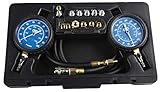
- OTC’s 5610 Transmission/Engine Oil Pressure Testing Kit is designed for static and/or on road testing and can be used on both domestic and import applications
- Included high (0-400 psi/0-2800 kPa) and low (0-100 psi/0-700 kPa) pressure gauges allow for testing on both transmissions and engines
- Large 3-1/2 inch diameter gauges feature chrome bezels, rugged protective outer boots, and hooks for easy hanging out of the way
- Gauges and hose assembly incorporate quick couplers; Kit includes 13 adapters to fit most applications and a detailed instruction manual
- Blow molded hard case with removable lid included to keep kit components contained and organized when not in use
2. How should you check the oil and filter?
Park on a level surface and verify the oil level using the manufacturer’s procedure. Confirm that the oil viscosity and filter match the owner’s manual or factory service information. Inspect for external leaks, fuel or coolant contamination, excessive sludge, and a damaged or collapsed filter.
PC Slower Than It Used to Be?
A free scan shows the junk files, broken settings and background clutter dragging Windows down - then fixes them in one click.Free scan · Windows 10 & 11Outdated Drivers Are Slowing You Down
One free scan finds every outdated or missing driver and matches the right update for your exact hardware.Free scan · exact hardware matchAn oil and filter change may be appropriate when the oil is incorrect, contaminated, overdue, or visibly affected by debris. An oil change is not a universal fix for a failed solenoid, damaged wiring, inaccurate sensor, worn pump, or internal engine problem. If the oil is low, identify and repair the leak or consumption problem instead of treating the refill as a complete repair.
3. How do you inspect the P06DE circuit?
Use the vehicle’s wiring diagram or service information to locate the oil-pressure-control solenoid and pressure sensor or switch. Inspect the connectors for oil intrusion, bent or backed-out terminals, corrosion, broken locks, and poor pin tension. Trace the harness for chafing, crushed sections, heat damage, and contact with moving parts.
Test power, ground, continuity, control signals, and resistance according to the vehicle-specific procedure. Do not apply a resistance value from another engine. GM bulletin PIP5932 (2023) specifies a 10–30 ohm test between particular terminals for the referenced Chevrolet application. According to General Motors (2023), the 10–30 ohm value belongs to that specified Chevrolet test and is not a universal P06DE specification.
4. Why is a mechanical oil-pressure test the key step?
A mechanical gauge directly checks the engine’s actual oil pressure and separates a genuine lubrication failure from a sensor, wiring, solenoid, or control-logic problem. Connect a suitable gauge with the correct adapter, then compare the readings at the temperatures and engine speeds required by the factory procedure.
For this diagnostic step, an automotive oil pressure test kit can be useful if the kit includes the adapter required by the vehicle and the user can connect it safely according to the service manual. The gauge reading must be compared with the correct specification for that engine; a generic gauge kit does not make a generic pressure specification valid.
According to Operation CHARM’s 2012 Jeep Grand Cherokee 5.7-liter service-manual entry, the cited application describes approximately 200 kPa (29 psi) for low-pressure regulation and approximately 450 kPa (65 psi) for high-pressure regulation. Those are vehicle-specific values for the 2012 Jeep Grand Cherokee 5.7-liter application, not universal P06DE limits.
Rank #3

- Exquisite design: Oil Pressure Tester Tool have dual display pressure gauge head, clear scale, easy to clean, and equipped with rubber buffer protection cover, shockproof and scratchproof.
- Complete accessories: Oil Pressure Tester select high-quality metal materials, 10 adapters to fit most brands and models, suitable for most gasoline and small diesel engine cars, motorcycles, boats and other vehicles, as long as the adapter can match your engine and The oil pressure does not exceed 140PSI, each marked with a number, stored in a fixed position in the red case for easy selection.
- Oil-resistant hose: Oil Pressure Tester Oil-resistant and high-temperature resistant hose, freely bendable, sturdy and durable, giving you professional high-quality products.
- Brass Fittings: Oil Pressure Gauge kit brass straight elbow quick fittings, quick and easy to install, faster, simpler, more reliable sealing, two types of straight and curved, to meet more needs. Durable, safe and environmentally friendly.
- 100% Satisfaction: We Oil Pressure Gauge kit are responsible for every product. If you have any problems with our products or services, please contact us immediately and we will provide you with exceptional responses to your every
| Test result | Most useful diagnostic direction | Parts not to replace yet |
|---|---|---|
| Mechanical pressure is correct, but the reported signal or commanded response is wrong | Test the pressure sensor or switch, solenoid, connector, wiring, power, ground, and control logic. | Do not replace the oil pump solely because P06DE is stored. |
| Mechanical pressure is low | Check oil level, filter, pickup screen, passages, pump, bearings, leaks, and other lubrication-system components. | Do not assume a sensor or electrical repair will restore pressure. |
| Pressure does not change as commanded | Investigate the control solenoid, pump-control mechanism, contamination, passages, and pump operation. | Do not install a visually similar solenoid without compatibility and test confirmation. |
| Pressure and circuit tests pass, but P06DE returns | Recheck related codes, scan data, connector pin tension, software or control logic, and the manufacturer’s diagnostic procedure. | Consider a control-module fault only after the other branches pass. |
5. How do you test the solenoid and pressure sensor?
Test the oil-pressure-control solenoid for the specified power supply, ground, resistance, control signal, and commanded operation. A solenoid can fail electrically or stick mechanically because of contamination. A pressure sensor can report implausible data even when the mechanical gauge shows normal pressure.
Replace the oil-pressure sensor or switch only when its signal is inaccurate, its circuit fails, or the vehicle-specific service procedure identifies it as the cause. P06DE is not an automatic instruction to replace the sensor. Some vehicles make the solenoid or oil pump the more relevant component, while other applications can involve the sensor, wiring, or mechanical oil system.
Quick wins for a faster PC:
Clear out junk files and repair common Windows errorsFree Scan →Fix the driver behind crashes, sound loss and screen glitchesFind Drivers →Repair Windows errors before they cause bigger problemsFix Now →6. When should you investigate contamination or a vehicle-specific failure path?
Investigate contamination when the oil contains sludge, carbon, metal, fuel, coolant, or other abnormal material, or when inspection finds a restricted filter, pickup screen, passage, or control valve. Also check whether an underlying engine problem is continually contaminating the oil system; cleaning the restriction without correcting its source may allow P06DE to return.
The Mazda example shows why a generic solenoid answer can be wrong. HELLA’s technical guidance for 2013–2017 Mazda CX-5 models with the 2.2-liter Skyactiv-D SH-Y4 engine describes injector-seal failure allowing combustion gases into the oil area, producing carbonaceous residue and potentially restricting the oil-pump pickup or filter element. The documented symptoms include a “System check required” message, poor acceleration, and limp-home behavior. The documented diagnostic path includes checking the oil-pressure switch and lubrication system and, when findings support it, inspecting injector seals and the pickup or filter element.
HELLA states, “Please always observe the maintenance and repair instructions provided by the vehicle manufacturer when carrying out such work!” That warning matters because Mazda’s injector-seal and pickup path is specific to the referenced engine and should not be generalized to every Mazda CX-5 or every vehicle with P06DE.
Independent reader supportYour contribution helps us test, update, and keep practical guides available for everyone.What do GM, Chrysler, Jeep, and Mazda examples show?
Manufacturer procedures show that P06DE is not a one-part diagnosis. The same generic code can lead to different tests depending on the pump design, pressure-control strategy, engine, and wiring architecture.
| Application or source | Documented diagnostic point | How to use the information |
|---|---|---|
| Specified Chevrolet applications | GM bulletin PIP5932 discusses P0521 and/or P06DD/P06DE, including oil-pump debris and an engine-wiring-harness issue; the bulletin includes a 10–30 ohm test for particular terminals. | Use the bulletin only when the vehicle matches its application and terminal procedure. |
| Other specified Chevrolet applications | GM bulletin PIP5676A addresses a malfunction indicator lamp with P06DE and may also involve P0521. | Check the exact application and related-code conditions instead of applying the bulletin to every Chevrolet. |
| Specified Chevrolet conditions | GM bulletin 22-NA-056 addresses a malfunction indicator lamp with P0172, P06DE, and/or P0521. | Use the related-code combination and vehicle coverage to select the correct procedure. |
| Covered Chrysler/Stellantis systems | Mopar/Stellantis technical guidance discusses P06DD/P06DE in relation to an oil-pump solenoid and pressure-switch diagnosis. | For the covered systems, the solenoid may be the leading suspect, but testing still determines whether it is the cause. |
| 2013–2017 Mazda CX-5, 2.2-liter Skyactiv-D SH-Y4 | HELLA documents injector-seal failure, carbonaceous residue, and restriction at the oil-pump pickup or filter element. | Follow the Mazda-specific contamination and lubrication-system path when the symptoms and inspection findings match. |
| 2012 Jeep Grand Cherokee, 5.7-liter application | The cited service-manual entry lists approximately 200 kPa (29 psi) low-pressure regulation and approximately 450 kPa (65 psi) high-pressure regulation. | Use those figures only for that application and its specified test conditions. |
For covered Chrysler and Stellantis systems, the manufacturer technical tip says, “The most likely cause is the oil pump solenoid.” The statement is useful for that documented application, but it is not a universal rule for Chevrolet, Mazda, Jeep, or other vehicles displaying P06DE. Read the Mopar/Stellantis P06DE technical tip together with the vehicle’s year, engine, and applicable service information.
Rank #4

- Exquisite design: dual display pressure gauge head, clear scale, easy to clean, and equipped with rubber buffer protection cover, shockproof and scratchproof
- Complete accessories: select high-quality metal materials, 10 adapters to fit most brands and models, suitable for most gasoline and small diesel engine cars, motorcycles, boats and other vehicles, as long as the adapter can match your engine and The oil pressure does not exceed 140PSI, each marked with a number, stored in a fixed position in the red case for easy selection
- Oil-resistant hose: Oil-resistant and high-temperature resistant hose, freely bendable, sturdy and durable, giving you professional high-quality products.
- Brass Fittings: Brass straight elbow quick fittings, quick and easy to install, faster, simpler, more reliable sealing, two types of straight and curved, to meet more needs. Durable, safe and environmentally friendly
- 100% Satisfaction: We are responsible for every product. If you have any problems with our products or services, please contact us immediately and we will provide you with exceptional responses to your every concern
How is P06DE fixed?
P06DE is fixed by correcting the confirmed oil, electrical, sensor, solenoid, contamination, pump, or internal-engine fault rather than by replacing a predetermined part. The appropriate repair branches are:
| Confirmed fault | Typical repair direction | Important qualification |
|---|---|---|
| Incorrect oil level, viscosity, or filter | Correct the level, install the manufacturer-specified oil and filter, and investigate leaks or contamination. | An oil change will not repair a wiring, sensor, solenoid, or worn-pump fault. |
| Damaged wiring or connector | Repair the harness or terminals, restore proper pin tension, clean or replace the connector as specified, and secure the harness. | Recheck circuit operation after the repair. |
| Failed oil-pressure-control solenoid | Replace the solenoid when electrical and functional tests confirm failure. | Verify year, make, model, engine, and VIN compatibility; some applications integrate the solenoid with the pump. |
| Faulty pressure sensor or switch | Replace the sensor or switch after the signal and mechanical pressure comparison identify it as faulty. | Do not use the P06DE label alone as proof that the sensor failed. |
| Sludge, carbon, debris, or restriction | Remove the restriction and correct the contamination source; inspect the pickup, filter, passages, and control valve as applicable. | Cleaning alone may not solve the problem if an injector, engine, or lubrication fault continues. |
| Oil-pump or internal engine fault | Service or replace the oil pump, pickup, bearings, or other affected lubrication-system components according to the factory procedure. | Confirm low or abnormal mechanical pressure before authorizing major parts replacement. |
How much does it cost to fix P06DE?
There is no reliable universal P06DE repair-cost or failure-rate statistic in the reviewed sources. Repair scope can range from correcting oil or a connector to removing contamination or servicing an oil pump, and labor access differs substantially by vehicle. The correct way to control cost is to pay for diagnosis that confirms mechanical pressure and the failed branch before buying expensive parts.
A vehicle-specific solenoid should be considered only after testing identifies the solenoid and after compatibility is verified by year, make, model, engine, and VIN. Some vehicles sell the solenoid separately; other vehicles integrate it with or service it alongside the oil pump. Do not buy a similar-looking part based only on a generic P06DE search.
Free tools Windows power users keep installed
One-click scans. No signup required.
What should you do after the repair?
After repairing the confirmed cause, clear P06DE with the scan tool, perform the manufacturer’s required verification drive or functional test, and confirm that the code does not return. Recheck the oil level and inspect for leaks when the procedure is complete. If P06DE returns immediately, the original fault may still be present or a related issue may remain.
Keep the original scan results, freeze-frame data, pressure readings, resistance measurements, and replaced-part information. Those records make a recurring P06DE easier to separate into an electrical, sensor, actuator, hydraulic, or internal-engine problem.
What should you not do with P06DE?
- Do not assume P06DE always means a bad oil-pressure sensor.
- Do not replace the oil pump without measuring actual pressure and checking the control circuit.
- Do not use a generic oil-pressure specification from another vehicle.
- Do not install a solenoid based only on a similar-looking part number.
- Do not keep driving when the oil-pressure warning is on or the engine shows signs of inadequate lubrication.
- Do not treat clearing the code as a repair.
Where can you find the correct P06DE procedure?
Use the vehicle’s factory service manual or reputable vehicle-specific repair information for the component location, wiring diagram, connector pinouts, pressure specifications, adapters, removal instructions, and verification drive. Vehicle-specific information is especially important because GM, Chrysler/Stellantis, Mazda, and Jeep applications can use different oil-pump controls and diagnostic thresholds.
Search using the complete vehicle identity: year, make, model, engine, transmission where relevant, and VIN. A generic search such as “P06DE oil pump solenoid” can identify the general system, but it cannot establish which component or procedure applies to a particular Chevy, Jeep, Mazda CX-5 diesel, or other vehicle.
Do these 3 things before closing this tab:
1Repair Windows errors before they cause bigger problems2Scan for outdated or missing drivers - takes under a minute3Clear out junk files and repair common Windows errorsThe Bottom Line
Bottom line: P06DE is an engine oil-pressure-control fault, not an automatic oil-pressure-sensor diagnosis. Check the oil, retrieve related codes, inspect the wiring, and measure actual oil pressure mechanically before replacing a solenoid, sensor, pump, or other part. Stop driving if the oil-pressure warning or low-pressure symptoms appear, and use the exact factory procedure for the vehicle.
Quick Recap
Product prices and availability are accurate as of the date/time indicated and are subject to change. Any price and availability information displayed on Amazon at the time of purchase will apply.




