Do these 3 things before closing this tab:
1Clear out junk files and repair common Windows errors2Fix the driver behind crashes, sound loss and screen glitches3Repair Windows errors before they cause bigger problemsThe Kia PV5 WKNDR is not a camper van you can buy. It is a 2024 concept vehicle that turns Kia’s modular PV5 electric-van platform into an adventure-oriented “escape pod,” with a pop-up roof, solar panels, off-road tires, flexible camping furniture, exterior gear storage and equipment aimed at spending nights away from electrical hookups.
Kia unveiled the WKNDR at the 2024 SEMA show in Las Vegas. The company’s U.S. concept page says the vehicle is not available for purchase, although Kia is separately planning camper-oriented production PV5 derivatives.
As an Amazon Associate I earn from qualifying purchases.
The Kia PV5 WKNDR is not a camper van you can buy. It is a 2024 concept vehicle that turns Kia’s modular PV5 electric-van platform into an adventure-oriented “escape pod,” with a pop-up roof, solar panels, off-road tires, flexible camping furniture, exterior gear storage and equipment aimed at spending nights away from electrical hookups.
Free tools Windows power users keep installed
One-click scans. No signup required.
Kia unveiled the WKNDR at the 2024 SEMA show in Las Vegas. The company’s U.S. concept page says the vehicle is not available for purchase, so there is no confirmed U.S. MSRP, EPA range, order process or dealership delivery date. The concept is nevertheless significant because Kia is separately planning camper-oriented production PV5 derivatives, including versions called the Light Camper and Camper. Those planned models should not be treated as proof that the WKNDR itself will reach production.
#1 Best Overall

- 【Wide Compatibility】With its 10 DC adapters, the 40W solar panel for power stations is compatible with the majority of portable power stations and solar generators that exist on the market
- 【3 Output Ports】The 40W camping solar panel has 3 distinct output ports: 1 DC output(18V/2.27A Max), 1 USB-C output, and 1 USB QC3.0. It can charge your phone, iPad, laptop, little refrigerator, camera, GPS, power bank, and other devices wherever you are
- 【High Conversion with Water Resistant】With a high conversion efficiency of 22%, the SinKeu monocrystalline foldable solar panel can generate power in most conditions(recommended light levels of above 40,000 Lux) and charge your devices faster. The camping solar panel charger is simple to clean and resistant to water. Ideal for travel, camping, hiking, and outdoor activities
- 【Foldable and Lightweight】With a folded size of 12.6 x 9.1 x 2 inches and a weight ofonly 3,3 pounds (1.5 kg), these home solar panels are suitable for outdoor work orcamping
- 【Security Technology】With TIR-C technology, the solar power panel will identify your devices, optimize charging speed, and shield them from security risks like overloadingor overcharging
What is the Kia PV5 WKNDR?
The WKNDR is a design and technology showcase built around Kia’s purpose-built vehicle, or PBV, strategy. The underlying PV5 is intended to support several body styles and uses rather than one fixed passenger-car configuration. Kia has described production PV5 versions including Passenger, Cargo and Chassis Cab models, with business and personal-mobility conversions planned for different markets.
For the WKNDR, Kia gives that practical electric van a recreational treatment. The van is lifted, fitted with off-road tires and arranged to support cooking, sleeping, gear storage and time off-grid. Kia’s phrase “ideal escape pod for extended weekends in nature” describes the concept’s intended lifestyle; it is not a production specification or a promise of all-terrain capability.
The Gear Head is the WKNDR’s signature feature
Most camper vans lose usable cabin space to permanent cabinets, beds and kitchen equipment. The WKNDR takes a different approach. Kia uses storage in the floor, walls and outside the vehicle so that camping equipment does not occupy the entire interior when it is not needed.
The most distinctive element is the exterior Gear Head. This pop-out storage assembly extends from the van when parked, creating sheltered space for equipment outside the cabin. Kia also describes it as reconfigurable into a mobile pantry for outdoor food preparation. In principle, that lets the interior remain more open while moving bulky or messy camping tasks outside.
The Gear Head is a concept feature, not a factory accessory currently listed for purchase through Kia’s consumer catalog. There is also no confirmation that a future PV5 camper will use the same mechanism, dimensions or storage layout.
A pop-up roof adds camping space
The WKNDR has a pop-up camping roof that expands the usable space when the vehicle is parked. Kia presents the roof as a way to create additional sleeping or standing room, giving the van more of the functionality associated with a traditional camper without permanently making the vehicle taller inside.
Solar panels are integrated into the roof. They support Kia’s self-sufficiency theme by potentially supplying energy while the vehicle is stationary, but Kia has not published the panel output, battery-charging rate, usable energy in different weather conditions or a production specification for the system.
Recommended Free Tools
That distinction matters. A solar-equipped concept roof is not the same as a verified off-grid power system. Real-world performance would depend on panel area, sunlight, shading, conversion losses, battery capacity and the energy demands of heating, cooling, cooking and charging personal devices.
Rank #2

- 【23.5% High-Efffciency A+ Monocrystalline Cells】Constructed with premium Grade A+ silicon cells, this 100W solar panel outperforms conventional polycrystalline panels, delivering higher conversion rates even in low-light conditions. The 2 adjustable kickstands allow you to angle the panel at 45° to capture up to 25% more sunlight than ffat laying, ensuring your power station tops up faster during limited daylight hours
- 【True 5-in-1 Universal Connectivity】 Unlike standard 4-in-1 cables, our upgraded solar cable features 5 distinct connectors to fit 99% of power stations: 1. DC8020 (Speciffcally for Jackery Explorer 1000V2/ 2000/1500 Pro & Plus series); 2. XT60 (for EcoFlow DELTA/RIVER, Anker C300/C300 DC/C200 DC,Bluetti Elite 30V2); 3. Anderson (For Jackery 1000 original); 4. DC7909/8mm (For Jackery 240/300/500, Bluetti EB3A/EB70); 5. DC5521 (For generic lithium batteries). No extra adapters needed
- 【IP67 Waterproof ETFE Coating】 Designed for the unpredictability of outdoor life. The advanced ETFE lamination offers superior durability, heat resistance, and light transmittance compared to PET panels. While the camping solar panel itself is fully IP67 waterproof against rain and splashes, the zippered pocket protects the built-in controller and cables from moisture. Ideal for RVing, overlanding, and marine use
- 【Foldable & Lightweight】 Weighing just 9.48 lbs with a magnetic easy-carry handle,this 100W camping solar panel folds down to a compact size of 24.13*21.06*1.77 IN.Setup takes seconds: unfold, snap the legs, and connect. A reliable green energy solution for camping, fishing, and emergency blackout preparedness.
- 【Direct Device Charging Hub】 Built-in intelligent controller features 3 fast-charging ports for direct use without a solar generator: 1x USB-C (PD 15V/3A) and 2x USB-A (including QC3.0 12V/1.5A). Perfect for charging smartphones, tablets, GPS, and cameras directly during camping, rv or power outages. Features overcurrent and short-circuit protection for safe off-grid energy
Inside: a flexible, deployable camper layout
The WKNDR’s cabin is designed to change according to the activity. Kia has shown furnishings that can stow in the floor or walls instead of remaining permanently installed. The concept also includes a side-mounted kitchen with an induction stove.
The arrangement is closer to a flexible equipment system than to a conventional motorhome interior. A user could, in theory, preserve open cargo space during the day, deploy the kitchen at camp and rearrange the cabin for sleeping later. Kia has also shown a steering wheel that can be moved out of the way while parked, emphasizing that the front cabin is part of the living space when the vehicle is stationary.
These are concept-presentation details, not independently tested production equipment. Kia has not confirmed sleeping capacity, bed dimensions, interior standing height, insulation, climate-control performance, water storage, wastewater handling, toilet provisions or the certification process for the pop-up roof.
Off-road appearance and hardware
The WKNDR has a visibly tougher stance than an ordinary urban delivery or passenger van. Kia says it is lifted and equipped with off-road tires. Those changes should improve clearance and give the concept a more suitable setup for rough access roads and campsites.
They do not make the WKNDR a confirmed rock-crawling vehicle. Kia has not released production-grade figures for ground clearance, approach and departure angles, suspension travel, water fording, payload or towing. The three-inch lift associated with Kia’s separate EV9 ADVNTR concept should not be assigned to the WKNDR.
Off-road tires and extra ride height can also involve trade-offs, including increased road noise, energy consumption and reduced range. Until Kia publishes the WKNDR’s final weight, tire dimensions, drivetrain details and battery data, its electric range and trail capability cannot be calculated reliably.
Compressor and the concept’s unusual energy claims
An onboard compressor is intended to handle practical camping tasks such as adjusting tire pressure and inflating a mattress. That is a sensible addition for a vehicle that combines lower-pressure off-road driving with overnight camping.
What’s actually slowing this PC down?
Pick the symptom - the matching free tool is one click away.
Kia also says the WKNDR uses solar panels and “unique hydro turbine wheels” to recharge its batteries in remote environments. The hydro-turbine claim needs careful qualification: Kia has not publicly disclosed enough information to establish the system’s electrical output, operating conditions, efficiency or production feasibility. It should therefore be read as a concept-level idea, not as demonstrated range-extending technology.
Rank #3

- 【TRAVEL LIGHT, POWER ANYWHERE】 Weighing only 6lb and folding to 19*26*0.5in, this 100W panel is easy to carry, store, or hang—perfect for RVs, vans, tents, and emergency backup power.
- 【LONG REACH FOR FLEXIBLE SETUP】 A 9.84ft (3m) cable lets you place the panel in direct sunlight while keeping the controller or power station shaded, making installation safer and more convenient.
- 【SEPARATE CONTROLLER FOR SAFE CHARGING】 Comes with a standalone PWM controller that protects your 12V system from reverse polarity, overcharge, overload, and short-circuit—safe to use and easy to replace or upgrade later.
- 【CHECK YOUR POWER STATION’S INPUT LIMIT】 Some power stations cap input (e.g. 60W max). Even in full sun, the panel cannot exceed that cap—this is normal system design, not a defect. Please confirm your specs or message us before buying.
- 【USB PORTS FOR ESSENTIAL DEVICES】 When connected to a 12V battery, the USB ports supply steady power to phones, lights, and small gadgets. They can also work under sunlight without a battery for emergency top-ups, though current may vary.
How the WKNDR relates to the production PV5
The WKNDR is based on the PV5 platform, but it is not the same vehicle as a regular PV5 Cargo or Passenger model. The production PV5 is a modular commercial and personal-mobility platform. The WKNDR is a heavily themed recreational concept built to explore what that platform might support.
Kia’s corporate plans provide evidence that camper versions are part of the company’s broader PV5 strategy. Its 2025 plan listed a B2C Premium version, Light Camper, Crew Van, Open Bed and Box/Refrigerated Truck variants. Kia’s 2026 CEO Investor Day materials expanded the stated conversion lineup to include Prime, Light Camper, Camper, Crew, Drop Side, Box Van and Freezer Box.
Those announcements make a production-oriented PV5 camper strategy plausible. They do not establish that the WKNDR’s Gear Head, pop-up roof, solar panels, hydro-turbine wheels, compressor or interior furniture will carry over. Kia has not provided a complete feature-by-feature production plan connecting the WKNDR to any one of those variants.
Do not transfer the regular PV5’s range to the WKNDR
Kia’s global production material reports a maximum WLTP range of up to 412 kilometers for a specified five-seat PV5 with a 71.2-kWh battery. That is approximately 256 miles, but WLTP is not the EPA test cycle used for U.S. range ratings.
More importantly, that figure applies to the specified production PV5 configuration—not the WKNDR. The concept’s battery capacity, weight, aerodynamics, tire setup and camper equipment have not been published as final production specifications. A lifted electric camper with off-road tires and additional equipment could perform differently from a standard five-seat PV5.
Can you buy the Kia PV5 WKNDR?
No. Kia’s U.S. concept page explicitly says the PV5 WKNDR is not available for purchase. A U.S. shopper should not expect to order one through a Kia dealer, and there is no confirmed WKNDR price, launch date, EPA range or production allocation.
Kia has announced sequential global rollout plans for PV5 base and conversion models in regions including Europe, Korea, Asia-Pacific and the Middle East. That does not establish U.S. retail availability for the WKNDR or for every planned PV5 camper derivative. Availability, certification and timing will need to be checked country by country.
In other words, there are three separate things to keep apart:
Rank #4
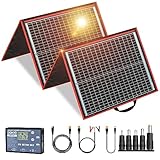
- 【COMPACT & TRAVEL-READY】 Folds down to 19.3x20.9x1.1in and just 7.3lb—light enough to pack, carry, and set up solo. Perfect for RVs, vans, camping, or backup power.
- 【LONG CABLE, COOLER & SAFER】 9.8ft (3m) cable lets you park the panel in full sun while your controller or power station stays shaded—better cooling, safer use, and more flexible setups.
- 【SEPARATE CONTROLLER, SAFER CHARGING】 Includes a standalone PWM controller for 12V batteries with full protections (reverse polarity, overcharge, overload, short-circuit). Easy to replace or upgrade later.
- 【CHECK DEVICE INPUT BEFORE ORDERING】 Some power stations cap solar input (60–100W). Even with 150W, output won’t exceed that cap—normal by design, not a defect. Message us if unsure—we’ll help confirm before you buy.
- 【USB PORTS FOR ESSENTIALS】 Connect to a 12V battery for steady phone/lights charging. Can also give quick emergency top-ups directly in sunlight (current may vary).
- PV5 WKNDR: a concept shown at SEMA in 2024 and not available to buy.
- Production PV5: a modular van platform offered or planned in different body styles and markets.
- PV5 Light Camper/Camper: announced or planned conversion directions whose exact specifications, markets, pricing and order dates remain to be confirmed.
What is still unknown?
The concept presentation leaves the questions that matter most to a camper-van buyer unanswered:
- Battery capacity and usable energy
- Real-world and certified range
- Charging speed and charging hardware
- Payload after camping equipment is installed
- Number of sleeping places and bed dimensions
- Fresh-water, gray-water and black-water systems
- Heating, ventilation and air-conditioning performance
- Pop-up-roof structure, weather sealing and certification
- Solar-panel output and charging behavior
- Practical output from the proposed hydro-turbine wheels
- Ground clearance, suspension geometry and off-road limits
- Production pricing, timing and country availability
Until Kia answers those questions, the WKNDR is best judged as a packaging and design exercise rather than a vehicle buyers can compare directly with an electric camper on price, range or capability.
Independent reader supportYour contribution helps us test, update, and keep practical guides available for everyone.Gear inspired by the WKNDR: what you can use today
Although the WKNDR itself is unavailable, its camping functions can be recreated on a much smaller scale in an existing vehicle. The right equipment depends on the vehicle’s electrical system, available cargo space and intended trip length; none of the following should be treated as Kia-approved or WKNDR-compatible equipment.
Quick wins for a faster PC:
Fix the driver behind crashes, sound loss and screen glitchesFind Drivers →Repair Windows errors before they cause bigger problemsFix Now →Scan for outdated or missing drivers - takes under a minuteDriver Scan →Portable power
A portable camping power station can provide a simple way to run small appliances and charge electronics away from a campsite hookup. Check its continuous and peak output, battery capacity, charging options and whether the appliances you intend to use are suitable for it. A power station is not a substitute for a professionally integrated high-voltage EV system.
Outdoor cooking
A portable induction cooktop can approximate the WKNDR’s deployable kitchen concept, provided the power source can support its electrical demand. Use it on a stable, heat-resistant surface with adequate ventilation, and confirm that the power station or shore connection is rated for the cooktop’s wattage.
Tire and mattress inflation
A 12-volt portable air compressor is useful for correcting tire pressure after driving on rough roads and inflating compatible camping gear. Verify the compressor’s connector, duty cycle, maximum pressure, fuse requirements and vehicle compatibility. Tire pressures should follow the vehicle manufacturer’s recommendations rather than a generic off-road setting.
Sleeping space and organization
A space-saving camping mattress can turn a flat cargo area into a basic sleeping platform, but measure the vehicle first and account for wheel wells, seat hardware and tailgate clearance. Modular storage containers or PV5 camper conversion components may eventually be relevant if Kia’s production variants reach a reader’s market, but no specific conversion provider or WKNDR kit is confirmed here.
PC Slower Than It Used to Be?
A free scan shows the junk files, broken settings and background clutter dragging Windows down - then fixes them in one click.Free scan · Windows 10 & 11Outdated Drivers Are Slowing You Down
One free scan finds every outdated or missing driver and matches the right update for your exact hardware.Free scan · exact hardware matchBottom line
The Kia PV5 WKNDR is an imaginative electric camper concept built around modular storage and flexible living space. Its Gear Head pantry, pop-up solar roof, deployable kitchen, compressor and lifted off-road stance show how Kia could turn a commercial-oriented EV platform into a weekend adventure vehicle.
Best Value

- [Industry-Leading 25% Efficiency] 16BB N-Type cells deliver more power from the same sunlight, supporting RV trips, camping, blackout backup, and off-grid use in limited or cloudy conditions.
- [Lightweight & Magnetic Design] Weighing 13.89 lb and folding to 23.72 x 22.99 x 1.97 in, this 200W panel stores at backpack size with a magnetic closure for SUVs, RVs, and campsites.
- [Direct Device Charging] Charge 3 devices with USB-C PD 45W and dual USB-A ports for phones, tablets, laptops, GPS, and cameras.
- [Compatible with Most Power Stations] Compatible with Jackery Explorer 1000 v2, EcoFlow DELTA 3/DELTA 3 Max/RIVER 3 Max, Anker SOLIX S2000, and other models that meet the requirements. MC4 output only; the 4-in-1 adapter is sold separately.
- [UL 61730 Certified] Tested to UL 61730 and listed with CE, RoHS, FCC, CA65, PSE, and ISO 9001 claims. Four kickstands, an accessory pouch, reinforced grommets, and 40°/50°/60° angles help position the panel on RVs, tents, or windy campsites.
But the headline should remain clear: the WKNDR is a concept, not a production camper for sale. Kia’s planned PV5 Light Camper and Camper variants make the company’s camper ambitions worth watching, while leaving the WKNDR’s distinctive features, specifications, price and availability unconfirmed.
Frequently Asked Questions
Can I buy the Kia PV5 WKNDR?
No. Kia’s U.S. concept page says the PV5 WKNDR is not available for purchase. It was shown as a 2024 SEMA concept vehicle, with no confirmed MSRP, U.S. launch date or dealer ordering process.
What is the Kia PV5 WKNDR’s range?
No. The 412-kilometer maximum WLTP figure applies to a specified production five-seat PV5 with a 71.2-kWh battery. Kia has not published a final battery, weight, tire or range specification for the WKNDR concept.
Will Kia build a production PV5 camper?
Kia has announced PV5 conversion directions called Light Camper and Camper in corporate planning materials. Their markets, prices, order dates and feature carryover from the WKNDR remain unconfirmed.
What is the WKNDR Gear Head?
The Gear Head is an exterior pop-out storage assembly that Kia says can provide sheltered equipment storage and convert into a mobile pantry. It is a concept feature, not a currently advertised Kia accessory.
How do the WKNDR’s hydro-turbine wheels work?
Kia says the concept has solar panels and unique hydro-turbine wheels that can recharge its batteries in remote environments. The company has not disclosed enough engineering information to establish practical output or production feasibility.
The Bottom Line
The Kia PV5 WKNDR is a 2024 electric camper-van concept, not a vehicle currently available to buy. Kia’s planned PV5 Light Camper and Camper derivatives suggest a possible production path, but the concept’s pop-up roof, Gear Head storage, solar system, hydro-turbine wheels and off-road hardware have not been confirmed for production.
The Tool Desk
Outbyte PC Repair FREERepair Windows errors before they cause bigger problemsFix Now →Outbyte Driver Updater FREEScan for outdated or missing drivers - takes under a minuteDriver Scan →Quick Recap
Product prices and availability are accurate as of the date/time indicated and are subject to change. Any price and availability information displayed on Amazon at the time of purchase will apply.




